




Key takeaways
- Argentina offers strong growth potential: A highly educated workforce and large middle class make it an attractive market for expansion.
- The 2026 labor reforms improve predictability: New rules simplify hiring, onboarding, and workforce management, but compliance still requires local expertise.
- Employment costs go beyond salary: Employer contributions, benefits, and mandatory bonuses like the aguinaldo significantly increase total hiring costs.
Argentina gives you access to a highly educated workforce, widespread digital adoption, and a large middle class.
But new 2026 labor modernization laws and compliance requirements are rewriting the hiring playbook.
Before expanding into Argentina, you’ll need to understand contracts, taxes, wages, benefits, and other employment laws. Our guide will tell you everything you need to know about hiring in Argentina.
What to know before hiring in Argentina
Local culture, employment laws, and standard practices influence how you hire and operate.
Here are four key factors you need to know:
1. Complexities of doing business
Argentina used to be a complex market for global businesses. Taxes, regulations, and admin processes made it hard to set up and hire — like Law 24,013 which had complex registration steps and strict penalties for errors or incomplete records.
That’s changing with the 2026 Labor Modernization Law. Now, you only need to register a new employment relationship with the Tax and Customs Collection Agency (ARCA). The law also allows fully digital employment records.
These changes make hiring more predictable. But ongoing compliance management is still a must.
Many companies choose to work with an employer of record (EOR) to simplify hiring. Partnering with G-P lets you hire in Argentina without setting up a local entity. We handle payroll, compliance, and employment requirements for you.
2. The workweek and vacation time
Argentina’s standard workweek is 48 hours, typically split into 8-hour days. Employees must have at least 12 hours of rest between workdays and a continuous 35-hour weekly break, usually over the weekend.
Overtime is allowed but tightly regulated. It’s capped at:
- 3 hours per day
- 30 hours per month
- 200 hours per year
Employers must pay overtime at premium rates:
- 50% above the normal wage for standard overtime
- 100% above the normal wage for holidays or rest days
Paid leave in Argentina Argentina observes 16 national public holidays. Paid annual leave depends on seniority:
|
Years of service |
Paid annual leave |
|---|---|
|
Up to 5 years |
14 days |
|
5–10 years |
21 days |
|
10–20 years |
28 days |
|
20+ years |
35 days |
Vacation is usually taken as one continuous period. Splitting up time off is possible if both parties agree or if a collective bargaining agreement (CBA) allows it.
Employees may also get additional paid leave for specific events, including:
|
Event |
Paid annual leave |
|---|---|
|
Marriage |
10 days |
|
Death of a close family member |
1–3 days |
|
School exams |
Up to 10 days |
3. Wages and required bonuses
Argentina has a national minimum wage called the salario mínimo, vital y móvil. The government updates it regularly.
Employers must pay wages through a bank account. As of 2026, salary payments through digital wallets aren’t allowed.
Argentina also requires a 13th-month salary, called the aguinaldo. Employers split this into two payments each year:
|
Payment timing |
How it’s calculated |
|---|---|
|
Mid-year |
50% of the highest monthly salary earned in the first six months |
|
End of year |
50% of the highest monthly salary earned in the last six months |
Some employers also offer performance bonuses. These reward results, but if they’re paid consistently, they may become part of regular compensation.
4. Payroll taxes
Argentina uses a progressive income tax system. Employers must withhold income tax from employee salaries.
Employers and employees also contribute to the national social security system which covers:
- Retirement and pensions
- Healthcare
- Unemployment
- Life insurance
- Family allowances
2026 labor updates: The 2026 Labor Modernization Law introduces changes that affect hiring and workforce costs.
- Probationary period: The standard probation period is now six months (up from three months).
It can extend further:
- Up to 8 months for companies with 6–100 employees
- Up to 12 months for very small companies, depending on CBAs
- Labor Assistance Fund (FAL): Starting June 2026, employers must contribute to a new fund designed to pre-fund severance. This helps make termination costs more predictable.
- Social security incentives: New programs may reduce employer contributions for certain hires, encouraging formal employment.
Note: Some provisions of the 2026 law are subject to ongoing judicial review and may be provisionally suspended. Consult the latest official guidance to ensure compliance.

Top hiring hubs in Argentina
Argentina’s major cities offer different strengths. Knowing where to hire helps you find the right talent faster.
The top hiring hubs in Argentina are:
- Buenos Aires is the country’s economic center. It leads in finance, technology, media, and creative industries. The city is home to the Buenos Aires Stock Exchange, multinational companies, and a growing startup ecosystem. Fintech, software development, advertising, and professional services are especially strong here.
- Córdoba is known as Argentina’s knowledge hub. It has a large student population and renowned universities. This creates a steady pipeline of talent in IT, engineering, and manufacturing. The city also has a strong presence in automotive, aerospace, and agtech.
- Rosario is a major industrial and logistics hub. It sits on the Paraná River, which supports trade and exports. Key industries include agribusiness, food processing, and biotechnology. The city also has a growing tech sector.
- Mendoza is known for wine production and agribusiness. It also has strengths in tourism, renewable energy, and mining. Local universities support talent in engineering and environmental sciences.
- La Plata is a university city focused on research and education. It has strong sectors in public administration, healthcare, and biotechnology. Its proximity to Buenos Aires adds to its appeal.
Key industries in Argentina
Argentina’s economy spans several major industries. Knowing where demand is highest helps you target talent and plan your hiring strategy.
- Agribusiness and food processing: Argentina is a leading exporter of soybeans, corn, wheat, and beef. The food processing industry is highly developed and supports global trade. Key roles include agronomists, food technologists, and supply chain specialists.
- Technology and software development: Buenos Aires is a regional hub for startups, fintech, and IT services. Companies hire software engineers, data scientists, UX designers, and cybersecurity specialists.
- Automotive and manufacturing: Global automakers operate across Córdoba, Buenos Aires, and Santa Fe. Demand is strong for mechanical engineers, production managers, and automation specialists.
- Energy (oil, gas, and renewables): Argentina has large oil and gas reserves, including the Vaca Muerta formation, alongside growing investment in wind and solar. Companies hire petroleum engineers, geologists, and renewable energy specialists.
- Banking and financial services: Buenos Aires is the country’s financial center, with major banks, insurers, and a growing fintech ecosystem. Common roles include financial analysts, compliance specialists, and risk managers.
- Digital mobility and delivery platforms: This sector is expanding quickly. New 2026 regulations recognize drivers and couriers as independent workers, giving both companies and professionals more flexibility.
2026 regulatory update:
In the past, strike rules varied by sector and were often defined through CBAs.
The 2026 law adds more structure. Essential services (such as healthcare, commercial aviation, and telecommunications) must now maintain operations during strikes. For the latest, sector-specific requirements, consult the Argentine Ministry of Labor.
Cost of hiring employees in Argentina
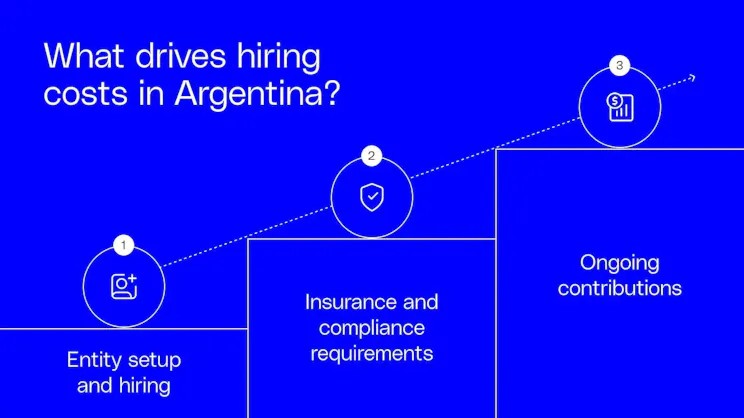
Hiring in Argentina comes with a range of costs beyond salary. Planning ahead helps you avoid delays and unexpected expenses.
Typical costs include:
- Entity setup (unless you use an EOR)
- Job advertising and candidate sourcing
- Travel and accommodation for in-country hiring
- Translation support for contracts and interviews
- Legal and accounting services to manage compliance
- Mandatory pre-employment medical exams
Employers must also provide:
- Occupational risk insurance (ART)
- Mandatory life insurance
Criminal background checks are highly restricted. Only request them if they’re directly relevant to the role and comply with local data protection laws.
Employer contributions
Employers must also pay mandatory payroll contributions on top of salary.
These include:
- Social security contributions of roughly 18–20.4%
- A 6% health insurance contribution
- A contribution to the FAL, introduced in 2026 to make severance costs more predictable
FAL contributions typically range from 1–2.5% of payroll, depending on company size.
These costs add up quickly, so it’s important to factor them into your hiring budget.
What does a company need to do to hire employees in Argentina?
Before you hire in Argentina, you need to meet several legal requirements.
To hire directly, your company must:
- Establish a legal entity, such as an SA, SRL, SAS, or branch.
- Register with the Public Registry of Commerce (or IGJ in Buenos Aires).
- Obtain a CUIT (tax identification number) from AFIP.
- Prepare and submit formation documents, including articles of incorporation and by-laws.
- Deposit at least 25% of the required capital at the National Bank.
- Publish a notice of incorporation in the Official Gazette.
These steps take time. That’s why many choose to simplify hiring with G-P. Whether you’re entering the market for the first time, hiring contractors, or need instant compliance guidance, G-P’s Global Employment Platform gives you the legal foundation and expertise you need to operate globally with total confidence.
We manage local tax, payroll, and employment requirements, so you move faster and stay compliant.
Key steps to hiring in Argentina
The hiring process in Argentina is similar to other markets, but local rules shape how each step works. Here’s what to expect:
1. Advertise job openings
Create clear job descriptions in Spanish. While online job boards are useful, newspapers like La Nación and El Clarín are still widely used. Speculative applications are also common, especially once your company is established.
2. Review applications and conduct checks
Most applications will be in Spanish. You may need local support to review them. Employers must also carry out a pre-employment medical exam.
3. Interview candidates
Argentina operates on a single time zone (Argentina Time). You can conduct interviews in person or virtually. Make sure your questions follow local anti-discrimination laws. Avoid topics like age, religion, political views, or marital status.
4. Make job offers
Provide a formal offer and written employment contract. The standard probation period is six months. This may extend to eight months for mid-sized companies or up to 12 months for very small companies, depending on local agreements.
5. Onboard new employees
You must register the employment relationship with AFIP. Employers also need to provide ART and life insurance. Digital employment records are now widely used, but all compliance requirements still apply. With G-P EOR, you don’t have to worry about the administrative burden of onboarding. Our Global Employment Platform streamlines the process, so you can focus on training your new hire and integrating them into your company culture.

Hire contractors in Argentina with G-P
Hiring independent contractors in Argentina is a flexible, cost-effective way to enter the market or scale your team. You avoid the long-term obligations that come with full-time employment.
Local contractors bring valuable knowledge of Argentine business culture, regulations, and consumer preferences. They’re often ready to start quickly, using their own tools and established processes.
Before you engage a contractor in Argentina, keep the following in mind:
1. Employees vs. independent contractors in Argentina
You need to clearly distinguish between employees and contractors.
- Employees work under your direction and control. They get a salary, benefits, and legal protections under Argentine labor law.
- Contractors work independently. They set their own schedules, use their own equipment, and are paid per project or deliverable. They don’t get employee benefits or protections.
2. Penalties for contractor misclassification
If a contractor is found to be working as an employee, you may be required to:
- Pay back social security contributions, taxes, and benefits for the full period
- Cover unpaid severance and accrued entitlements
- Pay fines and face potential legal action
3. How to pay independent contractors in Argentina
To ensure compliance, always:
- Use a clear services agreement that defines scope and payment terms
- Make payments against invoices and follow local tax regulations
Hire employees through G-P EOR and pay contractors with G-P Contractor™ — without setting up a local entity. You can manage compliance, contracts, and payments in one place with G-P’s Global Employment Platform.
Hire employees and contractors in Argentina with G-P
Our SaaS and AI-enabled products — EOR, Contractor, and Gia — power our Global Employment Platform to support companies as they build and manage global teams.
G-P is the recognized leader in global employment with more than a decade of experience, the largest team of HR, legal, and compliance experts, and a global proprietary knowledge base.
Make hiring in Argentina easier with G-P. Book a demo today.

What’s the minimum wage in Argentina as of March 2026?
Argentina sets a national minimum wage, known as the salario mínimo, vital y móvil. As of March 2026, it’s ARS 352,400 per month. The government adjusts this amount frequently to reflect inflation.
How’s aguinaldo calculated?
Aguinaldo is Argentina’s 13th-month salary.
Employers must pay it in two installments each year:
June payment: 50% of the highest monthly salary from the first half of the year
December payment: 50% of the highest monthly salary from the second half of the year
What’s the probation period under the new 2026 law?
The standard probation period is six months.
It may extend depending on company size:
Up to eight months for SMEs
Up to 12 months for very small companies
Extensions must align with applicable collective bargaining agreements (CBA).
Can I pay employees in Argentina in USD?
Yes. The 2026 reform allows salaries to be paid in international currency.
Many companies use USD payments to attract high-skill talent, especially in tech roles.
What’s the Employment Assistance Fund (FAL)?
The Employment Assistance Fund (FAL) is a mandatory employer contribution introduced in 2026. It helps pre-fund severance costs and reduce the risk of labor litigation.
Typical contribution rates include:
1% of payroll for large companies
Up to 2.5% for SMEs