








Key takeaways
- Colombia has a growing bilingual workforce: Strong technology hubs and a thriving BPO sector make Colombia an attractive hiring destination.
- Take note of the country’s unique employment laws: Employers must use Spanish-language contracts, follow 42-hour workweek rules, provide statutory leave, and pay the mandatory 13th-month salary (Prima de Servicios).
- Hiring costs go beyond salary: Pension contributions, health insurance, social welfare programs, severance obligations, and transportation subsidies all increase total employment costs.
- Worker classification is top priority: Any signs of subordination can trigger legal and financial penalties.
Hiring in Colombia gives you access to a highly educated workforce, growing bilingual talent, and thriving technology and business services hubs.
Recent labor reforms are changing how you hire and manage talent. Minimum wage increases and the phased transition to a 42-hour workweek are affecting hiring costs and workforce planning.
With the right strategy, you can turn these challenges into opportunities and grow your team in one of Latin America's strongest talent markets.
Our guide covers everything you need to know about hiring in Colombia, including employment contracts, payroll taxes, mandatory benefits, and contractor classification rules.
What to know before hiring in Colombia
Local employment laws shape how you hire, pay, and manage talent in Colombia.
Here are the top five things to know:
1. Employment contracts
Colombia recognizes oral employment contracts under the Código Sustantivo del Trabajo. However, written contracts create stronger compliance protection and reduce risk.
All employment documentation must be in Spanish, and compensation must be negotiated and stated in Colombian Pesos (COP).
Two common contract types are:
- Indefinite-term (término indefinido) contracts for ongoing employment relationships.
- Fixed-term (término fijo) contracts with a defined end date.
2. Probationary periods
Probationary periods are only valid when agreed to in writing. The duration depends on the type of contract:
Indefinite-term contracts | Probation can’t exceed two months |
Fixed-term contracts | Probation can’t exceed one-fifth of the contract term or be longer than two months. |
3. Working hours and overtime
As of July 15, 2026, Colombia's standard workweek is 42 hours.
This change completes the gradual workweek reduction introduced under Ley 2101 de 2021. The law reduced the maximum workweek from 48 hours to 42 hours without reducing employee salaries or statutory benefits.
Overtime rates
Overtime type | Premium above standard wage |
|---|---|
Daytime | 25% |
Nighttime | 75% |
Sundays | 75% |
Public holidays | 75% |
4. Statutory leave and vacations
Employees get 15 consecutive business days of paid annual vacation after one year of service.
Colombia also provides generous leave entitlements for expecting parents. Employees can take:
- 18 weeks of paid maternity leave
- Two weeks of paid paternity leave
5. Prima de servicios
Colombia requires employers to pay a mandatory 13th-month salary known as the prima de servicios. This benefit equals one-month's salary per year. Prima de servicios is paid in two installments:
- The first half within the first 15 days of June
- The second half within the first 20 days of December

Top hiring hubs in Colombia
Colombia's major cities offer distinct talent advantages. Understanding each market will help you find the right talent faster.
The top hiring hubs in Colombia are:
- Bogotá is Colombia's economic center and largest city. It offers the country's largest talent pool, a mature financial services sector, and a rapidly growing technology ecosystem.
- Medellín is one of Latin America's leading technology hubs. The city is known for software development, digital innovation, and a highly skilled technical workforce.
- Cali has become a strong location for customer support, multilingual business process outsourcing (BPO), and manufacturing.
- Barranquilla serves as a major logistics and trade hub. Strong language capabilities and access to international markets have driven growth in customer support, BPO, logistics, and manufacturing.
Key industries in Colombia
Several industries continue to drive hiring demand across Colombia.
- Technology and software development: Colombia's technology sector is growing quickly. The country attracts significant international IT outsourcing and offers a large pool of software developers, engineers, and technology specialists. Its time zone alignment with North America also supports real-time collaboration.
- Customer experience and business process outsourcing (BPO): Colombia is a leading destination for customer support and business services. The sector benefits from a large, highly educated, and increasingly bilingual workforce.
- Professional services and finance: Colombia offers strong regional expertise in management, banking, accounting, and professional consulting. Bogotá remains the country's primary hub for financial services and corporate operations.
Cost of hiring employees in Colombia
A 23.7% minimum wage increase took effect on Jan. 1, 2026. The increase raised the statutory minimum monthly wage to COP 1,750,905.
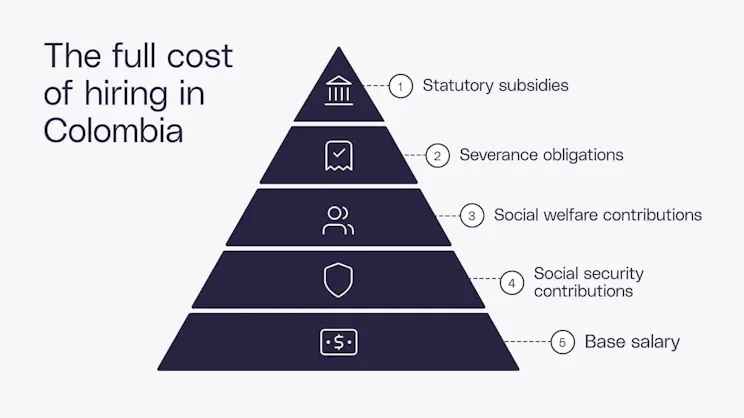
In addition to salary, employers should budget for mandatory payroll contributions, social welfare programs, severance obligations, and statutory benefits when calculating total employment costs.
Mandatory payroll contributions
Employers contribute to Colombia's social security and welfare system.
Fund type | Employer contribution | Employee contribution |
|---|---|---|
Pension | 12% | 4% |
Health insurance (EPS) | 8.5%* | 4% |
Occupational risk insurance (ARL) | 0.522% to 6.96% | — |
Family compensation fund (Cajas de Compensación Familiar) | 4% | — |
Instituto colombiano de bienestar familiar (ICBF) | 3%* | — |
Servicio nacional de aprendizaje (SENA) | 2%* | — |
*Exemptions:
- Employers are exempt from the 8.5% health insurance contribution for employees earning less than 10 times the statutory minimum monthly wage (SMMLV).
- Employers are exempt from the ICBF and SENA contributions for employees earning less than 10 times the minimum wage.
Severance pay (Cesantías)
Employers in Colombia contribute to a severance fund on behalf of employees.
You must deposit one month's salary each year into an approved severance fund. You will also need to pay annual severance interest equal to 12% of the severance balance directly to the employee.
Transportation subsidy
Employees earning less than twice the minimum legal wage are entitled to a mandatory monthly transportation subsidy.
What does a company need to do to hire employees in Colombia?
You can hire employees in Colombia through a local entity or an employer of record (EOR).
The traditional route | The agile route |
|---|---|
Establish a local entity | Use an EOR |
Direct hiring must involve a legal presence in Colombia. You typically need to: Incorporate a local entity, such as a Simplified Stock Company (SAS) Open a corporate bank account Register with the Dirección de Impuestos y Aduanas Nacionales (DIAN) Get a tax identification number Register employees with Colombia's social security system Manage payroll, tax reporting, and ongoing compliance requirements These steps take time and need ongoing administration. | An EOR removes the need to establish a local entity. The EOR manages: Payroll Tax reporting Statutory benefits Employment compliance You direct the employee's day-to-day activities while the EOR manages the legal employment relationship. This model provides a faster path to hiring in Colombia and reduces operational overhead. |
Key steps to hiring in Colombia
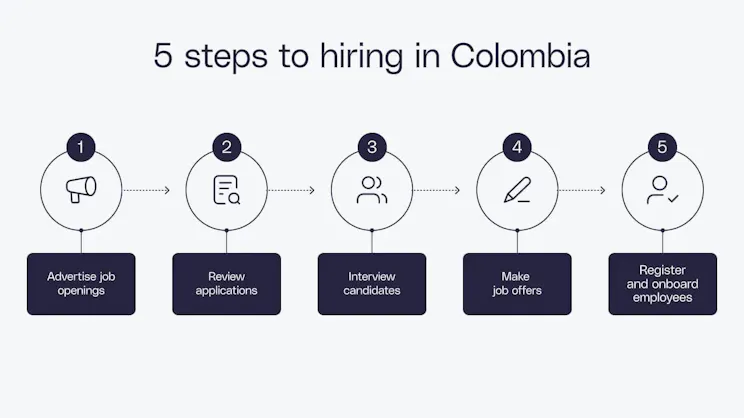
The hiring process inColombia is similar to other markets. Here’s what to expect:
1. Advertise job openings
Create clear job descriptions that outline responsibilities, qualifications, and compensation.
Job postings must comply with Colombian anti-discrimination laws. Employers can’t reference age, gender, or other protected characteristics. Popular hiring platforms include Indeed, JobStreet, and LinkedIn.
2. Review applications and conduct checks
Review candidates based on objective qualifications and job-related criteria.
Background checks are common, but Colombia's privacy laws impose strict limits. Employers can’t ask for HIV tests, pregnancy tests, or information about union membership.
3. Interview candidates
Interview shortlisted candidates virtually or in person.
Use this stage to assess technical skills, experience, and overall fit for the role.
4. Make job offers
Provide a written employment contract in Spanish. Compensation must be stated in COP. The contract should also specify the probation period.
5. Onboard new employees
Employers must register employees with Colombia's social security system before work begins. Registration must be completed at least 24 hours before the employee's start date. With G-P EOR, you don’t have to worry about the administrative burden of onboarding. Our Global Employment Platform streamlines the process, so you can focus on training your new hire and integrating them into your company culture.
Hiring independent contractors in Colombia
Hiring independent contractors gives you flexibility and faster access to specialized skills. However, you have to structure contractor relationships carefully to avoid compliance risks.
1. Use a service agreement
Contractors work under a business-to-business framework.
Companies engage contractors through a prestación de servicios arrangement that defines deliverables, timelines, and payment terms.
2. Avoid worker misclassification
Colombian labor authorities closely examine contractor relationships.
A contractor may be reclassified as an employee if the relationship shows signs of subordination. Common examples include:
- Fixed work schedules
- Company-controlled tools or equipment
- Direct day-to-day supervision
- Ongoing management similar to an employee relationship
Misclassification can result in back payments for social security contributions, statutory benefits, severance obligations, and financial penalties.
3. Use clearly defined service agreements
Clear service parameters reduce compliance risk. Use clearly defined service agreements, separate payment processes, and documented project-based deliverables.
Hire employees through G-P EOR and pay contractors with G-P Contractor™ — without setting up a local entity. You can manage compliance, contracts, and payments in one place with G-P’s Global Employment Platform.
Hire employees and contractors in Colombia with G-P
G-P is the recognized leader in global employment with more than a decade of experience, the largest team of HR, legal, and compliance experts, and a global proprietary knowledge base.
Our Global Employment Platform gives you the infrastructure you need to hire in Colombia without setting up a local entity:
- Use G-P EOR to hire employees compliantly.
- Use G-P Contractor to hire and pay contractors.
- Use G-P Gia™ to get instant, expert-vetted HR guidance across the employment lifecycle.
Make hiring in Colombia easier with G-P. Book a demo today.
Can I pay Colombia-based employees in other currencies like USD?
No. Employment contracts and payroll payments must be executed and recorded in Colombian Pesos (COP).
What’s the standard payroll cycle in Colombia?
Most employees are paid monthly, typically on the last day of the calendar month.
Employers may also use bi-weekly payroll cycles, provided they comply with local employment requirements.
What happens if an employer misclassifies an employee as a contractor?
The employer may become responsible for:
Costly legal penalties
Mandatory back payments for social security
Outstanding statutory benefits like the 13th-month salary and severance