



Key takeaways
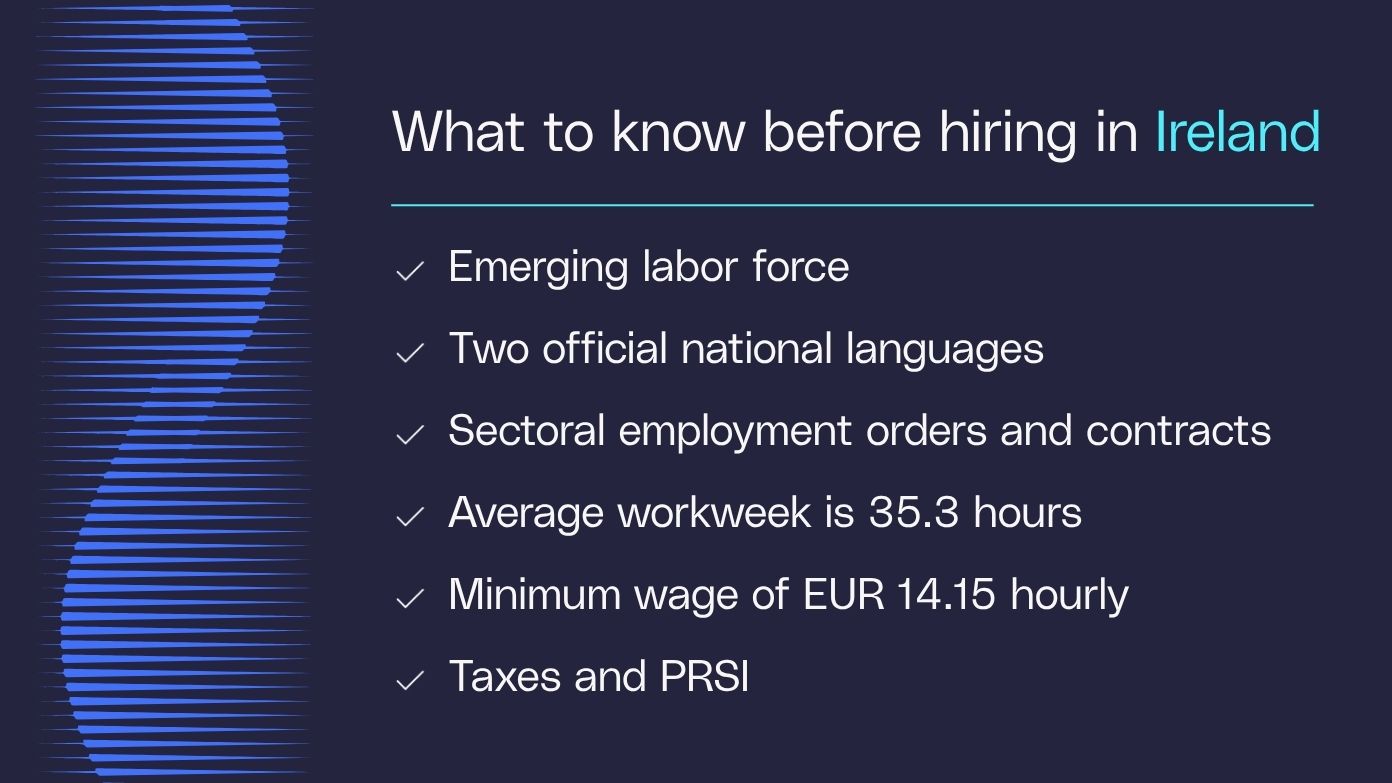
- Local laws and work customs: Ireland has a national minimum wage of EUR 14.15 for employees aged 20 and over. They also have strict laws regarding employee and independent contractor classification, with steep fines and legal penalties for misclassification.
- Ireland’s top hiring hubs and key industries: While Dublin is known for its booming ICT sector, Cork is a key site for the pharmaceutical industry, and Galway is a global hub for medtech.
- Taxes and PRSI: Ireland employees pay taxes at a standardized base rate of 20%. Employees who earn over EUR 352 weekly are also required to contribute 4.2% to Pay Related Social Insurance, or PRSI.
- Paths to hiring in Ireland: Understand the pros and cons of direct employer registration, using an EOR, opening a subsidiary or branch, or hiring independent contractors.
Ireland’s educated workforce and steady increase in GDP make it an attractive destination for companies looking to expand globally. However, Ireland has its own laws that govern hiring and employment practices. Our guide will tell you everything you need to know about hiring in Ireland.
What do I need to know before hiring in Ireland?
If you’re unsure where to begin, G-P Gia™, our AI-powered global HR agent, can answer your toughest compliance questions across 50 countries — including Ireland — and all 50 U.S. states. Reduce your reliance on outside counsel and cut the time and cost of compliance by up to 95% with Gia.
Let’s take a look at six things to know about hiring in Ireland:
1. Emerging labor force
Ireland has the youngest population in the European Union. The country's labor market is known for being highly educated. According to the 2022 census, 58% of people aged 15 to 44 had a third-level degree or equivalent. This is a significant increase compared to previous generations. In 1991, only 13.6% of those aged 15 and over had a third-level degree or similar.
Popular industries in Ireland include financial services, agriculture, export, trade, and technology. Pharmaceutical and medical technology, ICT, and software are particularly strong areas of Ireland’s tech sector. Even if your company doesn’t belong to one of these industries, you have a strong chance of finding qualified workers to join your team in Ireland.
2. Two official national languages
Ireland has two official languages: Irish Gaelic and English. Though Irish Gaelic is Ireland’s first official language, only a small percentage of the population speaks it. Even those who speak Irish Gaelic typically use English in most settings. About 99% of the population speaks English.
Ireland is an increasingly diverse nation: 19% of all Ireland residents were born in other countries, and 15% of the population speaks a language other than English or Irish at home. The most common of these languages are Polish, French, Romanian, and Lithuanian.
3. Sectoral employment orders and contracts
In many countries, you have to manage national employment laws and Collective Bargaining Agreements (CBAs) from trade unions. In Ireland, there’s no legal requirement to negotiate terms with trade unions. Some employers will have to refer to sectoral employment orders (SEOs). These are sets of employment terms that apply to specific sectors, such as construction.
Employers must provide a written statement covering core employment terms within five days of employment. The employment terms include employee info, employer name and address, nature of work, start date and contract duration, pay rate and reference period, expected working hours, and overtime and probation terms. While this statement isn’t a contract, most employers create a detailed written contract to fulfill this obligation.
G-P EOR has an Employment Contact Generator to help you draft compliant employment contracts that meet all legal requirements and best practices in Ireland.
4. Regulations around working hours and time off
Ireland limits the workweek to 48 hours. But in practice, the average workweek is 35.3 hours. Ireland employees are entitled to at least four weeks of paid annual leave every year. The law provides three methods for calculating annual leave. Employers must use whichever one gives the employee the most time off:
- Four working weeks if the employee worked at least 1,365 hours
- One-third of a working week every month the employee worked at least 117 hours
- 8% of the hours worked, up to a maximum of four weeks
Employees in Ireland also get time off for 10 public holidays. Employers that don’t give employees every holiday off must provide an alternative day off, extra annual leave, or an extra day’s pay.
5. Compensation and benefits
Ireland has a national minimum wage of EUR 14.15 hourly for those aged 20 or over. Occupations governed by SEOs may have their own minimum wage.
Employers who don’t offer an occupational pension scheme must give employees access to at least one standard PRSA. Employees who are ineligible to join the employer’s pension scheme after six months of work are also entitled to this benefit.
Ireland’s new auto-enrollment pension system, established Jan. 1, 2026, requires employers to match pension contributions for eligible employees not already in a qualifying pension arrangement.
Many employers also offer employees a private health insurance policy. Ireland has a public health system, but long waitlists drive many people to get private health insurance or expect it from their employer.
You can easily administer benefits plans with G-P EOR. Our in-house experts continuously monitor employment laws to meet country-specific regulations and norms. Build and manage benefits plans through our platform to provide a smooth employee experience.
6. Taxes and PRSI
Ireland employees pay income tax at a standard rate, which is currently set at 20%. Above a certain threshold, additional earnings are taxed at 40%. Ireland uses a pay-as-you-earn (PAYE) system, so employers withhold employees’ income tax from their paychecks.
Both employees and employers make pay-related social insurance (PRSI) contributions. The contribution amounts depend on the employee’s social insurance class and pay. Most employees belong to Class A. In this case, employers contribute 9% of an employee’s salary if the employee makes up to EUR 552 per week, or 11.25% if they make more than that amount.
On Oct. 1, 2026, those guidelines will increase to 9.15% for those earning up to EUR 552 weekly and 11.4% for those earning more.
Employees who make EUR 352 or less per week aren’t required to contribute to PRSI. Employees who earn over EUR 352 weekly are required to contribute 4.2%. On October 1, 2026, the required contribution will increase to 4.35%.
What are the hiring models for global companies in Ireland?
Companies looking to expand their businesses into Ireland have the following options:
- Direct employer registration: registering your company with Irish employment authorities, but still directly processing employees’ payroll, tax, social insurance, and other required business operations.
- Employer of record (EOR): using a third-party service, which will function as the workers’ legal employer, to handle payroll, benefits, and other HR/administrative support tasks.
- Subsidiary or branch: establishing a corporate presence in Ireland, either as an extension of your existing company or a separate legal entity.
- Independent contractor: Contractors are legally self-employed, so they handle their own tax and PRSI contributions. As employment contracts and arrangements are highly regulated in Ireland, there are legal and financial penalties for employers who missclassify employees as independent contractors.
What are the top hiring hubs in Ireland?
Some Irish cities are known for particular industries. Knowing what each city has to offer can help you channel your hiring efforts to the right place and fill roles faster.
The top talent hubs in Ireland are:
- Dublin: Ireland's largest city, with over 1.2 million people. It’s a major European tech hub. Companies like Google, Meta, Amazon, Microsoft, Apple, IBM, Intel, and Oracle are located here. The city has a strong talent pool in software development, data analysis, cybersecurity, AI, and cloud technologies.
- Cork: a key site for pharmaceutical, biopharmaceutical, and medtech companies. Seven of the top 15 global pharmaceutical companies are here, including Pfizer, Janssen, and Merck. This creates a solid talent base in research and development, manufacturing, quality assurance, and regulatory affairs for life sciences.
- Limerick: a key city in Ireland's mid-west region. The University of Limerick delivers a solid pipeline of students in engineering, science, and business. Limerick also offers a lower cost of living than Dublin and Cork.
- Waterford: a growing hub for pharmaceutical companies, building on its history as a port city. The government is making significant efforts to develop the southeast region, with Waterford at its center.
- Galway: a global hub for medtech. It has many international medical device companies and a strong talent pool.
What are the key industries in Ireland?
Understanding Ireland’s main industries helps you benchmark salaries and benefits. You can use this insight to make smart choices about where to invest and grow your workforce. The main industries in Ireland include:
- Information and Communication Technology (ICT): Dublin, often known as the Silicon Docks, is home to major tech companies, such as Google, Meta, and Apple. These companies have their European headquarters and important operations here. Specialist talent includes software developers, cloud architects, and cybersecurity experts.
- Pharmaceuticals: Ireland leads the world in producing and exporting pharmaceuticals. Many top companies, such as Pfizer, Johnson & Johnson, and Regeneron have manufacturing, research, and commercial operations in the country. Specialist talent includes process engineers, quality assurance and quality control experts, and regulatory affairs professionals.
- Medical technology: Ireland is one of Europe’s largest exporters of medical technology and a global hub for medical devices. Leading companies like Medtronic, Boston Scientific, and Abbott have a strong presence in Galway and Cork. Specialist talent includes various engineering roles, quality and regulatory experts, and clinical research professionals.
- Financial services and fintech: Dublin is a key international financial services center. It attracts global banks, investment firms, insurance companies, and has a growing fintech sector. Specialist talent includes financial analysts, risk management experts, accountants, and auditors.
- Professional services: Major accounting firms — Deloitte, PwC, EY, and KPMG — and important law firms have operations in Ireland. Specialist talent includes consultants, accountants and tax specialists, and legal professionals.
What are the costs of hiring an employee in Ireland?
Whether you’re hiring one employee or an entire team in Ireland, expenses are inevitable. Budget for the following:
- Purchasing or subscribing to applicant tracking software
- Paying to post job ads
- Conducting background checks or paying a third-party service
Unless you work with an EOR, you should also factor in:
- The cost to establish a business entity in Ireland
- Consulting costs for lawyers to help you follow Irish employment laws
- Travel expenses to set up your company
According to G-P Verified Sources from Gia, the employer burden rate in Ireland centers on the statutory Pay Related Social Insurance (PRSI) contribution. The PRSI rate varies between 8.9-11.15%, depending on the employee's weekly earnings.
What does a company need in order to hire employees in Ireland?
Make sure you cover these essentials before expanding your team in Ireland:
- File form A1 and your company constitution with the Companies Registration Office.
- Register with the Revenue Commissioners for corporation tax within one month of commencing trade.
- Register for PAYE, PRSI, and USC before paying employees.
- Register for value-added tax (VAT) if needed, generally when turnover exceeds the applicable threshold.
Setting up a company in Ireland can take weeks or even months. Use G-P EOR to hire full-time employees in Ireland without setting up your own entity. G-P EOR offers speed, flexibility, reduced risk, so you can start working quickly and compliantly.
What are the steps to hiring in Ireland?
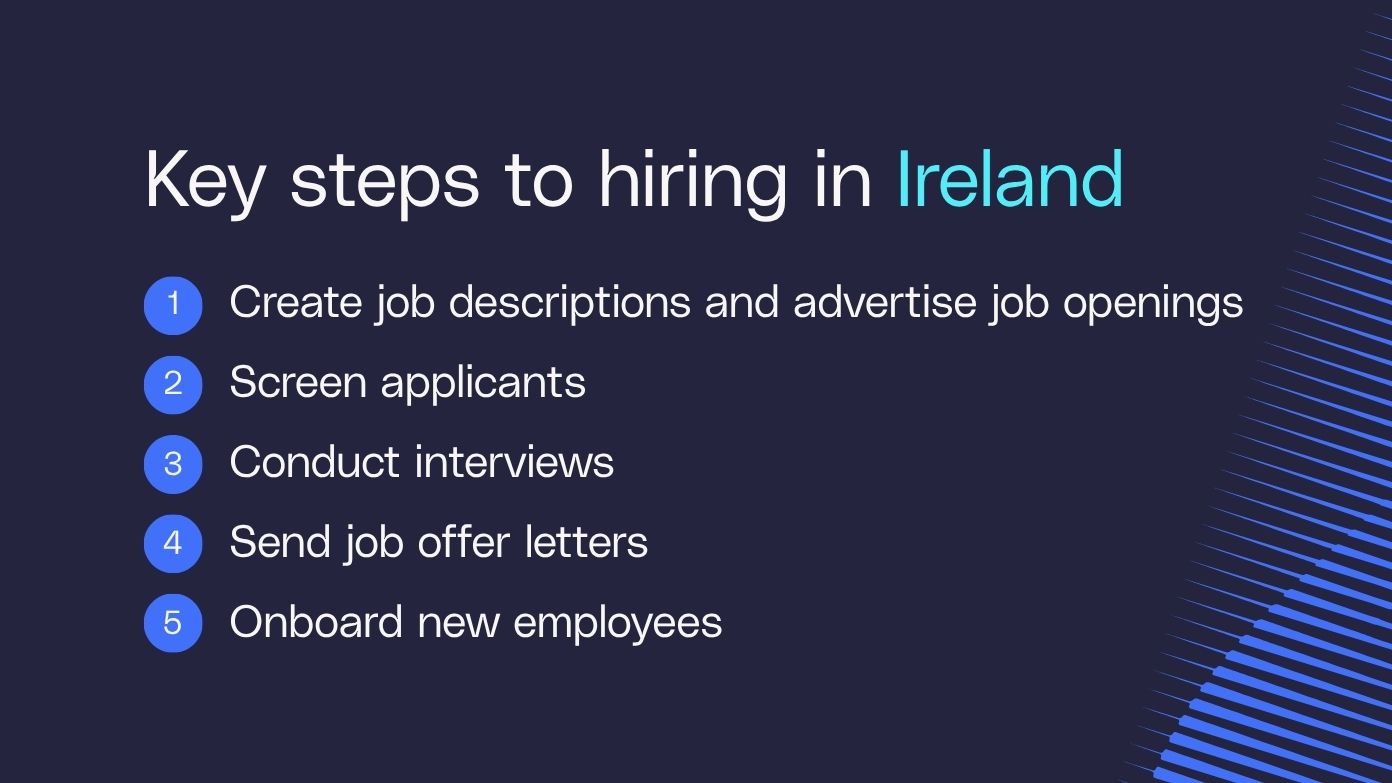
1. Create job descriptions and advertise job openings
You can post ads on various job boards online. Job sites like Glassdoor, Monster, and Indeed are popular in Ireland. You may also want to look for Irish job boards specific to your industry. Some job sites offer free posting options. LinkedIn is also popular among the country’s working population. Avoid language that may violate Ireland’s anti-discrimination laws in your job ads.
2. Screen applicants
Consider building screening tools into the application process. A survey found that 42% of graduate recruiters in Ireland use ability or technical tests, and 39% use psychometric tests to screen applicants.
3. Conduct interviews
Next, interview candidates who made it onto your shortlist. Phone or video interviews are especially helpful if you’re hiring remote employees in Ireland and want to avoid traveling there.
It’s important to confirm the candidate’s right to work in Ireland during the hiring process. This could be via a residence permit, passport, birth certificate, immigration status document, or certificate of registration or naturalization.
4. Send job offer letters
Send your selected job candidates offer letters that include the main terms and conditions of employment. If you need a background check, ask the candidate for consent and state that the job offer is contingent on the findings.
A background check typically covers employment history, references, and education. GDPR and Irish Data Protection Acts state that employers must have a lawful basis for processing personal data during recruitment.
A criminal background check is subject to stricter legal controls and is handled separately. Irish law requires a criminal background check for certain positions involving children or vulnerable adults.
When you send offer letters, ask prospective employees to accept or decline the offer in writing. There may be negotiations over salary or other terms that happen before a candidate officially accepts the offer.
5. Onboard new employees
The offer letter you send should include a written statement within five days of the new hire’s start date. At a minimum, the statement should include:
- The employer’s and employee’s names
- The employer’s address
- Duration or end date (for temporary or fixed-term contracts)
- The pay method and reference period
- Expectations for working hours (on a daily and weekly basis)
The Data Protection Acts establish rules for the processing of personal data. Any data you collect must be done lawfully, fairly, and transparently. You must also have the appropriate technical and organizational measures to protect personal information.
Another important onboarding step is requesting a Revenue Payroll Notification (RPN) to set up payroll. Other onboarding processes include providing internal paperwork or training to help new hires get used to their new role.
Onboard your team members in Ireland in minutes with G-P EOR. We’ll handle the legal and administrative tasks, so you can start working faster. Simple, self-guided workflows ensure a smooth process for you and your new hires.
How do I hire contractors in Ireland?
Working with independent contractors in Ireland can be a cost-effective way to test the market and build a presence without the commitment of full-time employees. Contractors based in Ireland understand local consumer behavior, rules, and business practices. They’ll be ready to start working quickly with their own equipment and established work processes.
Hiring contractors allows you to easily adjust your workforce based on your business needs, without the complexities and costs of employment.
Before you enter an agreement with an independent contractor in Ireland, consider the following:
1. Employees vs. independent contractors
In Ireland, employees usually have indefinite contracts with no fixed end date, providing job stability and access to benefits. Contractors are engaged for specific projects or fixed periods. They have services agreements that clearly define the scope of work and duration.
Employees get regular salaries from which employers withhold income tax and social security contributions. Contractors invoice for their services and are responsible for their own tax filings and social security contributions.
2. Penalties for misclassification
Misclassifying an employee as an independent contractor can lead to significant financial, legal, and reputational consequences. If misclassification occurs, you may:
● Be required to pay unpaid PAYE income tax, Universal Social Charge, Pay Related Social Insurance (PRSI) contributions, interest, and tax-geared penalties for the misclassification period.
● Face legal penalties up to and including criminal prosecution. PRSI-related offences can carry fines of up to EUR 13,000 or twice the unpaid social insurance contributions if greater. Imprisonment may also be ordered in serious cases. For example, filing false or misleading returns carry higher penalties than other infractions.
● Face legal action from misclassified employees for unpaid statutory leave, unfair dismissal remedies, pension entitlements, and other employment rights through the Workplace Relations Commission (WRC) or courts.
3. Pay contractors in Ireland
G-P Contractor™ takes away the messy, time-consuming process of hiring and paying international contractors. You can create and issue contracts and pay workers with just a few clicks, all while ensuring a compliant process.
Can G-P help me hire employees and contractors in Ireland?
G-P’s Global Employment Platform and its AI-based products – EOR, Contractor, and Gia – help companies of all sizes build and manage global teams.
Start hiring in Ireland today
With more than a decade of experience, the largest team of HR, legal, and compliance experts, and a global proprietary knowledge base, G-P is the recognized leader in global employment.
Make your expansion to Ireland easier with G-P. Contact us or book a demo today.
 Frequently asked questions
What are the requirements for registering employees with Social Security in Ireland?
You must register employees with the Irish Revenue Commissioners for pay-as-you-earn (PAYE) purposes, and make Pay Related Social Insurance (PRSI) contributions according to the employee's salary.
How does the probationary period work in Ireland?
The probationary period can be up to six months, with the possibility to extend to 12 months in exceptional circumstances. During this time, either party can terminate the contract with notice.
What are the rules regarding working hours and overtime in Ireland?
The standard workweek is 48 hours, averaged over a reference period. Overtime must be compensated according to the terms of the employment contract.
What kind of leave benefits are employees entitled to in Ireland?
Employees are entitled to a minimum of four weeks of paid annual leave. Pregnant employees get 26 weeks of paid maternity leave, while fathers are eligible for 2 weeks of paid paternity leave.
Employers must also provide access to Ireland's public healthcare system through social security contributions.
What are the anti-discrimination laws in Ireland?
The main law is the Employment Equality Act, 1998. This prohibits discrimination based on gender, age, disability, and other protected characteristics. You must also ensure compliance with sectoral employment orders where applicable.