






Key takeaways
- Peru is a growing talent market: The country offers access to skilled professionals across technology, mining, finance, and customer support.
- Employment costs go beyond base pay: Statutory benefits, insurance requirements, and employer contributions increase total hiring costs.
- You can hire without setting up a local entity: G-P EOR lets you hire professionals in Peru while managing local payroll, statutory benefits, and employment compliance.
Peru gives you access to a growing talent market with strong expertise across technology, finance, and business operations.
Before you hire in Peru, you need to understand the country's employment laws. Employers must navigate mandatory bonuses, compensation for time of service (CTS) contributions, and strict termination requirements.
Our guide will tell you everything you need to know about hiring in Peru.
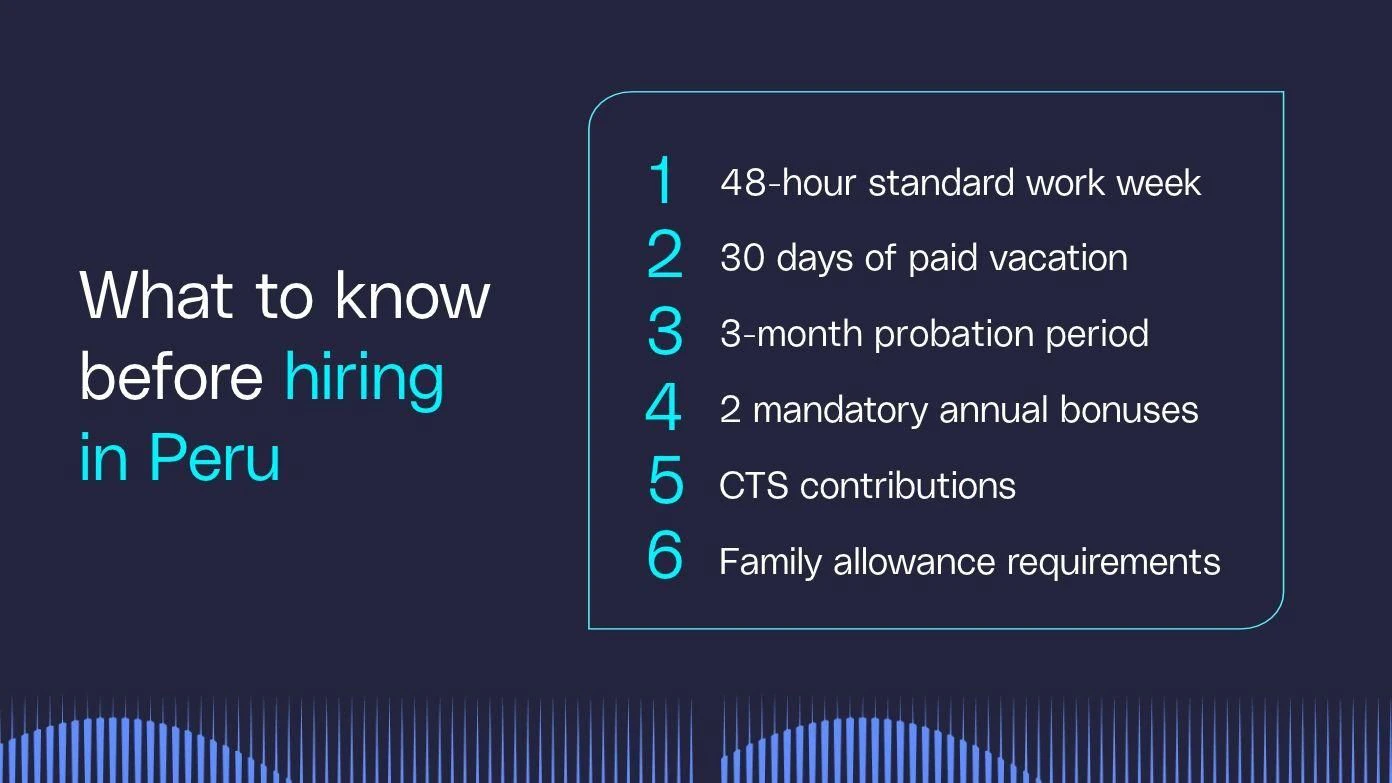
What to know before hiring in Peru
Peru’s labor laws give workers strong protections and benefits. Understanding these requirements makes it easier to hire compliantly and avoid unexpected costs.
Here are seven key factors to consider:
1. Working hours
Peru's standard workweek is 48 hours, typically divided into eight-hour workdays.
Employees who work beyond these limits are entitled to overtime pay. Overtime is voluntary and paid at premium rates:
| Overtime period | Premium rate |
|---|---|
| First 2 overtime hours | 25% above the employee's regular rate |
| Additional overtime hours | 35% above the employee's regular rate |
Important exceptions:
- Exempt employees: Certain management personnel, employees in positions of trust without effective working-hour supervision, and other legally exempt workers aren’t subject to standard working-hour limits or overtime requirements.
- Part-time workers: Regular overtime for part-time employees can cross a legal threshold that triggers full-time employee reclassification and the statutory benefits that come with it.
2. Paid time off
Employees get 30 calendar days of paid vacation after completing one year of service.
Peru observes 15 national public holidays throughout the year. Independence Day is celebrated over two days, so employees actually get a total of 16 days.
3. Probation
The standard trial period is three months, but it can extend to:
- Six months for skilled workers or employees in positions of trust
- One year for management roles
During the probationary period, employers may terminate employment without cause.
4. Mandatory bonuses
Employees get two statutory bonuses each year, known as gratificaciones.
| Payment period | Bonus amount |
|---|---|
| July (Independence Day) | 1 month's salary |
| December (Christmas) | 1 month's salary |
5. Compensation for time of service (CTS)
Also known as compensación por tiempo de servicios, CTS is a mandatory savings fund that supports employees during periods of unemployment.
Employers deposit CTS payments twice a year:
| Deposit period | Payment timing |
|---|---|
| First deposit | May |
| Second deposit | November |
The total annual CTS amount depends on the employee's eligible remuneration, statutory bonuses, and time worked.
6. Family allowance (asignación familiar)
Eligible employees covered by Peru's applicable private-sector labor rules receive a family allowance for qualifying dependent children. The benefit generally applies to children under 18 and may continue during qualifying higher education, subject to legal requirements.
The monthly family allowance equals 10% of Peru's minimum wage. As of October 2026, the minimum wage is PEN 1,230, giving eligible employees a monthly family allowance of PEN 123.
7. Employee protections
Peruvian labor law places strong protections around employment relationships.
Employers must follow specific rules for compensation, benefits, and termination. With G-P EOR, you can hire professionals in Peru without establishing a local entity or managing payroll and statutory benefits on your own.
Hiring models for global companies in Peru
There are several ways to build global teams in Peru, and what works best for one company may not be the best fit for another. Your hiring goals, along with the type of work being performed and whether you want to establish a permanent presence in the country, all impact the decision regarding which hiring model works best for your business.
Direct employer registration
If you decide to use a direct employer registration approach, you’re responsible for payroll, statutory benefits, and other forms of ongoing employment compliance. Carefully research local employment laws and stay up-to-date on regulatory changes to make sure you don't violate any requirements.
When you hire employees directly, you'll need to handle several key steps:
- Business registration: Peruvian authorities require you to complete several registrations, including registration with the National Superintendency of Customs and Tax Administration (SUNAT).
- Employee registration: T-Registro is an electronic employee registry where you must submit the required employee information to record new hires.
- Payroll reporting: PLAME is the electronic system for monthly payroll reporting in Peru, and employers must use it to report payroll information and employment-related contributions.
- Statutory benefits: You are responsible for keeping up with benefit requirements and making sure all eligible employees receive the benefits they're entitled to.
- Employment compliance: You must follow multiple forms of employment regulation, including rules for working hours, paid leave, and termination.
Direct hiring works best for companies that have the local infrastructure and resources in place to support ongoing employment requirements.
Employer of record
An EOR allows you to hire workers without having to set up a legal entity in Peru. In this type of arrangement, the EOR serves as the legal employer, handling payroll, statutory benefits, and employment compliance. It's an excellent way to hire talent in a new location when you want to test a new market to see whether you want to establish a permanent presence. In Peru, there can be certain legal and tax considerations that make EOR arrangements more complex, and that's why a provider with local expertise like G-P is so valuable.
Here's how an EOR can support your hiring and compliance needs when expanding into Peru:
- Register employees through Peru's T-Registro employment registry.
- Manage monthly PLAME payroll reporting requirements in Peru.
- Calculate Peru's mandatory July and December bonuses.
- Manage twice-yearly CTS deposits for eligible employees.
- Administer Peru's standard 9% EsSalud employer contributions.
- Provide required Seguro de Vida Ley coverage.
- Manage Peru's 30-day statutory vacation entitlement.
- Apply Peru's working-hour and overtime requirements correctly.
- Administer asignación familiar for qualifying Peruvian employees.
- Handle employment contracts according to Peruvian labor laws.
Subsidiary or branch
If you plan to establish long-term operations in Peru, you can set up a subsidiary or branch. Both create a formal business presence, but they have different legal requirements.
A subsidiary is a separate legal entity. A branch operates as an extension of its parent company without separate legal status.
Consider the following factors when deciding between a subsidiary and a branch:
- Business goals: Consider whether you need permanent operations or a limited local presence. Your long-term plans will help you determine the right structure.
- Hiring plans: Determine whether you’ll need a local team to support your operations. Both structures allow you to hire employees in Peru, but a subsidiary establishes a separate legal entity that can help distinguish the local company's obligations from those of its foreign parent.
- Legal responsibilities: Both structures require you to meet several local requirements, including business registration, tax obligations, and employment laws.
- Financial obligations: Whichever type you choose, you must account for local taxes, payroll costs, and ongoing administrative expenses.
- Long-term expenses: The cost of maintaining a registered business presence can be high, so consider whether the investment aligns with your long-term growth plans.
Independent contractor and misclassification risk
When you need to hire talent in Peru for a defined project, you can use independent contractor agreements to hire independent contractors. This is common for companies that want to access specialized skills without having to establish a long-term employment relationship. However, you must consider worker classification rules and the nature of the working relationship because you don't want to accidentally misclassify an employee as an independent contractor. If you do, your company may face fines, back payments for statutory benefits, and unpaid employment-related taxes and contributions.
G-P Contractor™ helps companies manage contractor agreements, evaluate classification risk, and process payments.
Top hiring hubs in Peru
Peru’s universities produce over 20,000 new technology graduates each year. Knowing where talent is concentrated can help you build your team faster and target the right skills.
These are the top hiring hubs in Peru:
- Lima is Peru's economic heart and largest employment market. More than 5.6 million people were employed in the city in 2025. Lima attracts technology, finance, accounting, and administrative talent, supported by some of the country's leading universities and digital infrastructure.
- Arequipa is a major industrial and engineering center with a rapidly growing technology sector. Employment grew by 5.7% in 2025. The city has become a popular destination for software development, data analytics, and technology services.
- Trujillo is known for its commercial and agricultural industries, but its professional talent pool continues to grow. The city reported a low unemployment rate of 2.6% in late 2025 and is gaining recognition for innovation in agricultural technology and related fields.
Key industries in Peru
Several industries are driving Peru's economic growth and creating demand for skilled professionals across the country.
- Mining and minerals: Peru's largest industry continues to evolve through technology. Mining companies are investing in artificial intelligence and IoT solutions to improve operations, creating demand for engineering, technology, and analytics talent.
- Agriculture and food processing: Agriculture remains a major employer and export driver. Agro-industrial products have grown from $645 million in 2000 to an estimated $15 billion in 2025. Cities such as Trujillo continue to invest in agricultural technology and innovation.
- Information technology and software development: Peru's technology sector is expanding rapidly, with software industry growth reaching 10.8% annually. Government-backed programs such as StartUp Perú are supporting startup growth and increasing demand for technical talent.
- Customer support and BPO: Peru's location allows teams to work in sync with North American companies. This time zone advantage, combined with competitive labor costs, has made the country a popular destination for customer support, consulting, and outsourced business services.
Cost of hiring employees in Peru
Budgeting for a global team in Peru goes beyond base salary.
Statutory benefits and employer contributions can add substantially to base pay. The total cost depends on the applicable employment regime and benefit requirements. Understanding these costs upfront makes it easier to scale your team and stay compliant.
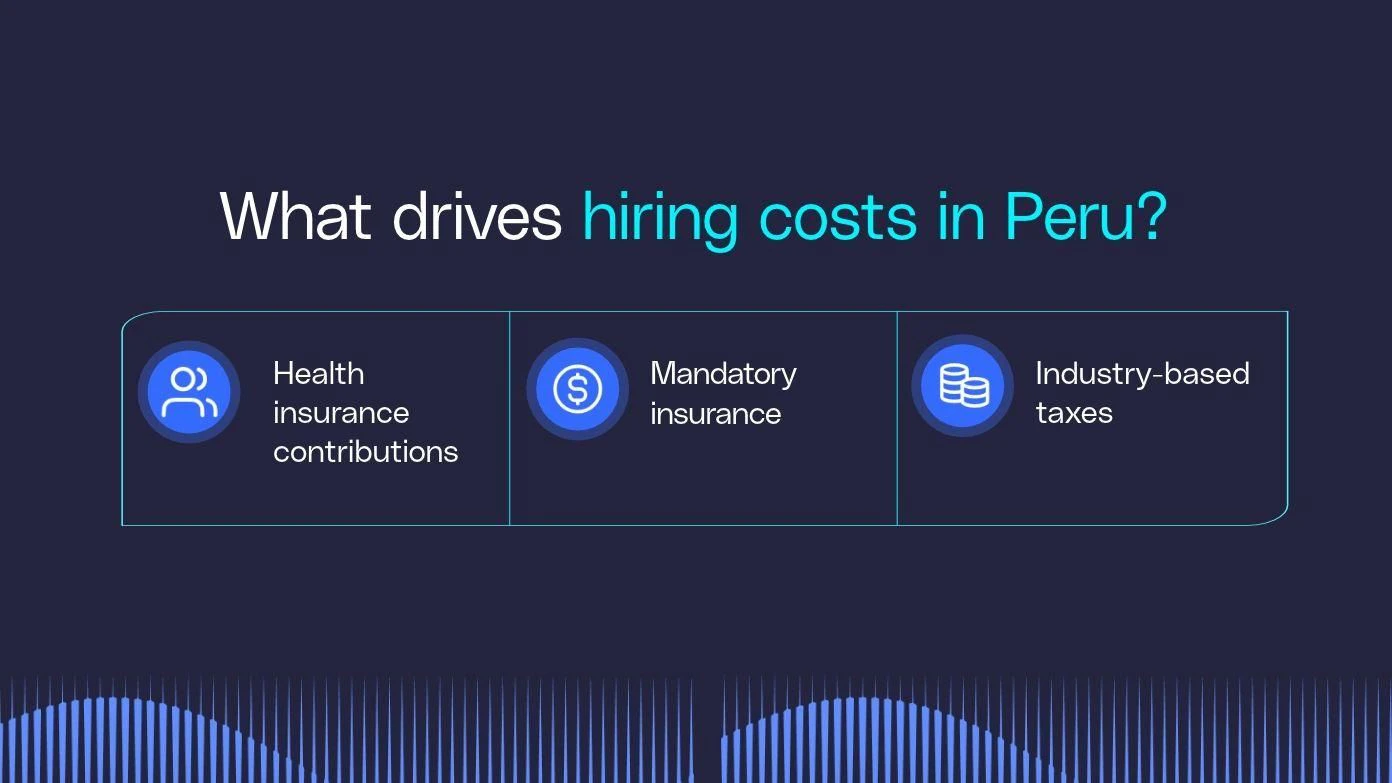
When you’re hiring employees in Peru, the primary statutory costs include:
- Health insurance (EsSalud): Employers must pay 9% of the employee’s monthly salary to fund Peru’s public health system.
- Life insurance (Seguro de Vida Ley): You must provide life insurance from an employee’s first day of work and cover the cost of the premium. The exact cost depends on the insurance provider and company risk profile, but commercial rates average around 0.48% of the employee’s salary.
- Industry-based taxes:
- SENATI: Companies with an average of more than 20 workers engaged in qualifying industrial activities during the previous year generally pay a monthly training contribution of 0.75% of applicable employee remuneration.
- SENCICO: Companies developing construction activities pay a monthly contribution of 0.2% applied to total billed income.
These statutory benefits are essential for protecting employees and supporting workforce development. Use our employer burden calculator to estimate your total hiring costs in Peru.
What does a company need to do to hire employees in Peru?
Before you hire in Peru, you need to meet several legal requirements. The steps depend on your business structure and planned activities:
- Establishing an appropriate legal presence or employer registration arrangement in Peru, depending on your business structure and planned activities
- Securing local legal representation
- Opening a local corporate bank account
- Establishing a physical business address in Peru
- Registering with the National Superintendency of Customs and Tax Administration (SUNAT)
- Registering with the Ministry of Labor and Employment Promotion (MTPE)
- Setting up and managing electronic payroll reporting through Peru's payroll systems
- Administering payroll, taxes, statutory benefits, and ongoing employment compliance
These steps take time and ongoing resources. That's why many companies choose to simplify hiring with G-P. With G-P EOR, you don't need to establish a local entity to hire in Peru. We manage local payroll, employment compliance, statutory benefits, and tax requirements, so you can hire faster and focus on growing your team.
Key steps to hiring in Peru
The hiring process in Peru follows a familiar structure, but local compliance rules shape how each step works. Here's what to expect:
1. Draft a compliant contract
Employment contracts should be written in Spanish and clearly outline compensation, statutory benefits, working hours, and employment terms.
Indefinite-term employment is the default under Peruvian labor law, so any other arrangement needs additional justification and documentation. For example, fixed-term contracts must be in writing and include a valid business reason for the temporary arrangement.
2. Collect employee data
Employers must register new hires on their first day of work.
This involves entering employee information into Peru's electronic payroll system, known as T-Registro. Registration also enrolls employees in the mandatory public healthcare system, EsSalud.
3. Set up payroll and benefits
Peru payroll operations account for more than monthly salary payments.
You need to accurately calculate mandatory bonuses, CTS deposits, tax obligations, and statutory benefits throughout the year.
4. Secure life insurance
Employers provide life insurance coverage through Seguro de Vida Ley.
The policy must be active from the employee's first day of work and registered with the Ministry of Labor's virtual system.
With G-P EOR, you don't have to manage these administrative requirements on your own. Our Global Employment Platform streamlines onboarding, payroll, benefits administration, and compliance, so you can focus on integrating new team members into your company’s procedures and culture.
Hire contractors in Peru with G-P
Hiring independent contractors in Peru gives you flexibility and faster access to specialized skills. But contractor relationships need to be structured carefully.
Peru makes a clear legal distinction between employment contracts and independent contractor agreements, known as locación de servicios.
- Employees work under direct supervision, follow set schedules, and get statutory benefits.
- Independent contractors generally work autonomously and deliver services under agreed terms without the level of subordination associated with an employment relationship.
Worker classification
SUNAT and local labor inspectors actively review contractor relationships.
A contractor may be reclassified as an employee if they:
- Work fixed hours
- Get direct supervision
- Use company-provided equipment
- Work in a way that resembles an employment relationship
Misclassification leads to:
- Financial penalties
- Legal action
- Back payments for taxes, benefits, and other employment obligations
G-P Contractor™ gives you a compliant way to hire and pay contractors in Peru. Use one platform to create contractor agreements, run AI-powered classification checks, and issue fast, secure payments in 130+ currencies.
Hire employees and contractors in Peru with G-P
Our Global Employment Platform and its AI-powered products, EOR, Contractor, and Gia, support companies as they build and manage global teams.
G-P is the recognized leader in global employment with more than a decade of experience; the largest team of HR, legal, and compliance experts; and a global proprietary knowledge base.
Make your expansion to Peru easier with G-P. Contact us or book a demo today.

FAQs
What’s the probation period in Peru?
The standard probation period in Peru is three months. It can be extended depending on the role:
Up to six months for skilled workers or positions of trust.
Up to 12 months for management personnel.
Employers can terminate employment without cause during the probation period.
Are 13th- and 14th-month salaries mandatory in Peru?
Yes. Employers pay two statutory bonuses each year, known as gratificaciones:
One month’s salary in July for National Holidays.
One month’s salary in December for Christmas.
Can I terminate an employee in Peru without cause?
Termination without cause is highly restricted in Peru after the probation period ends.
Employees benefit from strong legal protections against arbitrary dismissal. Employers generally need a valid reason related to conduct or job performance to terminate employment lawfully. Failure to follow local requirements could result in severance obligations, legal claims, and financial penalties.
How is CTS calculated in Peru?
Compensation for Time of Service (CTS) is a mandatory savings fund designed to support employees during periods of unemployment. Employers make CTS deposits twice a year in May and November.
The total amount depends on the employee’s eligible remuneration, including the applicable portion of statutory bonuses, and time worked.