





Key takeaways
- Access skilled talent in the UAE: Hiring in the UAE can help you build a team in industries ranging from energy and construction to finance and technology.
- Plan for employee benefits: Employer requirements in the UAE include providing an end-of-service gratuity, several weeks of annual paid sick leave, and at least a month of paid vacation leave to employees.
- Follow local hiring requirements: Certain private sector employers must meet targets for hiring UAE nationals. You must also follow anti-discrimination rules when recruiting and employing workers.
- Choose a compliant hiring approach: You can establish a local entity or use G-P EOR to hire eligible employees in the UAE without setting up your own entity.
As a major economic hub in the Middle East, the United Arab Emirates (UAE) is also a destination for companies looking to hire talent. Its GDP reached AED 1.9 trillion (USD 517.28 billion) in 2025. The UAE's economy includes oil and gas, real estate, and construction, alongside a growing advanced technology sector.
Before you expand into the UAE, you must understand the country’s contract, tax, wage, and benefits laws. Our guide covers everything you need to know about hiring in the UAE.
What to know before hiring in the UAE
If you plan to hire employees in the UAE for the first time, you must know your legal requirements. These norms and laws influence hiring practices in the country as well as many aspects of the employer-employee relationship, including compensation and benefits.
G-P Gia™, our AI-powered global HR agent, can answer your toughest compliance questions across 50 countries — including the UAE — and all 50 U.S. states. Reduce your reliance on outside counsel and cut the time and cost of compliance by up to 95% with Gia.
Here are five things to know about hiring in the UAE:
1. Contracts and termination requirements
You must draft a written employment contract in Arabic with English as a reference. Your contract must cover the employee’s position, duties, probation, compensation, benefits, and termination requirements. When they leave, employees who have completed at least one year of continuous service must receive an end-of-service gratuity equal to 21 days of basic wages per year for the first five years and 30 days for every year after that.
2. Payroll and taxes
The UAE doesn’t levy individual income tax, but social security contributions or other obligations for eligible workers may apply. The UAE levies corporate tax on businesses, generally at 9% on taxable income exceeding AED 375,000. Qualifying Free Zone Persons may benefit from a 0% rate on qualifying income, subject to applicable conditions. A 5% VAT applies to most goods and services.
3. Wages and working hours
The UAE government mandates at least one paid weekly rest day, as specified in the employment contract or workplace rules. Your employees can generally work a maximum of eight hours a day and 48 hours per week. During Ramadan, normal working hours are reduced by two hours per day.
Employees can generally work no more than two hours of overtime per day, paid at their basic wage plus at least 25%. If they work overtime between 10 p.m. and 4 a.m., that increase rises to at least 50%, except for shift workers. Work on a designated rest day requires an alternative day off or additional pay. The UAE Labour Law does not set a general minimum wage, although a separate minimum applies to Emirati employees in the private sector.
4. Time off
You must provide your employees with 30 calendar days of paid annual leave after one year of service. Those with 6 to 12 months of service accrue two days per month.
Sick leave is up to 90 days per year. The first 15 days are at full pay, the next 30 at half pay, and the remainder unpaid.
Female employees receive 60 days of maternity leave with 45 days at full pay and 15 days at half pay. Extra unpaid leave is possible for pregnancy-related illness. Male employees can take five working days of paternity leave within six months of their child's birth.
Hajj leave is a one-time, unpaid leave of up to 30 days. Employees get paid leave for official holidays, which are announced annually.
5. Anti-discrimination law
As an employer, the UAE prohibits you from discriminating against job candidates or employees based on race, nationality, sex, religion, marital status, or mental or physical disability. Certain private-sector employers must also meet Emiratisation requirements for hiring UAE nationals.
Hiring models for global companies in the UAE
- Employer of record: An employer of record (EOR) serves as the legal employer and handles payroll, benefits, and other compliance matters for you.
- Subsidiary or branch: You can register a subsidiary or branch directly in a free zone or the UAE, which allows you to manage everything in-house. However, registering a subsidiary or branch in the UAE carries significantly higher setup and administrative costs than working with an EOR.
- Independent contractor and misclassification risk: Hiring contractors in the UAE for project-based assignments can help you scale quickly. However, you must be careful to avoid misclassification and penalties under UAE labor laws.
Top hiring hubs in the UAE
Some cities in the UAE are known for particular industries. You can focus your hiring efforts in the right place and fill roles faster when you know what each region offers.
The top talent hubs in the UAE are:
- Dubai is the country’s largest city and business hub. The city’s real GDP was USD 255.3B in 2025. Hubs like Dubai Internet City, Dubai Media City, and Dubai Knowledge Park attract talent in software development, digital marketing, AI, and creative services.
- Abu Dhabi is the capital of the UAE. The emirate is the center for government and energy policy. It hosts the headquarters of the Abu Dhabi National Oil Company (ADNOC). The Abu Dhabi global market (ADGM), another financial free zone, attracts fintech and digital finance professionals.
- Sharjah is an industrial and cultural center, with a strong manufacturing base and proximity to Dubai. The Sharjah industrial area makes up 19 subdivisions and two major free zones. It’s one of the largest industrial zones in the UAE.
- Ajman, Ras Al Khaimah, and Fujairah are smaller emirates emerging as hiring locations, particularly for manufacturing, logistics, and specialized industries. For example, Fujairah is the only emirate located on the Gulf of Oman, giving it direct access to global shipping lanes outside the Strait of Hormuz.
Key industries in the UAE
You can benchmark salaries and benefits and make smart choices about where to invest and grow your talent pool by understanding the UAE’s key industries.
The top industries in the UAE include:
- Oil and gas: Abu Dhabi holds the majority of the UAE's oil reserves. Oil and gas revenue funds government investment in diversification projects.
- Trade, logistics, and aviation: The UAE's strategic location between Europe, Asia, and Africa has made it a global trade and logistics hub. This is supported by world-class infrastructure, including Jebel Ali Port (one of the world's largest container ports), and large airlines like Emirates and Etihad Airways.
- Construction and real estate: This sector is defined by large-scale developments like the Burj Khalifa and new city projects. Real estate is a strong investment sector, driven by government reforms like the Golden Visa.
- Financial services: The country has financial free zones, including the Dubai International Financial Centre and the Abu Dhabi Global Market. These attract global banks, asset managers, and insurance companies. The sector is expanding in fintech, digital banking, and investment management.
- Technology and innovation: The UAE is heavily investing in AI, advanced technology, cloud computing, and cybersecurity, driven by strategies like the UAE AI 2031.
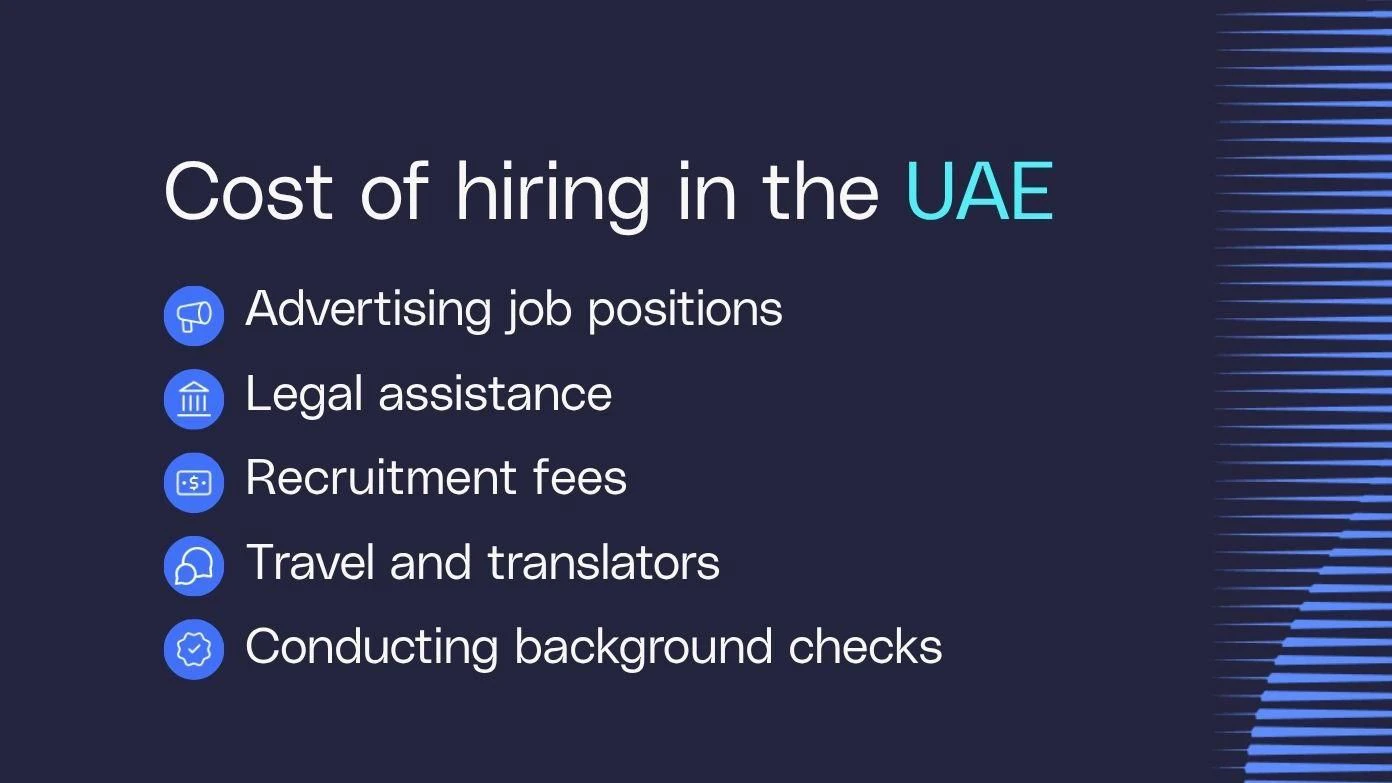
Cost of hiring in the UAE
- Entity setup, if applicable
- Job advertising and recruitment
- Legal and translation support
- Travel and background checks
- Payroll, benefits, and onboarding
The cost of hiring an employee in the UAE
Budget for the following when hiring in the UAE:
- Setting up an entity (unless you partner with an employer of record)
- Advertising job positions
- Paying referral bonuses to employees with connections in the UAE
- Paying an in-house hiring committee
- Traveling to and from the UAE, including hotel stays, meals, and transportation
- Partnering with a translator to draft documents or facilitate conversations, if applicable
- Using a background check service for screening candidates
- Drafting employment contracts, legal review, and consultation with HR and legal experts
- Costs for providing computers, phones, and software licenses
- Onboarding materials and initial training
- Costs for maintaining required tax and payroll records and documentation
According to G-P Verified Sources from Gia, the employer burden rate in the UAE, which includes costs triggered on top of salaries, is about 15%, excluding accident insurance, which can vary.
What does a company need to hire employees in the UAE?
Make sure you cover these essentials before hiring in the UAE:
- Set up a UAE-registered company.
- Get a trade or business license.
- Register your employee contracts with the Ministry of Human Resources and Emiratisation (MOHRE) or the free zone authority.
- Set up payroll in line with the UAE’s wage protection system (WPS).
- Keep proper employee records and stay compliant with local labor rights.
Setting up a subsidiary in the UAE can take weeks or months. Use G-P EOR to hire full-time employees in the UAE without setting up your own entity. Build your team at a lower cost and with peace of mind that you’re doing so compliantly.
The steps to hiring employees in the UAE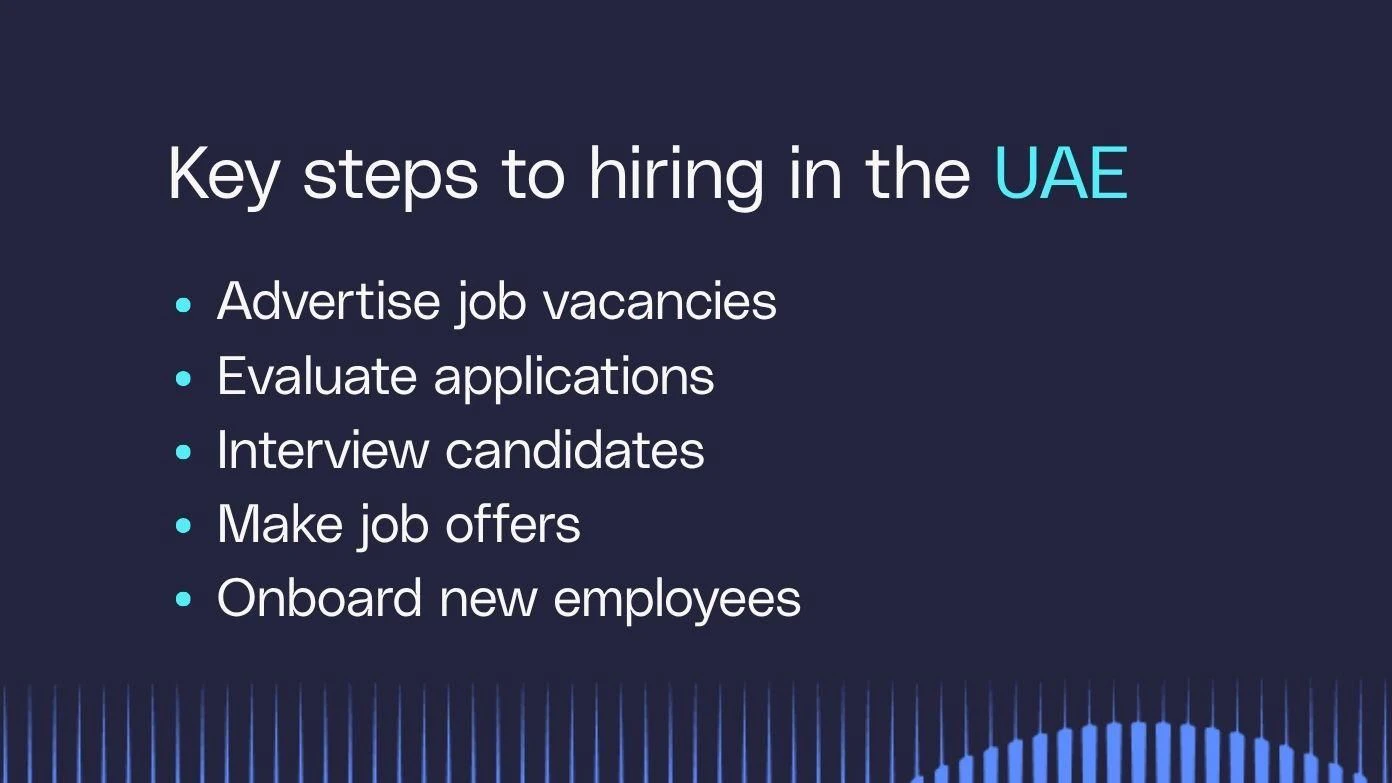
The hiring process in the UAE is similar to the one you’re likely familiar with in your own country. The process follows these five basic steps:
1. Advertise job vacancies
Prepare a clear, non-discriminatory job advertisement. Make sure it includes the job title, description, location, and required qualifications. You need to follow Emiratization requirements.
2. Evaluate job applications
Collect and review applications. Your selection criteria must be job-related and non-discriminatory. Shortlist candidates based on their qualifications and experience relevant to the role.
3. Interview candidates
Focus your interviews on job-related competencies. Avoid questions about protected characteristics like race, religion, gender, and marital status. Keep records of your interviews and hiring decisions. Get documented consent before conducting background checks. Make sure all data handling complies with UAE data protection laws.
4. Make job offers
Draft a formal offer letter in line with MOHRE. Upon acceptance, prepare a fixed-term employment contract in accordance with UAE requirements. Register the contract with the MOHRE or the relevant free zone authority.
5. Onboard new employees
Next, onboard new employees. Register your employee with the WPS for salary payments. Offer health insurance. For UAE nationals, register with the pension authority and make your required contributions. Keep employee records as required by law.
If you’re working with an UAE EOR, you won’t have to worry about the administrative burden of onboarding. We’ll streamline the process so that you can focus on training your new team members and integrating them into your company culture.
Hiring contractors in the UAE
Using independent contractors in the UAE can be a cost-effective way to test the market and build a presence without the commitment of full-time employees. Contractors based in the UAE understand local consumer behavior, rules, and business practices. They’ll be ready to start working quickly with their own equipment and established work processes.
Hiring contractors allows you to easily adjust your talent pool based on your business needs, without the complexities and costs of employment.
Before you enter an agreement with an independent contractor in the UAE, consider the following:
1. Employees vs. independent contractors
It’s important to understand the difference between employees and independent contractors. In the UAE, employees work under an employment contract registered with MOHRE, are under the employer’s supervision, and get statutory benefits such as paid leave, end-of-service gratuity, and health insurance.
In contrast, independent contractors provide services under a civil law service agreement. They set their own schedules, use their own equipment, and are paid per project or milestone.
2. Penalties for misclassification
Classifying someone as a contractor when they are not can lead to severe penalties. If misclassification occurs, you’ll have to:
- Pay back wages, benefits, such as end-of-service gratuity, and any unpaid social security contributions.
- Face visa cancellations, hiring bans, and extra fines.
- Possible suspension or revocation of the company’s business license.
3. How to pay contractors
G-P Contractor™ takes away the messy, time-consuming process of hiring and paying international contractors. You can create and issue contracts and pay contractors with just a few clicks, all while ensuring a compliant process.
Hire employees and contractors in the UAE with G-P
Our Global Employment Platform and its AI-powered products, EOR, Contractor, and Gia, support companies as they build and manage global teams. G-P is the recognized leader in global employment with more than a decade of experience, the largest team of HR, legal, and compliance experts, and a global proprietary knowledge base.
Make your expansion to the UAE easier with G-P. Contact us or book a demo today.
FAQs
Do I need a legal entity in the UAE to hire employees?
No. You can use an employer of record (EOR) like G-P EOR to hire and manage employees compliantly without establishing your own local entity.
Are there Emiratization requirements in the UAE?
Yes, there are Emiratization requirements in the UAE. Certain private sector companies have to hire a minimum number of UAE nationals. There are penalties for noncompliance depending on the company's size and industry.
What are the mandatory employee benefits in the UAE?
Mandatory employee benefits in the UAE include health insurance and end-of-service gratuity. Pension and social security contributions apply to eligible UAE nationals and other workers who may qualify. You have to comply with leave entitlements such as annual leave, sick leave, and maternity or paternity leave.
What is the wage protection system (WPS) in the UAE?
The WPS is a mandatory electronic salary transfer system that makes sure employees are paid accurately and on time through approved banks or financial institutions. You have to use WPS to process payroll.
What are the requirements for employment contracts in the UAE?
Employment contracts in the UAE have to be in writing. They have to specify terms such as job title, salary, and benefits, and be registered with the MOHRE or the relevant free zone authority. Contracts have to comply with UAE employment law and be written in Arabic, with English or other translations as needed.