



Key takeaways
- AÜG licensing regulates employee leasing in Germany: Licensed staffing agencies act as the legal employer while your company manages a leased professional's work within an assignment.
- Assignment duration and pay rules matter: The AÜG generally limits work assignments to 18 months and sets equal-pay and equal-treatment requirements, with limited exceptions under qualifying collective agreements.
- Incorrect worker classification is risky: Contractor-owned entities and contract labels don't determine legal status. German authorities look at how the working relationship functions in practice.
- A licensed EOR can reduce administrative burden. Partnering with an AÜG-licensed EOR lets your company avoid building its own employee-leasing infrastructure. The EOR handles core employer obligations.
With Europe's largest economy, Germany is home to one of the largest labor markets in the world. This makes Germany an attractive market for companies looking to expand internationally, especially when you need specialized, project-based talent.
However, before you hire through staffing or employee-leasing arrangements, you should understand the intricacies of German employment law. More specifically, you need to know the Arbeitnehmerüberlassungsgesetz (AÜG).
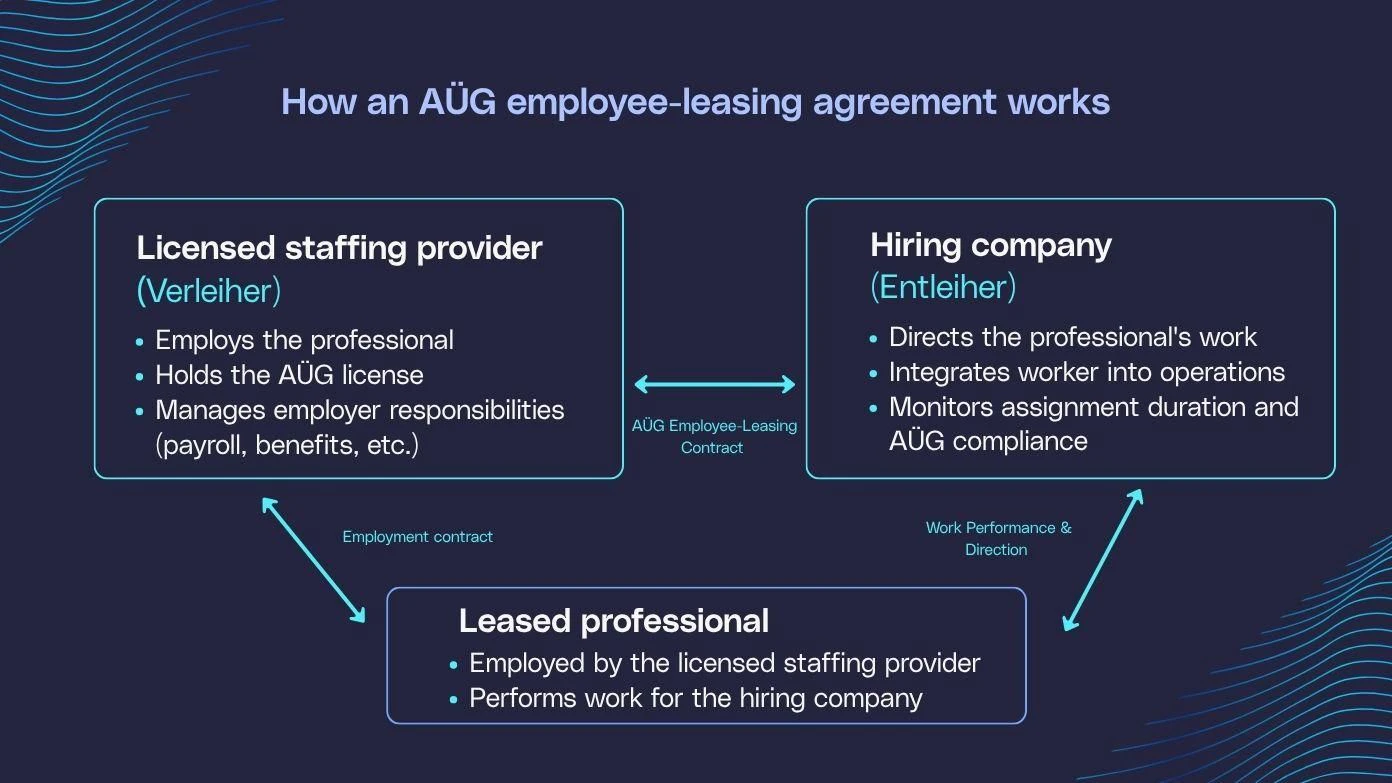
The AÜG (often written as AUG), also known as the Temporary Employment Act, is the German employment law that regulates employee leasing and temporary staffing. In a standard employee-leasing arrangement, a licensed staffing agency or lender (Verleiher) employs the worker and assigns them to the hiring company (Entleiher), which directs their day-to-day work. This hiring model offers many benefits for companies like yours, but working with a provider that doesn't hold an AÜG license or follow its rules can lead to severe financial, tax, and employment law consequences.
This guide explains key AÜG requirements your company needs to understand before engaging leased workers and hiring in Germany.
Why companies hiring in Germany must understand the AÜG
Companies outside Germany use AÜG-licensed staffing providers to access temporary or specialized talent without directly hiring professionals. With this model, you can cover short-term needs, support project-based hiring, enter the German market more quickly, and reduce some of the administrative work involved with hiring in Germany.
However, these arrangements must comply with the AÜG. Working with a licensed provider helps you structure employee leasing compliantly while reducing risks.
What is an AÜG license?
An AÜG license is an official permit granted by the Federal Employment Agency that lets staffing providers lease employees to another company in Germany.
The licensed lender or staffing agency remains the legal employer of the worker. They handle important tasks like payroll and benefits administration. The hiring company is the client of the licensed lender. It's the operational supervisor managing the worker's day-to-day operations.
A properly licensed lender can help you reduce risks associated with unauthorized employee leasing. However, the AÜG license itself doesn't apply to you, the hiring company. Instead, it applies to the staffing provider you work with.
The role of the Federal Employment Agency (Bundesagentur für Arbeit)
The Federal Employment Agency is responsible for overseeing AÜG licensing in Germany. It reviews applications, renews permits, and can inspect staffing providers to ensure they're meeting all applicable legal requirements.
Obtaining an AÜG permit involves meeting detailed financial, operational, and legal requirements. If a provider violates any AÜG rules, the Federal Employment Agency can take action, including revoking permits.
Critical compliance rules and legal restrictions under German labor law
It's not enough to ensure that your staffing provider holds a valid AÜG license. To successfully recruit and hire in Germany, you also need to track how long a professional works for your company, comply with equal-treatment rules, and more.
Germany sets clear limits for duration, pay, and working conditions for leased professionals. Keeping those rules in mind can help you effectively manage temporary talent while reducing compliance risks.
The 18-month maximum assignment limit (Überlassungshöchstdauer)
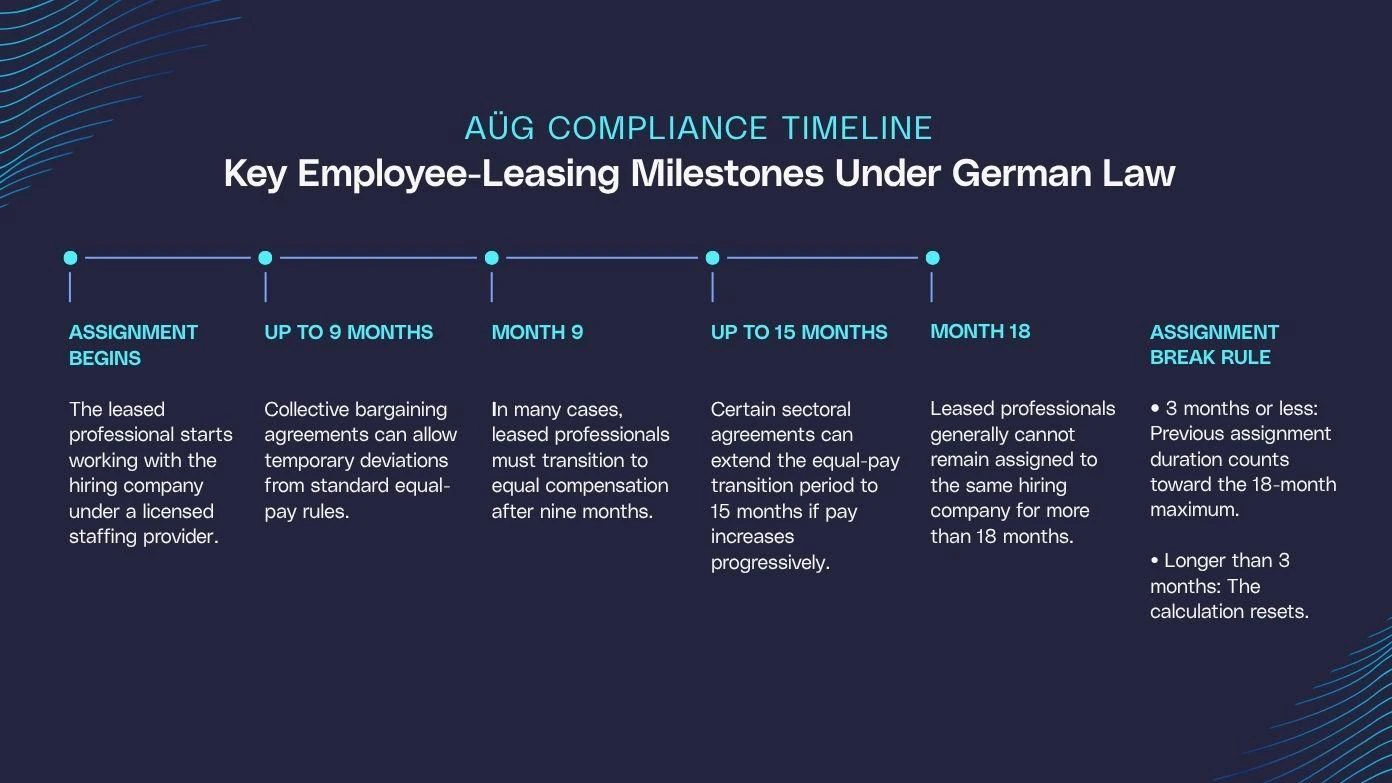
The Überlassungshöchstdauer is a statutory cap on how long a leased worker can stay with the same hiring company. Under the AÜG, a leased professional can't be assigned to the same company for more than 18 consecutive months. That limit follows the professional rather than the role. It doesn't matter if the professional changes roles, departments, or work locations; the 18-month clock keeps running.
To prevent companies from repeatedly restarting short assignment periods, a three-month assignment-break rule applies. Previous assignment periods count toward the 18-month total if the worker returns to the company within three months, even through a different staffing provider. However, if the break lasts longer than three months, the statutory limit resets.
Collective bargaining agreements (Tarifverträge) in certain industries may have different maximum assignment periods. However, because these exceptions are highly specific, you need to check relevant collective agreements before relying on a longer period.
Equal pay and equal treatment
Under the AÜG, leased professionals are generally entitled to the same compensation and working conditions as comparable employees at your company. That means equal pay, working time, breaks, vacation time, and access to certain workplace facilities.
Collective bargaining agreements can allow temporary deviations from equal-pay requirements. However, those deviations generally can't last longer than nine months. Certain sectoral agreements can extend the transition period to 15 months if the pay increases progressively and the arrangement meets statutory requirements.
In many cases, leased professionals must transition to equal compensation after nine months on assignment. You need to understand which collective agreements apply, track the length of each assignment, and ensure compensation and working conditions remain compliant.
Licensing and non-compliance penalties
A valid AÜG license comes with ongoing compliance obligations. Staffing providers need to meet a wide range of financial, operational, and employment-law requirements to obtain and retain a license. These include:
- Sufficient financial resources and liquidity.
- Proper payroll, wage, and social security administration.
- Reliable business management and compliance history.
- Correct employment contracts and assignment documentation.
- Compliance with equal-pay and equal-treatment rules.
- Accurate assignment duration and worker status records.
- Appropriate corporate and registration documents.
Non-compliance can trigger serious penalties. Unauthorized employee leasing, including using a provider that doesn't hold a valid license, and maximum-assignment-period violations can carry fines of up to EUR 30,000. Both the staffing provider and the hiring company can face these fines. Other violations, such as breaching equal-pay and equal-treatment rules, can carry even higher penalties of up to EUR 500,000.
Beyond the financial penalties, invalid employee-leasing arrangements can create employment, tax, and social security issues for all companies involved. Vendor due diligence matters. Before working with a staffing agency or lender, verify that they hold a valid AÜG license and have processes in place to comply with all relevant labor laws in Germany.
Common compliance pitfalls for international employers
There are several German labor law and AÜG risks you need to understand. Some of the biggest involve the working relationship itself. Mismatches between what's in the work contract and a professional's day-to-day reality can create significant compliance problems for your company.
The fallacy of contractor personal limited companies
Using a contractor-owned company doesn't automatically remove AÜG or worker-classification risks. You can engage a professional in Germany through a single-member entity, such as a UK Ltd, US LLC, or German UG. However, the corporate structure doesn't determine their legal status.
German authorities assess how the professional actually performs the work, not just what's reflected in the contract. If the professional effectively functions as an employee and is supplied to work within your organization, the arrangement may constitute employee leasing and may require AÜG authorization.
Corporate structure alone isn't a compliance shield. Carefully review the actual working relationship to determine whether German employment law or AÜG rules apply.
The fiction of employment (Fingiertes Arbeitsverhältnis)
Fingiertes Arbeitsverhältnis is one of the more serious AÜG risks. In certain invalid or unlicensed employee-leasing arrangements, German labor law can treat professionals as if your company employed them directly.
The consequences are significant. Your company could become responsible for employment obligations, backdated wage taxes, social security contributions, and statutory worker protections that you didn't expect to manage directly.
The outcome of this situation isn't automatic. German employment law includes specific exceptions and procedures that can affect whether a deemed employment relationship arises. The safest way to avoid this scenario is to structure the arrangement correctly from the start and verify that the provider holds a valid AÜG license.
Remote and hybrid workplace obligations
AÜG compliance also extends to the leased professionals who work remotely or on a hybrid schedule. German labor law workplace safety requirements apply even when a worker operates outside a traditional office setting.
As the hiring company, you have several occupational health and safety responsibilities during the assignment. Meanwhile, the licensed staffing agency or lender retains its own employer obligations. Remote and hybrid arrangements still need clear processes for workplace safety, risk assessment, and communication.
Benefits of AÜG-compliant hiring
AÜG-compliant hiring gives you more flexibility when building a team in Germany. You can respond to short-term workforce needs while accessing a broad pool of specialized talent. When the arrangement follows AÜG rules, you can focus on operational priorities while the licensed staffing provider manages its responsibilities as the legal employer.
Agile market testing and trialing talent
Using this model to hire professionals in Germany gives you a practical way to tap into the local market without immediately committing to a larger permanent workforce. Bring in specialized professionals, adjust staffing levels as priorities change, and see how professionals perform before making longer-term decisions.
Covering short-term business fluctuations
When your workforce needs change, you can use AÜG-compliant hiring to quickly fill gaps. For example, leased professionals can cover project spikes, employee absences, seasonal demand increases, or unexpected turnover, all without immediately expanding your permanent headcount.
Reduced administrative overhead
Bringing in temporary professionals can create substantial administrative overhead. A licensed staffing provider handles core employer responsibilities, including payroll, wage tax filings, and social security contributions.
Your licensed staffing agency reduces the burden on your HR and finance teams, giving them more time to focus on strategic business priorities.
Applying for an AÜG license vs. working with an employer of record (EOR)
There are two ways to approach employee leasing under the AÜG in Germany. If your company plans to establish its own employee-leasing operation, the entity employing and supplying the workers can apply for an AÜG license. This is more involved than simply obtaining a permit as the end-user company. Alternatively, you can work with a licensed employer of record (EOR).
Applying for your own AÜG license
Obtaining an AÜG license for your company means taking on the responsibilities of a legal employer. You'll need to submit financial, corporate, and operational documents, meet liquidity requirements, and demonstrate compliance with all relevant German employment laws.
Federal Employment Agency fees currently range from EUR 218 to EUR 2,060, depending on the application and level of review. First-time applications generally cost EUR 377. Initial licenses are valid for one year, and providers must apply to extend them. After three consecutive years of licensed operation, a provider can apply for an unlimited license. Licensed providers must also maintain ongoing compliance and can be subject to inspections.
Partnering with a licensed employer of record
An AÜG-licensed EOR functions as the Verleiher, or licensed staffing provider. Working with a licensed EOR avoids the need to build employee-leasing infrastructure internally or manage the licensing yourself. The EOR serves as the legal employer, handling core employer responsibilities, such as payroll, taxes, social security, and employment administration.
You remain the operational supervisor. You can direct a professional's everyday work while the EOR manages the legally mandated employer obligations.
“Partnering with G-P gave us access to the expertise we needed. Having a knowledgeable partner handle German employment compliance meant we could focus on finding the right people, without the constant second-guessing.
Joy Spijkerboer, HR Manager and Finance Coordinator at JANZEN
Comply with German employment law with G-P
Hiring leased professionals in Germany means keeping several moving parts carefully aligned. You need to monitor assignment length to stay within the relevant duration ceilings, follow applicable equal-treatment rules, and comply with all legal requirements of the AÜG license. When working with staffing providers, verify licensing, monitor assignment clocks, and review contractor relationships to stay aligned with German labor law.
G-P EOR gives you a way to manage those requirements without building your own employee-leasing infrastructure or establishing a local entity. G-P holds an AÜG license in Germany and can serve as the legal employer for your new team members there, handling core employer responsibilities while you focus on workforce performance, business continuity, and growth.
Ready to streamline your company's approach to hiring professionals in Germany? Consult a compliance expert or book a demo to see how G-P EOR supports hiring through an AÜG-licensed employment model.
 Frequently asked questions
How long does it take to get an AÜG license?
Germany's federal administration portal lists a typical processing time of approximately three months. The timeline may vary depending on the application's completeness and complexity. Full documentation helps the agency reach a decision faster, while missing information can cause delays.
What are the key sources of German labor law?
German labor law derives from several sources, including federal statutes such as the AÜG, collective bargaining agreements, works agreements, employment contracts, and court decisions. Which rules apply to your company depends on the specific employment arrangement and industry.
What are the penalties for operating without an AÜG license?
Both the staffing provider and the hiring company can face fines of up to EUR 30,000 for unauthorized employee leasing. Certain AÜG violations, including some equal-pay and equal-treatment breaches, can incur financial penalties of up to EUR 500,000. An invalid arrangement can also create employment, tax, and social security consequences.
What are employee vs. contractor rules under German labor law?
German authorities look at how working relationships function in practice instead of relying solely on what's in a contract. They consider factors such as integration into your organization, independence, and the degree of control you exercise over their work to determine whether a professional is an employee or an independent contractor.