






Key takeaways
- Navigating global compliance in 2026: Regulations like the Fair Credit Reporting Act (FCRA) and the General Data Protection Regulation (GDPR) set firm guardrails for how candidate data is collected, used, and protected.
- Accountability in automation: AI streamlines and accelerates the hiring process, but you’re still responsible for making fair hiring decisions.
- How G-P can help: G-P manages risk by combining human expertise with AI-powered compliance guidance.
The rulebook for background checks changes the moment you cross the border.
Each local market has its own regulations, including what employers can ask for, how they can use that information, and when they can conduct a background check.
The process takes on an added layer of complexity with AI-generated resumes and AI screening tools. Now, regulators are tightening oversight of AI hiring systems. For example, New York City’s Local Law 144 requires independent bias audits for AI-powered employment decision tools.
This guide breaks down everything you need to know about international background checks, what information you can screen for, local privacy laws, screening restrictions, and how you can manage global screening more efficiently.
When to run an international background check
First, determine whether an international background check is necessary before screening a candidate. The type of background check you conduct should relate to the requirements of the role and the local laws where the candidate will work.
What type of information can a background check provide?
- Employment history verification
- Education and credential verification
- Professional license verification
- Identity verification
- Criminal record checks (where legally permitted)
- Credit history checks (for certain roles and jurisdictions)
- Driving record checks (for positions that require driving)
Challenges of international background checks
International background checks are often more challenging because no single system collects and verifies a candidate’s information. Records are typically kept by different educational institutions, government agencies, employers, courts, and other organizations. Collecting this data from different sources isn’t always straightforward.
Your team may also face different requirements related to data privacy, consent from the candidate, criminal record checks, and record retention. Keep in mind that a process that works in one country may not work in another.
Challenges when conducting a background check for international employees include:
- Different legal requirements: Each country has its own rules for carrying out background screenings.
- Scattered records: Education, employment, and court records often come from different sources.
- Privacy restrictions: Local privacy laws have limitations on how you can use, store, collect, and transfer a candidate’s information.
- Long turnaround times: Collecting and verifying a candidate’s information across different countries and jurisdictions takes longer than domestic screenings.
- Inconsistent processes: Using different procedures in each country can make global hiring a more challenging process.
- Candidate experience: Requests for personal information, such as court documents, may create friction with candidates during the hiring process.
Given these challenges, a standardized global procedure can streamline the process. However, that standardized procedure should take local requirements and privacy laws into account.
Why global employee screening is a dual mandate for HR
Global teams manage two hiring priorities at the same time. They must protect the candidate experience while mitigating compliance and workforce risks across multiple regions.
Balancing risk mitigation and hiring speed
A disjointed screening process creates hiring bottlenecks. Top candidates get multiple offers and won’t wait for slow hiring decisions. Delays also waste recruiter time and can damage your brand reputation.
Ensuring credential and education validity
Verifying that a candidate's education records and professional licenses match their resume is a basic hiring step.
Some fraudulent organizations, commonly called diploma mills, sell fake degrees and credentials without providing legitimate education or training. These risks are harder to manage in a global setting because there’s no centralized international education verification system.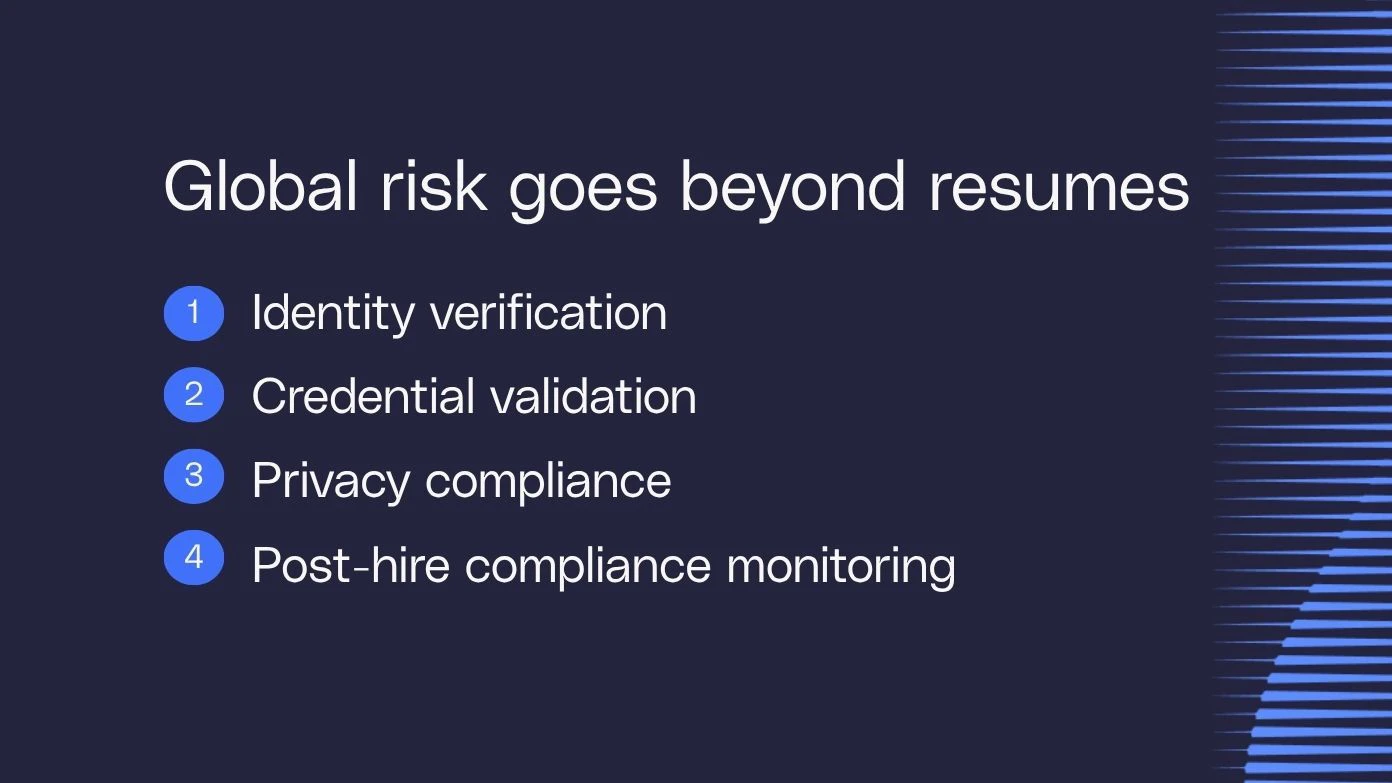
2026 global compliance framework
Compliant global hiring starts with a screening process that considers local privacy laws, labor regulations, and candidate protections. Because these requirements vary by country, your team should confirm them before conducting a background check.
The Fair Credit Reporting Act (FCRA) in the U.S.
The FCRA places strict rules around transparency and candidate consent in the U.S.
Before conducting a background check, employers must:
- Provide a clear and conspicuous standalone disclosure.
- Get the candidate’s written authorization.
- Keep disclosure language separate from the job application.
The FCRA also requires a formal adverse action process when screening results may affect a hiring decision.
This process typically includes:
- A pre-adverse action notice
- A copy of the background report
- A summary of candidates’ rights
- A waiting period
- A final adverse action notice
This process gives candidates time to respond to inaccurate or incomplete information before a final decision is made.
GDPR and data privacy in Europe
European privacy laws place tight limits on how you collect and manage candidate data.
Under GDPR, background checks must be necessary and proportionate to the role. Your team should collect only information that directly relates to the position.
Depending on the circumstances, GDPR also gives candidates stronger control over their personal data, including:
- The right to access their background reports
- The right to request data deletion in certain cases
- Protections around how employers store and transfer data
Regional restrictions on criminal checks
Criminal background checks are handled differently worldwide. Some countries place strict limits on when employers can ask about criminal history and how that information influences hiring decisions.
In the U.S., many states enforce “ban the box laws,” which prohibit questions about criminal history until later in the hiring process, so candidates are evaluated on qualifications first. Some countries take this a step further. In Argentina, employers can’t directly request criminal background checks from candidates. Candidates can only provide that information voluntarily.
An AI-powered global HR agent like G-P Gia™ can support your HR and legal teams with real-time guidance on local compliance obligations, anti-discrimination laws, and hiring restrictions across 50 countries and all 50 U.S. states.
Step-by-step: Conducting a compliant international background check
Your team needs screening workflows that balance identity verification, candidates’ privacy, and local compliance requirements across different countries. Here’s where to start.
Step 1: Research local labor laws and timing
Timing is everything. Some countries allow screening during the application process, while others require employers to wait until after making a conditional offer.
Make sure to check:
- When screening is legally allowed
- What candidate consent rules exist in your target region
Starting background checks too early can trigger compliance risks before the hiring process even begins.
Step 2: Get candidate consent and digital identity verification (DIV)
Once your team confirms that a screening is permitted, follow the candidate consent requirements before conducting a background check.
Companies have started to add Digital Identity Verification (DIV) at this stage to reduce synthetic identity fraud.
Modern DIV tools use:
- Document authentication
- Digital identity wallets
- Biometric verification, such as facial scans
These checks allow you to verify that candidates are who they claim to be before you move forward in the hiring process.
Step 3: Source reliable in-country data
Global background screenings rely on local data sources instead of one centralized global database. Court records, education verification, and employment data are often fragmented across different agencies and regions. These fragmented systems slow turnaround times and make global screening harder to standardize. You may need to work with local verification providers and navigate country-specific reporting systems to get accurate information.
Step 4: Review and document findings
Your team must review screening results carefully to avoid discriminatory hiring decisions. Many countries restrict blanket exclusions tied to criminal history.
Instead, HR teams should conduct individualized assessments that consider whether the finding relates directly to the role and whether the candidate has an opportunity to respond.
Real-world example: Meet Nelly.
Nelly is hiring a finance manager in Argentina for a remote-first team. Since employers in Argentina generally can't obtain criminal records, Nelly’s team compliantly asks the candidate (Andrea) to voluntarily provide her criminal record certificate.
Andrea’s report reveals a minor shoplifting offense from more than 12 years ago.
Instead of automatically rejecting the candidate, Nelly’s team reviews:
- Whether the offense directly relates to the role
- How long ago the incident occurred
- Whether local hiring laws restrict the use of that information
Because the offense doesn’t relate to financial misconduct, happened many years earlier, and falls outside the relevance window for the role, Nelly’s team continues the hiring process instead of disqualifying the candidate automatically.
This example illustrates why a global background check requires context. Clear documentation creates a stronger compliance record if hiring decisions are later challenged.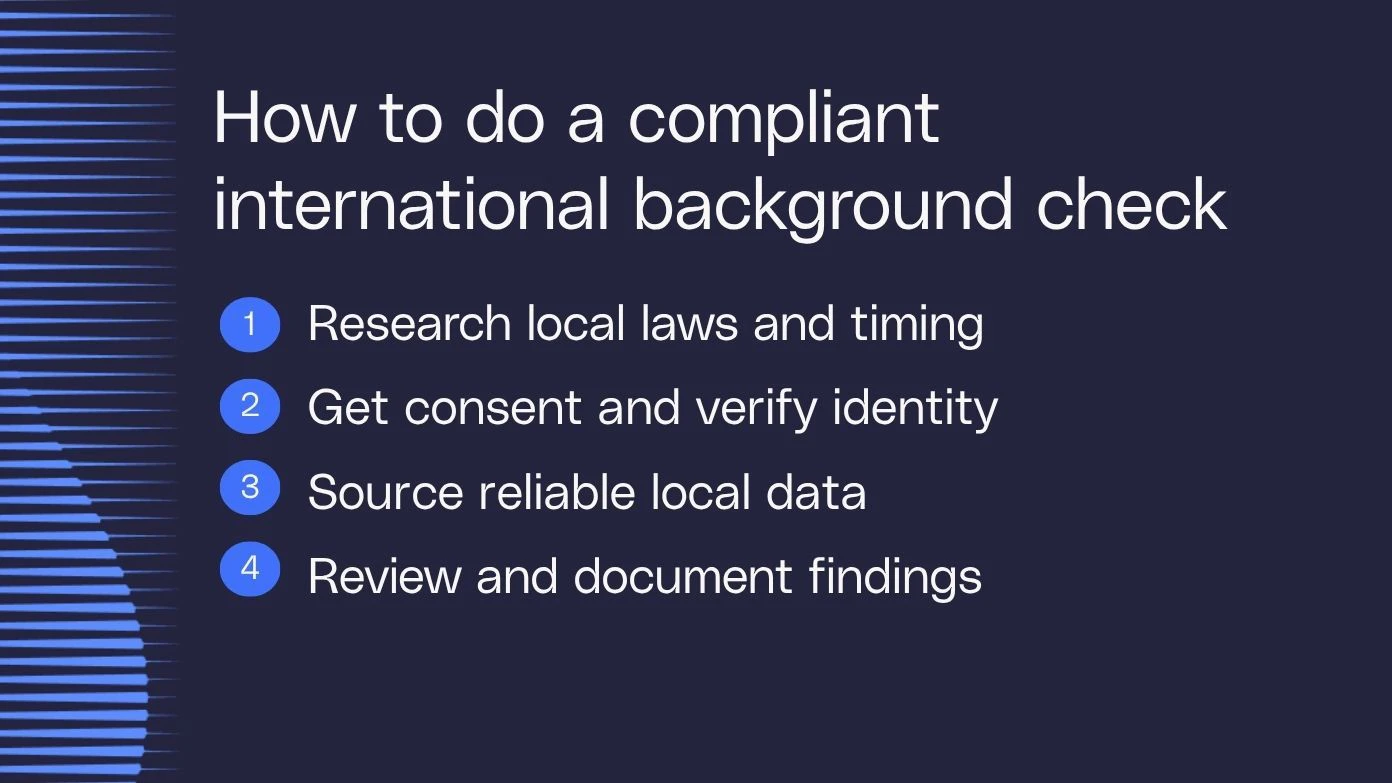
The role of AI and automation in global background screening
Manual background checks for international employees create administrative bottlenecks, especially if your team is hiring across multiple countries. AI-driven automation eases that friction by integrating screening requests directly into hiring workflows.
This allows your team to:
- Reduce manual data entry
- Streamline screening workflows
- Track candidates’ progress across regions more efficiently
- Identify tasks that require additional review
Use G-P Gia™ for real-time compliance guidance
Global screening laws continue to evolve across jurisdictions. Your HR and legal teams need up-to-date guidance to stay aligned with changing hiring restrictions.
This is where agentic AI tools like Gia come in.
Gia helps you:
- Access expert-verified compliance guidance across 50 countries and all 50 U.S. states.
- Get real-time alerts on changing labor laws.
- Generate locally compliant contracts and HR documents.
Gia reduces administrative work and cuts compliance management time by up to 95%.
Ensuring algorithmic fairness
Regulations like New York City’s Local Law 144 and EEOC guidance continue to increase scrutiny of AI-driven hiring technologies. This means employers are responsible for preventing discriminatory hiring outcomes tied to automated systems. It’s best practice to:
- Regularly audit automated screening tools to identify bias
- Keep a human-in-the-loop for all final employment decisions
- Keep documents on how AI automated tools are used
- Review results for any inconsistencies
AI improves efficiency, but humans still need to review hiring outcomes to ensure fairness and consistency. Gia’s responses are 10x better than the AI industry standard.
Built on a proprietary knowledge base of over 100,000 legally vetted articles and 1,500+ government sources, guidance is meticulously reviewed by HR and legal experts. This human-in-the-loop approach ensures all content is G-P Verified, so users can trust Gia’s answers, the first and every time.
How G-P supports global hiring
|
OFAC checks |
Guidance on regional hiring laws |
Centralized workforce management |
|
G-P performs integrated Office of Foreign Assets Control (OFAC) checks directly within the platform. |
Gia provides expert real-time guidance on local compliance requirements and hiring restrictions. |
G-P centralizes global hiring, compliance, and workforce management processes in one platform. |
|
This means your team can flag potential compliance risks early without pausing hiring workflows. |
Your team can confidently navigate changing privacy laws and regional screening rules. |
This gives your team better visibility across international operations and reduces administrative complexity. |
“In partnering with G-P, we found a reliable ally that streamlines our global operations. G-P's extensive global hiring expertise facilitates smooth navigation through complex regulatory environments.” Mark Lee, CFO and COO at ProtoPie
Build your global team with G-P
G-P removes the legal, administrative, and compliance barriers that come with global employment. Driven by advanced AI-powered products — EOR, Contractor, and Gia — our Global Employment Platform gives the tools (and speed) you need to manage the full employee life cycle.
Build your global team in 180+ countries today. [Book a demo]
 Frequently asked questions
How long does an international background check take?
Domestic checks may take 2–7 days, while international screenings typically take 2–4 weeks.
Are criminal background checks allowed in all countries?
No. Countries like Argentina, Singapore, Japan, and parts of the EU prohibit employers from performing criminal checks directly. In these cases, the employer may ask the candidate to voluntarily share their criminal record certificate.
What's the 7-year look-back rule?
Under the Fair Credit Reporting Act (FCRA), consumer reporting agencies are generally restricted from reporting negative information older than seven years. This restriction applies to roles paying less than USD 75,000.
Can I use AI to score background check results?
Yes, but you should make sure that AI-driven scoring complies with transparency and employment discrimination requirements in your jurisdiction. To prevent discriminatory outcomes, these processes must include human verification and oversight.
Do I need a separate background check for contractors?
Some countries have specific laws or regulations that require background checks for certain roles (e.g., working with children in Finland, regulated professions in the UAE), regardless of whether the professional is an employee or a contractor.


