


Key takeaways
- HR AI agents help you scale efficiently: You can hire faster and stay compliant across jurisdictions.
- AI agents automate core HR tasks: These include writing compliant job descriptions, preparing interview questions, drafting onboarding materials, and managing employee workflows.
- G-P Gia™ is a trusted AI HR agent: Gia uses an extensive knowledge base of government sources to deliver reliable HR guidance across 50 countries and all 50 U.S. states.
In 2026, HR teams are pressured to deliver more with tighter budgets. AI is a strategic tool that can cut costs and simplify global workforce management. But picking the right AI agents for human resources can be tricky.
Let's take a closer look at how agentic AI can extend your HR team's capacity and ensure smooth operations across new markets.
What are AI agents for HR?
In HR, AI agents are technology systems that automate HR tasks. These systems are intelligent assistants that handle routine work so your team can focus on strategic initiatives. HR AI agents handle core tasks, such as:
- Writing compliant job descriptions tailored to role, location, and level
- Preparing interview questions aligned with competencies and local labor laws
- Drafting onboarding checklists, employee contracts, and policy communications
- Engaging employees in workflows for prehire, onboarding, or training, with automated follow-ups
G-P Gia™ is an AI-powered global HR agent. With a proprietary knowledge base of 100,000+ vetted articles and 1,500+ government sources, Gia is a reliable AI agent for HR. It can generate localized employment contracts, handbooks, and offer letters across 50 countries and all 50 U.S. states in minutes.
Learn more about Gia's HR document capabilities
Generative AI vs. agentic AI in HR
Not all AI is the same. The terms "generative AI" and "agentic AI" are often used interchangeably, but they describe different functions. One is built to create, and the other is built to act. Let’s break down the differences:
- Gen AI in HR: Passive text creation, prompt-dependent, and prone to hallucinations.
- Agentic AI for HR: Multi-step reasoning, active workflow orchestration across HRIS/ATS/payroll engines, and legal-grade validation.
Benefits of HR AI agents for global teams
HR AI agents reshape how you manage global teams. You get faster processes, better accuracy, and consistent employee experiences across locations. These agents help you build a future-ready workforce and stay compliant as your company grows.
Benefit 1: Streamline onboarding and payroll
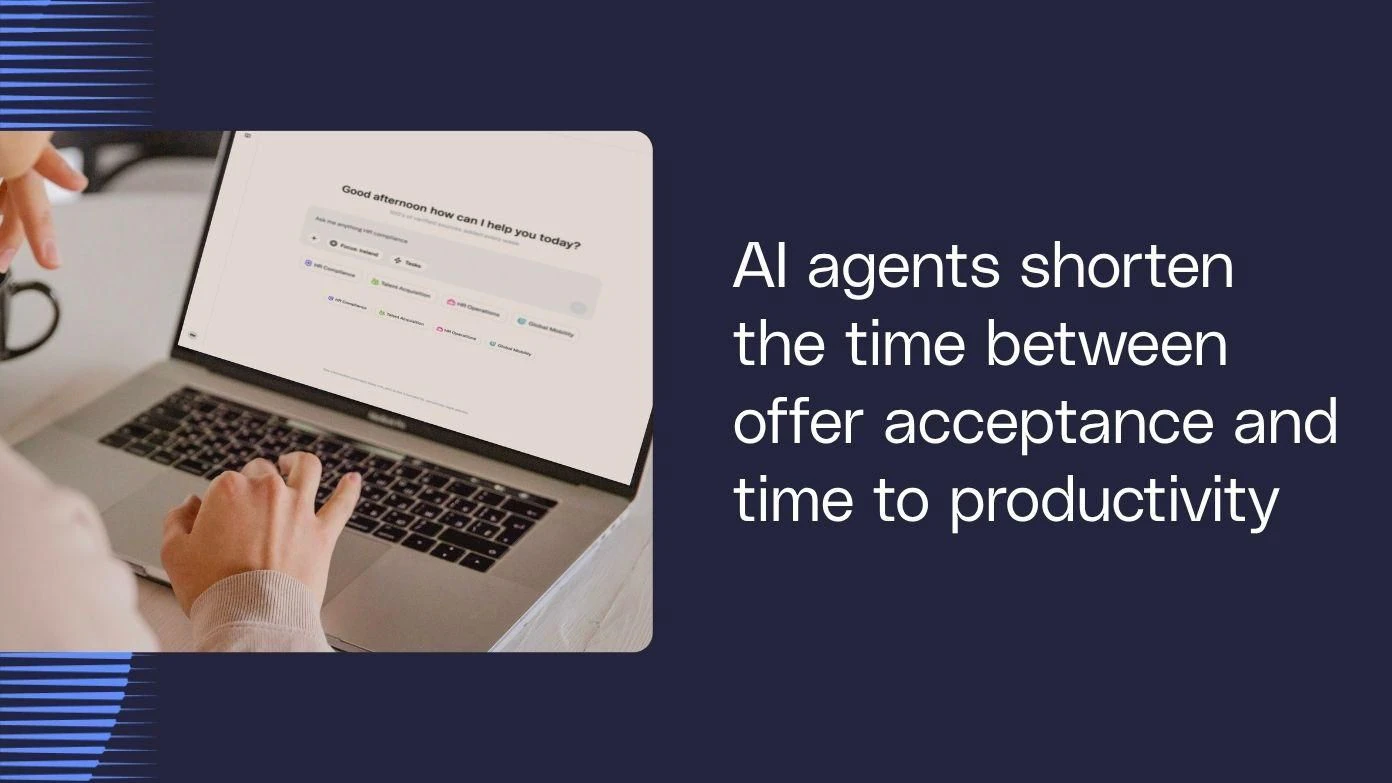
AI agents shorten the time between offer acceptance and time to productivity. New hires increase their productivity by up to 50% following standardized onboarding. AI tools generate localized documents, streamline workflows, and keep new hires informed throughout the process by bringing order to scattered tasks.
AI platforms prepare role-specific onboarding steps, stick to checklists, and ensure your teams meet local regulations. This minimizes delays and removes manual handoffs. It also creates clear paths for payroll, benefits, and internal system access. When each step follows a defined process, you see fewer errors.
With global hiring, payroll accuracy is mission-critical. AI agents identify the information you need to keep documents current and minimize downstream inconsistencies early, protecting employee trust.
G-P is the world’s first agentic Global Employment Platform. The Global Compliance Engine powers our platform and automatically applies real-time local labor laws and compliance requirements to every employment workflow — so you can move from offer to onboarding 87% faster.
“We used to spend hours combing through documentation. Now, we get concise answers from a quick prompt."
Benefit 2: Ensure compliance and risk management
Regulations differ between countries, and HR teams must quickly respond to changes to stay consistent across legal environments. AI agents track obligations, update processes as rules change, and flag outdated content for immediate action. With these systems in place, you minimize the risk of noncompliance.
With an AI agent, you create a reliable foundation for audits. AI-managed workflows deliver clear documentation and consistent records, giving you steady oversight in HR, legal, and finance departments.
With Gia’s automated compliance checks and up-to-date information, tasks that typically take days are completed in minutes — cutting the time and cost of compliance by up to 95%.
Benefit 3: Improve employee experience and engagement
New employees appreciate clarity and support. AI agents give each hire clear information and standardized documents. They offer guidance at each stage of the employee lifecycle, simplify complex tasks, and keep communication consistent across global teams. This lowers confusion and increases confidence in your company's processes.
Reduced administrative friction creates space for higher-value work. Managers can spend more time supporting team members, while HR focuses on strategy. Your teams benefit from a stronger culture and clearer expectations, regardless of where you operate.
You may run into a few speed bumps when you adopt HR AI agents. Many of these are easy to solve with clear rules, strong data inputs, and steady review.
- Data privacy and security: Employee and benefit data is sensitive. To protect team members' privacy, you need an AI system certified to global security standards that can implement role-based access and encryption and maintain audit logs.
- Integration with existing systems: You may already have an applicant tracking system, payroll, and onboarding tools in place. Choose an AI agent that connects to these platforms, uses APIs or workflows, and shares data without silos.
- Ensuring human oversight: AI agents automate, but they don't replace your valuable HR, finance, or legal team. Define workflows that let team members review outputs, manage exceptions, and monitor results.
- Change management: Adopting AI agents changes roles, processes, and corporate culture. You can overcome hesitations by involving HR stakeholders early, clarifying how tasks are shifting, sharing benefits, and providing training on the new technology.
- Quality of data and definitions: Establish role competencies and have reliable local data so AI agents can generate precise and relevant outputs.
Best practices for rolling out an HR AI agent
Successful HR AI adoption needs clear planning, as 30% of generative AI pilots fail. Define your company's goals, prepare your teams, and create strong governance processes. A structured rollout helps with reliable performance and positive adoption, delivering measurable results.
Identify where your teams need support. Start by focusing on tasks that take up the most time or carry the most risk. A narrow starting point makes it easier to refine the process before expanding. It's also crucial to get a service provider with global employment experience, secure infrastructure, and strong compliance practices.
A pilot phase can help you refine your program. Focus on a few countries and a defined set of tasks. Then measure the results, gather feedback, and adjust your workflows before expanding. Once the pilot performs to expectations, scale the system. Expand coverage across jurisdictions, connect more HR tasks, and integrate more workflows. Ongoing monitoring keeps the system effective.
How to best use AI in HR?
Recruiting and talent acquisition
- Resume matching: Scan and rank incoming applications based on skill sets rather than basic keyword counts.
- Content generation: Draft inclusive job descriptions, interview question banks, and initial outreach emails.
- Scheduling automation: Coordinate interview times across candidate and hiring manager calendars without manual back-and-forth.
Employee experience and support
- 24/7 policy chatbots: Provide instant, verified answers regarding PTO balances, benefits packages, and internal guidelines.
- Onboarding guidance: Guide new hires seamlessly through document checklists, compliance requirements, and role-specific training materials.
Retention and performance management
- Sentiment tracking: Analyze employee pulse surveys and feedback data to spot early indicators of disengagement.
- Review assistance: Help managers draft constructive, data-informed performance summaries while mitigating recency bias.
- Skills gap analysis: Compare current workforce capabilities against future business targets to direct internal upskilling.
2026 HR-AI trends
As AI integrates more with general workflows, HR teams are moving from task execution to a strategic partnership. Now, HR professionals guide policies, culture, and talent strategy, while AI agents manage scale and routine. HR AI agents support this transformation by delivering new capabilities across global hiring, onboarding, development, and compliance.
Emerging trends and innovations include:
- AI agents working in hyper-local labor market intelligence, analyzing regional supply and skills.
- Agents that do scenario planning for cross-border workforce models, simulating how hiring, compensation, and compliance variables change across regions.
- Co-pilot agents for career mobility and internal talent scouting, mentoring cross-border moves, and managing relocation logistics.
- Performance management agents that will further lessen HR tasks and deliver information to team leads for feedback processes.
How agentic AI is transforming the HRBP role
Addressing compliance and data security with AI
AI can strengthen your global compliance strategy and protect sensitive HR data when paired with the right frameworks and partner. G-P backs this responsibility through certified controls, secure workflows, and a compliance-first approach. We’re ISO 27001 certified. This certification ensures secure data handling and gives your teams a trusted framework that extends to Gia.
“With Gia, we’ve cut compliance costs significantly. If I need to write a policy, I plug in the parameters and jurisdiction, and Gia creates it instantly. Knowing that Gia’s guidance is based on expert-reviewed, legally vetted sources gives me peace of mind.” - Katy Burris, Senior Director of Human Resources
How to choose an agentic AI for HR
Key selection criteria:
- Define use cases vs. Workflows: See if you need dynamic agentic reasoning or a fixed automation workflow. Use structured workflows for high-volume, low-risk, or strict rule-based tasks like basic headcount reporting, and save true agentic AI for complex, multi-step orchestration like cross-system employee onboarding or personalized career pathing.
- Confirm integration and tool access: Ensure the agent connects natively via secure APIs to your core human capital management systems (like SAP SuccessFactors or Workday) and communication apps, allowing it to autonomously pull data, route approvals, and update records safely.
- Assess guardrails and human oversight: Require built-in decision boundaries, role-based access controls, and mandatory human checkpoints for sensitive, high-stakes outcomes like hiring rejections, compensation changes, or performance promotions.
- Ask about bias detection and compliance: Demand proof of regular fairness audits, explainable reasoning logs, and strict alignment with regional regulations like the EU AI Act or local data privacy laws.
- Start with a pilot and measure value: Start with a focused pilot on a single sub-process — such as an internal mobility matching assistant or policy Q&A — to measure time saved and cost efficiency before scaling enterprise-wide.
How Gia supports global HR teams
Gia is agentic AI that gives reliable, up-to-date employment law information across 50 countries and 50 U.S. states. Gia uses a range of data sources, including our internal resources, attorney-created digests, and government publications. Our patent-pending Gen AI RAG approach dives deep into data, providing nuanced and relevant insights that go beyond surface-level information. 
In short, here's how Gia supports global HR teams:
- Instant compliance answers
- Immediate HR documents, tailored to specific needs
- Transformative policy management
- Legal-grade reasoning and guidance
How Herb Pharm scaled with Gia
Herb Pharm was bogged down by multi-jurisdictional compliance demands. Their HR team relied on a patchwork of manual resources. These limited resources for contract reviews, policy creation, and legal research were time-consuming and expensive.
They turned to Gia to centralize and streamline HR compliance processes by:
- Immediately generating employment policies relevant to specific jurisdictions
- Comparing laws across states with Gia's jurisdiction-comparison feature
- Accessing a knowledge base of legally vetted articles and government sources to make data-driven decisions
In two months, Herb Pharm saved hours of work and saved thousands in legal fees. Their HR team shifted attention from reactive compliance to strategic priorities, like employee engagement and retention.
See Gia in action
AI agents are reshaping HR practices around the world. Innovative solutions like Gia can streamline HR operations, ensure compliance, and allow your teams to focus on strategic growth.
Through patent-pending AI technology, Gia acts as an extension of your HR team and gives you expert-vetted guidance with clear source citations so you can assess the reliability of its responses.
Get started today and try free for 14 days.
FAQs
How does Gia ensure data privacy?
Your data is protected with industry-leading encryption both at rest and in transit to prevent unauthorized access. User data remains confidential and isn't shared with or used by third parties. Gia adheres to data privacy regulations and guidelines, with data handling governed by G-P's Terms and Privacy Policy.
What are the limitations of AI agents in HR?
AI agents support structured tasks but can't replace human judgment. They require oversight, training, and accurate input data, relying heavily on your existing internal processes. Furthermore, AI agents aren't a substitute for legal advice, and organizations should always consult licensed legal counsel in their jurisdiction.
How does AI improve global onboarding?
AI enhances onboarding by establishing structured workflows, creating localized documentation, and keeping new hires informed throughout the process. This leads to faster processing times, fewer administrative errors, and a uniform onboarding experience across all countries.