





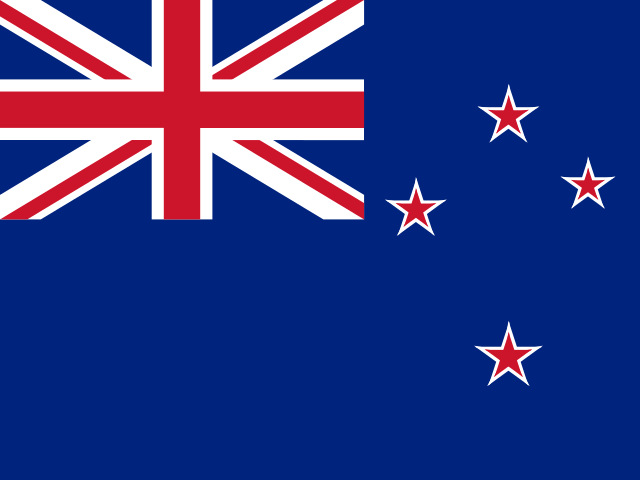
New Zealand offers a business-friendly environment with a skilled pool of English-speaking talent to choose from. Hiring in this market gives you access to new perspectives and efficiencies that fuel innovation, but the country’s employment regulations require a deep understanding of local legislation.
That’s where a New Zealand employer of record (EOR), like G-P EOR, comes in. An EOR New Zealand enables global hiring without needing a local entity.
As a global EOR, G-P manages everything, from payroll and contracts to severance and termination. With G-P, you can hire global talent in 180+ countries, including New Zealand, quickly and easily.
Simplify hiring in New Zealand with an employer of record
When hiring in New Zealand, an EOR like G-P acts as the legal employer for your global team members, managing all aspects of employment on your behalf.
A New Zealand EOR drafts compliant employment contracts, processes payroll with accurate tax deductions, administers benefits, manages leave, and more. This allows you to focus on your business while the EOR handles the day-to-day compliance complexities.
The EOR hiring process in New Zealand:
- Partner with a global employment expert. Choose an EOR with deep expertise in New Zealand as they’ll guide you through the local legal landscape.
- Source your ideal candidate. You find the best talent, and the EOR handles the rest.
- Generate a compliant employment contract. Your EOR drafts a locally compliant contract in line with New Zealand’s labor laws, including salary, working hours, and notice periods.
- Onboard and manage your team. The EOR manages the entire employment lifecycle. This includes registering your team members with New Zealand’s tax authorities and social security system, payroll, and administering benefits.
Employment contracts in New Zealand
Employers must give employees a written contract with essential employment terms, including compensation, benefits, and termination requirements. It’s best practice for the offer letter and contract to be in English, and compensation amounts must be in New Zealand dollars (NZD).
An employer of record in New Zealand drafts contracts that comply with New Zealand’s labor law. This protects your business and gives your team clarity.
Leave entitlements in New Zealand
Working hours in New Zealand
The standard workweek in New Zealand is 40 hours, but this must be agreed to in the employment contract, as there is no legal maximum. Overtime isn’t paid at a higher rate unless it’s in the employment agreement, or it’s on a public holiday. Any hours worked beyond the agreed amount are considered overtime. We recommend clarifying these terms in the contract.
Public holidays in New Zealand
Employees in New Zealand are entitled to 11 paid public holidays, plus one regional anniversary day based on where they work. The national public holidays are:
- New Year's Day
- Day after New Year's Day
- Waitangi Day
- Good Friday
- Easter Monday
- Anzac Day
- King's Birthday
- Matariki
- Labor Day
- Christmas Day
- Boxing Day
Vacation days in New Zealand
Employees get at least four weeks’ paid annual leave after 12 months of continuous service. This leave is normally taken at a time that works for the employer and employee.
In some cases, employees are paid 8% of their gross pay instead of getting paid annual leave. This “pay-as-you-go” holiday pay only applies if the employee:
- Has a fixed-term contract of less than 12 months
- Works so irregularly that it’s impossible to give them four weeks’ annual leave
New Zealand’s Holidays Act of 2003 governs employee leave, but new employment leave legislation is in the pipeline.
Sick leave in New Zealand
Employees get 10 days of annual paid sick leave after six months of continuous employment. They can use this leave to care for themselves, partners and children, or other dependents. Unused sick leave can be carried over and built up to a maximum of 20 days, unless the employment agreement allows more.
Parental leave in New Zealand
New Zealand has a comprehensive parental leave system, including primary carer leave, extended leave, and partner's leave.
Eligible primary carers get 26 weeks (six months) of government-funded parental leave payments. This is a weekly payment for taking care of a new baby or a child under six and is separate from parental leave offered by employers.
Job-protected parental leave can be up to 52 weeks. An employee on job-protected parental leave has the right to return to their original role or a similar position. This leave can be made up of 26 weeks of primary carer leave, plus up to 26 weeks of extended leave. Extended leave is usually unpaid. An employee only gets parental leave payments during extended leave if they take less than 26 weeks of primary carer leave.
Some employers offer extra payments. These details should be included in employment agreements, for example:
- Top-up payments while an employee gets government parental leave payments
- Payments after the parental leave payments end
- A one-off payment when an employee returns to work or after a period of time
Employees can get up to two weeks of unpaid partner’s leave to support their partner during pregnancy or while caring for a child under six. Special leave allows pregnant employees to take up to 10 days of unpaid leave for pregnancy-related reasons, such as attending medical appointments, scans, or prenatal classes.
A New Zealand EOR handles the complexities of parental leave entitlements and applications, so that you stay compliant and your team members are supported.
Other leave in New Zealand
By law, employers must also provide other leave types, including:
- Bereavement leave: Paid leave following the death of a close family member. Employees are entitled to three days of paid leave per bereavement for immediate family members, and one day for someone else if the employer agrees. Employees usually need six months of continuous employment or an average of 10 hours per week over six months to qualify for this leave.
- Family violence leave: Up to 10 days of paid leave per year for employees affected by family violence. Eligibility is the same as for bereavement leave, and unused leave doesn’t carry over.
How an employer of record in New Zealand helps manage leave entitlements
Partnering with a New Zealand EOR simplifies leave management. An EOR New Zealand ensures you comply with labor laws applying to working hours, public holidays, and several other types of leave.
Benefits and compensation in New Zealand
Health insurance in New Zealand
New Zealand has a universal public healthcare system covering citizens, permanent residents, and holders of work visas valid for two years or more. While public healthcare is robust, offering supplementary private health insurance gives faster access to specialist services. This is a common practice to attract and retain top talent.
Retirement savings in New Zealand
Employers must enroll employees aged 18–64 who are New Zealand citizens or residents in the KiwiSaver retirement savings scheme. Employees can opt out, but employers must contribute at least 3% of the employee’s gross pay if the employee is contributing.
The minimum employer and employee contributions will increase to 3.5% on April 1, 2026, and 4% on April 1, 2028.
Supplementary benefits and bonuses in New Zealand
Employers offer perks beyond the legal minimums to create competitive benefits packages. These can include:
- Private medical, dental, and life insurance
- Additional employer contributions to KiwiSaver
- Wellness allowances or gym memberships
- Flexible working arrangements
- Professional development budgets
Performance-based bonuses are common but not legally required. These are typically tied to individual, team, or company performance outlined in the employment agreement. Bonuses are considered part of an employee's earnings and are taxed.
How an employer of record helps with benefits in New Zealand
A New Zealand employer of record makes sure all compensation and benefits — including bonuses and KiwiSaver contributions — meet labor law requirements.
An EOR manages benefits administration so you can offer attractive packages that align with employee expectations.
Termination and severance in New Zealand
Employment agreements must include a plain-language explanation on how to resolve employment relationship problems, including:
- The 90-day period for raising a personal grievance
- The 12-month period for raising a sexual harassment grievance
- The three-year window to file with the Employment Relations Authority
There’s no legal requirement for redundancy or severance pay, unless included in the employment agreement.
A New Zealand employer of record ensures compliance during offboarding and termination by managing these processes according to local law.
Payroll and payroll taxes in New Zealand
Employers withhold and remit pay-as-you-earn (PAYE) income tax, Accident Compensation Corporation (ACC) levies, and KiwiSaver retirement contributions. Income tax rates are progressive, based on how much you earn, ranging from 10.5–39%. An ACC Earners’ Levy, which helps cover costs if someone gets hurt in an accident outside of work is deducted via PAYE.
An EOR handles all payroll calculations and payments to the Inland Revenue Department (IRD), ensuring your team is paid accurately and on time. This includes withholding and remitting taxes from employee salaries through PAYE, ACC levies, and KiwiSaver contributions.
Choosing the right EOR in New Zealand
When partnering with an employer of record in New Zealand, consider the following for compliant and hassle-free global employment:
- Compliance expertise: Your EOR must have a deep understanding of New Zealand's employment laws, including the Employment Relations Act 2000 and the complex Holidays Act 2003. A New Zealand EOR proactively manages changes to ensure ongoing compliance.
- Comprehensive service offering: A best-in-class EOR should manage all aspects of employment, including payroll, taxes, benefits, leave, and offboarding.
- Dedicated support and local knowledge: Access to a dedicated team with local knowledge in New Zealand is invaluable. This ensures you get accurate, trusted advice tailored to the local context.
- Technological capabilities: Confirm that the EOR integrates with your existing HCM, PEO, or payroll systems to avoid operational delays.
- Reputation and industry leadership: Research the EOR's market reputation. G-P is the recognized leader in global employment and the #1 EOR according to all industry analyst reports. Customer testimonials and case studies are also important when choosing an EOR.
- Scalability and flexibility: Look for an EOR that supports both your current hiring needs and future growth. Their products and services should be scalable to match your business's expansion, whether you're hiring one employee or an entire team.
- Transparent, flat-rate pricing: Evaluate total cost predictability rather than low base rates. Look for standard, clear pricing models. Compare pricing structures carefully, as some EORs use percentage-of-payroll models that penalize high earners. Flat-rate pricing ensures long-term operating budget accuracy. The G-P EOR starting price of USD $599 monthly gives you full access to the G-P Global Employment Platform. We use a flat platform fee rather than charging a percentage of payroll.
Use G-P EOR for global hiring in New Zealand
G-P EOR is the award-winning, AI-enabled global hiring solution that empowers startups, SMBs, and enterprise businesses to build global teams with ease. Onboard, manage, and pay top talent in over 180 countries in minutes, without the complexity of entity setup.
G-P EOR is the preferred partner for leading HCM, PEO, and payroll platforms. Bring your workforce data together in one place to maintain existing workflows while keeping consistent and accurate data across your integrated systems.
Request a proposal to start hiring in New Zealand today.
FAQs
When should an employer use a New Zealand EOR instead of setting up a local entity?
Employers should use an EOR to hire in New Zealand quickly without establishing a local company. This model works best when testing the market or hiring a small team. The EOR manages all local compliance, payroll, and HR obligations to reduce administrative burden and risk.
Is an EOR cost-effective for a startup hiring one or two team members?
An EOR provides a far more cost-effective path than managing global compliance through internal teams or expensive external counsel. For a scaling company, setting up a legal entity often costs tens of thousands of dollars. G-P EOR offers flat-rate platform pricing starting at USD 599 per month.
Use our EOR vs. entity cost calculator to see how much your business can save.
What should startups look for in EOR solutions?
Startups should look for EOR solutions with clear cost models. User-friendly platforms, dependable customer support, and proven track records of compliant hiring are also crucial.
What criteria should employers use to select a compliant EOR provider in New Zealand?
Companies should choose an EOR with a strong compliance record, deep expertise in New Zealand employment law, and robust payroll systems. Look for transparent contracts and clear processes for handling PAYE, KiwiSaver, and employment agreements. The provider must offer responsive support and a clear allocation of responsibilities.
How does an EOR ensure minimum wage compliance in New Zealand?
An EOR pays supported team members at least the current New Zealand minimum wage. As of April 2025, this rate equals NZD 23.50 per hour. The EOR monitors wage rates so talent pay never falls below the legal minimum.
What are the PAYE and payroll withholding obligations for an EOR?
An EOR must register as an employer with Inland Revenue. The EOR deducts Pay As You Earn (PAYE) tax, Accident Compensation Corporation (ACC) levies, KiwiSaver, and other statutory withholdings from talent pay. The EOR remits these funds to the Inland Revenue Department (IRD) on time. It also files employment information for each payday within two working days.