








With a strong economy and reputation as a stable “safe haven,” Switzerland is an attractive hiring destination for global companies. But you need local know-how to navigate the country’s active unions and complex labor laws.
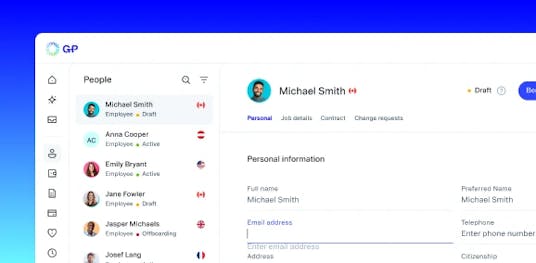
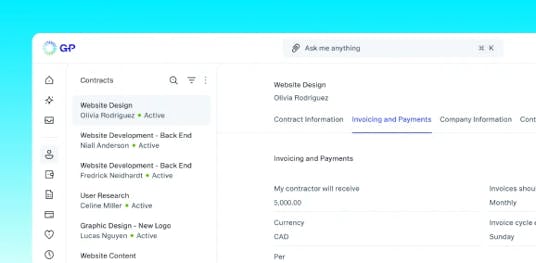
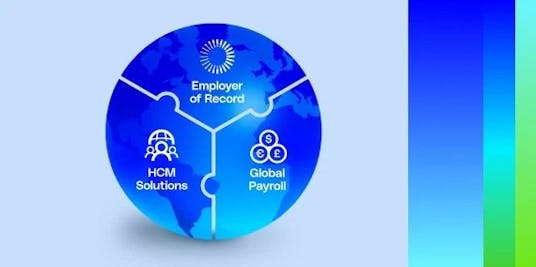
That’s where the right partner makes a difference. A Switzerland employer of record (EOR), like G-P, manages your end-to-end global employment needs. We take care of payroll, employment contracts, benefits, and termination. With G-P, you can hire top talent in 180+ countries, including Switzerland, quickly and easily — all without setting up an entity.
Simplify hiring in Switzerland with an employer of record
Switzerland's employment terms and working conditions are mainly shaped by individual employment contracts and collective bargaining agreements (CBAs). Labor laws set some minimum standards — often to implement EU directives — but most specifics are negotiated individually or through CBAs.
Only about 21% of the workforce belongs to a trade union. However, if a CBA applies to a company, sector, or region, it covers all employees — not just union members.
An EOR helps you hire in Switzerland quickly and compliantly. A Switzerland EOR understands how the country's labor laws, CBAs, and individual contracts work together to determine employment terms and conditions. This knowledge ensures your business is compliant from day one.
The EOR hiring process in Switzerland
-
Partner with a global employment expert. Choose an EOR Switzerland with deep, in-country expertise as they’ll guide you through the local legal landscape.
-
Source your ideal candidate. You find the best talent for your needs, and the EOR handles the rest of the employment process.
-
Generate a compliant employment contract. Your EOR drafts a locally compliant contract that reflects all mandatory terms, including salary, working hours, and notice periods.
-
Onboard and manage your team. The EOR manages all aspects of the employment lifecycle. This includes processing payroll and administering benefits.
Employment contracts in Switzerland
A verbal agreement is possible, but Swiss law states that employers must have the main employment terms in writing within one month of the start date.
These terms include:
-
A description of the job
-
Salary and any extra compensation
-
Working hours
An employment contract must state compensation in Swiss francs (CHF).
An EOR Switzerland ensures employment contracts comply with Swiss labor law. An EOR, like G-P, acts as the legal employer. We draft contracts that meet all legal standards, employee terms and conditions, and best practices.
Leave entitlements in Switzerland
Working hours in Switzerland
The Swiss Labor Act sets the maximum workweek at 45 hours for office, technical, and retail employees, and 50 hours for all other workers. Executive employees generally don’t need to stick to these limits.
Most CBAs or individual employment contracts set a workweek of 40–42 hours. Anything over this is overtime.
There are two types of overtime:
-
Contractual overtime (überstunden): Hours between the contract’s maximum and the legal maximum, which is 45–50 hours. Employees are paid 25% more or get time off instead. This can be set aside by a written agreement or CBA.
-
Statutory overtime (überzeit): Hours above the legal maximum. Employees are paid 25% more, but they can’t get time off instead.
This doesn’t apply to certain employees, like office, technical, or retail workers. They’re paid their regular wage for the first 60 hours. The extra 25% is only paid if the employee works more than 60 overtime hours per year.
Public holidays in Switzerland
Switzerland-based employees get one national public holiday, Swiss National Day on August 1. The rest are set at state, cantonal (administrative regions), and municipal levels. Most cantons observe the following:
-
New Year’s Day
-
Good Friday
-
Easter Monday
-
Ascension Day
-
Whit Monday
-
Christmas Day
-
St. Stephen’s Day (Boxing Day)
Payment for these holidays depends on cantonal law, CBA, or contract.
Vacation days in Switzerland
Employees get at least four weeks’ paid annual leave. Employees younger than 20 get five weeks off.
Most employers offer five or more weeks’ vacation to everyone, especially those with long service records. Contracts or CBAs can set longer annual leave.
Sick leave in Switzerland
Sick leave payment is complex. The minimum legal requirement depends on the employee's years of service and which cantonal scale applies, such as the Bern, Zurich, or Basel scales. The scale sets how long an employee gets payments.
For example, in some cantons, the legal minimum is three weeks if an employee is in their first year of service. To give better coverage and manage risk, most employers take out sickness allowance insurance (krankentaggeldversicherung, or KTG), which usually covers 80% of the employee's salary for up to 720 days.
Maternity and paternity leave in Switzerland
Switzerland-based employees get maternity and paternity leave.
-
Maternity leave: Eligible employees get 14 weeks’ maternity leave, paid at 80% of their average earnings, capped at a maximum of CHF 220 per day. Employees must be insured under the state social security scheme — called AHV/AVS (Alters- und Hinterlassenenversicherung, or AHV in German; Assurance Vieillesse et Survivants, or AVS in French — at least nine months before childbirth. They also need to have worked for at least five of those months. Employees can’t be dismissed during pregnancy and for 16 weeks after birth. The canton of Geneva gives 16 weeks’ leave and a higher payment cap.
-
Paternity leave: Eligible employees get two weeks’ paid paternity leave, which can be taken within six months of the child's birth. Compensation is the same as maternity leave.
-
Adoption leave: Eligible parents get two weeks’ paid leave when they adopt a child younger than four.
How an employer of record helps manage leave entitlements in Switzerland
You don’t need to track working hours or leave entitlements yourself. A Switzerland EOR manages compliance with contracts and CBAs, including sick and maternity leave, so nothing falls through the cracks.
Health insurance in Switzerland
There’s no “free” public healthcare system. All residents get basic coverage called krankenversicherung. Employees arrange this coverage.
The basic coverage system is governed by the Federal Health Insurance Act (KVG in German, LAMal in French). The cost depends on the plan. Employees choose an annual deductible (franchise) between CHF 300–2,500.
Employees pay their medical costs until they reach their chosen annual deductible. Once this is reached in a calendar year, the insurer covers eligible healthcare costs. A 10% co-payment applies, up to a yearly maximum of CHF 700. The insurer covers 100% of further eligible costs for the rest of that year after the maximum co-payment is reached.
Supplementary benefits and bonuses in Switzerland
The basic health coverage has its limits, so offering a supplementary private health insurance plan is a highly valued employee benefit. These plans cover gaps in the basic policy, such as dental care or alternative medicine, or give access to private or semi-private hospital rooms.
Common employee bonuses in Switzerland
Bonuses are only mandatory if they’re included in a contract or a CBA. Many employers offer bonuses to stay competitive, such as:
-
13th-month salary: This bonus is customary in many sectors and is paid in December.
-
Performance bonuses: Many employers offer annual or semi-annual bonuses based on individual, team, or company performance. These are usually linked to specific targets or results.
-
Profit-sharing: Some companies have profit-sharing schemes where employees get a share of the company’s profits, usually paid annually.
-
Signing or retention bonuses: Less common but used in competitive industries to attract or retain talent.
-
Other incentives: Such as sales commissions, project completion bonuses, or special rewards for exceptional contributions.
How an employer of record helps with benefits in Switzerland
An employer of record Switzerland ensures you understand the Swiss basic coverage system. They also advise on or administer supplementary benefits , like private health insurance, so you can offer your team competitive benefits.
Termination and severance in Switzerland
The default probationary period is one month. The employer or employee can terminate the contract with seven days' notice during probation. Probation can be extended to three months by written agreement.
After probation, notice periods apply. Both employers and employees must give the following notice if they want to terminate a contract:
-
One month in the first year of service
-
Two months from the second to ninth year
-
Three months thereafter
These notice periods apply unless a different period is agreed in writing, but it can’t be less than one month.
An employer doesn’t need a reason to terminate an employee, but they must give the reasons in writing if the employee asks for them. Pay in lieu of notice isn’t allowed without the employee's consent, but “garden leave” — when the employee doesn’t come to work but you still pay them — is common.
Employees over 50 with at least 20 years of service get severance pay. Employers rarely need to pay this. Contributions from a compulsory state occupational pension plan, called BVG/LPP (Berufliche Vorsorge Gesetz in German or Loi sur la Prévoyance Professionnelle in French), typically offset this obligation.
Individual contracts or CBAs can set more generous severance terms.
Payroll and payroll taxes in Switzerland
Employers and employees pay several kinds of payroll taxes.
|
Type |
Purpose |
Rate and split |
Notes |
|---|---|---|---|
|
Social security |
Old-age, survivors’, disability, and income compensation insurance |
10.6% of gross salary - employer and employee pay half |
No upper salary limit |
|
Unemployment insurance |
Unemployment benefits |
2.2% of gross salary |
No contributions on salary above CHF 148,200 a year |
|
Occupational pension |
Mandatory pension scheme |
Rates increase with age: 7–18% of coordinated salary* |
Mandatory for employees earning over CHF 22,050 a year |
|
Accident insurance |
Workplace and non-workplace accidents |
Occupational |
Non-occupational is mandatory for employees working 8+ hours a week |
|
Family allowances |
Child and education allowances |
Typically 0.7–3.5% of gross salary |
Rate varies by canton |
|
Withholding tax |
Income tax deducted at source |
Varies by canton, income, marital status, number of dependents |
Applies to foreign employees without permanent residence permit |
* The “coordinated salary” is the portion of salary between a set minimum and maximum.
Employers must register with the authorities and social funds, calculate and remit taxes and contributions, provide detailed payslips and annual salary certificates, and maintain payroll records for at least 10 years.
An EOR Switzerland simplifies global employment by handling all aspects of payroll and tax compliance. This includes managing the Swiss tax system and ensuring correct withholding and remittance to the authorities.
How to choose the right EOR in Switzerland
Consider these factors when selecting an EOR in Switzerland:
-
Compliance expertise: Your EOR must have a deep understanding of Swiss labor laws and CBAs. A partner with a dedicated team of local HR and legal professionals can proactively manage changes to ensure you’re always compliant.
-
Comprehensive service offering: The right partner offers a range of global employment products and EOR solutions. Our global employment platform delivers everything you need to manage the employee lifecycle, from drafting compliant employment contracts and managing payroll to administering benefits and offboarding.
-
Technological capabilities: Confirm that the EOR integrates with your existing HCM, PEO, or payroll systems to avoid operational delays.
-
Transparent cost structure: Look for transparent costs so you can accurately budget for your global employment goals.
-
Reputation and industry leadership: Research the EOR's market reputation. G-P is the recognized leader in global employment and is ranked #1 according to all industry analyst reports . Customer testimonials and case studies are also important when choosing an EOR.
Use G-P EOR for global hiring in Switzerland
G-P EOR is the award-winning, AI-enabled global hiring solution that empowers startups , SMB s, and enterprise businesses to build global teams with ease. G-P EOR handles everything from onboarding to paying top talent in over 180 countries. With us, you bypass the complexity of local entity setup.
G-P EOR is the preferred partner for leading HCM, PEO, and payroll platforms . Bring your workforce data together in one place to maintain existing workflows while keeping consistent and accurate data across your integrated systems.
Request a proposal to start hiring in Switzerland today.