


Key takeaways
- Bring your HR team in early. Involve HR in workforce planning, retention strategy, and integration decisions before you close a merger or acquisition. Early involvement gives you time to protect your talent and identify workforce risks.
- Build your HR M&A playbook. Your playbook should include workforce data, communication plans, compliance requirements, onboarding processes, and retention strategies.
- Track employee metrics throughout integration. Monitor retention, absenteeism, onboarding, employee sentiment, workforce costs, and training. These numbers will tell you where integration is working and which areas need attention.
- Treat integration as an ongoing process. Create a post-M&A plan that supports managers, reinforces your culture, and brings teams together.
During mergers and acquisitions (M&As), chief human resources officers (CHROs) are tasked with steering teams through the delicate and complex process of talent integration. Global M&As often involve significant workforce changes across countries, and the wrong approach can disrupt employees and undermine the value of a deal.
CHROs have to balance retaining top talent with creating a unified company culture. An employer of record (EOR) can support a smoother transition by helping employ eligible team members in countries where the buyer doesn’t have a local entity.
By working with an EOR, HR leaders can more effectively navigate global employment challenges while focusing on workforce stability and integration.
Let’s explore how HR teams can use EORs to support the global M&A process.
What should an HR M&A playbook include?
An HR M&A playbook helps you manage people before, during, and after a transaction. It turns integration goals into specific actions and deadlines.
Your playbook should include:
- Governance and decision-making: Identify your HR integration leaders and define who makes workforce decisions across HR, legal, payroll, finance, IT, and business leadership.
- HR due diligence checklist: Review compensation, benefits, employment contracts, headcount, workforce costs, employee relations, and country-specific employment requirements, including any workforce-transfer or employee-consultation obligations. Create a checklist to identify risks before they affect your integration plan.
- Workforce planning: Map transition timelines, headcount, and overlapping positions. Then establish a clear timeline for organizational design and staffing decisions.
- Compliance and documentation: Create country-by-country documentation of employment requirements, contracts, benefits, payroll, and employee records. Organize your documents so that the HR, finance, and legal teams can identify problem areas quickly.
- Culture and change management: Create a cultural integration strategy that defines the values, behaviors, and working practices you want the company to reinforce. Make sure these outcomes are measurable.
- Communication plan: Create a communication plan for employees, managers, executives, and other stakeholders. A set plan gives your teams consistent answers about what is changing, what isn't changing, and when employees can expect more information. Use two-way communication to identify concerns early.
- Retention strategies: Build retention strategies that combine financial and nonfinancial incentives, career opportunities, and clear communication about the company's future.
- Onboarding and employee experience: Create a consistent onboarding experience for employees across regions with local adjustments where needed. Cover payroll, benefits, policies, responsibilities, manager expectations, and company values.
- Integration milestones and owners: Create a timeline with clear responsibilities for all teams. Cover pre-close planning, day one, the first 30 days, 90 days, 180 days, and longer-term integration.
- Success metrics: Define measures for workforce integration, such as employee sentiment, payroll accuracy, onboarding completion, training, and HR service delivery.
A strong playbook allows you to adapt as the integration progresses. McKinsey's 2025 research on M&A talent retention emphasizes communicating effectively, identifying key talent early, equipping your management team with the right tools, and continuing engagement after you close the deal.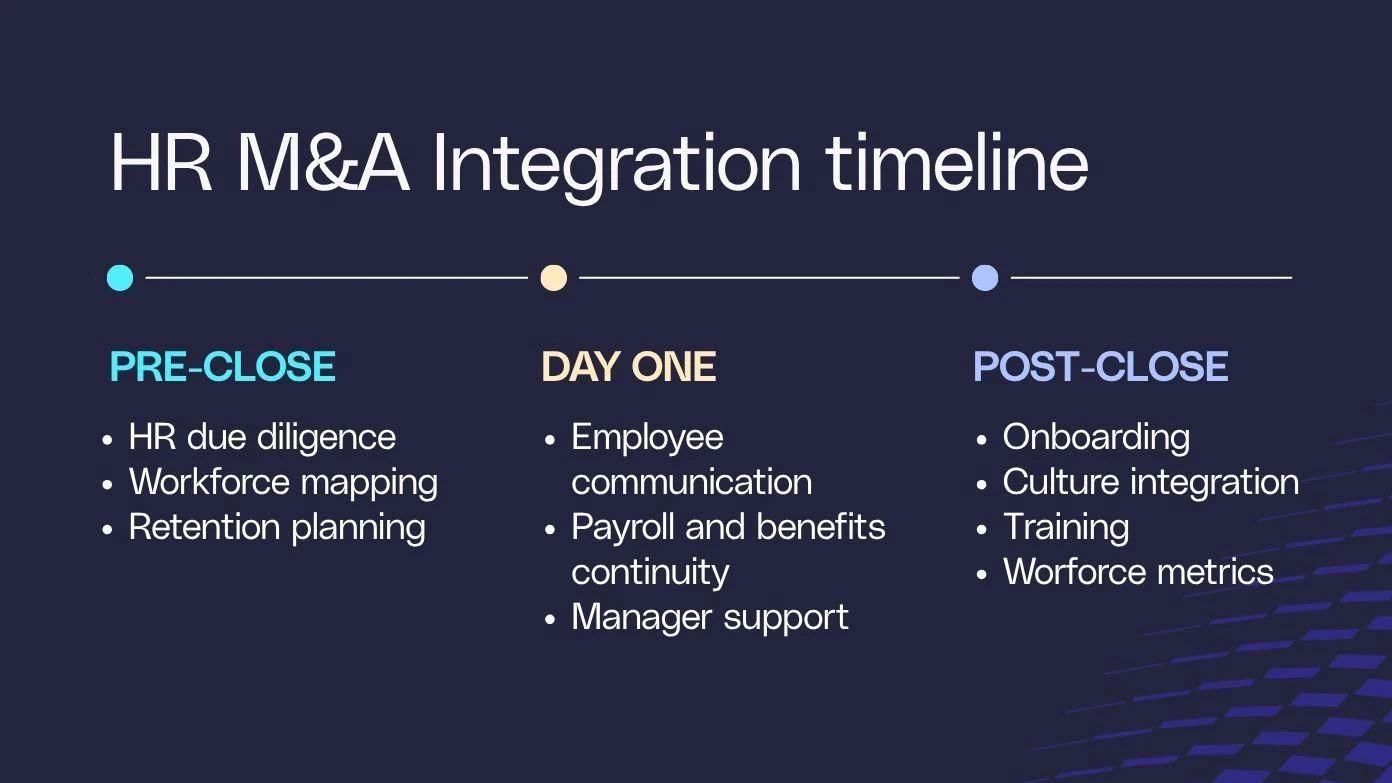
HR metrics to track during M&A integration
HR metrics help you monitor workforce stability and identify problems during integration. Track indicators that show whether employees are staying, leaving, adapting, and becoming productive. For global transactions, review these metrics by country and employment arrangement, as workforce risks and integration progress may differ across markets.
- Voluntary turnover rate: Track resignations across your company and compare them with the pre-deal baseline. Then, organize the data by location, function, seniority, and role so that you can focus on high-potential talent and key revenue-generating roles.
- Retention agreement performance: Review retention agreements, acceptance, completion, and turnover. This tells you whether your retention strategy is reaching the people your company identifies as critical.
- Unplanned absenteeism: Watch for sudden spikes in sick leave or burnout indicators. An increase can signal workload problems, uncertainty, or other concerns that need attention.
- Pulse survey scores: Run short surveys at 30, 90, and 180 days. Ask about role clarity, confidence in leadership, communication, workload, and belonging.
- eNPS (Employee Net Promoter Score): Track whether employees would recommend the newly combined company as a good place to work. Review the results alongside qualitative feedback, so you understand why sentiment is rising or falling.
- Cross-team collaboration: Track communication patterns, such as joint project participation. Look for evidence that teams from both organizations are working together across projects and functions.
- HR service delivery: Monitor employee inquiry resolution times and payroll accuracy rates during the initial administrative merge. Administrative problems can quickly damage employee confidence during a transition, so address recurring issues promptly.
- Training completion rates: Measure how quickly employees adopt new company policies, shared values, and software systems. Review these completion rates by location and employee group to identify gaps.
- Cost synergy realization: Compare planned workforce savings with actual results. Track changes in payroll, benefits, recruiting, severance, contractor costs, and other workforce-related expenses.
- Cost-per-hire and time-to-fill: Monitor the efficiency of your recruiting team as the organization stabilizes. Time-to-fill and cost-per-hire can indicate unclear roles, weak employer messaging, or increased competition for critical skills.
Top 3 global M&A challenges for CHROs
HR executives encounter unique challenges that can cause disruptions if they're not handled strategically. From HR due diligence to ensuring a positive employee onboarding experience, the CHRO's responsibilities during an M&A are:
- HR due diligence: Conducting due diligence on HR practices, benefits, and local employment regulations is challenging in cross-border mergers. Missing key details can lead to unexpected risks and potential legal disputes.
- Employee onboarding: Integrating employees with differing employment expectations can be complex. A seamless onboarding process ensures a positive transition and minimizes disruption.
- Retention and workforce stability: Retaining talent is essential to maintaining productivity and preventing employee disengagement. Acknowledge uncertainty honestly and set up direct channels for questions.
How an EOR simplifies global M&As for HR teams
An employer of record (EOR) provides support for executive HR leaders managing global M&As. EORs reduce the stress of cross-border workforce transitions by:
- Centralizing compliance management: EORs have expertise in managing compliance across different regions, reducing the risk of violations and fines.
- Streamlining onboarding: EORs facilitate quick and efficient onboarding, ensuring that all EOR professionals, regardless of location, receive a uniform onboarding experience.
- Enhancing strategic alignment: Partnering with an EOR frees CHROs to focus on important initiatives and strategic alignment with the organization's broader financial, operational, and legal objectives.
- Protecting IP: EORs ensure that employee contracts in every region include essential clauses to protect intellectual property (IP). This safeguards company innovations and proprietary information, reducing the risk of IP disputes post-merger.
Post-M&A workforce integration
Once you close the deal, turn your integration plan into a consistent experience across teams and locations. Give managers the information and tools they need to answer questions and support their teams. Track workforce metrics throughout the integration so that you can identify retention risks, administrative issues, and gaps in employee experience.
For global teams, an EOR can support employment continuity while the company determines its long-term operating structure. The buyer can use an EOR as a bridge solution to retain acquired employees in countries where they don't have a legal entity.
Retaining talent and maintaining workforce stability post-M&A
Workforce stability is a top priority for CHROs. Losing key talent can undermine the M&A's value and cause instability that impacts morale and productivity.
An EOR can help by providing:
- Consistent benefits and compensation: EORs manage compensation and benefits across different markets. Employees have the assurance that their needs will be met during and after the transition.
- Cultural integration support: An EOR partner with experience in diverse regions can advise on culturally appropriate customizations in onboarding and employee experience, which can help unite employees from different backgrounds and regions.
EOR solutions for global HR compliance in M&As
Global compliance is a top concern in cross-border M&As, as each country has its own complex employment laws. EORs play a vital role in ensuring compliance by:
- Staying up-to-date on local regulations: EORs stay current with local employment laws, reducing the risk of compliance errors in areas like labor laws, tax, payroll, and benefits.
- Facilitating efficient documentation and reporting management: Having an EOR simplifies handling employee records, contracts, and benefits in multiple regions. This helps CHROs keep accurate and compliant records.
- Mitigating legal risks: With an EOR managing compliance, HR executives can focus on strategic initiatives while reducing regulatory risks.
Use G-P EOR for global M&A success
Deal timelines don't wait for entity setup. G-P EOR streamlines workforce transitions and mitigates the HR risks in global M&As. Global labor law intelligence is built directly into our platform, so you can keep people legally employed through a transition, even without an entity in place.
For executive insights on how to navigate workforce integration during M&As, download our M&A Playbook. If you're a CHRO and would like to hire globally or increase time to value during cross-border deals, contact us or book a demo.
 Frequently asked questions
What should an HR M&A playbook include?
An HR M&A playbook should include:
Governance and decision-making HR due diligence checklist Workforce planning Compliance and documentation Culture and change management Communication plan Retention strategies Onboarding and employee experience Integration milestones and owners Success metrics
When should HR get involved in an M&A deal?
HR should be part of the process during the earliest stages of the deal. Early involvement lets HR identify workforce risks, review employment arrangements and benefits, plan communications, and prepare for changes before the deal closes.
How does HR support post-merger integration?
HR supports post-merger integration by bringing teams, roles, pay, benefits, and workplace culture together. HR also tracks workforce metrics to identify employee concerns, productivity issues, retention risks, burnout, and administrative problems.
What is the role of HR in mergers and acquisitions?
HR manages the people side of mergers and acquisitions. This includes identifying critical talent, retaining key team members, communicating with employees, supporting onboarding, managing culture changes, and ensuring a smooth post-merger integration.