



Key takeaways

  • Germany offers a high-value market with a skilled workforce: The country has the largest economy in Europe and a stable business environment.

  • Navigating the country’s regulatory landscape: Businesses expanding to Germany must navigate strict labor protections and tax regulations.

  • Prepare for new digital and transparency mandates: Employers must comply with the EU Transparency Directive and EU AI Act.

  • The right partner simplifies hiring in Germany: With G-P as your global employment partner, you can hire in Germany quickly and compliantly, without the red tape.


Europe’s economic engine sits in Germany. It’s the largest economy in the continent and the third largest in the world. The country is home to a thriving innovation ecosystem, ranking 11 in the 2025 Global Innovation Index (GII). 

Strong commercial and hiring potential come with robust compliance obligations. Recent labor reforms and digital requirements can slow your global expansion to Germany. A little prep goes a long way. Here are a few essentials to get you started. 

Why expand to Germany: economic and market opportunities

Germany’s stable economy and political climate support business expansion.

Its population of 83.5 million represents 19% of Europe. Germany is the largest consumer market in the region by size and purchasing power. Consumer spending reached EUR 478.54B in the second quarter of 2025 alone. 

Expanding business to Germany gives you access to this active customer base. Plus, its central location puts you on the doorstep of the EU’s 450M consumers. Sharing borders with nine countries makes it ideal for regional headquarters. 

The country is a popular location for trade shows and industry-wide events. Germany hosts two-thirds of the world’s leading trade fairs, welcoming around 10M visitors every year. Germany expansion gives you a front-row seat to these events and easy access to a European network. 

The country’s Future Research and Innovation Strategy focuses on AI, quantum technologies, microelectronics, and climate-neutral energy. Companies working in these spaces benefit from grants to fund research and development projects

Benefits of expanding to Germany

Access to skills

Germany’s vocational education and training (VET) system supports a skilled workforce. The VET system combines part-time vocational training at school with on-the-job training. According to the OECD, 88% of learners are enrolled in programs that cover over 320 occupations. 

Of all graduates with a bachelor’s degree or equivalent, 35% hold a degree in STEM. The OECD average is 23%. Your business could benefit from a steady supply of specialized vocational and post-graduate talent.

Stable business environment

Germany’s regulatory environment is predictable and transparent. The country performs strongly on international rule-of-law benchmarks, reflecting independent courts and reliable contract enforcement. Its robust intellectual property framework — supported by one of Europe’s most active patent systems — protects innovation and reinforces investor confidence. 

Germany also ranks highly on global transparency and anti-corruption indices, underscoring the integrity of its institutions.

These factors create a stable foundation for long-term growth in a highly regulated but dependable market.

Green energy opportunities
Germany’s transition to a climate-neutral economy by 2045 offers growth potential for green energy and sustainability companies. Backed by decades of environmental leadership, the government continues to invest in climate technologies and infrastructure to accelerate that shift.

Challenges of expanding to Germany

Part of doing business in Germany is dealing with challenges like labor laws and tax compliance. Get the basics down before you dive in:

Strict employee protections

Germany has some of the strongest employee protections in the world. For example, employees get rest breaks during the day and at least 11 hours of uninterrupted time after every working day. No one can work on Sundays and public holidays, except for employees in essential sectors. 

Employee termination rules

The Dismissal Protection Act outlines strict termination rules. Businesses with 10 or more employees can’t dismiss an employee who has worked there for more than six months without a justified reason. 

Three categories justify termination: 

  1. Conduct-related reasons: Based on employee behavior or misconduct that violates their employment contract.

  2. Person-related reasons: Based on personal capabilities or characteristics, like long-term illness. 

  3. Operational reasons: Based on urgent business needs, such as redundancy because of restructuring or business closure. 

Companies must prove that dismissal is justified. Terminating an employee is always a last resort after taking other steps.

Work councils

A work council (betriebsrat) is an employee-elected body that represents the interests of employees within a company. They negotiate workplace policies, working conditions, and social matters. 

Works councils can be formed in any private sector workplace with at least five employees. Works councils have the right to:

  • Information (informationsrechte

  • Consultation (anhörungsrechte)

  • Co-determination (mitbestimmungsrechte)

Tax compliance

Germany has a wage tax deduction system for income tax. Employers must withhold the correct amount of taxes and social contributions from employee paychecks and remit them to the authorities. 

Tax compliance is notoriously complex. A typical small business in Germany spends around 218 hours on tax reporting and payment, compared to 122 hours in Sweden, and 63 in Switzerland.

A clear understanding of allowances, credits, deadlines, and rules helps employers manage tax obligations while staying compliant. Partnering with experts saves time and prevents penalties.

High operating costs

The average hourly cost of labor in Germany is EUR 43.4 — compared to the EU average of EUR 33.5. Germany’s national minimum wage is EUR 13.90 per hour.

High payroll taxes add to the cost of employing workers in Germany. Employers pay pension, health, unemployment, nursing care, and accident insurance. They typically contribute around 21% on top of an employee’s gross salary to social security. 

Expanding to Germany

HR requirements you should know

Germany’s 2026 labor law updates affect how employers hire and operate. 

Wage and tax thresholds

  • The minimum wage is EUR 13.90 per hour. This will increase to EUR 14.60 in 2027. 

  • Mini-jobs (geringfügige Beschäftigung) give flexible employment opportunities that are subject to simplified social security and tax rules. They’re often filled by students, retirees, or people looking for supplementary income. The monthly maximum someone can earn from mini-jobs is EUR 603. 

  • The EU Blue Card is a residence and work permit for highly qualified non-EU nationals who want to work in Germany (and other EU countries). 

    • Applicants in most professions must have a job offer with a gross annual salary of at least EUR 50,700

    • Applicants in shortage occupations and some recent graduates must have a job offer with a gross annual salary of at least EUR 45,934.20

Labor rights written notice

Starting January 1, 2026, employers must notify international hires in writing about free counselling services. These services — such as those provided by the Fair Integration network — offer confidential advice and support on topics like labor rights, working conditions, wages, contract issues, and protection against exploitation.

The notice must be given on the employee’s first day of work and include details of the closest counselling center. 

This ensures employees know their rights and have access to support. Employers face fines of up to EUR 2,000 per violation for noncompliance.  

EU Pay Transparency Directive

The EU Pay Transparency Directive aims to improve pay transparency, the gender pay gap, and the enforcement of equal pay rights. These changes come into effect June 7, 2026:

  • Employers must provide salary range information to job applicants. 

  • Companies can’t ask applicants about their pay history. 

  • Employees can ask for information about pay levels and criteria.

  • Companies of more than 100 employees must publish regular gender pay gap reports. 

  • Unjustified gender pay gaps of 5% or more must be assessed with employee representatives. 

  • If an employee shows evidence of possible pay discrimination, the employer must prove that there was no discrimination.   

EU AI Act

The EU AI Act introduces rules for employers that use AI in HR. It classifies some processes as high risk, including recruitment, performance evaluation, promotion, dismissal, task allocation, and employee monitoring. These activities will be strictly regulated. 

Employers using AI in HR must conduct impact assessments, ensure transparency, maintain human oversight, and more.

Most of the act becomes enforceable beginning mid-2026.

Build your team in Germany with G-P

3 considerations for success

Punctuality, directness, and structure shape the German workplace. Time is respected, communication is clear and task-focused, and defined roles and processes are expected. Feedback is direct but not personal.

While English is widely spoken in business, speaking German builds trust and unlocks the full talent market. A bilingual approach signals commitment to the local culture.

Stability and planning also matter. German business culture values predictable relationships over hard-selling, so demonstrating consistency and a clear roadmap builds credibility with employees and partners.

How an EOR can help

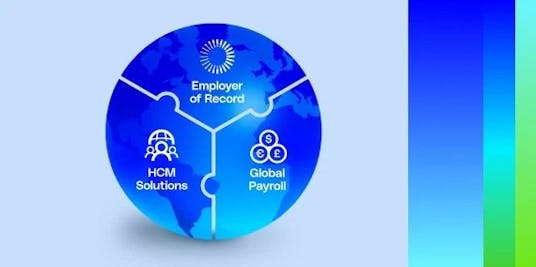
An employer of record (EOR) simplifies your expansion in Germany. An EOR legally employs workers on your behalf, so you can hire globally without the compliance headaches. With an EOR, you don’t have to worry about payroll, taxes, and other complex tasks. 

G-P EOR streamlines the entire employment lifecycle — from contract generation to payroll and offboarding. Our 100% pass rate on compliance reviews means you’re partnering with an EOR that mitigates risks.

An EOR ensures compliance across the employee lifecycle

How to expand into Germany: A global case study

Kraft Sports + Entertainment (KSE) needed to hire quickly in Germany to support local operations and grow fan engagement. They partnered with G-P to navigate compliance challenges and hire quickly. 

KSE used G-P EOR to onboard a local employee to manage Germany operations, strengthen cultural connections, and expand their business network while staying compliant. 

The result: fast, compliant hiring in one of Europe’s most regulated markets — without the burden of establishing a local entity.

Read the full case study.

Hire in Germany with G-P

The secret to a seamless expansion in Germany lies in the right partnerships. Local expertise turns challenges into manageable operational steps instead of roadblocks. 

G-P EOR lets you hire in Germany without setting up a local entity. We handle all employment matters, so you can hire in minutes, not months. 

Book a demo today.