






Key takeaways
- Access specialized talent anywhere. Moving beyond local borders allows companies to find the best skills for every role. This strategy eliminates geographical limits and fills critical talent gaps quickly.
- Diversify and protect revenue. Expanding into new markets reduces dependency on a single economy. A global footprint provides more stable growth and protects your business from local market shifts.
- Drive innovation through diversity. Multicultural teams bring unique perspectives and local insights. These varied viewpoints lead to better problem-solving, smarter strategies, and stronger financial performance.
The future of work is global. This is why companies of all sizes are embracing today’s global mindset by expanding beyond borders and boundaries. Access to global markets, high returns on investment, and new revenue streams are just a few of the benefits of global expansion and global hiring.
What is global expansion?
Global expansion is a business strategy that involves growing a company's operations, products, or services to new target markets. Global expansion can help you grow beyond your home market and local customer base to build new revenue streams.
Why do businesses expand globally in 2026? You can connect with new customers, bring products or services to new markets, and increase revenue.
With a reliable global expansion strategy and efficient resource allocation, growth also becomes more sustainable.
What are the benefits of global business expansion?
Global expansion benefits include risk mitigation, cost reduction, increased revenue, and workforce diversity. G-P's 2025 World at Work Report found that 84% of executives have difficulty finding skilled talent in their markets. As a result, leaders are looking beyond their borders to source success and reap the key benefits of expansion.
1. Access new markets
Seizing new, promising markets is at the core of any strong global expansion strategy. Expanding globally helps diversify your customer base across multiple markets and regions. By reducing dependency on a single market, you can better handle market fluctuations and expand your revenue opportunities.
2. Tap into the best global talent
G-P's 2025 World at Work Report found that 50% of companies that don't hire globally struggle to find top talent. Global expansion provides access to diverse skills, which is invaluable for both innovation and productivity.
Whether you need independent contractors or full-time employees, sourcing talent from different regions can promote innovation from day one.
Increased employee mobility can also drive your global growth strategy. If you're not sure where to start, G-P can help. We enable companies to hire anyone, anywhere, without setting up new entities. Our agentic Global Employment Platform allows you to hire, manage, and pay teams in 180+ countries. Thanks to our comprehensive offering, companies can now manage both global talent and contractors from a single dashboard.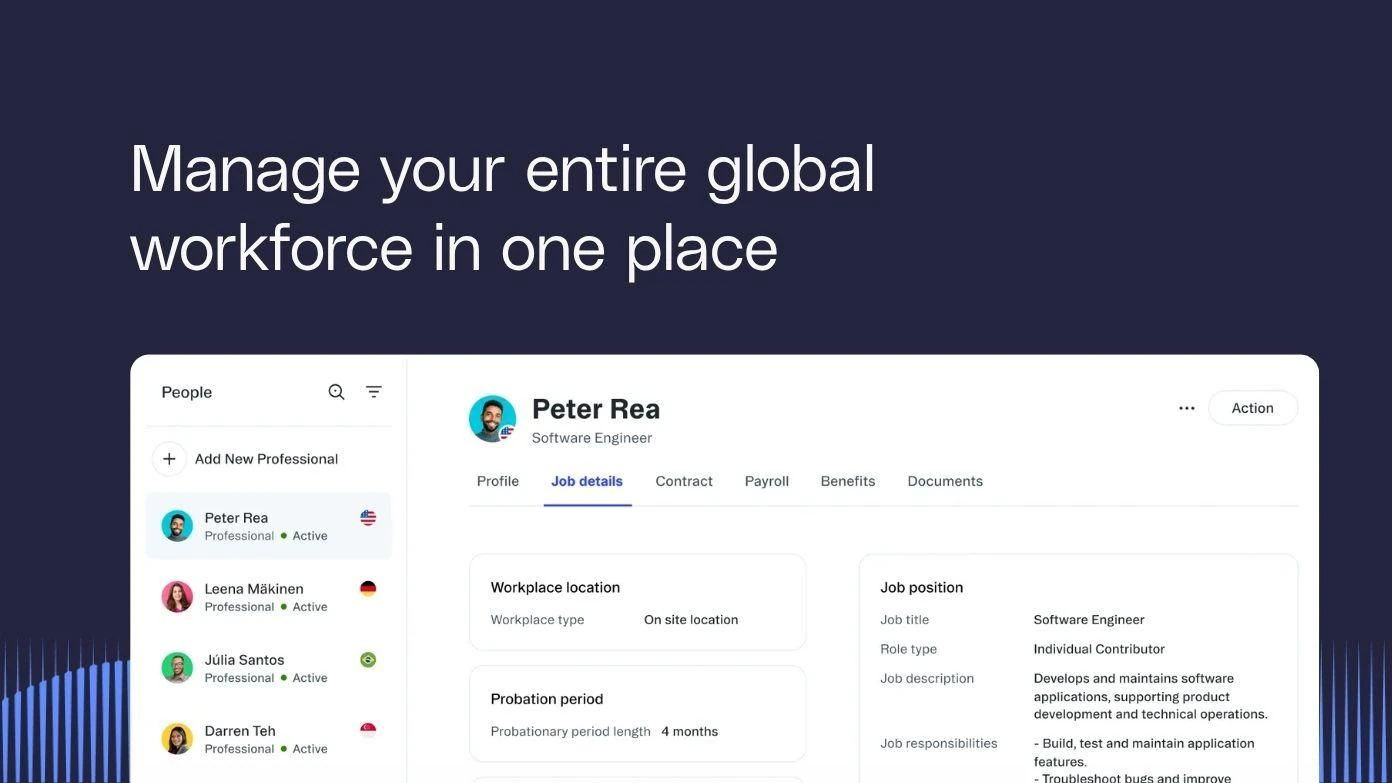
3. Take advantage of economies of scale
Companies can benefit from emerging economies by operating at a larger scale and at a lower cost. Across markets, companies can reduce the cost of production, distribution, and even procurement and take advantage of more efficient distribution networks.
4. Diversify company culture
Building a diverse company culture is key to any effective talent management strategy. After all, the business case for diversity, equity, and inclusion (DEI) is stronger than ever in the modern business landscape.
Data shows that building an inclusive workforce across cultures can even benefit your bottom line. According to 2025 research spanning 66 countries, workplace inclusion is positively associated with both profitability and market valuation. Companies can benefit from bringing together employees with different backgrounds and perspectives while creating an environment where those differences are effectively integrated into the workplace.
5. Connect with new customers
Global expansion also creates opportunities to reach new customer segments with unique needs, preferences, or purchasing behaviors. When building out market research, focus on predicting how customers will receive your product or service in a specific market.
6. Diversify your long-term revenue streams
Businesses can increase revenue growth by tapping into new markets and customer segments that might not be available in mature domestic markets or more saturated environments. Expanding internationally can help you find new customers while lowering operational costs and saving money in a new country.
7. Mitigate market risk
Expanding operations across multiple markets makes you more resilient to market challenges, including volatile economic conditions, government policy changes, or changes to legal environments across countries.
8. Enhance brand recognition and adaptation
Building and maintaining a consistent brand across borders can be challenging. Localizing your branding, marketing messaging, and promotional strategies to different markets can help you connect with a new customer base to improve your brand recognition.
Establishing a presence in multiple countries can enhance both brand visibility and credibility on a global scale as well. A global presence can also improve both customer perception and loyalty.
9. Gain a competitive advantage
Organizations that want to thrive and expand must stay ahead of the curve. By being among the first to expand in an emerging international market, you can establish a strong presence ahead of competitors who may take longer to launch.
10. Build strategic partnerships
Global expansion can also facilitate strategic alliances and partnerships with international companies. By entering new markets, your business can access new resources, advanced technologies, or valuable distribution channels.
Yet, global expansion also comes with challenges. From cultural differences to regulatory complexities and unexpected costs, there are many obstacles to seamless expansion. Successful growth requires detailed market research, careful planning, and an in-depth strategy to capitalize on benefits while mitigating risks. What does this look like in practice? One G-P customer says:
“Having G-P as an extension of our team has made all the difference. Thank goodness we have G-P. Their platform is so user-friendly, and we rely on their expertise while focusing on our global expansion.”
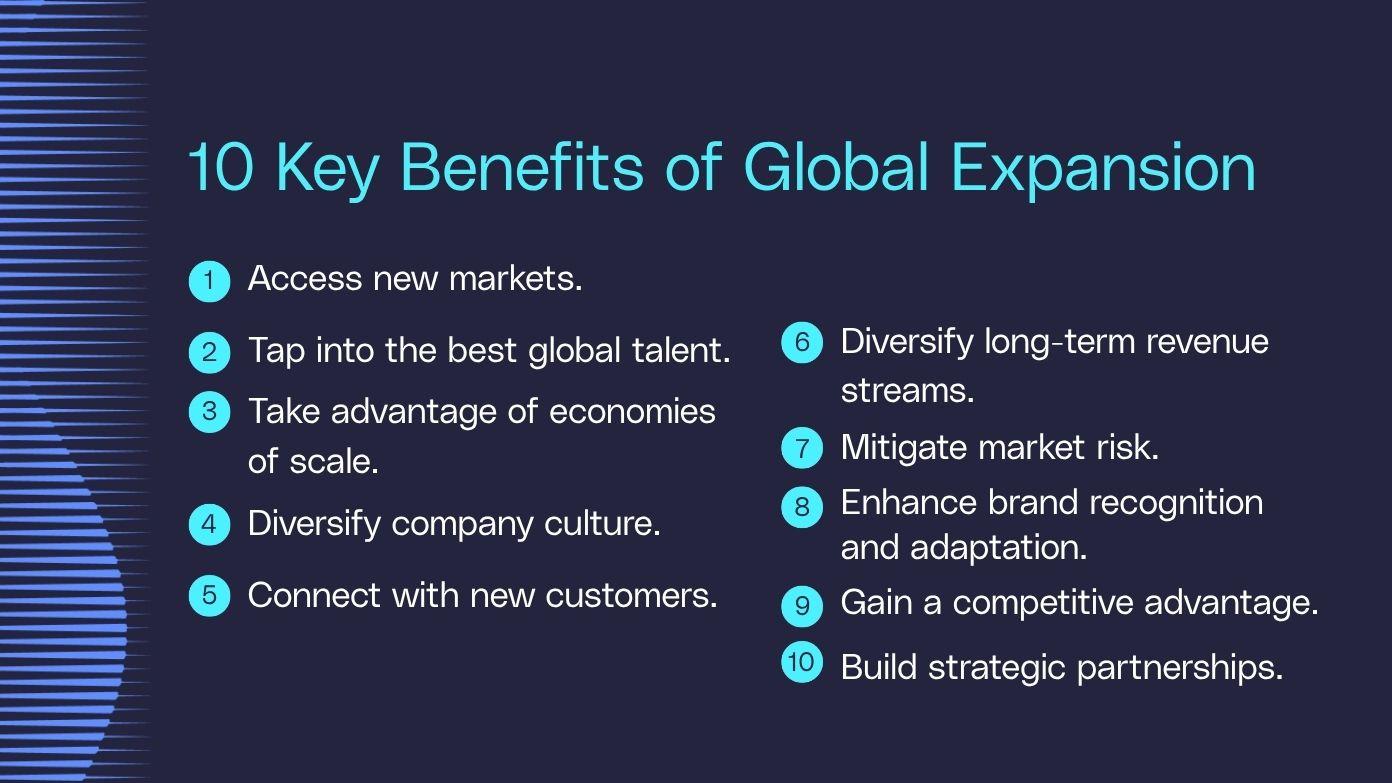
10 benefits of global expansion
- Access new markets.
- Tap into the best global talent.
- Take advantage of economies of scale.
- Diversify company culture.
- Connect with new customers.
- Diversify long-term revenue streams.
- Mitigate market risk.
- Enhance brand recognition and adaptation.
- Gain a competitive advantage.
- Build strategic partnerships.
The role of AI in global expansion and market research
Understanding AI's role in global expansion and market research is crucial to uncover market opportunities, reduce uncertainty, and make more informed investment decisions. It can also help HR teams research local employment requirements and complete administrative tasks associated with global expansion. With reliable data and appropriate human oversight, companies can use AI to research new markets and support workforce planning in new locations.
Transforming market intelligence with AI market research
Traditional market research used to take months to prepare and implement, especially when using lengthy surveys mailed out to potential clients' homes or businesses and other forms of manual data collection. Collecting responses could take several months, and analyzing the results could add even more to the overall timeline.
AI market research can significantly reduce the time needed to gather and analyze information. You'll have faster access to insights that can inform decisions about which markets to enter and how to position products or services.
What is machine learning?
Machine learning is a type of artificial intelligence that can analyze extremely large amounts of data. Many businesses expanding globally will use this type of technology to evaluate real-time consumer data alongside economic trends and competitor activity to provide a more current picture of a potential market.
For example, you might use machine learning along with human reviews to analyze a competitor's pricing and market share while assessing local purchasing behavior. Evidence of strong demand and limited competition could open the door to a promising market opportunity.
Here are several ways digital-first platforms can use AI to analyze customer behavior before establishing a physical presence in a market:
- Search behavior: The AI can go through enormous amounts of data to pinpoint what a particular market searches for to guide a business on which products or services they should offer in that location.
- Browsing patterns: By determining which pages users visit, how long they stay on a site, and which content most grabs their attention, it's easier to understand what interests and influences local consumers.
- Purchase activity: Analyzing this type of data gives you a real-world picture of which products or services the local consumers are willing to spend money on.
- Pricing responses: Evaluating different price points for different products/services shows you local price sensitivity so that you can more accurately set prices for the new market.
- Regional trends: AI can also identify regional trends, including seasonal buying patterns and shifts in consumer preferences. Using AI to identify these patterns is vital to the planning and execution of your marketing and sales processes as you expand globally.
Streamlining HR and compliance with agentic AI
In addition to using AI for faster and more accurate market research, it's also helpful for setting up a workforce in the new location. You can use AI tools to research local labor laws, pinpoint compliance risks, identify worker classification requirements, and complete certain HR and administrative tasks.
What is agentic AI?
Agentic AI is a form of artificial intelligence that uses machine learning combined with automation to analyze information, make decisions, and complete multi-step tasks, all with very little human intervention. Global companies often use this type of technology to reduce the workloads within their HR departments and enhance compliance with local employment laws.
Companies can use G-P Gia™, our AI-powered global HR agent, to:
- Research local labor laws: Gia uses thousands of vetted sources and government databases to give users reliable, location-specific guidance on country-specific employment laws and HR requirements across 50 countries and all 50 U.S. states.
- Pinpoint compliance risks: Workers in the new location may need certain benefits or must follow specific employment requirements. Gia can help you identify these obligations so you don't have to manually research complex regulations and then deal with compliance problems during expansion.
- Identify worker classification requirements: Misclassifying a worker is a common compliance mistake that can result in fines and other penalties. Gia uses local employment requirements and worker information to provide guidance on proper classification, even when a working arrangement involves contractors or includes circumstances that make classification more complex.
- Complete HR and administrative tasks: Gia can draft localized employment contracts and answer country-specific HR questions in seconds.
Interpreneur vs. entrepreneur: What are the biggest international expansion challenges according to interpreneurs?
Understanding mid-market global business trends is essential to effective expansion. Today, there’s a new term that captures the excitement at the core of global expansion: “interpreneurship.” Kreston Global’s interpreneur report reveals that small and medium businesses across the world are ready to harness disruption to drive commercial growth.
The Kreston Interpreneur Report is based on a survey across 11 different countries of 1,100 business leaders at small and medium-sized companies that have expanded internationally.
What exactly is an interpreneur, and what does this term mean for international expansion? An entrepreneur builds and grows a business, while Kreston uses "interpreneur" to describe a business leader who successfully expands a company’s presence into international markets. The term combines “international” and "entrepreneur." Both entrepreneurs and interpreneurs pursue business opportunities, but interpreneurs focus specifically on expansion across borders.
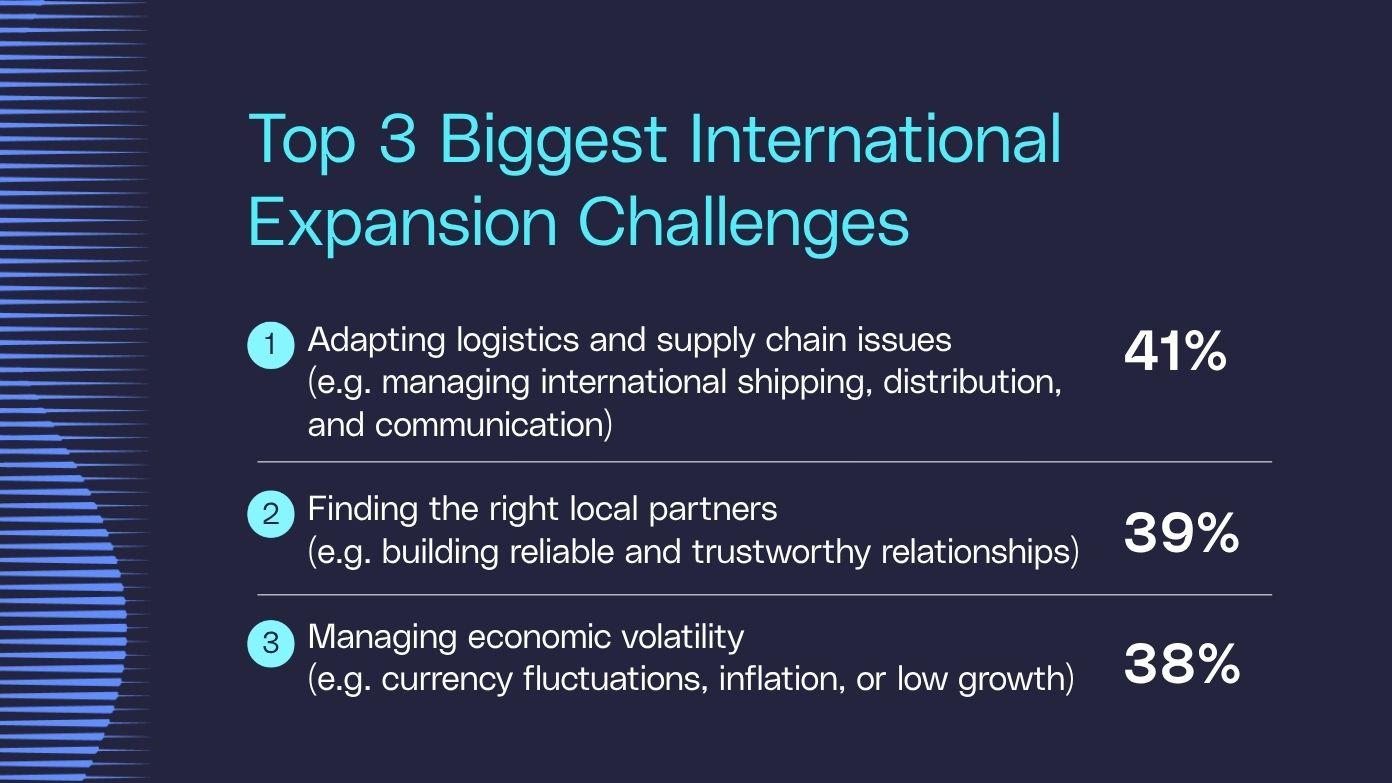
Interpreneurs acknowledge the challenging macroeconomic headwinds, yet they remain optimistic about international expansion. Research shows that 86% of interpreneurs expect conditions for international business expansion to become more favorable within the next two to three years. Market growth opportunities also remain a top reason for expanding internationally, with 59% citing them as a primary motivation.
A reliable employer of record (EOR) can help interpreneurs and entrepreneurs alike tackle these unique challenges.
Your global expansion playbook
Using a phased approach within your global expansion playbook is a smart move for global expansion because it allows you to better prioritize your tasks and risks.
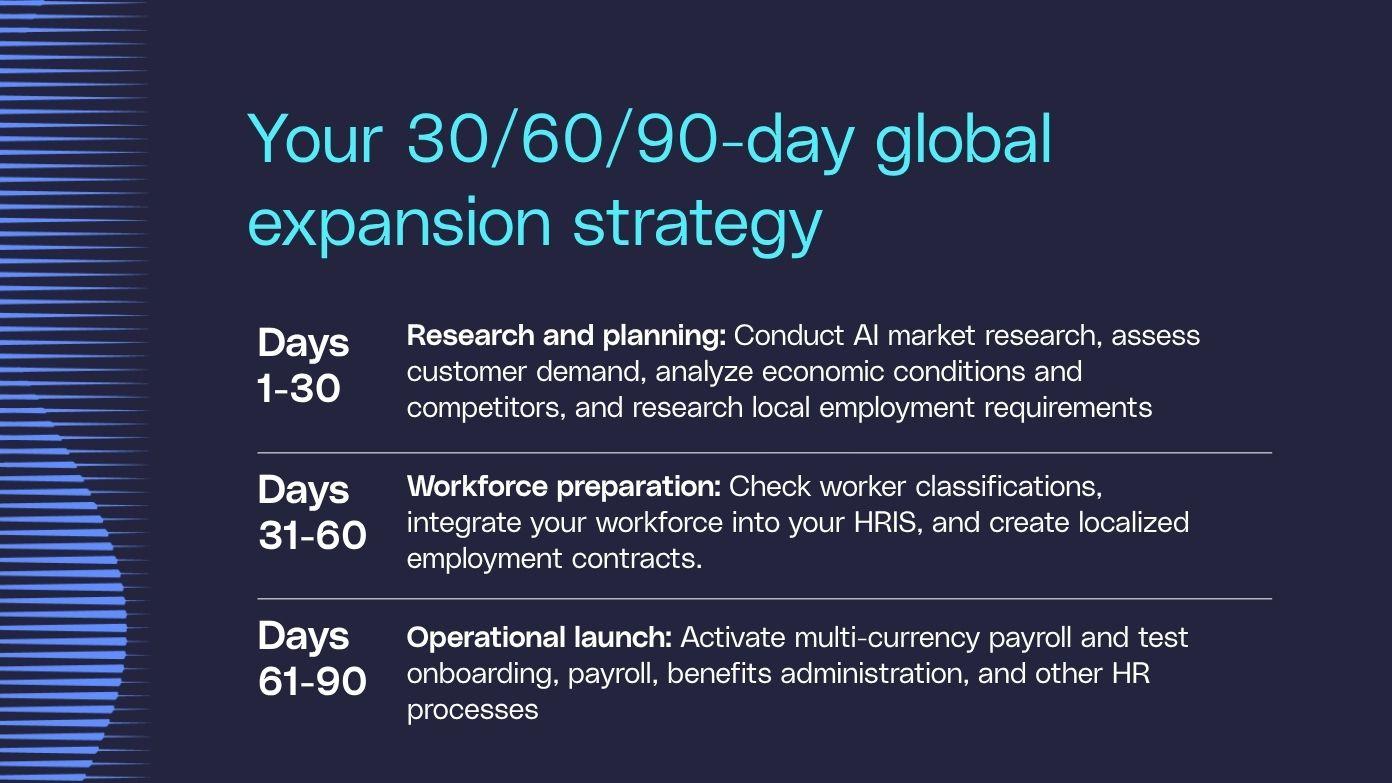
- The 30/60/90-day strategy
- Days 1–30: Research and planning. Spend the first month conducting AI market research to get a clear picture of the new location's customer demand for your product or service and to identify economic conditions and competitors likely to affect market entry and long-term growth. This phase should also focus on understanding the legal scope of hiring and employing workers in the new location.
- Days 31–60: Workforce preparation. Classify each worker according to the employment rules in that country. Ideally, you'll have an HRIS that you integrate the new workforce into. Using agentic tools and country-specific employment requirements to create localized employment contracts is an easy way to reduce manual HR work during this phase.
- Days 61–90: Operational launch. This phase focuses on activating multi-currency payroll, especially if you're hiring and paying workers across multiple countries. You'll also want to run new hires through finalized workforce processes to confirm onboarding, payroll, benefits administration, and other HR workflows operate as intended.
- Strategic approaches by company size
The right expansion model depends on what your business looks like today and where you want it to go next.
- Startups/SMBs: Start with an entity-free expansion model to test a new market before making a larger investment.
- Enterprises: Combine EOR with existing entities to create a more flexible structure for international hiring, expansion, and mergers and acquisitions (M&A).
Expand globally with G-P's Global Employment Platform
Global organizations can only thrive with leaders who are committed to the growth of their business and workforce. But growth is no longer a linear journey. To keep up with today’s fast-moving markets, emerging tech, and widespread talent shortages, leaders need to rethink their strategies for success.
That’s where an G-P's Global Employment Platform comes in. Our technology is engineered to adapt entirely to you — designed to support you at every stage of your growth journey, and integrate securely with the systems you already use. With our platform, companies of all sizes can:
- Build global teams without setting up new entities.
- Hire, manage, and pay contractors in multiple local markets.
- Make accurate payments to your teams in your preferred payment method and currency.
- Offer competitive benefits plans that align with the rules and norms of the countries where your global workforce is located.
- Tap into AI-enabled global employment guidance, 24/7.
Global expansion requires more than identifying the right market. You'll also need a plan for hiring, compliance, payroll, and workforce management. G-P helps you build and manage global teams without setting up new entities.
 Frequently asked questions
What are the benefits of global expansion?
Global expansion allows you to gain a competitive edge and build a more resilient, dynamic business. It also strengthens your business by reducing reliance on a single market's economic conditions and grants access to a worldwide talent pool to help you innovate and scale.
What is the purpose of global expansion?
The purpose of global expansion is to reach more customers, diversify revenue, and gain a strategic advantage over competitors.
What’s the best way to scale teams globally with flexible headcount?
One way companies can scale teams globally is by using an employer of record (EOR). An EOR allows you to hire quickly and compliantly in new countries without setting up legal entities, making it easy to adjust workforce size, onboard hires quickly, and centralize HR, payroll, and benefits management.
How can AI support compliance in international expansion?
You can use AI in many different ways to support successful global expansion. By researching country-specific labor laws, identifying worker classification requirements, and flagging potential compliance risks, it's much easier for your legal and HR departments to stay on top of changing requirements. Agentic AI can perform tasks like drafting localized employment contracts or answering country-specific HR questions to speed up workforce expansion and reduce manual workloads.
What are the biggest international expansion challenges?
Many companies find it difficult to adapt their logistics and supply chains to new markets and regional requirements. Some struggle with finding reliable local partners for distribution and operational purposes. Others also deal with economic volatility that impacts their costs, pricing, and long-term financial planning. Navigating local employment laws and cultural expectations can add to the complexity of managing a global workforce. AI can help with all these areas.