






Key takeaways
- Bring HR in early: Early HR involvement in global mergers and acquisitions helps identify workplace risks, local obligations, and integration needs before a deal closes.
- Choose the right employment framework: Local entities, TSAs, and EORs differ in costs, speed, control, and flexibility.
- Use an EOR as your bridge: An employer of record can support workforce continuity while you evaluate long-term entity decisions in each market.
- Plan beyond day one: Effective cross-border M&A integration depends on diligence, strong onboarding, smooth systems integration, and strategic long-term workforce planning.
Mergers and acquisitions (M&As) can give your fast access to new markets, capabilities, and talent. An M&A deal is a high-stakes transaction in which companies combine, or one business buys another's operations. When done right, these deals are an effective way to expand your business, reduce costs, and grow quickly without the growing pains of doing it alone.
When a deal crosses international lines, however, workplace integration becomes more complex. Known as a global M&A, these transactions can involve multiple companies from different countries or include team members located around the world.
An employer of record (EOR) serves as a strategic bridge between deal close and long-term integration while helping you preserve workplace continuity. EORs can employ professionals in various countries while you decide your company's long-term structure. This setup helps you manage the transition without establishing entities in every country.
The role of HR in mergers and acquisitions
Human resources plays a central role in keeping global M&As on track. HR teams focus on the people side of the equation. They can help minimize turnover, align global teams around a single vision, and in many cases protect the deal's value.
HR teams can also identify workplace risks before closing and help shape the integration plan. Their responsibilities include reviewing employment contracts, compensation, benefits, worker classification, and immigration requirements across multiple countries.
Here are the HR best practices that can make or break an M&A:
Bring HR into the fold early
Don’t wait until the deal closes to ask HR to get involved. They need to be there from the beginning. Shift HR from a downstream operational role to an early part of deal planning. Early participation gives your HR team time to map out the workforce. They can identify local employment obligations and flag any potential issues that can delay integration.
That early involvement makes a difference. It can help leadership better understand which workers can transfer directly and where a different employment structure is necessary.
Track compensation and benefits continuity
Changes to healthcare, pay, pensions, bonuses, and more can create uncertainty in the workforce during an M&A deal. Your HR team needs to understand local requirements and plan transitions accordingly. Affected personnel deserve clear information about what changes will happen and when.
Protect talent retention and employee trust
When uncertainty about cross-border M&A affects roles, employment terms, or futures, professionals may make sudden decisions that influence the deal's outcome. Furthermore, leaving teams in the dark creates confusion and erodes trust between the workforce and leadership.
Clear, consistent communication helps reduce confusion and frustration. Localized employment contracts and country-specific onboarding can also give team members more clarity as your organization moves through the integration process.
Why HR and EOR matter in cross-border deals
Global mergers and acquisitions add a layer of complexity to workforce integration. There are new challenges that largely don't exist in deals involving companies in the same country.
Employment laws, payroll rules, worker-transfer requirements, and immigration matters all differ from one country to the next. As a result, the role of HR in mergers and acquisitions can't be overstated. There are ways to navigate those complexities to save time and reduce costs. During a cross-border M&A transaction, an employer of record becomes the legal employer of the professionals it hires. It will handle local employment administration, including payroll, statutory benefits, documentation, and more. With an EOR, your company can keep eligible team members employed locally without establishing an entity in every market.
An EOR provides greater flexibility during integration. HR leaders can focus their efforts on workplace planning, communication, and retention rather than navigating red tape.
In a cross-border M&A, that flexibility can help separate immediate workforce needs from slower business decisions. Instead of tying day-one continuity to entity setup, HR can use an EOR as a transitional employment structure while the larger integration strategy takes shape.
Choosing the right framework for global M&A
Choosing the right employment framework is a major decision in any global M&A transaction. The best approach depends on several factors, including where your team members work and how many professionals you need to transfer. Also consider how quickly the transition needs to happen and whether you plan to maintain a long-term presence in each market.
Companies use three common frameworks for mergers and acquisitions.
Direct local subsidiary
Some companies choose to create a local subsidiary in each target market. This option gives you direct control over employment operations. You can run payroll, manage benefits, issue contracts, and oversee compliance directly in-house through your own local entity.
However, that level of control adds more responsibility. Establishing a subsidiary comes with more setup, a bigger time commitment, additional costs, and greater administrative duties. Your organization will have to establish the entity, register with local authorities, create payroll and HR processes, and manage ongoing compliance obligations.
This approach can make sense in certain situations, such as when mergers and acquisitions bring a large workforce into a strategic market you plan to keep long term. For smaller headcounts, however, the costs and time involved often outweigh the immediate benefits.
Transition services agreement
A transition services agreement (TSA) gives a buyer (such as your company) temporary access to systems or services that the seller continues to provide after closing. It's a temporary agreement that's meant to preserve continuity while your business builds its own local infrastructure. Systems and services can include payroll, benefits administration, HR systems, or other employment-related support.
One key consideration, however, is increased dependence on the seller. While the arrangement is temporary, there are negotiated service levels, timelines, fees, and exit terms to think about.
For those reasons, companies that opt for a TSA need a clear transition plan to reduce and eventually eliminate dependence on sellers. Without a clear transition strategy, that dependence can persist longer than you intended, adding costs or creating sudden operational disruptions when the TSA terms end.
Employer of record
Under this model, eligible professionals transition to the EOR, which employs them locally and manages defined local employment responsibilities. Meanwhile, your organization can focus on long-term strategy and integration.
EORs give HR teams greater flexibility during integration by separating immediate workforce needs from longer-term business decisions. They are particularly useful for global M&A deals with smaller headcounts, tight timelines, or markets where establishing a local entity doesn't make business sense.
|
Evaluation criteria |
Direct local subsidiary |
Transition services agreement (TSA) |
Employer of record (EOR) |
|---|---|---|---|
|
Time to deploy |
Longer setup timeline; entity formation typically takes 3–6 months* |
Moderate; depends on negotiated deal term and seller support |
48–72 hours |
|
Capital requirement |
High setup and ongoing operating costs |
Seller service fees and other negotiated costs |
Predictable service fees without entity setup costs |
|
Compliance responsibility |
Buyer manages local employment compliance |
Seller retains agreed responsibilities temporarily |
EOR manages defined local employment responsibilities |
|
Permanent establishment consideration |
Establishes a local legal presence |
Temporary arrangement that doesn’t replace long-term entity planning |
Minimizes PE risk |
|
Talent retention |
Entity setup can delay workforce transfers |
Supports continuity but maintains dependence on the seller |
Supports local employment continuity without waiting for entity setup |
HRIS and systems integration
Global M&A deals can leave HR teams working across several systems at once. For example, as the buyer, your company can use entirely different platforms for payroll, benefits, employee records, and workforce management than what the seller uses. That separation creates extra manual work and administrative burden on your HR teams.
G-P EOR integrates with enterprise HRIS platforms such as Workday or SAP SuccessFactors to simplify those processes. System integration reduces duplicate data entry and gives HR teams a more consistent view of workforce information across countries. Having a single source of truth and smoother data flow helps streamline onboarding, payroll coordination, and reporting as your company brings teams together.
For HR leaders, the goal during mergers and acquisitions is to reduce system friction during a time that's already full of confusion and change. A connected HR tech stack reduces manual work, improves data consistency, and supports post-merger integration.
"The integration between G-P and Workday helps us streamline processes across the employee lifecycle and give our professionals onboarded through G-P a seamless experience."
Eduardo Ramos
Sr. Staff Total Rewards Analyst at Boston Dynamics
Integrating an EOR into the cross-border M&A lifecycle
An EOR can support workforce integration at several stages of a cross-border M&A. The key is to bring the EOR into the planning stages early, giving HR teams more options before, during, and after global mergers and acquisitions.
Phase 1: Pre-deal diligence and headcount mapping
Start by mapping the target workforce. Have HR teams review worker classifications, statutory benefits, employment terms, and any visa or work authorization requirements in each country.
This process helps HR identify where local obligations can affect the transition. A global HR agent like G-P Gia™ can give you expert-vetted guidance on global employment laws and compliance requirements. This phase will help teams see where an EOR fits into the bigger integration picture.
Phase 2: Day-one execution and onboarding
After the cross-border M&A deal closes, speed and clarity are vital. An EOR can issue local employment contracts, enroll eligible professionals in benefits, and coordinate payroll and onboarding. An EOR can streamline these tasks, and HRIS integration supports cleaner data transfer while reducing manual work during the transition.
Phase 3: Post-merger optimization
Once the initial transition is complete, your company can reassess its long-term structure in each market.
Smaller workforce locations may continue with the EOR. Meanwhile, markets with larger headcounts or strategic importance can transition to a local entity as the business grows.
The goal here is flexibility. Navigating mergers and acquisitions with an EOR maintains workforce continuity without forcing every market into the same long-term commitment from day one.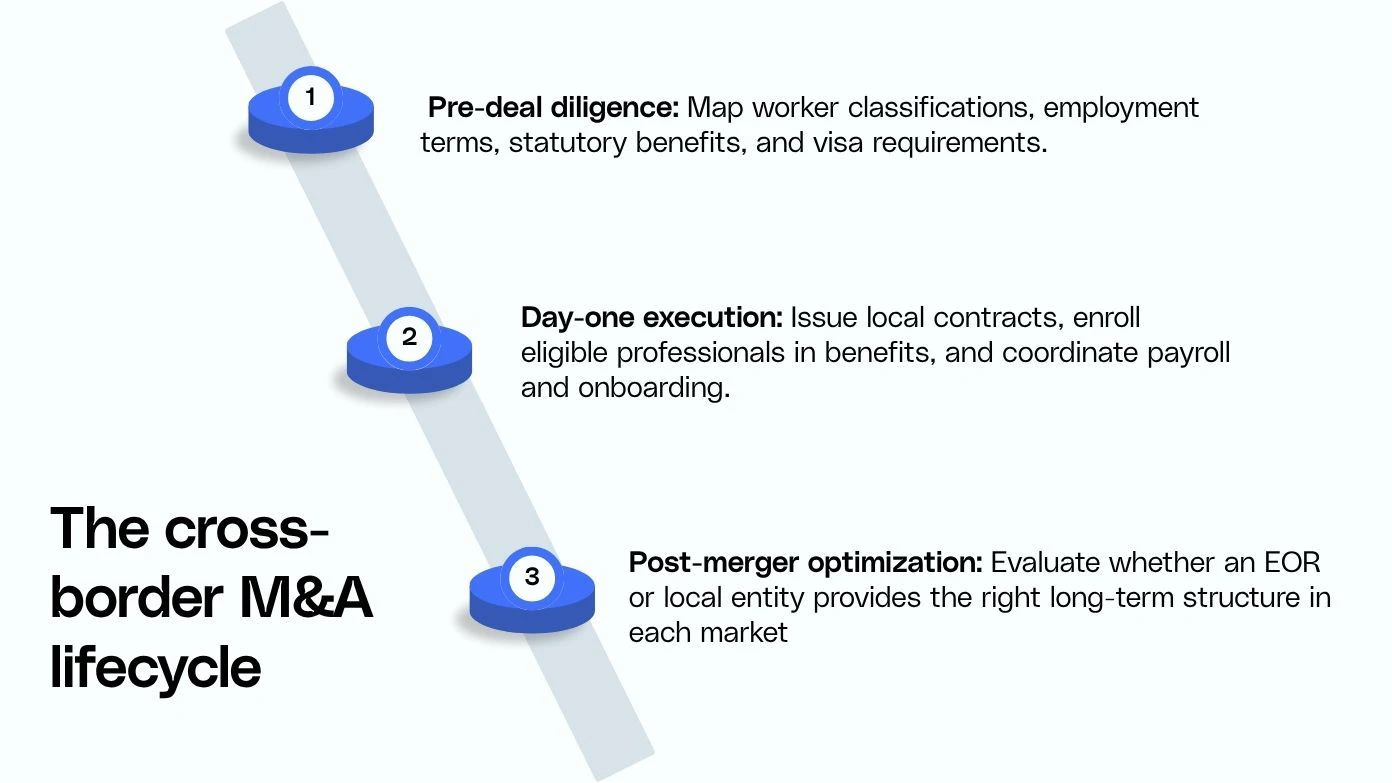
Partner with G-P for your next global M&A
Global mergers and acquisitions move fast, but workforce integration still needs careful planning.
G-P EOR keeps workforce transitions moving and reduces the administrative burden of global M&As.
With G-P EOR, you can hire, onboard, and manage talent across 180+ countries without establishing an entity in every market.
Book a demo today to see how you can keep people legally employed through a transition, even without an entity in place.
Frequently asked questions
What is the role of HR in mergers and acquisitions?
HR helps assess workforce risks, review employment terms, and plan benefits and payroll administration. HR teams also support communications and shape integration before and after M&A deal closing.
How does an employer of record support cross-border M&A?
An EOR can employ eligible professionals locally and manage defined employment responsibilities. EORs help companies maintain workforce continuity while longer-term decisions are still underway.
When should a company use an EOR instead of setting up a local entity?
Generally, an EOR is a practical choice when headcounts are small, timelines are tight, or companies need more time to determine how to structure operations in each market. The EOR serves as the legal employer of eligible professionals and manages local employment responsibilities, providing flexibility while the company evaluates whether a permanent local entity is the right move.