







Key takeaways
- Written contracts are mandatory: Employers must provide a written employment contract when employment begins or within one month of the employee starting work.
- Mandatory statutory benefits and high employer burden: China has a "5+1" benefit system, which includes five types of social insurance (Pension, Health, Unemployment, Work Injury, Maternity) and the Housing Provident Fund. The total cost, or employer burden rate, for these mandatory contributions and other costs is approximately 30–40% on top of employee salaries.
-
Working hours are regulated: China has strict rules for standard working hours, paid leave, and overtime.
- Streamlined hiring via employer of record (EOR): Establishing an entity (like a China subsidiary) can take months and involves numerous steps (business license, tax registration, bank account, etc.). You can hire full-time employees faster and compliantly without setting up an entity by using an employer of record (EOR) solution, such as G-P EOR.
China has the world’s second-largest economy and a population of over 1.4 billion people. The country’s expanding middle class is a key consumption driver. China's highly developed infrastructure, including seven of the world's largest container ports and an extensive high-speed rail network, supports domestic distribution and global exports. This integrated ecosystem makes it attractive to global businesses.
Before expanding into China, you’ll need to understand contracts, taxes, wages, benefits, and other employment laws. Our guide covers what you need to know about hiring in China.
What to know before hiring in China
If you’re expanding your business into China for the first time, you must understand several key legal requirements. These norms and laws influence hiring practices in China and many aspects of the employer-employee relationship, including compensation and benefits.
G-P Gia™, our AI-powered global HR agent, can answer your toughest compliance questions across 50 countries — including China — and all 50 U.S. states. Reduce your reliance on outside counsel and cut the time and cost of compliance by up to 95% with Gia.
Here are five things to know about hiring in China.
1. Languages in China
China recognizes 56 ethnic groups, and there are close to 300 living languages throughout the country. This diversity is a fundamental aspect of Chinese culture and society. Standard Mandarin is the official language spoken by over 1.1 billion people in the world. This makes it the second most-spoken language globally. Its use in business, government, and education is widespread across mainland China.
Around 10-25 million people in China speak English with some level of proficiency. English proficiency is higher in major cities like Shanghai and Beijing.
When you’re hiring in a specific city, find out what the local employment requirements are before you make an offer. Local rules will affect minimum wages, overtime, contributions, and benefits.
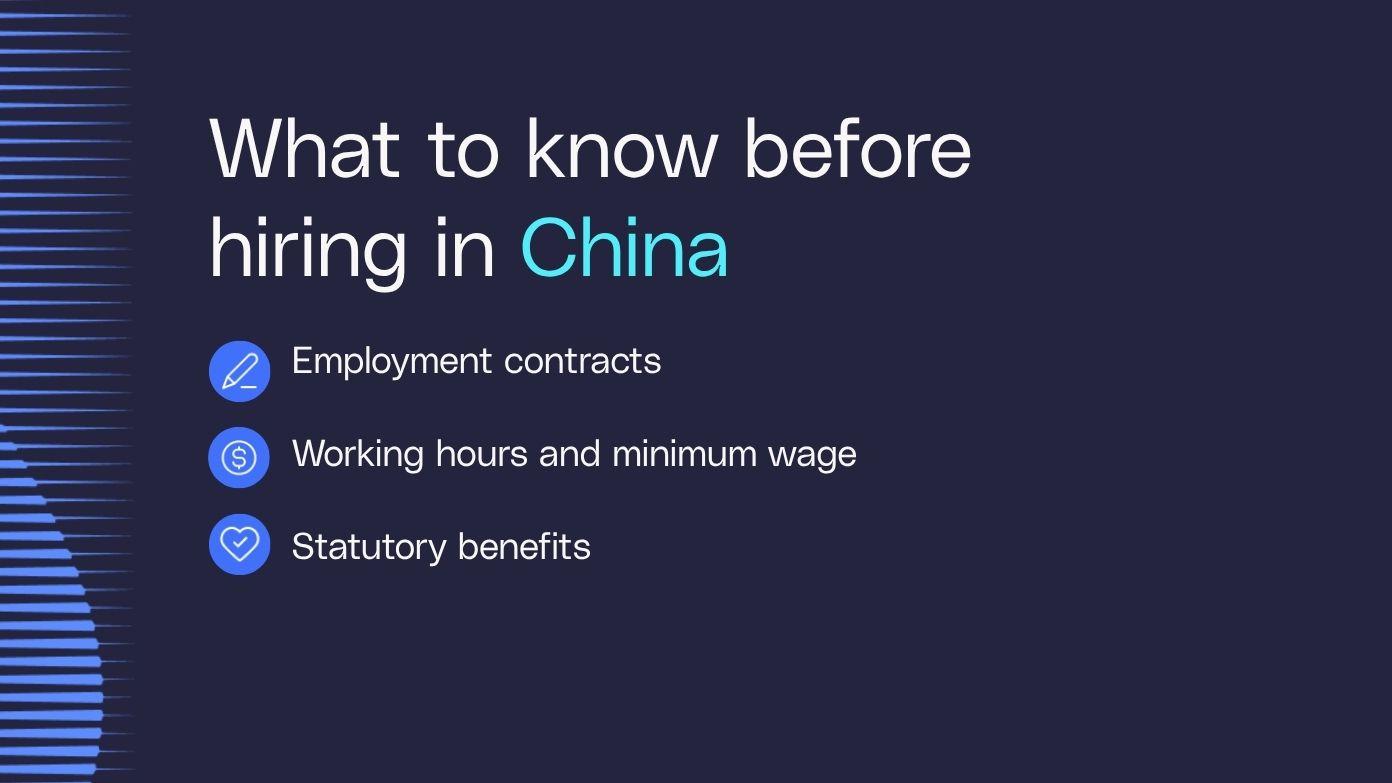
2. Employment contracts in China
Employers in China have to provide a written employment contract to every employee. Employers must conclude a written employment contract when employment begins or within one month of the employee starting work. If the contract isn’t signed within one month of the employee starting, the employer must pay double the employee’s monthly wage for each month the contract remains unsigned (up to one year).
A compliant employment contract in China must include:
- Employer’s full name, registered address, and legal representative or principal person in charge
- Employee’s full name, address, and valid identification number
- The type of contract (fixed-term, open-ended, or project-based)
- Job description and place of work
- Working hours, rest, and leave entitlements
- Compensation details (salary in Chinese Yuan Renminbi, payment frequency, and any bonuses)
- Social insurance obligations (both employer and employee contributions)
- Occupational protection, working conditions, and protection against occupational hazards
- Termination conditions and procedures
- Any other items required by law or mutually agreed upon
Draft contracts in Mandarin Chinese. If you use a bilingual contract, make sure the Chinese version accurately lists all the terms in case there are discrepancies.
3. Wages and working hours in China
The standard workweek in China is eight hours per day and 40 hours per week. This is set out by the Labor Law and the State Council’s Regulations on Employee Working Hours. Employees get at least one full rest day per week.
Overtime pay in China breaks down as follows:
- Workday overtime: At least 150% of the normal wage for extra hours worked
- Rest day overtime: At least 200% of the normal wage if compensatory time can’t be provided
- Statutory holiday overtime: At least 300% of the normal wage. Compensatory time off is not allowed as a substitute.
Overtime should not exceed one hour per day, or three hours in special circumstances, and must not exceed 36 hours per month.
There’s no national minimum wage in China. Provinces, municipalities, and autonomous regions set their own minimum wages. For example, as of July 2025, Shanghai’s minimum wage is 25 yuan per hour and 2,740 yuan per month.
China doesn’t provide a 13th-month or annual bonus. However, it’s a customary practice, and many employees expect it as part of their total compensation.
4. Statutory benefits in China
Employees in China get the following five types of social insurance, plus the housing fund.
- Pension insurance: Provides retirement income security
- Health insurance: Covers nonoccupational medical expenses, including outpatient and hospitalization
- Unemployment insurance: Offers financial support to employees who are involuntarily unemployed
- Work-related injury insurance: Covers workplace injuries or occupational diseases contracted during employment
- Maternity insurance: Covers maternity-related medical expenses and provides income replacement related to childbirth (now often merged with medical insurance, but still a statutory benefit)
- Housing provident fund: A mandatory savings program to help employees with housing-related expenses, such as buying or renovating a home or repaying a mortgage
Both employers and employees contribute to these funds, except for work-related injury and maternity insurance, which the employer funds. Local governments set contribution rates, which vary by city and region. Each locality sets minimum and maximum salary thresholds for calculating contributions, which are adjusted annually.
Employers are responsible for registering employees and remitting both employer and employee contributions to the relevant authorities each month. The statutory “5+1” benefits are mandatory. Many employers offer supplemental benefits (such as higher housing fund contributions, supplemental health insurance, or additional allowances) to attract and retain top talent. This is a common and effective strategy in competitive labor markets.
5. Holidays and required leave in China
China has 13 national holidays. These include New Year’s Day, Spring Festival (Lunar New Year), Qingming Festival, Labor Day, Dragon Boat Festival, Mid-Autumn Festival, and National Day. Some holidays span multiple days (e.g., Spring Festival and National Day). The government publishes an annual schedule for public holidays and any adjusted working days.
Annual leave is based on years of service (across all employers):
- 1-10 years: 5 days
- 10-20 years: 10 days
- 20+ years: 15 days
When an employer doesn’t arrange required annual leave, it generally must pay 300% of the employee’s daily wage for the unused statutory leave. Unused leave can be carried over to the next year with employee consent, but has to be used within that year.
Sick leave entitlements and pay are set by local regulations and depend on the employee’s length of service and work history. Sick leave can range from a few months to up to two years. Sick leave pay ranges from 60–100% of the employee’s regular wage but can’t fall below 80% of the local minimum wage.
Hiring models for global companies in China
You have several options when hiring employees in China.
- Direct hiring through your own entity: If you establish a local entity in China, you will take responsibility for all the employment obligations. This includes local compliance, payroll, taxes, employment contracts, HR records, housing provident fund contributions, and social insurance. Establishing a local entity may make sense when your goal is to build a long-term business in China.
- Hiring through an employer of record: An China employer of record (EOR) allows you to hire employees in a country where you don’t have a local entity. The EOR is essentially the “legal employer” and handles the employment obligations while you take care of the day-to-day work. G-P EOR lets companies hire, onboard, and manage employees in 180+ countries without establishing their own entities. If you’re hiring in China, this approach reduces your administrative work.
- Establishing a subsidiary or branch: A subsidiary is a separate legal entity that can hire employees in China directly while still operating as part of your business. A branch is an extension of your parent company rather than a separate legal entity. In both cases, you must maintain a local presence and comply with Chinese employment obligations. These options make sense for companies planning a long-term presence in China.
- Hiring independent contractors: An independent contractor provides services rather than working as an employee. China doesn’t decide what a worker’s status is based on a label. Rather, Chinese courts and labor authorities inspect the work relationship, including what work they do for your company and how they fit into your business. If the person works like an employee, you could face the risk of misclassifying them. Review your worker’s classification before hiring begins, and make sure your classification matches the actual working relationship.
Top hiring hubs in China
Some cities in China are known for particular industries. Knowing what each city has to offer allows you to focus your hiring efforts in the right place and fill roles faster.
The top talent hubs in China are:
- Beijing is the capital city and a major center for government, technology, finance, education, and media. It’s home to many multinational headquarters, state-owned enterprises, and a growing startup scene.
- Shanghai is China’s largest city and a global financial hub. It’s known for its finance, technology, trade, and professional services sectors and attracts big global investment and talent.
- Shenzhen is a leading technology and innovation center, often called China’s Silicon Valley. Shenzhen is home to major tech companies like Huawei and Tencent. It’s strong in electronics, manufacturing, and financial services.
- Guangzhou is the capital of Guangdong Province and a manufacturing and trade hub. It’s home to major industries, including automotive, electronics, and logistics.
- Chengdu is the economic and technology center of western China. The city is a growing center for IT, finance, and the automotive sectors. It’s popular for tech startups and R&D centers as well.
Key industries in China
Understanding China’s main industries allows you to benchmark salaries and benefits. You can use this insight to make smart choices about where to invest and grow your workforce.
The main industries in China include:
- Manufacturing: China is known as the “world’s factory,” producing electronics, machinery, textiles, automobiles, steel, and consumer goods.
- Technology and electronics: Major sectors include IT, telecommunications, semiconductors, and consumer electronics. China is home to global tech giants like Huawei, Tencent, Alibaba, and Xiaomi.
- Automotive: China is the world’s largest automotive market, with strong domestic brands and big global investment. Electric vehicles (EVs) and battery manufacturing are fast-growing areas.
- Finance and banking: Shanghai and Shenzhen are major financial centers. The sector includes banking, insurance, asset management, and fintech.
- E-commerce and retail: China leads the world in e-commerce, with platforms like Alibaba, JD.com, and Pinduoduo. There’s fast growth in online retail, logistics, and digital payments.
Cost of hiring an employee in China
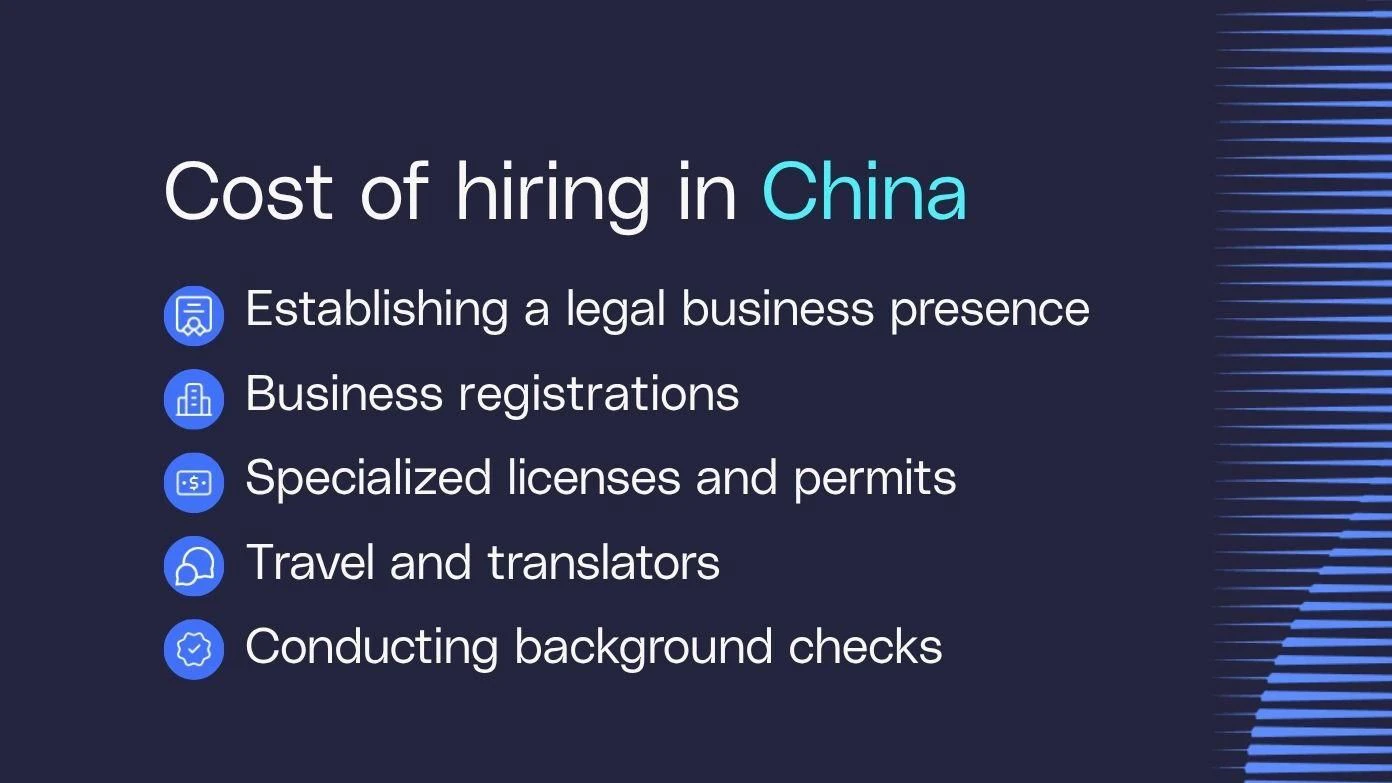
Whether you’re hiring one employee or an entire team in China, expenses are inevitable, and you’ll need to cover more than salary. Budget for the following:
- Entity setup (unless you partner with an employer of record)
- Job advertisements
- Labor costs for applicant review
- Payroll
- Taxes
- Salaries
- Benefits
- Bonuses
- Allowances
- Insurance
- Travel
- Translator (if applicable)
According to G-P Verified Sources from Gia, the employer burden rate in China, which includes costs triggered on top of salaries, is approximately 30–40%.
What does a company need to hire employees in China?
Make sure you cover these essentials before expanding your team in China:
- Get a business license from your local Administration for Market Regulation (AMR).
- Register with the local tax bureau to get your taxpayer identification number (TIN).
- Set up tax accounts for value-added tax (VAT), corporate income tax, and other applicable taxes.
- Open a local bank account.
- Register your company and employees with the local Social Insurance Bureau and Housing Provident Fund Management Center.
- Set up a compliant payroll system to calculate and withhold taxes, social insurance, and housing fund contributions.
- Register for other local requirements (e.g., foreign exchange registration, customs registration for import/export businesses).
- Keep proper HR records and comply with local labor law reporting and filing obligations.
Setting up a China subsidiary can take weeks or months. Use G-P EOR to hire full-time employees in China without setting up your own entity. Build your team in China at a lower cost and with peace of mind that you’re doing so compliantly.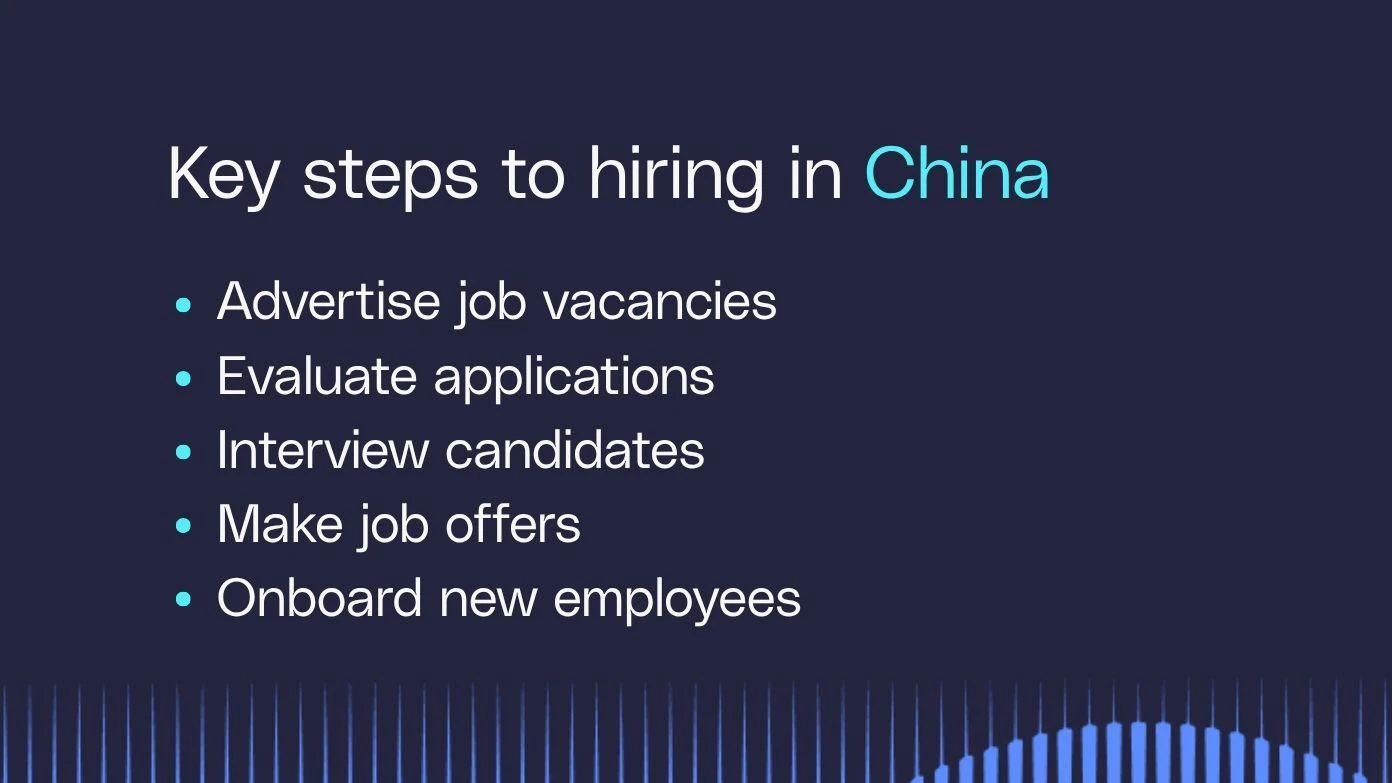
Steps to hiring in China
The hiring process in China is similar to the one you’re likely familiar with in your own country. The hiring process follows five basic steps: advertising the job, evaluating applications, interviewing candidates, sending job offers, and onboarding new employees.
1. Advertising job vacancies in China
Define the role, responsibilities, qualifications, and compensation package. Make sure the job description is compliant with Chinese labor laws. 51job, Zhaopin, and Liepin are popular job sites in China.
2. Evaluating job applications in China
Collect applications and review resumes. Screen candidates based on their qualifications, experience, and fit for the role.
3. Interviewing candidates in China
Interview candidates who made it onto your shortlist. You can do these interviews in-person or virtually. Gia can help you create questions that follow antidiscrimination laws in China, so you can find the best fit for the role while complying with local regulations. Use skills assessments, technical tests, or psychometric evaluations if relevant to the role. Check references and verify qualifications.
4. Making job offers in China
Contact your chosen candidate to offer them a position with your company. Draft a compliant, written employment contract in Chinese (bilingual if needed), including all mandatory clauses (job title, compensation, benefits, working hours, etc.). The employment contract should be signed when employment begins or within one month of the employee starting work.
5. Onboarding new employees in China
Now you can onboard new employees. Register your new hire with the local social insurance and housing fund bureaus. Collect required documents (ID, diplomas, bank account details, etc.) and provide orientation, training, and access to company systems.
Make sure that payroll, social insurance, and tax withholdings are set up correctly and keep accurate HR records.
If you’re working with G-P EOR, you won’t have to worry about the administrative burden of onboarding. We’ll streamline the process, so you can focus on training the new hire and integrating them into your company culture.
Hiring contractors in China
Working with independent contractors in China can be a cost-effective way to test the market and build a presence without hiring full-time employees. Depending on their experience, local contractors can bring knowledge of consumer behavior and business practices to specific projects. They may also have established work processes that help them get started quickly.
Hiring contractors allows you to easily adjust your workforce based on your business needs, without the complexities and costs of employment.
Before you enter an agreement with an independent contractor in China, consider the following:
1. Employees vs. independent contractors in China
It’s important to understand the difference between employees and independent contractors. In China, employers hire employees to do work and, in return, pay them a regular salary and benefits. Independent contractors provide services. Unlike employees, contractors set their schedules, use their own equipment, and work on specific projects rather than having an ongoing role.
2. How to pay contractors in China
G-P Contractor™ takes away the messy, time-consuming process of hiring and paying international contractors. You can create and issue contracts and pay contractors with just a few clicks, while supporting a compliant process.
Hire employees and contractors in China with G-P
Our SaaS and AI-powered products – G-P-EOR, G‑P Contractor, and Gia – support companies as they build and manage global teams. G-P is the recognized leader in global employment with more than a decade of experience, the largest team of HR, legal, and compliance experts, and a global proprietary knowledge base.
Make your expansion to China easier with G-P. Contact us or book a demo today.
FAQs
What are the mandatory parts of an employment contract in China?
Employment contracts have to be in writing and include job title, duties, compensation, working hours, benefits, social insurance, and termination conditions.
What are the five types of social insurance in China?
Pension, medical, unemployment, work injury, and maternity. Contribution rates vary by city.
What are the rules for working hours and overtime in China?
The standard working hours in China are eight hours per day and 40 hours per week. Overtime pay is 150% on a workday, 200% on a rest day, and 300% on a public holiday.
How is annual leave determined in China?
Annual leave is based on cumulative years of service: five, 10, or 15 days. Unused statutory leave is compensated at 300% of the employee's daily wage.
Is there at-will employment in China?
No. Termination must follow statutory procedures and grounds. Severance is usually required unless for serious misconduct.

