





What to know before hiring in Vietnam
If you're expanding your business into Vietnam for the first time, there are important legal requirements to be aware of. These norms and laws influence hiring practices in Vietnam and many aspects of the employer-employee relationship, including compensation and benefits.
G-P Gia™, our AI-powered global HR agent, can answer your toughest compliance questions across 50 countries — including Vietnam — and all 50 U.S. states. Reduce your reliance on outside counsel and cut the time and cost of compliance by up to 95% with Gia.
Here are five things to know about hiring in Vietnam:
1. Languages
Vietnam's official language is Vietnamese. Many residents speak English, French, Chinese, Khmer, and other languages from the country's mountainous region. Consider hiring a professional Vietnamese translator and written interpreter if you're unfamiliar with the Vietnamese languages.
2. Working hours and sick leave
Vietnam has 11 paid public holidays per year, including a five-day Tet Lunar New Year celebration. Employees get these holidays off in addition to their annual leave.
Employees get a minimum of 12 paid annual leave days after one year of service. This increases by one day every five years of service with the same employer. Employers under the age of 18 or in hazardous jobs get 14 days after one year of service, and those in especially hazardous jobs get 16 days.
The maximum working time in Vietnam is capped at 12 hours in a single day or 48 total hours in a week, including overtime. Overtime is allowed within statutory limits: 40 hours per month and 200–300 hours per year, depending on the sector. Employees get at least 24 consecutive hours of rest per week. If operational needs prevent a weekly rest day, employees get at least four rest days per month.
Vietnam law provides for extra paid leave for personal reasons like marriage or death of immediate family. Unpaid leave is available upon mutual agreement. Employees covered by social insurance get paid sick leave. This is paid by the Social Insurance Fund.
3. Leave entitlements
Expecting employees get six months of paid maternity leave for their first child and seven months for their second. Employees are also given an extra month of leave for twins or two extra months for triplets. This is paid by the Social Insurance Fund at 100% of the average salary used for social insurance contributions. Fathers contributing to social insurance get 5–14 days of paid paternity leave, depending on the circumstances:
- Five days for a standard birth
- Seven days for a caesarean or premature birth
- 10 days for a second child
- 10–14 days for multiple births
4. Employment contracts
Vietnamese law requires a written employment contract for any work relationship lasting one month or longer. Verbal contracts are only allowed for jobs under one month (with some exceptions). There are only two types of contracts:
- Indefinite-term (no end date)
- Fixed-term (up to 36 months)
Contracts have to include employer and employee identification details, job description and workplace, salary and compensation (in local currency), benefits and insurance, working hours, rest periods, holidays, termination and severance conditions, rights and obligations of both parties, probationary period (if applicable), and health and safety provisions.
All of these are statutory requirements. The contract can be declared void or subject to penalties if you leave any clauses out. All contract amendments, including promotions and salary increases, have to be mutually agreed and documented in writing.
5. Compensation and benefits
Minimum wage in Vietnam is set by region. As of Jan. 1 2026, these rates are:
- Region I: VND 5,310,000
- Region II: VND 4,730,000
- Region III: VND 4,140,000
- Region IV: VND 3,700,000
Employers and employees have to contribute to:
- Social insurance: 17.5% of salary (employer), 8% (employee)
- Health insurance: 3% (employer), 1.5% (employee)
- Unemployment insurance: 1% (employer), 1% (employee)
Employers have to give health insurance to all employees. They must also provide annual health checks for employees. Extra benefits such as housing, transportation, and other allowances are common. These are generally taxable unless specifically exempted by law.
Hiring models for global companies in Vietnam
There are a few options for expanding your business into Vietnam, each with their own pros and cons. These options include:
- Direct employer registration: establishing a legally registered entity in Vietnam to employ workers directly. You will independently manage payroll, tax withholding, statutory insurance, and other employer obligations.
- Employer of record (EOR): G-P EOR acts as the legal employer, handling administrative and payroll processes on behalf of your company, including contracts, withholding, contributions, and statutory benefits.
- Subsidiary or branch: a subsidiary will function as a separate legal entity, while a branch will function as an extension of your parent company.
- Independent contractor: hiring independent contractors in Vietnam doesn't require establishing a local entity or branch. However, there are significant penalties for misclassified workers, so legal tests must be followed when hiring them.
Setting up a Vietnam subsidiary can take weeks or months. Use a Vietnam EOR to hire full-time employees without setting up your own entity. Build your team in Vietnam at a lower cost and with peace of mind that you're doing so compliantly.

Top hiring hubs in Vietnam
Some cities in Vietnam are known for particular industries. Knowing what each city has to offer allows you to focus your hiring efforts in the right place and fill roles faster.
The top talent hubs in Vietnam are:
- Ho Chi Minh City is the largest city and economic powerhouse. It's known for industries like technology, manufacturing, finance, and services.
- Hanoi is the capital city and a major center for government, education, technology, and professional services.
- Hai Phong is a key port city and industrial hub in northern Vietnam. It's strong in manufacturing and logistics.
- Da Nang is the largest city in central Vietnam. It has a growing tech, tourism, and manufacturing sector.
- Binh Duong and Dong Nai are provinces near Ho Chi Minh City. They're major industrial zones, home to factories and export-oriented businesses.
Key industries in the Vietnam
Understanding Vietnam's main industries allows you to benchmark salaries and benefits. You can use this insight to make smart choices about where to invest and grow your workforce.
The main industries in Vietnam include:
- Manufacturing and export processing: Vietnam is a major global hub for electronics assembly and textile production.
- Logistics and supply chain: Logistics, warehousing, and transportation are key growth sectors.
- Agriculture and aquaculture: Vietnam is a leading exporter of rice, coffee, seafood (especially shrimp and fish), and other agricultural products.
- IT and software development: Vietnam's IT sector is growing, with strong software development, digital services, and business process outsourcing.
- Tourism and hospitality: Vietnam's natural beauty and cultural heritage make tourism a big contributor to the economy, supporting hotels, resorts, and related services.
Cost of hiring an employee in Vietnam
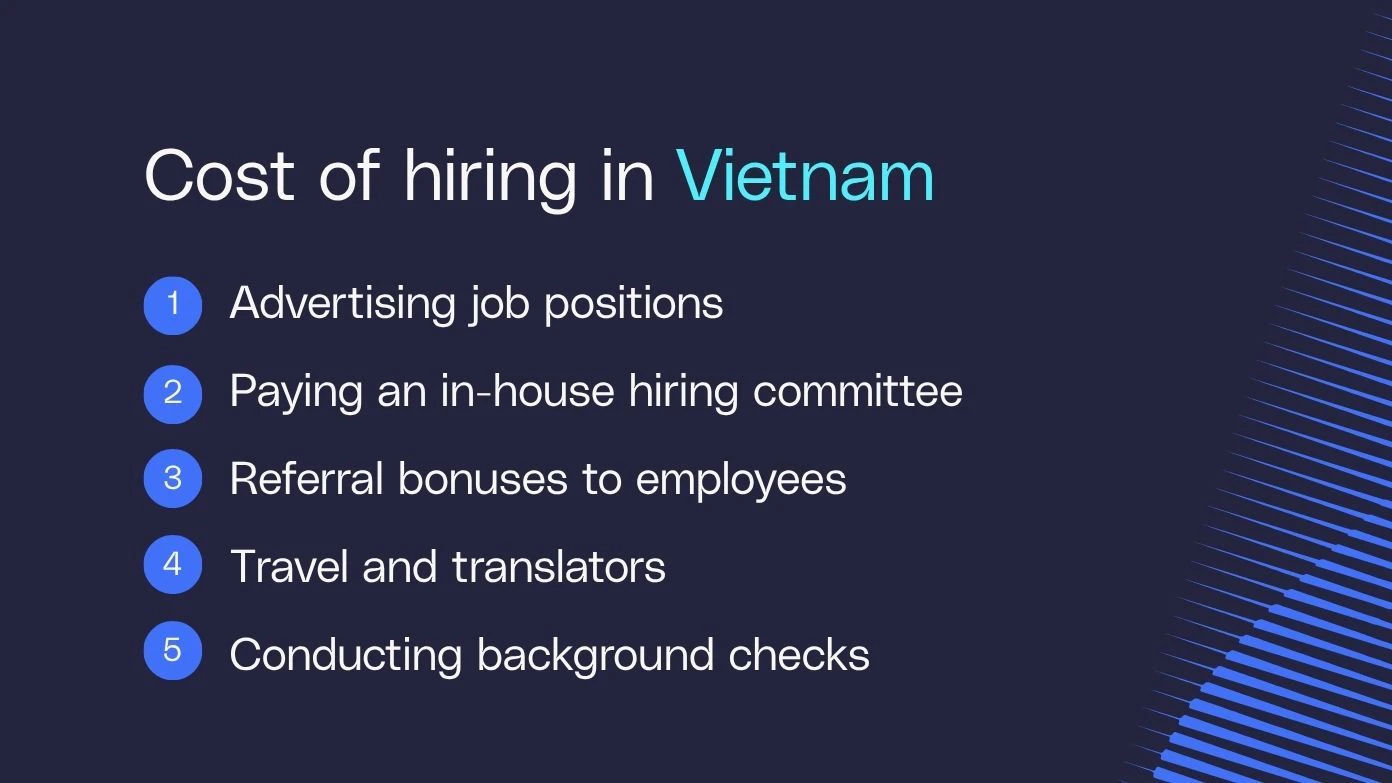
Whether you're hiring one employee or an entire team in Vietnam, expenses are inevitable. Budget for the following:
- Entity setup (unless you partner with an employer of record)
- Job advertisements
- Labor costs for applicant review
- Payroll
- Taxes
- Salaries
- Benefits
- Bonuses
- Allowances
- Insurance
- Travel (if applicable)
- Translator (if applicable)
According to G-P Verified Sources from Gia, the employer burden rate in Vietnam, which includes costs triggered on top of salaries, is approximately 21.5%.
What does a company need to do to hire employees in Vietnam?
Make sure you cover these essentials before expanding your team in Vietnam:
- Secure a lawful Vietnamese employing entity or third-party employment solution.
- File your official company name and register with a competent provincial business registration authority.
- Get an Enterprise Registration Certificate (ERC), which generally also serves as your Taxpayer Identification Number (TIN).
- Open a local bank account using your ERC and TIN. This supports payroll but does not authorize hiring.
- Register with the local social insurance agency to enroll employees in social, health, and unemployment insurance schemes.
- Sign written employment contracts with each employee, in compliance with Vietnamese labor law.
- Register new hires with the local labor authority by the applicable deadlines.
- Submit periodic workforce reports to Vietnamese authorities.
Worker authorization for non-nationals in Vietnam
Non-nationals must meet specific requirements in order to work legally in Vietnam. These include:
- Getting a work permit, unless they qualify for a statutory exemption. The employer usually sponsors this application to prove that all local requirements are met. The employer is also responsible for tracking the permit's validity period and renewing or replacing it as needed.
- Submitting supporting documents, which may include a valid passport, health certificate, background check, skill and reference check, and an employment contract or letter. Documents issued from outside Vietnam may need to be legalized, translated, and notarized.
- Potentially getting a visa or temporary residence card, which will be linked to the sponsoring employer.
Employers who allow individuals to work without the required authorization may face fines or other compliance penalties. 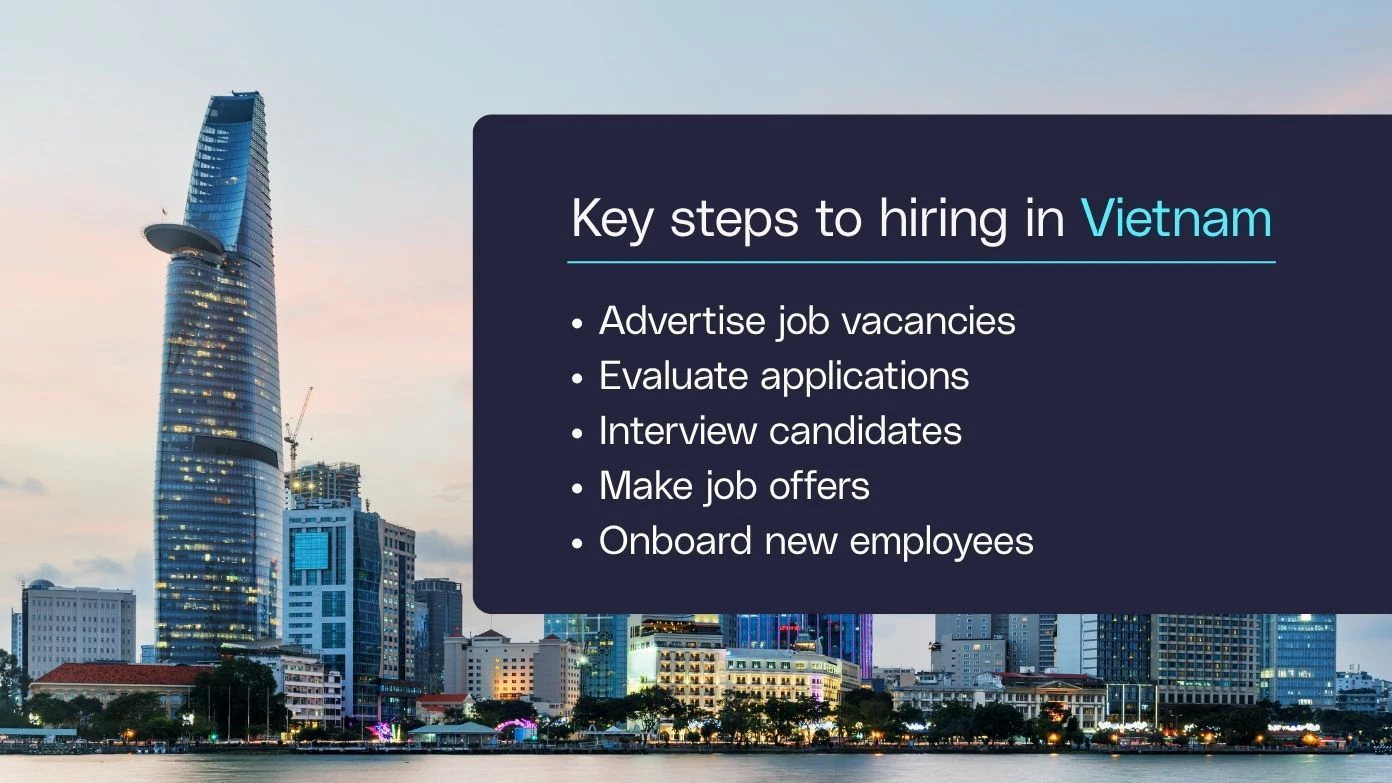
Steps to hiring in Vietnam
The hiring process in Vietnam is similar to the one you're likely familiar with in your own country. The hiring process follows five basic steps:
1. Advertise job vacancies
Clearly define the role, responsibilities, qualifications, and compensation package. Make sure the job description complies with Vietnamese labor laws.
VietnamWorks, CareerBuilder, and TopCV are popular job sites in Vietnam.
2. Evaluate applications
Collect applications and review resumes. Screen candidates based on their qualifications, experience, and fit for the role. If you do an initial screening, avoid asking candidates about their age, marital status, or health.
3. Interview candidates
Interview candidates who made it onto your shortlist. You can do these interviews in-person or virtually. Use structured, nondiscriminatory interview questions. Gia can help you create questions that follow antidiscrimination laws in Vietnam, so you can find the best fit for the role while complying with local regulations.
4. Make job offers
Contact your chosen candidate to offer them a position with your company. Prepare a compliant employment contract. Both parties have to sign the contract before the employee starts work.
5. Onboard new employees
Now you can onboard new employees. Register your employee with the local social insurance agency for social, health, and unemployment insurance. Notify the local labor authority (DOLISA) of the new hire within 30 days.
If you're working with G-P EOR, you won't have to worry about the administrative burden of onboarding. We'll streamline the process, so you can focus on training your new hire and integrating them into your company culture.
Hiring contractors in Vietnam
Working with independent contractors in Vietnam can be a cost-effective way to test the market and build a presence, without the commitment of full-time employees.
Contractors based in Vietnam understand local consumer behavior, rules, and business practices. They'll be ready to start working quickly with their own equipment and established work processes.
Hiring contractors allows you to easily adjust your workforce based on your business needs, without the complexities and costs of employment.
Before you enter an agreement with an independent contractor in Vietnam, consider the following:
1. Employees vs. independent contractors
It's important to understand the difference between employees and independent contractors. In Vietnam, employers hire employees to do work and, in return, pay them a regular salary and benefits. Independent contractors provide services. Unlike employees, contractors set their schedules, use their own equipment, and work on specific projects rather than having an ongoing role.
2. Penalties for misclassification
Classifying someone as a contractor when they're not can lead to severe penalties. Worker classification isn't just based on contracts, but also supervision, direction, payment, and working arrangements. If misclassification occurs, you may have to:
- Legally reclassify the employee.
- Face administrative penalties imposed by labor authorities from related contract, registration, payroll, insurance, tax, and benefits violations.
- Pay outstanding social, health, and unemployment insurance contributions that should have been made for the misclassified employee, including late payment charges.
- Pay applicable retroactive statutory benefits, which may include paid leave, severance pay, and other entitlements under the Labor Code.
- Face criminal liability in serious cases of qualifying insurance or tax evasion. Misclassification alone doesn't cause criminal liability.
3. How to pay contractors
G-P Contractor™ takes away the messy, time-consuming process of hiring and paying international contractors. You can create and issue contracts and pay contractors with just a few clicks, all while ensuring a compliant process.
Hire employees and contractors in Vietnam with G-P
Our Global Employment Platform and its AI-powered products, EOR, Contractor, and Gia, enable companies of all sizes to build and manage global teams.
G-P is the recognized leader in global employment with more than a decade of experience, the largest team of HR, legal, and compliance experts, and a global proprietary knowledge base.
Make your expansion to Vietnam easier with G-P. Contact us or book a demo today.
 Frequently asked questions
What are the main statutory requirements for hiring employees in Vietnam?
You have to comply with the Vietnamese labor code, register employees with social insurance, and make sure contracts are in writing.
What are the standard probation periods in Vietnam?
Probation periods vary by job type but generally range from 6–60 days, depending on the position and qualifications, but may extend up to 180 calendar days for qualifying enterprise managers.
What are the minimum wage requirements in Vietnam?
Vietnam has region-specific minimum wages that are updated periodically. As of Jan. 1 2026, these rates are:
Region I: VND 5,310,000 Region II: VND 4,730,000 Region III: VND 4,140,000 Region IV: VND 3,700,000
How is overtime regulated in Vietnam?
Overtime requires employee consent and is paid at least 150% on normal workdays, 200% on weekly rest days, and 300% on public holidays or paid leave days. Additional premiums apply to night work.
What are the rules for terminating an employee in Vietnam?
Termination has to follow strict legal procedures, including notice periods and, in some cases, severance pay. Employees with at least 12 months of service are entitled to half a month's average salary (over the last six months) for each year of service, unless terminated for disciplinary reasons. Unlawful termination can result in penalties.