




Key takeaways
- Portugal’s top hiring hubs are Lisbon, Porto, and Braga.
- Top industries in Portugal include manufacturing, agriculture, fishing, renewable energy, and technology.
- Companies hiring in Portugal have various options for setup, including partnering with an employer of record (EOR), hiring contractors, establishing a subsidiary, or direct employer registration.
Portugal's time zone is great for companies with operations across the Americas and Europe. The country’s high English proficiency, affordable cost of living, and business-friendly practices make it an attractive market for global companies. According to the OECD, Portugal offers one of the lowest operational costs in Europe.
Before expanding into Portugal, you’ll need to understand contracts, taxes, wages, benefits, and other employment laws. Our guide will tell you everything you need to know about hiring in Portugal.
What to know before hiring in Portugal
If you’re expanding your business into Portugal for the first time, there are important legal requirements to be aware of. These norms and laws influence hiring practices and many aspects of the employer-employee relationship, including compensation and benefits.
G-P Gia™, our AI-powered global HR agent, can answer your toughest compliance questions across 50 countries — including Portugal — and all 50 U.S. states. Reduce your reliance on outside counsel and cut the time and cost of compliance by up to 95% with Gia.
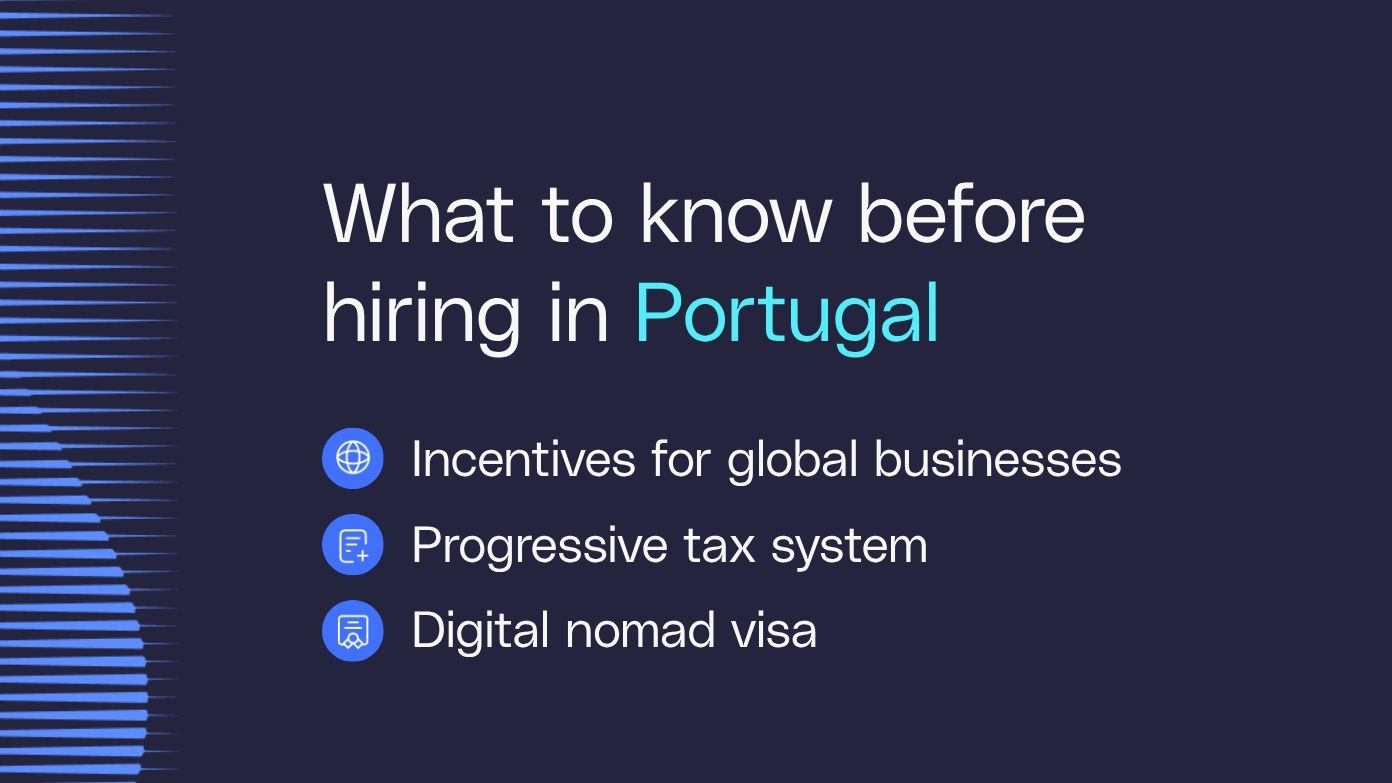
Here are six things to know about hiring in Portugal:
1. Incentives for global businesses
The Portuguese government has created programs to attract international investors. These programs aim to prevent population decline, boost the workforce, and support long-term economic sustainability. Programs and incentives include:
- D2 entrepreneur visa: The D2 visa is for non-EU/EEA/Swiss nationals looking to set up or grow their business in Portugal. The visa grants residence rights. Applicants have to present a business plan highlighting economic impact, and the potential for job creation is also beneficial.
- Startup visa: This visa is aimed at entrepreneurs from outside the EU/EEA. Applicants must present a scalable business idea that’ll create qualified jobs, and certified-incubator acceptance is required.
- Golden visa program: This residency-by-investment program allows non-EU/EEA/Swiss nationals to get residence permits by investing in job creation, research support, cultural projects, and more.
- Tax Incentive for Scientific Research and Innovation (IFICI): This program, sometimes called NHR 2.0, offers benefits for new, eligible tax residents. Benefits include a 20% flat tax rate on qualifying income and potential exemptions for foreign-source income for 10 consecutive years.
2. Digital nomads
Portugal welcomes skilled workers and investors from around the world to help grow the economy and bring fresh ideas. The country offers two options for digital nomads: a temporary stay visa, and a D8 visa, which can lead to a two-year renewable permit. This visa allows non-EU/EEA/Swiss citizens to live and work in Portugal for up to a year, with an option to extend their stay.
Applicants must prove they work remotely and earn at least EUR 3,680 per month, as of 2026. For immigration eligibility, income can't be from Portuguese sources. Remote work may create tax, payroll, social security, or permanent-establishment exposure for both business owners and employees.
3. Minimum wage
As of Jan. 1, 2026, the national minimum wage is EUR 920 per month in mainland Portugal. The minimum wage is EUR 980 in Madeira and EUR 966 in the Azores. Collective Bargaining Agreements (CBAs) can also set higher sector-specific minimum wages. Wages are usually paid over 14 installments: 12 monthly salaries, a holiday bonus, and a Christmas bonus, which is generally due by December 15.
4. Working hours and time off
The standard workweek is 40 hours. Overtime is generally capped at 150–175 hours, but may vary depending on your company’s size, the worker’s status, and any applicable CBAs. It's paid at premium rates.
The first 100 hours of overtime are paid at:
- 125% for the first hour
- 137.5% for subsequent hours
- 150% on rest days or holidays
After 100 hours of overtime, the rates increase to:
- 150% for the first hour
- 175% for subsequent hours
- 200% on rest days or holidays
Employees are also entitled to a minimum of 22 working days of paid leave. This is in addition to 13 public holidays.
5. Leave entitlements
For maternity leave in Portugal, mothers must take 42 consecutive days (six weeks) of compulsory leave immediately after childbirth. Mothers can take up to 30 days of optional leave before the birth. For multiple births, an extra 30 days per child (after the first) is granted. The national social security system pays for this leave. The payment is based on the average gross earnings over the six months before the leave. Eligibility requires at least six months of social security contributions.
Fathers get 28 calendar days of paternity leave. Fathers must take seven days immediately after birth. The remaining 21 days can be taken consecutively or non-consecutively within 42 days of the birth. For multiple births, fathers get two extra days per additional child. An extra seven working days of voluntary paternity leave may be taken during the mother’s initial leave. All paternity leave is paid at 100% of salary by social security.
Parental leave is also a statutory benefit in Portugal. Parents can choose between 150 days of parental leave at 100% pay or 180 days at 83% pay. If both parents share the leave (with each taking at least 30 consecutive days or two periods of 15 days), the leave can be increased to 180 days at 83% pay. Adoptive parents are usually given the same rights as biological parents.
6. Taxes
Tax rates start at 13% for incomes up to EUR 8,059. Rates increase progressively to 48% for incomes over EUR 83,696. There’s also a solidarity surcharge of 2.5% on incomes over EUR 80,000 and 5% on incomes over EUR 250,000.
Both employer and employee pay social security tax. The tax rate is 11% for employees and 23.75% for employers. These contributions fund pensions, healthcare, unemployment benefits, parental leave, and other statutory benefits.
7. Contract types
Indefinite (open-ended) employment contracts are the default and most common arrangement in Portugal. The law requires a written contract for fixed-term, part-time, or telework employment arrangements. Types of employment contracts include:
- Fixed-term
- Intermittent
- Part-time
- Telecommuting
- Temporary work
Probation periods vary depending on the contract type and employee category. It’s 90 days for most employees and 180 days for management roles.
You should draft contracts in Portuguese. If this isn’t your first language, you can use Gia to draft compliant contracts and other HR documents in Portuguese.
Hiring models for global companies in Portugal
There are a few options for expanding your business into Portugal, each with their own benefits and drawbacks. These options include:
- Direct employer registration: registering your company with Portugal’s government, while handling payroll and other services independently. This may create permanent-establishment or corporate-tax exposure.
- Employer of record (EOR): G-P EOR handles administrative and payroll processes on behalf of your company, including contracts, withholding, contributions, and statutory benefits.
- Subsidiary or branch: a subsidiary will function as a separate legal entity, while a branch will function as an extension of your parent company.
- Independent contractor: hiring independent contractors in Portugal doesn’t require establishing a local entity or branch. However, there are significant penalties for misclassified workers, so strict guidelines must be followed when hiring them.
 Top hiring hubs in Portugal
Some cities in Portugal are known for particular industries. Knowing what each city has to offer allows you to focus your hiring efforts in the right place and fill roles faster.
The top talent hubs in Portugal are:
- Lisbon is the capital and largest city. Situated on the country’s western coast, it’s Portugal’s main economic and employment center. The city is home to multinational companies, tech startups, financial institutions, and service sector employers.
- Porto is Portugal’s second-largest city. Located in the northwest, it’s a major industrial, commercial, and tech hub. The city is especially strong in manufacturing, logistics, and the wine industry.
- Braga is known for its growing technology sector. It attracts both domestic and international companies, particularly in IT and engineering.
- Coimbra is known for its university. The city is a hub for education, research, and healthcare. It's increasingly attracting technology and life sciences companies.
- Faro is the capital of southern Portugal’s Algarve region. The city is a center for tourism, hospitality, and related services.
Key industries in Portugal
Understanding Portugal’s main industries allows you to benchmark salaries and benefits. You can use this insight to make smart choices about where to invest and grow your workforce.
The main industries in Portugal include:
- Manufacturing: Portugal’s strong manufacturing base is particularly successful in automotive, textiles, footwear, and machinery. Specialist talent includes several engineering roles, supply chain and logistics managers, and production and operations planners.
- Agriculture and agri-food: Portugal’s wine, olive oil, cork, and fresh produce are popular exports. Specialist talent includes agronomists, environmental engineers, and food technologists.
- Renewable energy: Portugal is a leader in renewable energy, especially wind, solar, and hydropower. Specialist talent includes several engineering roles, maintenance technicians, and project managers.
- Fishing and maritime: The fishing sector and related maritime industries are important due to Portugal’s long coastline. Specialist talent includes marine biologists, fishery managers, and marine engineers and surveyors.
- Technology and startups: The tech sector is growing fast thanks to new government incentives that encourage investment in startups. Specialist talent includes software developers, engineers, and AI and data scientists.
 Costs of hiring employees in Portugal
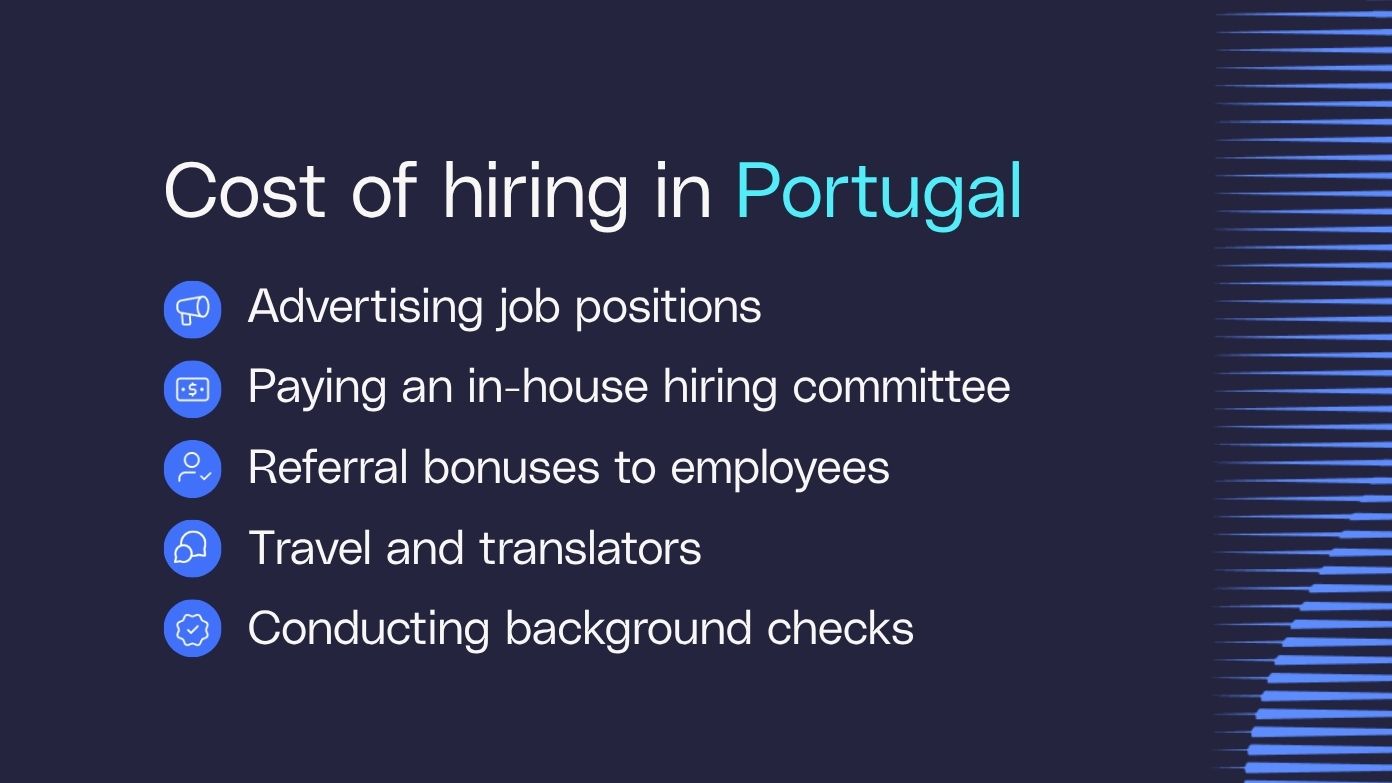
Whether you’re hiring one employee or an entire team in Portugal, expenses are inevitable. Budget for the following:
- Setting up an entity (unless you partner with an employer of record)
- Advertising job positions
- Paying referral bonuses to employees with connections in Portugal
- Paying an in-house hiring committee
- Traveling to and from Portugal, including hotel stays, meals, and transportation
- Partnering with a translator to draft documents or facilitate conversations (if applicable)
- Using a background check service for screening candidates
- Providing employee benefits such as a pension, health insurance, stock options, company car, and meal vouchers
According to G-P Verified Ssources from Gia, the employer burden rate in Portugal, which includes costs triggered on top of salaries, is around 23.75%.
What does a company need to do to hire employees in Portugal?
Make sure you cover these essentials before expanding your team in Portugal:
- Obtaining a Certificate of Admissibility from the National Registry of Collective Persons (RNPC)
- Drafting and submitting Articles of Association
- Providing a registered office address
- Getting a Portuguese Tax Identification Number (NIF)
- Registering with the Portuguese Social Security Authority
- Showing proof of share capital deposit
- Filing a Declaration of Commencement of Activity with the Tax Authority within 15 days of registration
Use a Portugal EOR to hire full time employees without setting up your own entity. Build your team in Portugal at a lower cost and with peace of mind that you’re doing so compliantly.
 The steps to hiring in Portugal
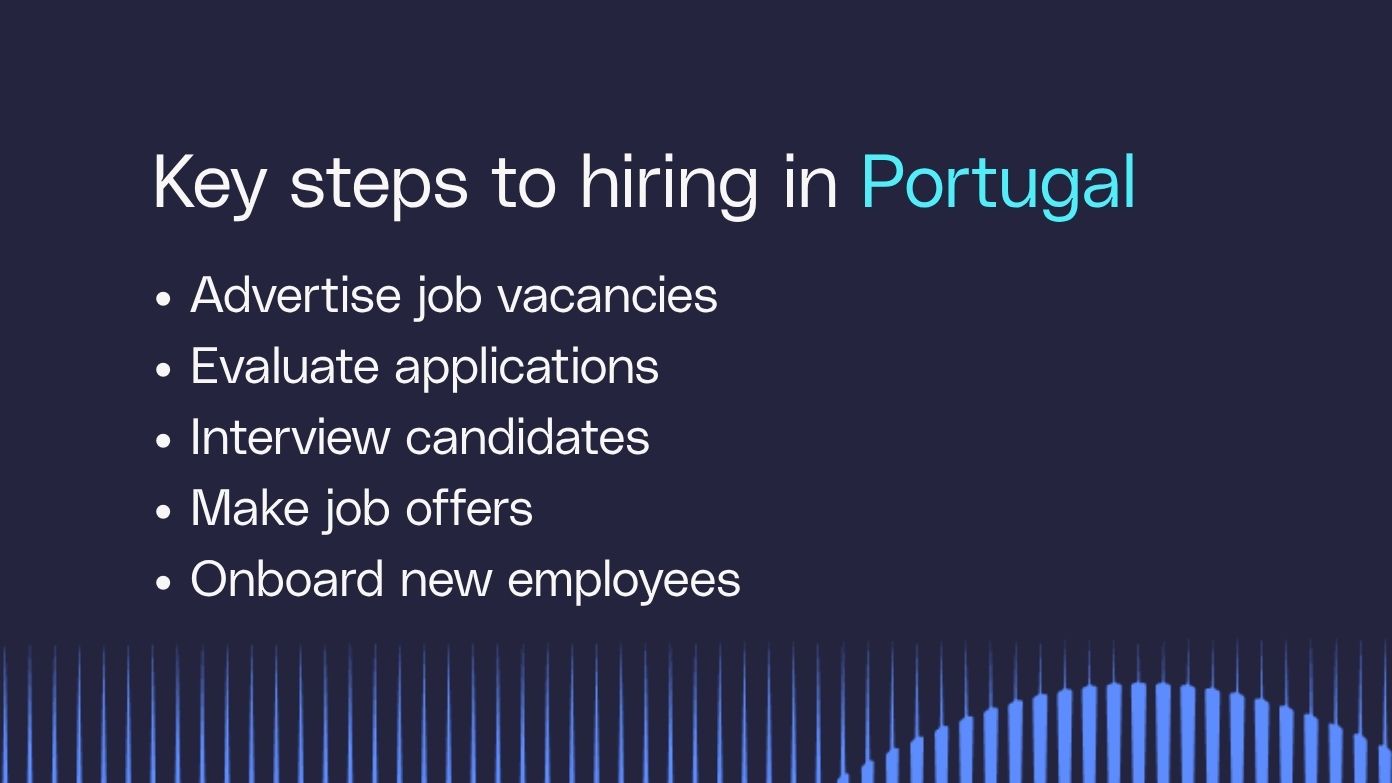
The hiring process in Portugal is similar to the one you’re likely familiar with in your own country. The hiring process follows five basic steps:
1. Advertise job vacancies
Clearly outline the job description, responsibilities, and qualifications. The posting has to mention the contract type and duration, working hours, job qualifications, and workplace location. For remote roles, specify work conditions and equipment provisions. Portuguese is the default language for ads but another language can be used if justified by the role.
Net-Empregos, Alerta Emprego, SAPO Emprego, Empregos Online, and Expresso Emprego are all popular job sites in Portugal.
2. Evaluate applications
Gather CVs and application forms. Screen candidates based on qualifications and experience, ensuring compliance with privacy and antidiscrimination regulations. Inform candidates about how their personal data will be processed, and obtain explicit consent where required.
3. Interview candidates
Interview candidates who made it onto your shortlist. Use structured, nondiscriminatory interview questions. Gia can help you create questions that follow antidiscrimination laws in Portugal, so you can find the best fit for the role while complying with local regulations.
Reference checks and background verifications are allowed but have to comply with data protection regulations.
4. Make job offers
Contact your chosen candidate to offer them a position with your company. A written contract is best practice and is mandatory for fixed-term, part-time, telework, and all non-EU/EEA employees.
5. Onboard new employees
Now you can onboard new employees. You’ll have to register with the Portuguese Social Security Institute (ISS) and file a Declaration of Commencement of Activity. If you’re working with an EOR like G-P, you won’t have to worry about the administrative burden of onboarding. We’ll streamline the process, so you can focus on training your new hire and integrating them into your company culture.
Hiring contractors in Portugal
Working with independent contractors in Portugal can be a cost-effective way to test the market and build a presence without the commitment of full-time employees.
Contractors based in Portugal understand local consumer behavior, rules, and business practices. They’ll be ready to start working quickly with their own equipment and established work processes.
Hiring contractors allows you to easily adjust your workforce based on your business needs, without the complexities and costs of employment.
Before you enter an agreement with an independent contractor in Portugal, consider the following:
1. Employees vs. independent contractors
It’s important to understand the difference between employees and independent contractors. In Portugal, employers hire employees to do work and, in return, pay them a regular salary and benefits. Independent contractors provide services. Unlike employees, contractors set their schedules, use their own equipment, and work on specific projects rather than having an ongoing role.
2. Penalties for misclassification
Classifying someone as a contractor when they’re not can lead to severe penalties. If misclassification occurs, you’ll have to:
- Pay all social security contributions for the period of misclassification.
- Pay all holiday pay, sick leave, and allowances.
- Face limitations on eligibility for certain public funds or services.
3. How to pay contractors in Portugal
G-P Contractor™ takes away the messy, time-consuming process of hiring and paying international contractors. You can create and issue contracts and pay contractors with just a few clicks, all while ensuring a compliant process.
Hire employees and contractors in Portugal with G-P
Our Global Employment Platform and its AI-powered products, EOR, Contractor, and Gia, enable companies of all sizes to build and manage global teams.
G-P is the recognized leader in global employment with more than a decade of experience, the largest team of HR, legal, and compliance experts, and a global proprietary knowledge base.
Make your expansion to Portugal easier with G-P. Contact us or book a demo today.
FAQs
Is there a minimum wage in Portugal?
Yes. As of 2026, the minimum wage in mainland Portugal is EUR 920 per month.
What are the mandatory benefits in Portugal?
Employers must provide social security coverage, holiday and Christmas bonuses (13th and 14th-month pay), and workplace accident insurance.
What are the requirements for terminating an employment contract?
Termination must comply with statutory notice periods and, in some cases, severance pay. Dismissals are only permitted for just cause or redundancy, and unfair termination can result in penalties.
What are the rules for remote or telework arrangements?
Telework is allowed, but it must be formalized in writing and comply with specific legal requirements regarding equipment, expenses, and working conditions.
Do I have to register new hires with Portuguese authorities?
Yes. Employers must register employees with the Social Security system at least 24 hours before employment begins, as well as comply with monthly reporting and payment obligations.