





Key takeaways
- Hiring globally can open the door to legal mistakes, including worker misclassification, permanent establishment risk, overly generic contracts, and overlooking required benefits and bonuses.
- Growing across borders comes with new operational challenges, such as payroll delays, time zone issues, benefits availability, or inefficient onboarding practices.
- Expanding internationally requires cultural sensitivity, like communicating with international employees according to their local norms, acknowledging national holidays, and not assuming that all work locations operate similarly.
Your next hire may be waiting outside your country’s borders. Global hiring gives you access to new markets and specialized talent you can't find locally, but the wrong move can stall your entire international growth strategy.
For over 14 years, G-P has helped companies of all sizes build global teams in 180+ countries, and we’ve seen it all. We’ve put together a list of the 15 most common global hiring mistakes to help you sidestep everyday challenges and build the global team you need to succeed.
Hiring mistakes that have legal consequences
Employment laws differ from country to country. You may be familiar with domestic rules, but these don't apply cross-nationally. These mistakes may have costly consequences, so it's important to keep an eye on changing laws and regulations wherever your company operates.
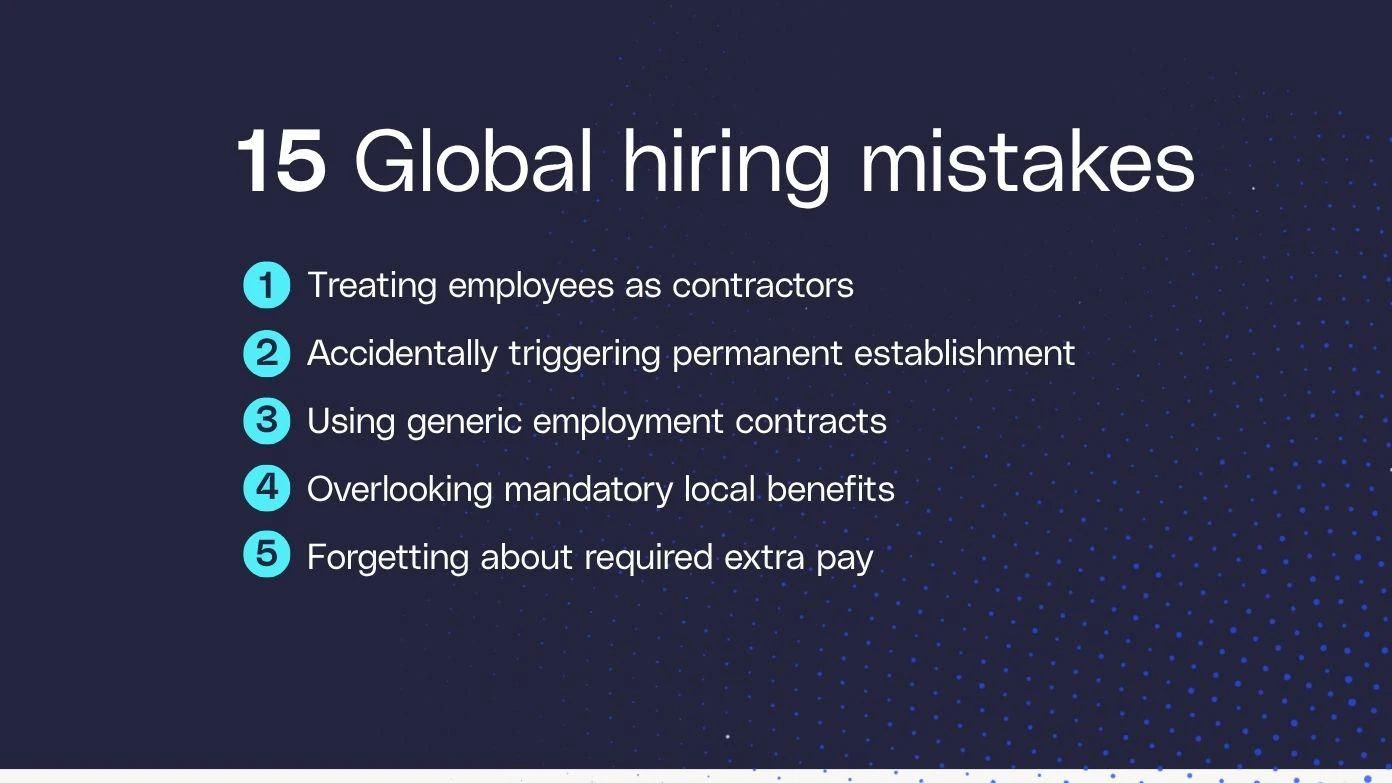
Mistake #1: Treating employees as contractors
Worker misclassification is one of the most common global hiring mistakes. Every country has specific criteria for classifying workers, but it typically comes down to the level of supervision and control. If you misclassify an employee as a contractor, you can face fines and back taxes.
In France, deliberate misclassification can lead to fines of up to EUR 45,000 for individuals and EUR 225,000 for companies, plus imprisonment for up to three years. An employer of record (EOR) like G-P EOR can hire workers on your behalf and make sure they're correctly classified at all times.
Mistake #2: Accidentally triggering permanent establishment (PE)
Opening a branch or setting up an office in a new country can create a local tax presence known as permanent establishment (PE). Failure to meet PE obligations can result in back taxes, interest, and penalties. Some countries even impose criminal sanctions for tax evasion. Make sure to research exactly what activities will create a tax presence in every location you hire in.
If you need a jurisdiction-specific breakdown or want to know what activities create PE in a particular country, G-P Gia™ can help. Gia is an AI-powered global HR agent that doesn't just cut compliance costs — it acts as your immediate, real-time compliance alert system, minimizing legal risks.
Reduce your reliance on outside counsel and cut the time and cost of compliance by up to 95% with Gia.
Mistake #3: Using generic employment contracts
Employment laws are region-specific, so a generic contract won't cut it. Some countries require specific clauses (e.g., probation periods, severance, noncompete terms) or prohibit others.
Courts and labor authorities will often disregard contract terms that conflict with local law. If a dispute arises, only the locally compliant portions of the contract will be upheld. You may have to pay back wages, reinstate employees, or face fines. To avoid major legal missteps like this, draft contracts that are specifically tailored to each country you hire in.
Mistake #4: Overlooking mandatory local benefits
Not offering the right in-country benefits can lead to penalties and unhappy workers. For example, Brazilian labor law requires a comprehensive set of statutory benefits for employees, including:
- A 13th-month salary
- Paid annual vacation with an extra vacation bonus
- A severance fund (FGTS)
- Paid public holidays
- Maternity and paternity leave
- Mandatory social security contributions
Employees can file a claim with the Brazilian labor courts for unpaid benefits. Courts almost always side with employees in such cases. With G-P EOR, you can create country-specific benefits packages and gain peace of mind knowing your global team is getting everything they're entitled to.
Mistake #5: Forgetting about required extra pay
Global hiring has a lot of moving parts. Between base pay, bonuses, benefits, and statutory payments, it's easy to overlook some compensation rules, but forgetting things like 13th-month pay can land you in hot water. Failure to pay this mandatory bonus in Mexico can result in fines ranging from 50 to 5,000 times the daily minimum wage for each affected employee.
Make sure your payment structures are compliant with local regulations.
Common hiring mistakes that lead to operational pitfalls
Getting the legal part right is a big win, but that's just step one. The day-to-day work of managing a global workforce is equally complex. Protect your budget and your team by looking out for these operational pitfalls:
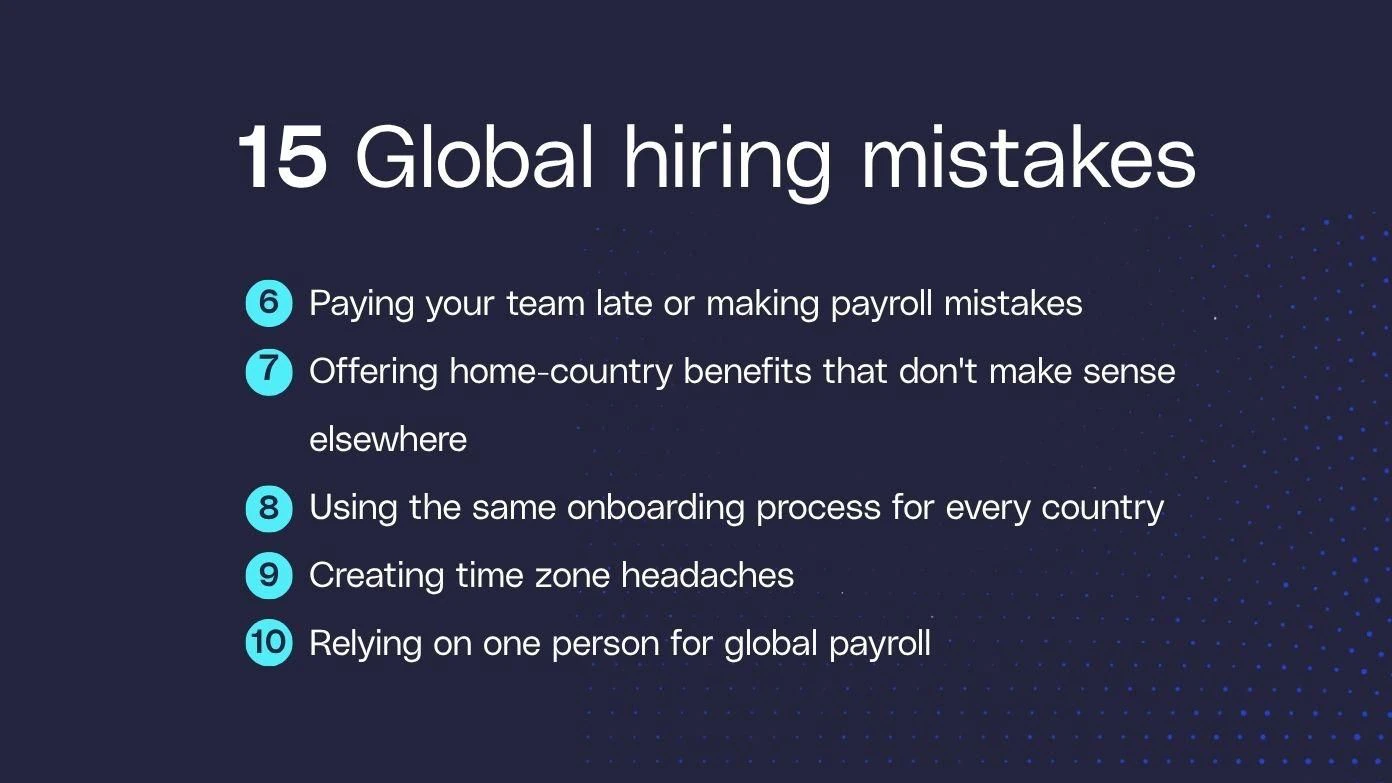
Mistake #6: Paying your team late or making payroll mistakes
Nothing destroys trust faster than payroll errors. Paying late, incorrectly, or using the wrong currency will impact employee productivity and retention. In the U.K., employees can file a claim for "unlawful deduction from wages" when paychecks are late or required deductions are missing.
Avoid this common mistake by investing in global payroll technology that can handle multiple currencies and tax systems, and keep a calendar of payment dates for every country.
G-P's straightforward payroll management adds a layer of simplicity to handling global operations. Putting my trust in G-P means navigating the international business landscape with confidence and ease.
Mistake #7: Offering home-country benefits that don't make sense elsewhere
Don't make the mistake of handing out perks that are only useful in one location. For example, a local gym membership in San Francisco won't benefit your employees in Berlin. Employees should have access to benefits of similar value, regardless of location, to foster a sense of fairness and inclusion across teams.
Instead of a one-size-fits-all approach, develop a core benefits plan that includes flexible, local options for every market.
Mistake #8: Using the same onboarding process for every country
Using the same onboarding process everywhere can cause new global hires to feel lost. Each country has its own mandatory onboarding requirements. These may include:
- Documentation collection
- Health and safety training
- Data privacy notices
- Employment registrations
There are several things you can do to incorporate country-specific considerations into your onboarding, such as:
- Offering welcome materials in the local language.
- Clearly explaining local benefits, statutory entitlements, and any region-specific perks.
- Granting access to local IT support, equipment, and systems.
Use G-P EOR to ensure your onboarding is both compliant and culturally relevant in every market. We'll handle the legal and administrative tasks, so you can start working faster. Simple, self-guided workflows ensure a smooth process for you and your new hires.
Mistake #9: Creating time zone headaches
Distributed teams shouldn't have to constantly attend meetings at midnight or 5:00 a.m. This expectation is a recipe for burnout. The good news is you can fix it by using asynchronous work tools like shared project dashboards and time zone-aware task assignments. Your team can update project progress, share feedback, and review campaign assets on their own schedules and achieve follow-the-sun productivity.
Mistake #10: Relying on one person for global payroll
Relying on only one person to handle global payroll creates a single point of failure for your team. The whole system can fall apart if they're sick or on PTO. You can prevent this by training multiple professionals to manage payroll across different countries.
Cultural mistakes to look out for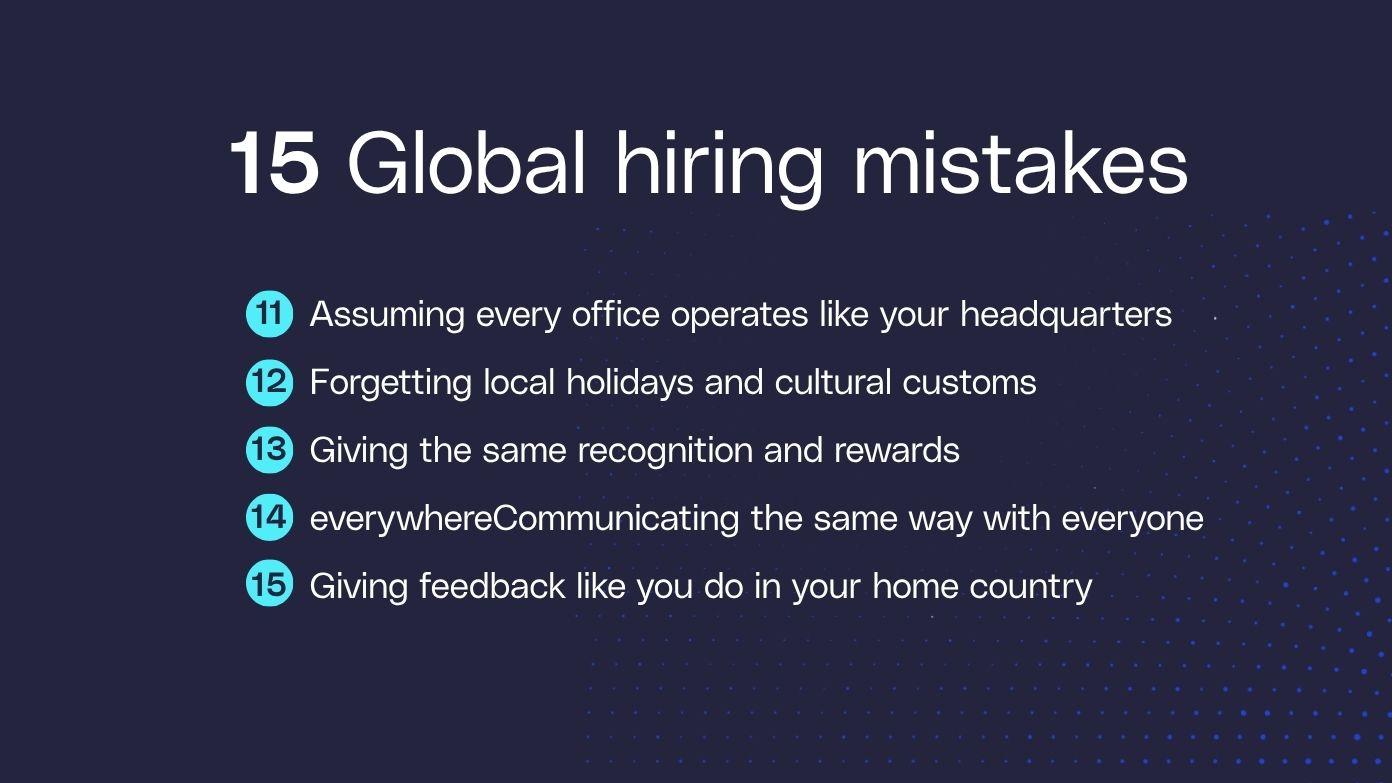
Cultural differences can lead to misunderstandings if you're not prepared. Failing to account for these differences is one of the most common global HR challenges. Some common mistakes include:
Mistake #11: Assuming every office (or remote location) operates like your headquarters
Expecting your global team to adapt to your headquarter’s culture can make employees feel disconnected and isolated. It also harms morale and productivity. You can help by creating a simple guide to work styles in each location and actively promoting cross-cultural awareness across your company.
Mistake #12: Forgetting local holidays and cultural customs
Failing to acknowledge a country's local holidays and customs can create scheduling conflicts, unnecessary stress, and resentment from your team. We suggest creating a global calendar that includes all local holidays. This small step simplifies scheduling and shows your team that you respect their cultures and customs.
Mistake #13: Giving the same recognition and rewards everywhere
In the U.S. or Australia, public recognition, such as announcing an employee of the month in a company-wide meeting, can be motivating for employees. But in countries like Japan or South Korea, public praise can cause embarrassment or discomfort, as modesty and group harmony are highly valued.
Your recognition efforts should always align with cultural expectations. Start by setting up reward systems that are meaningful in each region. If possible, give employees the option to choose what’s most meaningful to them, such as a wellness stipend, an extra vacation day, or a local experience.
Mistake #14: Communicating the same way with everyone
A straightforward communication style can be seen as aggressive or impolite in some countries. Cultures like the U.K. or U.S. are comfortable with written directives and emails. In others, like Brazil or the Middle East, verbal communication and relationship-building are more important. To make sure your messages are always clear and effective, create basic communication guidelines tailored for each region you work in.
Mistake #15: Giving feedback like you do in your home country
Performance reviews give employees a roadmap for growth, but feedback is all about delivery. In some cultures, managers give candid feedback. But this straightforward approach can be perceived as harsh in other regions. Striking the right balance ensures feedback is both constructive and culturally considerate.
Strengthen your hiring process to avoid recruitment mistakes
Having a well-developed recruitment process can help your team hire more effectively, no matter where you’re sourcing candidates. Improve your team’s global hiring strategy by:
-
Defining objective criteria for each role before reviewing candidates.
-
Using multiple reviewers to help reduce individual bias and evaluate candidates more holistically.
-
Scoring candidates on demonstrated skills and relevant experience to avoid personality-based judgements.
-
Documenting feedback quickly after each round of interviews to help keep more accurate records. AI note-takers can also be helpful, as long as candidates consent to their use.
-
Looking into genuine red flags without over-filtering candidates based on differences in their working styles or personal backgrounds.
-
Keeping candidates informed and moving quickly between interview rounds. Unnecessary delays or poor communication throughout the hiring process can cause frustration and create space for top candidates to accept other offers.
Avoid common hiring mistakes with an EOR
EORs are designed to support compliant global hiring and pay regulations. They streamline complicated HR, payroll, and reporting functions, helping you avoid hefty fines and other legal consequences.
An EOR can support your team’s international growth by helping you:
- Enter new markets quickly: If you’re entering a country to test demand, an EOR can help you hire local talent immediately, while you validate the opportunity.
- Lower upfront costs: EORs are more cost-effective than direct entity setup, giving you more freedom and budget flexibility.
- Scale compliantly: An EOR supports compliant employment practices so you can focus on product development and growth.
- Reduce legal exposure: The EOR is the legal employer for your global team members, giving your company an extra layer of protection against risk. This is especially helpful when navigating rules related to statutory benefits, tax withholdings, and other international regulations
- Simplify onboarding: EORs speed up the time to hire, helping you get employees trained and working more quickly. Companies can move from offer to onboarding 87% faster with G-P EOR.
- Unify global operations: An EOR can streamline payroll, benefits administration, and onboarding into a single dashboard. This reduces the potential for manual errors.
- Generate locally compliant HR documents: Many EORs have document creation capabilities such as job descriptions, offer letters, and employment contracts.
- Minimize manual work: EORs streamline hiring administration, including contracts, onboarding, payroll, and offboarding, so your internal HR team doesn’t get bogged down in admin work.
Hire globally with G-P
Our Global Employment Platform and its AI-powered products, G-P EOR, Contractor, and Gia, support companies as they build and manage global teams. International hiring can unlock many competitive advantages, but only when local legal, financial, and operational best practices are followed.
G-P is the recognized leader in global employment with more than a decade of experience. We can help you avoid these 15 costly hiring mistakes to protect your company runway, reduce regulatory audits, and grow compliantly and sustainably.
Make your global expansion easier with G-P. Contact us or book a demo today.
 Frequently asked questions
How can I reduce bias in hiring decisions?
Conduct highly-structured interviews. Be prepared with detailed, job-related questions to assess the candidate's capabilities, and don't make decisions based on emotions or intuition.
Ensure that you have standardized scoring criteria to make hiring decisions based on concrete, measurable information. You should also train interviewers to recognize signs of their own internal biases and work to reduce them.
How do unclear job descriptions lead to bad hires?
Unclear job descriptions can attract candidates with mismatched skills. They can also create inconsistent expectations between interviewers, making the whole process more complex than it needs to be.
Defining the role's core responsibilities, required experience and technical skills will help attract stronger candidates for the role. Breaking down exactly how success will be measured also helps level expectations between hiring managers and job applicants.
When should I involve my team in the hiring process?
Relevant team members should be brought in as needed to assess collaborative potential, technical skills, or responsibilities in their areas of expertise. Each interviewer should evaluate candidates within their own specialties to avoid asking redundant questions or providing less valuable feedback.
What interview mistakes cause you to lose top candidates?
Unstructured or unclear questions, too many rounds of interviews, or lack of communication between rounds can all deter strong candidates. Overly subjective "culture fit" assessments can also be off-putting. Instead, use a focused process, clearly communicate timelines and expectations, and use documented, established criteria to fairly evaluate candidates.
How do you spot red flags without over-filtering candidates?
During the application process, it's important to separate true, job-relevant concerns from harmless interpersonal differences. While variations in backgrounds or working styles are usually inconsequential, issues like unverifiable work experience or accountability problems should be flagged.
To separate neutral differences from true red flags, be sure to ask candidates detailed follow-up questions. You should always consider the context of what is being shared, and avoid excluding candidates for issues unrelated to the role.