







Key takeaways
- What Form W-9 is: Form W-9 is used for gathering a contractor's tax information. It lets you file accurate 1099 Forms and avoid backup withholding and penalties.
- How Form W-9 compares to other forms: A W-9 Form is only for record-keeping and is applicable to U.S. contractors. A W-8 Form is for non-U.S. citizens. W-2 Forms are used by employees to prepare their taxes. 1099 Forms are for reporting different income types, like miscellaneous payments to contractors.
- Where to get a Form W-9: You can download the W-9 Form on the IRS website or generate one with G-P Contractor™.
- Who's required to fill out a W-9: Individuals and businesses that work with your company, such as independent contractors and vendors, must fill out a Form W-9.
Hiring independent contractors makes it easier to scale your business up or down as your needs shift. While contractors aren't on your company payroll, you still need to follow certain requirements to engage with this worker type.
In the U.S., full-time employees fill out I-9 Forms, while independent contractors or 1099 workers fill out W-9 Forms. These forms help ensure tax compliance and reduce the risk of penalties for incorrect or missing information.
Let's break down what a W-9 tax form is, what it's used for, how to fill it out, and common mistakes to avoid.
What is a W-9 Form?
A W-9 Form is for collecting taxpayer information from independent contractors and business entities, so you can file accurate returns. You don't file a W-9 with the Internal Revenue Service (IRS). But you use the information on this form to prepare a 1099 Form that you submit to the IRS at the end of the year.
The W-9 collects the tax identification number (TIN) from individuals and entities. For individuals, this is typically the Social Security Number (SSN), and for businesses, it's the Employer Identification Number (EIN).
Note: There's no W-9 Form for employees. A W-9 is only for independent contractors or businesses.
How Form W-9 compares to other forms
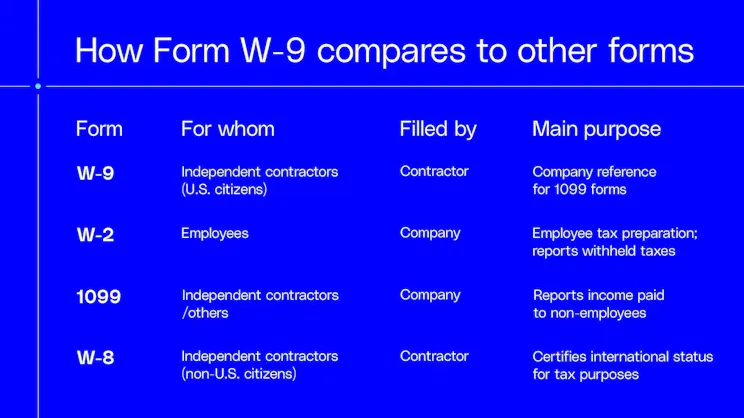
A W-9 Form for businesses is only for record-keeping. Here's how the W-9 differs from other IRS forms:
W-9 vs. W-2 Forms
While independent contractors fill out a W-9 Form, companies complete and send W-2 Forms to the IRS.
Employees use W-2 Forms to prepare taxes. Before they receive a W-2, employees need to fill out Form W-4 and indicate their tax information, filing status, and other jobs, if applicable. You'll calculate the taxes to withhold based on Form W-4, while Form W-2 should reflect these taxes.
A W-9 Form is for preparing the 1099 Form. A W-9 contains the contractor's name, address, and TIN. Unlike employees, contractors are responsible for reporting and paying their taxes. Generally, there's no tax withholding for contractors, except in certain situations, such as if they fail to provide or certify a correct TIN.
W-9 vs. 1099 Forms
The 1099 is a set of IRS forms that report varying income types. Companies most commonly use:
- 1099-NEC: Use this form if you pay your independent contractors USD 600 or more annually.
- 1099-MISC: Use this form to report miscellaneous payments, such as royalties, healthcare payments, and rent, if they amount to USD 600 or more per year.
Your company is responsible for filling out and sending 1099 Forms to the IRS. In contrast, independent contractors fill out W-9 Forms, which you'll keep in your records. You only need W-9 Forms as a reference for filing Form 1099.
W-9 vs. W-8 Forms
Whether you'll use a W-9 or a W-8 Form depends on the independent contractor's citizenship status. W-9 Forms are for U.S. citizens, while non-U.S. citizens require a W-8.
There's only one type of W-9 Form. However, there are five types of W-8 Forms. The right form depends on whether the contractor is an individual or a business, the income type, and whether they qualify for a special tax treatment.
You should collect the W-8 Form before you make your first payment. It's best practice to collect the W-9 before the contractor performs any work.
Where to get a Form W-9
Contractors can download Form W-9 directly from the IRS website. Or you can use G-P Contractor to simplify the entire contractor hiring lifecycle — from payments to managing paperwork. Easily generate W-9 Forms and access all your workforce information on one dashboard.
If you're scaling and building global teams, G-P Gia™, our first-of-its-kind agentic AI for HR, offers detailed insights on labor laws, tax regulations, and benefits in over 50 countries and all 50 U.S. states.
Who's required to fill out a W-9?

Certain individuals and business entities that receive income from your company need to fill out Form W-9. These include, but aren't limited to, independent contractors, vendors, partnerships, limited liability companies (LLCs), corporations, trusts, and estates.
Here are a few example scenarios where a W-9 is necessary:
- You're a small company hiring contractors in the U.S. Small companies without large in-house teams often hire independent contractors. For example, if you use G-P Contractor to hire and pay contractors for a graphic design project, the worker can use the W-9 Form generation feature to complete the form before they begin work.
- You're a bank with a customer opening a new account. Banks use W-9 Forms to collect taxpayer information needed to report interest and other earnings to the IRS.
- You canceled a debt. Canceled debt is often considered taxable income. Form W-9 helps in submitting the required information.
- You're an investment firm. You'll collect Form W-9 from your customers, and then report your earnings to the IRS on the appropriate Form 1099.
When and why a W‑9 is requested
The W-9 Form is only required for vendors you pay for services. This doesn't include corporations, as they're usually exempt from 1099 reporting. You also don't need a W-9 for any vendors through which you pay by card, as those payments are reported by the payment processor.
A W-9 Form lets you accurately report contractor payments to the IRS. While you don't need to file this document, keeping it on hand makes preparing 1099 Forms easier. You'll also avoid noncompliance fines and civil or criminal penalties for failing to collect the form.
How to fill out a W-9 Form
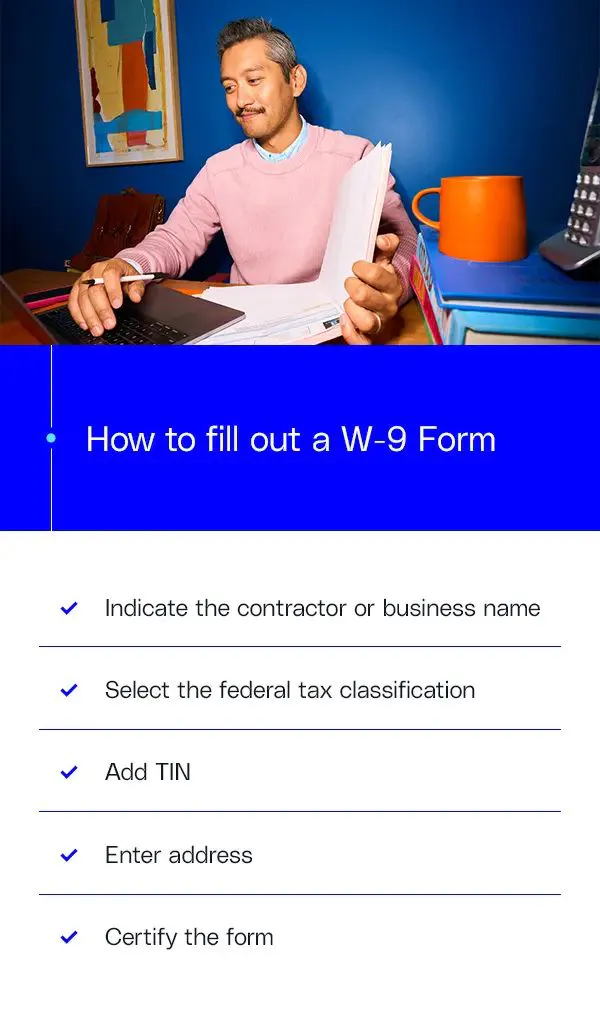
Contractors must fill out a W-9 Form accurately to ensure compliance. They can follow these W-9 instructions:
- Indicate the contractor or business name: Contractors put their name on Line 1 as it appears on their tax return. Legal entities, such as a partnership, LLC, or corporation, put their name on Line 2, using their “doing business as” information. If the contractor operates under a specific business name, they should enter this information on the “Business name” line.
- Select the federal tax classification: The contractor checks the relevant box for tax classification. Some options include individual, C corporation, S corporation, partnership, trust or estate, or LLC.
- Add TIN: Contractors should add their SSN if they're an individual. Businesses should add their EIN. Depending on their citizenship or entity status, contractors can apply for a TIN and write “applied for” under Part I. They'll be subject to backup withholding until they receive their TIN. After which, they need to submit an updated W-9.
- Enter address: Under the “address” line, add the address associated with the TIN.
- Certify the form: All information should be accurate and match IRS records. The person filling out the form should sign and date the designated areas to certify. You can use the IRS TIN Matching program to verify records.
G-P Contractor makes filling out and collecting forms easier. Contractors can generate the form on the platform, which you can access at any time.
How to submit and store a W-9 Form
The independent contractor or entity should send you the completed form for record-keeping. You must store W-9 Forms for at least four years. Longer record-keeping also helps with extended audit periods.
3 common W-9 mistakes and how to avoid them
While you don't need to submit W-9 Forms to the IRS, they still need to be accurate to avoid legal and financial issues. Watch out for these common mistakes:
- Adding incorrect information: Mistakes include using the wrong TIN and entity type. An incorrect TIN can lead to an IRS notice, while the right business type ensures your 1099 reports are accurate.
- Collecting forms late: You need to collect W-9 Forms before contractors or entities start working and before you make your first payment. This way, you're prepared for year-end reporting.
- Failing to update: Create a system for regularly reviewing and updating W-9 information. Use methods where a contractor can easily update their information.
Hire employees and contractors with G-P
Over 80% of business leaders struggle to find skilled talent in their existing market. G-P offers a quick and compliant solution to hire global employees and contractors, without setting up new entities.
Our AI-powered EOR and Contractor solutions are backed by the largest team of in-country HR, legal, and compliance experts to simplify the entire global employment lifecycle. Add world-class talent to your team without the stress of international tax compliance.
Book a demo today.

W-9 Form FAQs
What's Part I of the W-9 Form?
Part I of Form W-9 is where contractors and entities add their SSN or EIN. Individuals without a TIN should use their individual tax identification number (ITIN) from the IRS.
What's Part II of the W-9 Form?
Part II of Form W-9 is for certifications related to backup withholding. Backup withholding is a safety precaution by the IRS to ensure they get paid in case you're required to withhold taxes from payments. For instance, a contractor may fail to provide or certify the TIN. You may be asked for backup withholding.
A contractor declares that the information they provided is accurate once they sign and date the form. If an individual is subject to backup withholding for failing to report all interest and dividends on their tax return, they must cross out Item 2 in the certification before signing.
Is there a deadline to collect a W-9 Form?
It's best practice to collect the completed form prior to making contractor payments or when they sign their contractor agreement. Form 1099 does have a deadline. Your company needs to send copies of 1099s to contractors and the IRS by January 31 annually. Requesting Form W-9 early leaves you with plenty of time to prepare.
Do I pay more taxes with a W-9?
Your company won't pay more taxes by requesting Form W-9 — it's an informational document. Independent contractors are responsible for their own tax obligations.
Is a W-9 the same as a 1099?
The W-9 Form isn't the same as the 1099 Form. The W-9 Form collects the taxpayer information you need to accurately prepare and file the 1099 Form. While independent contractors and entities fill out the Form W-9, your company prepares Form 1099.
What happens if I don't file a W-9?
You don't need to file a W-9. However, if a contractor or entity fails to provide a W-9, it can lead to:
Backup withholding: The IRS sets the backup withholding rate at 24%. Failing to comply can make you liable for any uncollected amounts.
Reporting issues: Form W-9 provides the information you need to file Form 1099. Without this form, you risk inaccurate reporting and potential audits.
Legal repercussions: You can face civil and criminal penalties due to noncompliance. In 2025, penalties for inaccurate and late returns range from USD 60-660. These penalties will increase to USD 60-680 in 2026. The IRS also charges interest on penalties.