



Key takeaways
- Definition: Co-employment is when two companies share employer responsibilities. The arrangement is typically between a customer company and a professional employer organization (PEO).
- Benefits: Working with a co-employer can simplify HR, payroll, compliance, and benefits administration.
- Limitations: PEOs are U.S.-centric and not scalable for global hiring. The customer company is still responsible for compliance errors.
- Co-employment vs. employer of record (EOR): An EOR is a global alternative to co-employment that offers better protection against compliance risks.
Co-employment is when two companies share employment responsibilities. One party manages the employee’s day-to-day duties, and the other handles admin matters like payroll and compliance.
This is an attractive solution for companies looking to simplify employment and cut administrative costs. But co-employment also comes with risks. Compliance responsibility is shared, and errors can have legal consequences for both co-employers.
This guide explains how co-employment works and how it compares to alternatives like an employer of record (EOR).
What does co-employment mean?
Co-employment is a contractual relationship where two companies share employment responsibilities for an employee. Typically, the relationship is between a customer and a professional employer organization (PEO). The PEO handles admin duties while the customer manages the employee’s day-to-day. The employee reports to the customer company, not the PEO.
A co-employment contract clearly divides responsibilities between the customer company and the PEO. The customer company's responsibilities include assigning projects, managing workflows, and overseeing performance. It controls hiring, supervises employees' daily tasks, and guides the team's professional development from onboarding to offboarding.
The PEO manages the administrative logistics. This includes payroll, benefits, insurance, and employment taxes. PEOs also administer workers' compensation and unemployment claims.
Although the PEO handles many compliance responsibilities, the customer company has legal obligations, like:
- Following employment regulations for hiring, promotion, termination, and performance management
- Maintaining a safe and healthy work environment
- Using fair employment practices that follow local laws and prevent discrimination and harassment
- Tracking work time and setting wages
- Enforcing internal HR policies
Since co-employers share responsibility for the employee, they also share liability. A reputable PEO can reduce risks for customers, but the legal protection is limited.
What are the benefits of co-employment?

Co-employment offers several advantages:
- Streamlined admin: Co-employment simplifies HR for the customer company and frees them to focus on core business operations.
- Competitive benefits: A PEO may also provide access to better benefits, including health insurance, workers' compensation, and retirement plans, by pooling its customers to access large-group benefits plans.
- Full-service payroll: The PEO handles all aspects of pay. This ensures accuracy and on-time processing.
- Compliance guidance: PEOs have expertise in labor laws and regulations. This can reduce the risk of violations and penalties.
- Operational control: The customer company retains direct control over team members. They manage employees' daily activities and the team's strategic direction.
- Liability mitigation: With shared employment and a clear division of obligations, a PEO can reduce the customer's liability in certain areas, such as payroll tax compliance.
Talent management support: Some PEOs help with aspects of onboarding, training, and performance management.
What are the risks of co-employment?
One limitation of co-employment is that traditional PEOs operate within one country — most commonly, the U.S. So this isn’t a scalable solution for global employment. The model also has significant risks:
- If your company makes a compliance mistake in an area you're responsible for, the co-employment relationship doesn’t protect you. A written contract helps clarify responsibility and mitigate risk, but it doesn’t eliminate liability. Courts will look at the actual work arrangement to determine employer responsibility and liability.
- A PEO's error in classification or payroll tax handling can lead to shared penalties, including back taxes, fines, and legal fees.
- If you enter a co-employment relationship, you must align your internal HR and accounting processes with the PEO's operations. Any misalignment or overlapping responsibilities can have consequences for both parties. For instance, the PEO and customer share responsibility for preventing discrimination against team members.
Companies in highly regulated industries and those seeking to hire in multiple countries have a safer option to consider — an employer of record (EOR).
What is not co-employment?
Let’s compare the co-employment model to other arrangements to see how they differ.
1. Co-employment vs. employment leasing
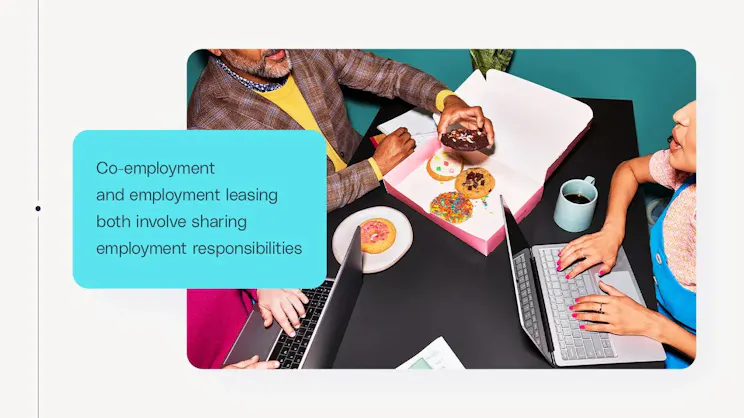
Co-employment and employment leasing both involve sharing employment responsibilities. Technical differences fall under local laws. In the U.S., some states, like New Jersey, consider co-employment and employment leasing as the same thing. In Canada, employment leasing is a type of co-employment service.
Both arrangements can involve working with PEOs. Companies may rely on PEOs for leave administrative tasks, such as payroll, taxes, and workers’ compensation insurance. Many confuse employment leasing with temporary staffing. However, employment leasing involves an ongoing employee relationship. Temporary workers only cover special situations.
2. Co-employment vs. hiring agencies
PEOs aren’t talent scouts or hiring agencies. They don’t recruit team members for customers or make decisions about who to hire. A PEO steps in after the customer company hires a candidate and assists with onboarding processes, like setting up the new employee's payroll and benefits.
3. Co-employment vs. joint employment
Though the terms both involve shared responsibilities, co-employment and joint employment are different. Co-employment means that only the customer company directs the team member's work while the PEO handles administrative functions. In joint employment, both entities share direct and ongoing control over workloads, hours, and daily activities. This means the employee works for and reports to both companies.
An arrangement is classified as joint employment rather than co-employment if both parties:
- Conduct employee supervision.
- Track employee performance.
- Negotiate worker compensation and wages.
- Have the authority to discipline and terminate employees.
Joint employers share liability for violations of laws like the Fair Labor Standards Act (FLSA) and the Family and Medical Leave Act (FMLA) in the U.S. For example, if a nonexempt employee works beyond their maximum regular weekly hours, both employers are accountable for ensuring proper overtime payments.
Joint employment can be triggered accidentally if your company and another business, such as a vendor, both have significant control over an employee's work conditions or management, even without a written agreement.
4. Co-employment vs. EOR
Companies often see PEOs and EORs as competing solutions. They both streamline HR functions, but these solutions have different structures, scopes, and strengths. This table shows the core differences.
|
Feature |
PEO |
EOR |
|---|---|---|
|
Employment model |
Both parties share legal status as co-employers. |
The EOR is the sole legal employer while the customer company directs daily work. |
|
Global reach |
Co-employment works within a single country. PEOs mainly operate in the U.S. with limited international capabilities, if any. |
An EOR is a global solution. Partnering with a leading EOR allows you to hire in 180+ countries. |
|
Entity setup |
You need to register your own in-country entity and enter a co-employment relationship with a PEO. |
You can hire in a new country without establishing a local entity. The EOR provides the entity, saving you time and money. |
|
Liability |
The PEO and the customer company share responsibility and liability for employment-related compliance. |
The EOR manages most areas of employment-related compliance. Some responsibilities, such as complying with nondiscrimination laws, are shared with the customer company. |
|
Admin support |
Manages payroll, benefits, HR support, and tax filings in the U.S. |
Manages global payroll, benefits, HR support, tax filings, compliance, onboarding, offboarding, and, in some cases, visa sponsorship. |
|
Scalability |
Isn’t a scalable international hiring solution, since it’s typically only licensed to operate in a single region. |
Highly scalable for international hiring. An EOR provides quick market entry with minimal risk and overhead. |
|
Contractor management |
PEOs provide HR administration for full-time employees. They don’t manage or engage independent contractors. |
A leading EOR with a contractor offering can enable compliant global hiring for both worker types. |
How do PEOs and EORs reduce employment risks?
Both PEOs and EORs mitigate employment risks. They simplify onboarding, handle compliance, and offer guidance in their areas of expertise. Both arrangements divide responsibilities clearly to avoid confusion and mitigate liability.
PEOs are expert employment partners for U.S. hiring needs. They reduce the likelihood of noncompliance by handling HR logistics. PEOs manage domestic regulatory requirements for employee payroll and taxes. This includes administering workers' compensation and group benefits.
As the sole legal employer, an EOR offers more comprehensive risk mitigation than a PEO. It also provides many of the same advantages, but extends them across borders.
Partnering with an EOR eliminates the need to establish your own local entities. You maintain control over daily work, professional development, and strategy. And the EOR manages HR administration and compliance with local labor laws. An EOR can help you offer competitive and compliant benefits anywhere in the world to attract top talent.
Hire globally with G-P
With G-P EOR, global hiring is simple. Our industry-leading EOR solutions let you hire top talent in 180+ countries, without setting up local entities. We use agentic AI to give you real-time guidance and create compliant HR documents in minutes. Our solutions are backed by the largest team of HR and legal experts in the industry.
We also have a Contractor offering, so you can hire the talent you need for specialized projects. Partnering with G-P means peace of mind — anywhere you want to hire.
As Kisha Thompson, Chief People Officer at ClickDimensions, puts it: "An HR professional’s time is much better spent executing than researching the intricacies of country-specific labor laws, tax policies, employee benefits, and more. We decided to leave those details to the experts at G-P."
Request a demo today and make global hiring simple.

Is co-employment legal?
Yes, co-employment is legal. It’s a recognized arrangement where a customer company and a PEO share employer responsibilities. Each party's duties are outlined in a contract. Typically, the PEO is responsible for taxes, payroll, and benefits administration while the customer company directs daily work and manages performance. This structure helps companies streamline administrative tasks.
How does co-employment affect tax filings?
In co-employment, the PEO typically handles payroll taxes and filings, including withholding, reporting, and remitting to authorities. While this offloads a significant burden, your company may be liable for back taxes or penalties if errors occur within the shared employment relationship.
Do written contracts eliminate co-employment risk?
Written contracts mitigate co-employment risks, but they don't eliminate them. Courts examine the actual working relationship. If daily practices contradict the contract, you could be liable for compliance errors even in areas that the contract says the PEO is responsible for.
How can I tell if my company is in a co-employment situation?
Your company is likely in a formal co-employment situation if you partner with a PEO. The PEO manages HR, payroll, and benefits. Your company retains control over team members' daily work and management.
Is a PEO good for global hiring?
No. PEOs aren’t a global employment solution. PEOs are most common in the U.S. and typically operate under U.S. labor law. Though some PEO providers claim to be global, their offerings may be limited in reach and scope. An EOR is a better choice for flexible global hiring and true scalability.
What’s the difference between a PEO and an EOR?
A PEO enters a co-employment relationship with the customer company, sharing employer responsibilities for domestic employees. An EOR is the sole legal employer for your global team members, handling all compliance without requiring you to set up local entities.