



Puntos clave
-
Estructura federal, normas locales: Aunque las leyes federales (como la Ley Laboral y el Código de Obligaciones) establecen los estándares laborales básicos, los tipos impositivos específicos, los días festivos y los procesos administrativos varían entre los 26 cantones de Suiza.
-
Normas estrictas de licencia de trabajo para talentos no pertenecientes a la UE/EFTA: Para contratar empleados en Suiza de trabajadores no pertenecientes a la UE/EFTA, tienes que demostrar la prioridad del mercado local de trabajo, cumplir cuotas nacionales estrictas y obtener la aprobación de licencias multinivel.
-
La tasa de carga del empleador es 10% –20%: Más allá de los salarios base, los empleadores deben presuponer aportaciones obligatorias y habituales cuando contratas en Suiza. Esto incluye la seguridad social (AHV/IV/EO), el seguro de desempleo, las pensiones profesionales (BVG), el seguro de accidentes y 13salarios de los tres meses.
-
La clasificación errónea conlleva penalizaciones retroactivas de cinco años: Clasificar erróneamente a los empleados como contratistas al contratar en Suiza puede conllevar sanciones económicas, incluyendo cinco años de pagos retroactivos de entidad empleadora y empleado seguridad social, además de intereses.
La población de Suiza de 8.9 millones es una combinación de suizos, alemanes, franceses, italianos, portugueses y kosovares. Cada cantón emplea la misma moneda nacional: el franco suizo. Entre los sectores más destacados se encuentran las finanzas y la banca, los equipos médicos y la ingeniería.
Las leyes favorables de impuestos corporativos y la accesibilidad cultural son dos razones por las que muchas multinacionales se expanden a Suiza. Nuestra guía te contará todo lo que necesitas saber sobre contratar en Suiza.
Qué debes saber antes de contratar en Suiza
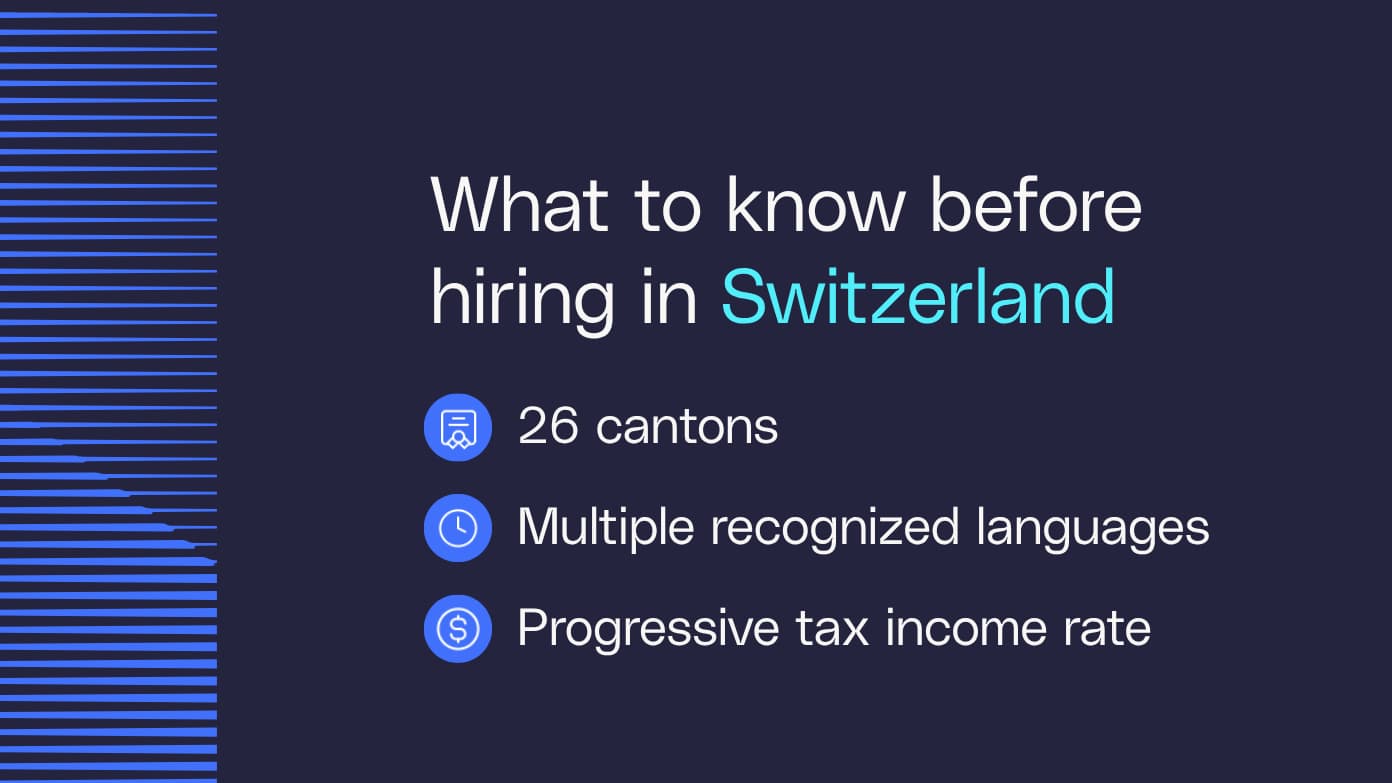
Si estás expandiendo tu negocio a Suiza por primera vez, hay requisitos legales importantes que debes conocer. Estas normas y leyes influyen en las prácticas de contratación en Suiza.
Si no sabes por dónde empezar, G-P Gia™, nuestro agente global de Recursos Humanos con inteligencia artificial, puede responder a tus preguntas más difíciles sobre cumplimiento en 50 países —incluida Suiza— y en todos 50 estados de EE. UU. Reduce tu dependencia de abogados externos y reduce el tiempo y costo de cumplimiento hasta en un 95% con Gia.
Veamos ocho cosas que debes saber sobre contratar en Suiza.
1. Estatutos empleador-empleado
Todas las relaciones entidad empleadora-empleado deben cumplir con los siguientes estatutos:
-
SR 151.1 — La Ley Federal de Igualdad de Género
-
SR 220 — El Código de Obligaciones
-
SR 822.11 — Ley Laboral
-
SR 822.14 — Ley de Participación de los Trabajadores
-
SR 823.11 — Ley Federal de Servicios de Empleo y Contratación de Servicios
-
SR 823.20 — Ley de Trabajadores Desplazados
Suiza reconoce a los sindicatos siempre que cumplan todos los requisitos legales.
2. Cantones en Suiza
Suiza está dividida en 26 cantones. Aunque todas se engloban bajo el paraguas nacional suizo, son entidades poderosas por derecho propio. Cada cantón tiene tradiciones y cultura únicas. También tienen sus propias formas de autogobierno, que incluyen leyes, constituciones y estructura gubernamental.
Al contratar empleados en Suiza, ten en cuenta el cantón en el que anuncias tu puesto. El cantón de residencia de los candidatos te dará una visión de las expectativas de traducción, los tipos impositivos a incluir en tus contratos de trabajo y las consideraciones a las que tienen derecho.
Las comunas —organismos gubernamentales más pequeños que residen en cada cantón— determinan cómo contratar en Suiza.
3. El mercado de trabajo en Suiza
Más de 5 millones de personas están activas en el mercado suizo de trabajo. La tasa de empleo es 80.6%. Para comparar, la tasa de la UE es 75.8%. Los trabajadores son altamente cualificados y poseen títulos de instituciones de educación superior. En cuanto a la educación infantil y los institutos secundarios, el sistema educativo suizo varía entre cantones. El IMD World Talent Ranking 2024 nombrado a Suiza como el país1 en el desarrollo del talento local en el mundo.
4. Lenguas en Suiza
El multilingüismo es un componente fundamental de la cultura suiza, en gran medida debido a la Ley de Idiomas. Esta ley reconoce al alemán, al francés, al italiano y al romanche como lenguas nacionales. El alemán, el francés y el italiano son también idiomas oficiales de la Confederación. El romanche se emplea oficialmente en las comunicaciones con hablantes de romanche. Aproximadamente dos tercios de los habitantes del país hablan más de un idioma. Los niños suizos aprenden al menos dos de las lenguas nacionales durante sus primeros años de escolarización.
El suizo-alemán es el más hablado en los cantones. El francés es común en los cantones occidentales y el italiano en el sur. El romanche es una lengua menos empleada que proviene del pueblo rético, habitantes tempranos de la región de los Alpes. Algunos cantones y demografías también tienen sus propios dialectos y coloquialismos.
Todos los contratos laborales, entrevistas y asignaciones deben considerar la persona entrevistada o el primer idioma del empleado. Es buena práctica traducir todos los documentos y contratar a un intérprete cuando sea necesario.
5. Horario de trabajo y tiempo libre
La Ley Suiza del Trabajo regula las leyes sobre el horario laboral y el tiempo libre. La máxima semana de trabajo es de 45 horas para empleados en compañías industriales, personal de oficina, personal técnico y personal de ventas en grandes compañías minoristas. Para todos los demás empleados, son 50 horas. Las horas diarias de trabajo, incluidas las pausas y horas extra, no deben superar las 14 horas. En la práctica, el tiempo típico de trabajo en Suiza es 12.5 horas.
Las horas extra solo se permiten en circunstancias extraordinarias. Debe compensar con un tiempo libre sueldo premium del 25% o equivalente. Los empleados deben disponer de al menos 11 horas consecutivas de descanso cada día. Esto puede reducir a 8 horas una vez a la semana, siempre que el descanso medio durante dos semanas sea al menos 11 horas. Los trabajadores disponen de un descanso continuo de al menos 35 horas cada semana, incluido el domingo.
Los empleados tienen derecho a tres semanas de licencia por enfermedad dentro del primer año de empleo en una compañía. Cada cantón tiene sus propias restricciones pagadas de tiempo libre y licencia por enfermedad.
Las empleadas embarazadas reciben 14 semanas de licencia por maternidad remunerada, y los padres tienen derecho a dos semanas de baja por paternidad.
Independientemente de su cantón, cada empleado recibe cuatro semanas de vacaciones al año, o cinco si el empleado es 20 o menor. Si así lo desean, los empleados y empleadores pueden negociar tiempo libre adicional en sus contratos.
Los cantones tienen sus propios festivos locales y públicos. El Día Nacional del 1de agosto es el único festivo federal. Si el Día Nacional cae en martes o jueves, es común dar a los empleados un fin de semana prolongado. Suiza también celebra el día de Año Nuevo, la Pascua y el día de Navidad, pero las regulaciones específicas para esos periodos varían entre empleadores. Los empleados pueden elegir un salario extra en lugar de cometer vacaciones pagadas.
6. Contratos de empleo
Los empleados pueden ser temporales, suministrados por agencia, a tiempo parcial o a tiempo completo. El primer mes de empleo se considera periodo de prueba. Puedes ampliar esto hasta un máximo de tres meses en tu contrato de empleo. Si en algún momento decides terminar la relación laboral, debes dar al menos un preaviso de siete días.
Los contratos de trabajo no son obligatorios, pero son comunes y muy recomendables, ya que algunos términos solo se reconocen legalmente si están por escrito. Los contratos son vinculantes. Los empleadores no pueden infringir los términos del contrato acordado. Suiza tiene varias leyes para proteger a los sindicatos y a ciertos empleados, como mujeres o menores. Los empleadores deben tener una carta escrita que detalle la fecha de inicio, la función laboral, el sueldo y el número de horas que los empleados trabajarán cada semana.
Los contratos indefinidos son comunes en Suiza. Los contratos "cadena" son vistos de forma desfavorable por los tribunales suizos. Los contratos en cadena son un serial de contratos de duración determinada iniciados consecutivamente con el mismo empleado. Esta práctica puede considerar un abuso de derechos si se emplea para eludir las protecciones del empleo permanente, como la seguridad laboral y los periodos de preaviso. Una vez finalizado el último día del contrato, la relación empleado-entidad empleadora termina, sin necesidad de aviso.
Tú y tu miembro del equipo podéis acordar un plazo igual para dar un aviso de salida o despido. Este aviso no debe ser inferior a un mes en el primer año de empleo, y dos meses por cada duración de empleo hasta nueve años. Tres meses es lo habitual más allá de eso. No puedes despedir a empleados si están embarazados, enfermos o con licencia por maternidad. Solo tienes que pagar indemnización si los empleados tienen 50 años o más y trabajaron para ti durante 20+ años.
G-P Plataforma global de empleo (Empleador de Registro) cuenta con un generador de contactos laborales para ayudarte a redactar contratos de cumplimiento laboral cuando contratas empleados en Suiza que cumplan con todos los requisitos legales y las mejores prácticas.
7. Compensación y beneficios
La Ley Federal Suiza sobre Igualdad de Género (GEA) exige que todas las compañías con 100 o más empleados realicen una auditoría interna para garantizar que se cumpla la igualdad salarial.
Suiza no tiene un único salario mínimo federal. Las obligaciones salariales mínimas pueden proceder de cantones o municipios, acuerdos colectivos o contratos de trabajo para sectores específicos. De lo contrario, el salario se establece mediante contratos y prácticas del mercado. Los empleados cobran una vez al final del mes.
Las horas extra legales incluyen el tiempo trabajado por encima del máximo de horas legales de trabajo. Las horas extra legales son diferentes de las contractuales y solo están permitidas durante turnos diurnos o de noche en días laborables. Debe compensar con un suplemento de sueldo de al menos un 25%.
Los empleados también pueden elegir tiempo libre en lugar del aumento de sueldo. Las horas extra legales nunca deben superar las dos horas diarias y nunca pueden superar las 170 horas en semanas laborales de 45horas o 140 horas en semanas laborales de 50horas. Se pueden conceder algunas excepciones en emergencias.
Los empleadores suelen pagar el 80% — con un límite anual — del salario de un empleado si sufrió una lesión laboral. La cantidad puede variar según la industria o el plan de seguro específico. Los empleadores son responsables de establecer una relación de seguridad social entre sus empleados y la oficina de seguridad social de su cantón. Social seguridad incluye contribuciones al Seguro de Baja por maternidad (MSE), Seguro de Discapacidad (DI), Seguro de Capacidades por Hijos (FZ) y pensiones, o Seguro de Vejez y Supervivientes (OASI). Social las tasas de seguridad son 6.4% para la entidad empleadora y 6.4% para el empleado.
No se requieren bonificaciones ni 13salario de tercer mes, pero sí son habituales. Los empleadores pueden conceder bonificaciones contractualmente o a su discreción. Ten en cuenta que Suiza tiene directrices estrictas de bonificaciones para el sector financiero. Esto es para evitar la asunción excesiva de riesgos y garantizar que las prácticas de compensación no perjudiquen la estabilidad financiera.
Si un empleado lleva más de tres meses en tu compañía, trabaja al menos ocho horas a la semana y cumple con los requisitos de ingresos, puede participar en un fondo de pensión patrocinado por la entidad empleadora. El mínimo actual para la pensión AHV es CHF 1,260. Los empleadores también son responsables del seguro de accidentes.
Puedes gestionar fácilmente planes de beneficios con G-P Plataforma global de empleo (Empleador de Registro). Nuestros expertos internos monitorear continuamente las leyes laborales para cumplir con las normativas y normas específicas de cada país. Crea y gestiona planes de beneficios a través de nuestra plataforma para ofrecer una experiencia de empleado fluida.
8. Impuestos
El impuesto federal sobre los ingresos de Suiza es progresivo, con un máximo de 11.5% para la franja de ingresos más alta. Es importante señalar que también se aplican impuestos cantonales y municipales. Esto puede afectar mucho al importe total de tu impuesto, dependiendo de dónde estés basado. El tipo federal de IVA es 8.1%.
9. Igualdad, privacidad de datos y prácticas de contratación
Las prácticas de reclutamiento y empleo deben cumplir con la Ley Federal de Igualdad de Género. Esto previene la discriminación directa e indirecta por motivos de género a lo largo del ciclo laboral, incluyendo:
-
Contratación
-
Remuneración
-
Asignación de funciones
-
Promoción
-
Capacitación
-
Acoso
-
Despido.
Los empleadores deben garantizar igualdad salarial por trabajo de igual valor. Deben aplicar criterios objetivos y relacionados con el puesto para las decisiones de reclutamiento, compensación, promoción y despido.
Los empleadores con 100 o más empleados en Suiza deben realizar un análisis interno de igualdad salarial empleando un método científicamente válido. El análisis debe ser verificado de forma independiente y los resultados deben comunicar a los empleados dentro del plazo requerido. Esto es independiente de la obligación general de igualdad salarial para todos los empleadores.
Los datos personales de los candidatos deben recopilar y procesar de conformidad con los requisitos suizos de protección de datos. Esto incluye la Ley Federal de Protección de Datos y los límites específicos para el empleo establecido en el Código de Obligaciones suizo. Los datos de reclutamiento deben ser:
-
Limitado a lo necesario para evaluar la idoneidad para el puesto.
-
Gestionado de forma transparente y segura.
-
Conservar solo el tiempo necesario.
Las verificaciones de antecedentes solo se pueden realizar cuando sean proporcionales, relevantes para el puesto de trabajo y se divulgaron adecuadamente.
Modelos de contratación para compañías globales en Suiza
El mejor modelo cuando decides contratar empleados en Suiza depende de los objetivos generales de tu negocio.
| Modelo | Mejor para | Puntos clave | Principales riesgos |
|---|---|---|---|
| Direct entidad empleadora registration | Contratar personal en Suiza sin una entidad local. | Regístrate en las autoridades suizas de la seguridad social y de impuestos. Haz la nómina suiza. Gestiona licencias, beneficios y cumplimiento con la legislación laboral. | Alta carga administrativa. Diferencias en los procesos cantonales. Riesgo de errores en la nómina, los impuestos o las licencias. |
| Plataforma global de empleo (Empleador de Registro), como G-P Plataforma global de empleo (Empleador de Registro) | Proceso rápido para contratar en Suiza sin crear una entidad. | Plataforma global de empleo es la entidad legal empleadora. El proveedor gestiona la nómina, los beneficios y los contratos. Debe estar debidamente licenciado para el alquiler de personal. | Riesgo asociado al uso de proveedores sin licencia. Control menos directo. Los clientes aún pueden tener responsabilidades laborales y de supervisión. |
| Filial o sucursal | Operaciones a largo plazo en Suiza. | Crea una presencia local formal. Apoya la contratación directa y la gestión local. Es mejor para equipos grandes o permanentes. | Mayor costo de instalación y mantenimiento. Más impuestos corporativos, nóminas y tareas de cumplimiento de Recursos Humanos. |
| Contratista independiente | Trabajo especializado, a corto plazo y basado en proyectos. | Los contratistas deben trabajar de forma independiente. Emplee términos basados en entregables. Verifique su condición de trabajador autónomo siempre que sea posible. | Riesgo de clasificación incorrecta. Respalda la seguridad social y la exposición fiscal. Los derechos laborales pueden aplicar de forma retroactiva. |
Los principales centros de contratación en Suiza
Algunas ciudades suizas son conocidas por sus industrias particulares. Saber qué ofrece cada ciudad puede ayudarte a canalizar tus esfuerzos de contratación hacia el lugar adecuado y cubrir puestos más rápido cuando contrates en Suiza.
Los principales polos de talento en Suiza son:
-
Zúrich es la ciudad más grande de Suiza. Su principal centro financiero y empresarial es conocido por sus servicios bancarios, tecnológicos y profesionales. Aquí se encuentran bancos importantes como UBS, Julius Baer y ZKB.
-
Ginebra es un centro internacional con muchas organizaciones sin ánimo de lucro y compañías globales en finanzas y comercio. Es sede de importantes organizaciones internacionales como la Sede Interna de las Naciones Unidas, la OMS, la OMC y la Cruz Roja.
-
Basilea es famosa por sus industrias farmacéutica, química y de ciencias biológicas. Tiene una fuerte presencia financiera y es la sede de importantes compañías como Roche y Novartis, así como de muchas compañías biotecnológicas e instituciones de investigación más pequeñas.
-
Berna es un centro neurálgico para el gobierno, la administración y las industrias de servicios. Muchos puestos de trabajo y cargos del gobierno federal en los sectores de la salud, la educación y la industria manufacturera tienen su sede aquí.
-
Lausana es conocida por su educación y tecnología. Esta ciudad francófona destaca por su excelencia en la docencia y la investigación relacionadas con las ciencias de la vida, la informática y la gestión deportiva.
Industrias clave en Suiza
Comprender las principales industrias de Suiza te ayuda a consultar los salarios y beneficios al contratar empleados en Suiza. Puedes emplear esta información para tomar decisiones inteligentes sobre dónde invertir y hacer crecer tu fuerza de trabajo.
Las principales industrias en Suiza incluyen:
-
Servicios financieros: Suiza es bien conocida por su sector bancario, de seguros y gestión de activos. La estabilidad política del país, las leyes de confidencialidad y la experiencia atraen clientes de todo el mundo. Grandes bancos globales como UBS tienen su sede aquí. El talento especializado incluye asesores financieros, planificadores patrimoniales y analistas de inversión.
-
Farmacéutica y ciencias de la vida: Suiza alberga muchas de las principales compañías farmacéuticas, biotecnológicas y de dispositivos médicos. Líderes globales como Roche y Novartis tienen su base allí. El sector se centra en productos de alto valor, como vacunas, medicamentos especializados y sueros. El talento especializado incluye profesionales de I&D, científicos e ingenieros.
-
Maquinaria, instrumentos de precisión e ingeniería: Suiza lidera el mundo en maquinaria, relojes e instrumentos de alta precisión. El talento especializado incluye diversos puestos de ingeniería como ingenieros mecánicos, eléctricos y de fabricación.
-
Tecnologías de la información y comunicaciones: Suiza es líder en tecnología blockchain y criptomonedas, atrayendo a startups y compañías financieras descentralizadas consolidadas. El talento especializado incluye desarrolladores de software, científicos de datos y arquitectos de la nube.
-
Químicos: La industria química cuenta con grandes compañías del sector de aromas y fragancias, como Givaudan y DSM-Firmenich. El talento especializado incluye profesionales de R&D, ingenieros y científicos.
Costo de contratar a un empleado en Suiza
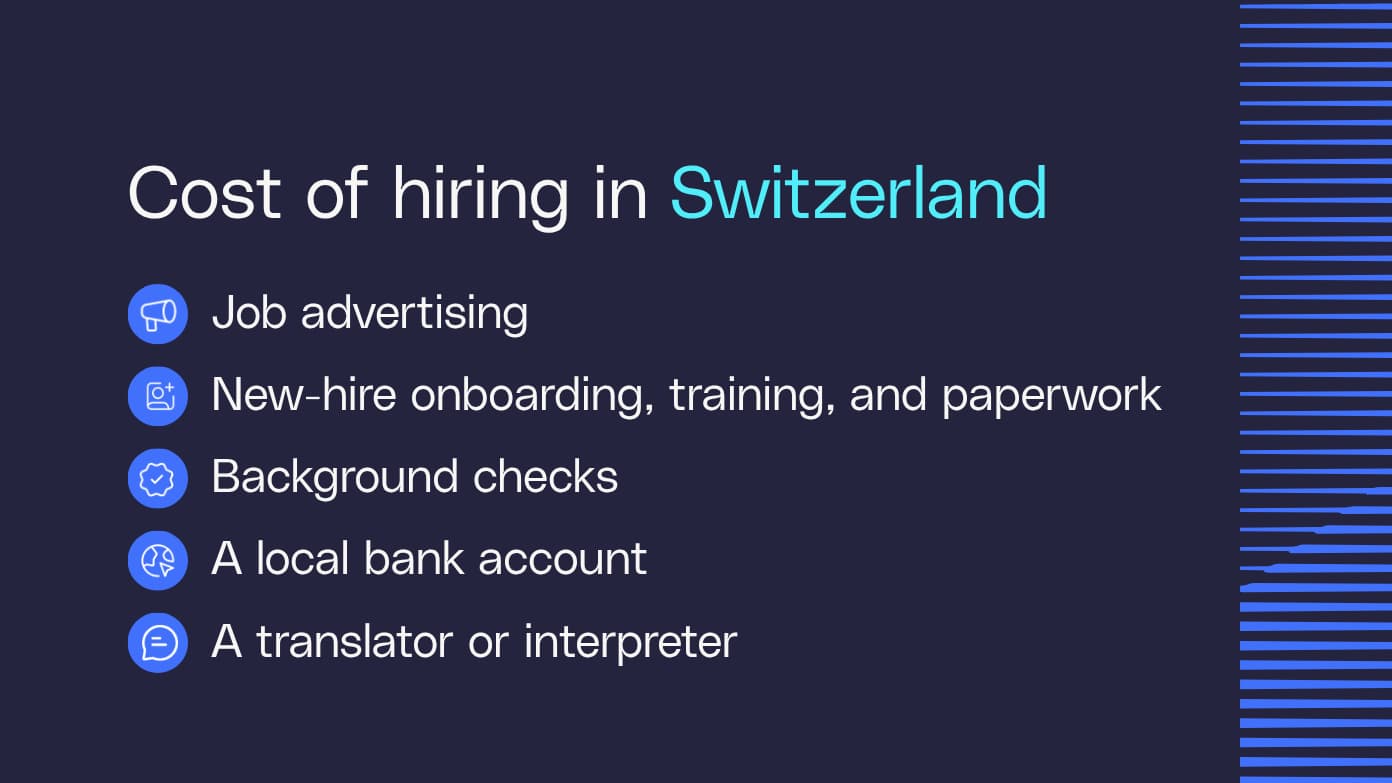
Ya sea que contrates a un solo empleado o a todo un equipo, el proceso de contratación en Suiza conlleva gastos inevitables.
Cotización para lo siguiente:
-
Publicidad de empleo
-
Incorporación, formación y trámites administrativos
-
Software de seguimiento de candidatos
-
comprobación de antecedentes
-
Cualquier equipo especial para empleados
-
Un traductor o intérprete (si procede)
-
Gastos de viaje para ir y venir de Suiza, si es necesario
-
AHV/IV/EO
-
Seguro de desempleo
-
seguro de accidentes laborales
-
Contribuciones familiares a las capacidades
-
Seguro de capacidades por enfermedad diaria
-
Derecho a vacaciones para empleados
-
Tiempo libre pagado por empleados y derecho a días por enfermedad
Según Gia, la tasa anual total de carga de la entidad empleadora en Suiza, que incluye los costos derivados además de los salarios, está entre el 10% y el 20% del salario bruto. Las tarifas dependerán del salario del empleado, la industria y el cantón. Gia aprovecha los 13+ años de experiencia laboral global de G-P, junto con conocimientos de casi un millón de escenarios reales, para proporcionar información precisa y actualizada sobre leyes laborales.
¿Qué necesita una compañía para contratar en Suiza?
Trabajadores de la UE/AELC frente a trabajadores no pertenecientes a la UE/AELC
Gracias al Acuerdo sobre la Libre Circulación de Personas (AFMP), contratar ciudadanos de los Estados afiliados a la UE/EFTA implica pocos obstáculos administrativos. Los empleadores no necesitan dar prioridad a los trabajadores suizos locales ni justificar por qué se eligió a una candidata de persona de la UE/EFTA. Para contratos de corta duración (hasta 90 días por año natural), las compañías solo necesitan enviar una notificación en línea antes de que el empleado comience a trabajar. Para acuerdos más largos, el empleado se registra en su comuna suiza local para obtener una licencia de trabajo (como una licencia L o B). Esto les da acceso inmediato al mercado suizo de trabajo.
Nacionales de países no pertenecientes a la UE/AELC
La contratación de candidatos procedentes de países que no pertenecen a la UE/AELC (incluidos el Reino Unido y EE. UU.) está más regulada. Según la Ley Federal sobre Extranjeros e Integración (FNIA, por sus siglas en inglés), los empleadores deben demostrar que los esfuerzos de reclutamiento local fracasaron. Las licencias para personas que no pertenecen a la UE/AELC están restringidos casi exclusivamente a personal como gerentes, especialistas sénior o graduados universitarios con experiencia especializada.
Cupos de licencias y cronograma administrativo
El gobierno suizo tiene una estricta cuota nacional anual de licencias de trabajo para los nacionales no pertenecientes a la UE/EFTA. La licencia de trabajo necesita un proceso de aprobación en varios niveles que involucre a las autoridades laborales cantonales y a la Secretaría de Estado para Migración (SEM). Los empleadores deben comenzar la solicitud de la licencia con antelación. El empleado no puede empezar a trabajar hasta la autorización formal.
Te conviene establecer una relación con las oficinas económicas locales o la embajada de un cantón. No necesitas una entidad jurídica para contratar en Suiza, pero si decides crear una compañía suiza, puedes elegir entre:
-
Una compañía individual de un solo propietario
-
Una sociedad colectiva
-
Una sociedad limitada
-
Una sociedad anónima o sociedad anónima
-
Una compañía de responsabilidad limitada
-
Una filial
-
Una sucursal local
Las sucursales son una vía común para compañías internacionales y requieren que pagues impuestos locales y mantengas al menos un residente suizo con autoridad legal. Debes tener preparada toda la documentación legal, contratos y cuentas financieras establecido.
Contrata empleados en Suiza sin crear tu propia entidad con G-P Plataforma global de empleo (Empleador de Registro). Forma tu equipo en Suiza a un costo menor y con la tranquilidad de que cumples con los requisitos únicos de cada cantón.
Pasos para contratar en Suiza
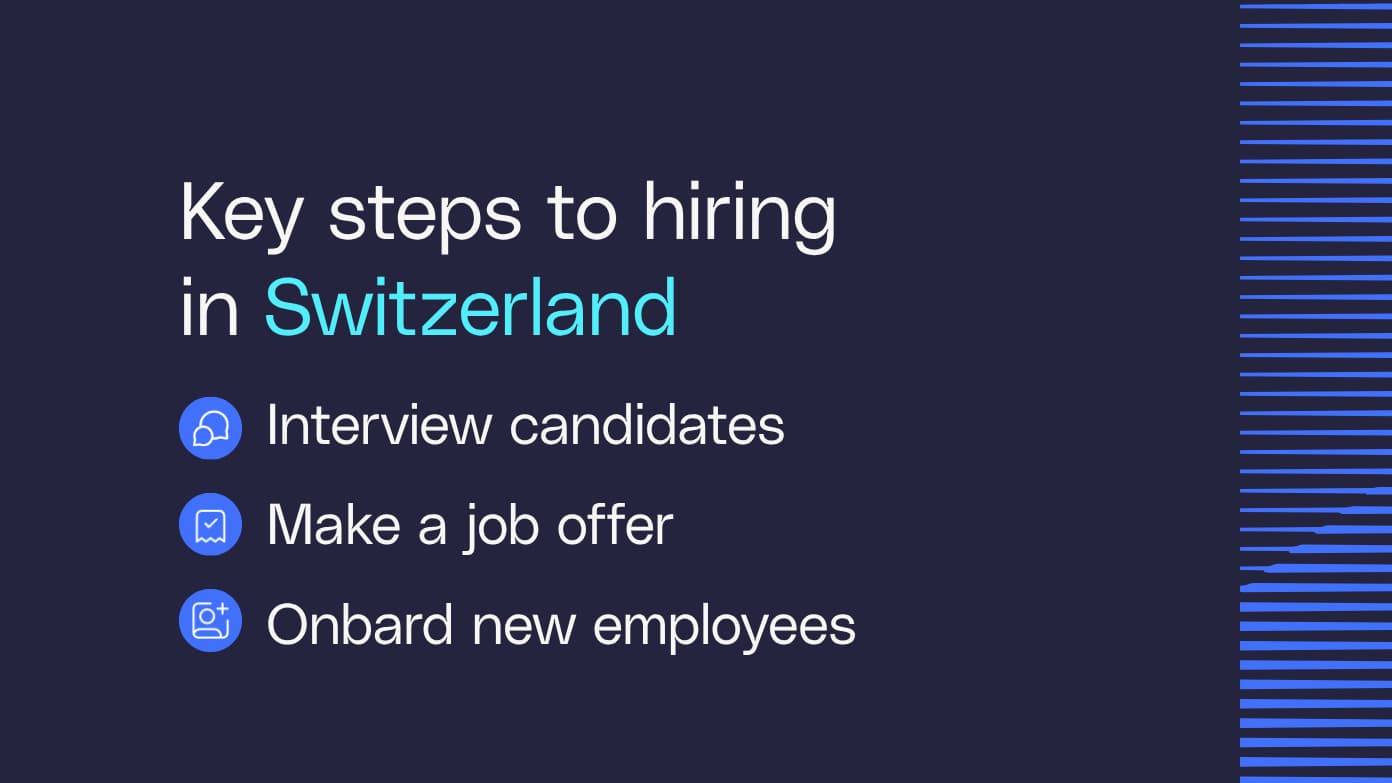
El proceso de contratación en Suiza sigue cinco pasos básicos: anunciar el puesto, evaluar solicitudes, entrevistar candidatos, enviar ofertas de empleo e incorporar nuevos empleados.
1. Anunciar vacantes de trabajo
Primero, crea una descripción detallada del puesto. Define el rol, las responsabilidades y las cualificaciones que necesitas. Para ciertas profesiones con tasas de desempleo más altas, los empleadores están legalmente obligados a notificar a las agencias de empleo cantonales las vacantes antes de publicarlas públicamente. Esto garantiza el acceso prioritario para los buscadores de empleo registrados y el cumplimiento de la Ley Federal de Servicios de Empleo.
2. Evaluar solicitudes
Una vez que los candidatos aplicar tus nuevos puestos, podrás evaluar sus solicitudes y determinar cuáles son los candidatos que mejor encajan para el puesto. La ley suiza prohíbe la discriminación por género, edad, origen, raza, religión, discapacidad, orientación sexual u otras características protegidas en todas las etapas del reclutamiento. Esto está recogido en la Constitución Federal Suiza y en la Ley de Igualdad de Género.
Verifica dos veces que las ofertas de empleo, los criterios de selección y las preguntas de entrevista estén libres de sesgos.
3. Entreviste a las personas candidatas
Después, entrevista a los candidatos que entraron en tu lista corta. Emplea criterios de selección relevantes para el puesto y entrevistas estructuradas para garantizar la equidad y la coherencia. Gia puede ayudarte a crear preguntas de entrevista que cumplan con las leyes antidiscriminación al contratar empleados en Suiza, para que puedas encontrar la mejor opción para el puesto cumpliendo con la normativa local.
Se recomienda conservar la documentación del proceso de reclutamiento, incluidas las notas de las entrevistas y las decisiones de selección, durante al menos cinco años.
4. Haz ofertas de trabajo
Ahora es el momento de notificar a tu candidata de persona elegido. Redacta un contrato de empleo escrito que cumpla con la ley laboral suiza. El contrato debe incluir términos esenciales como el título del puesto, funciones, salario, horas de trabajo, periodos de preaviso y cualquier Convenio Colectivo (CBA) aplicable.
5. Incorpore a las nuevas personas empleadas
Registrar el nuevo empleado en el sistema suizo de seguridad social (AHV/AVS), seguro de accidentes, fondo de pensión (BVG/LPP) y, si procede, ante las autoridades fiscales correspondientes. Configura la nómina para garantizar pagos correctos del salario, deducciones por seguridad social, contribuciones a pensiones e impuestos.
Contratación de contratistas en Suiza
Trabajar con autónomos en Suiza puede ser una forma rentable de probar el mercado y consolidar una presencia sin el compromiso de empleados a tiempo completo. Los contratistas con sede en Suiza comprenden el comportamiento local de los consumidores, las normas y las prácticas empresariales. Estarán listos para empezar a trabajar rápidamente con su propio equipo y procesos de trabajo establecido.
Contratar contratistas te permite ajustar fácilmente tu fuerza de trabajo según las necesidades de tu compañía, sin las complejidades ni los costos laborales.
Antes de firmar un acuerdo con un contratista independiente en Suiza, considera lo siguiente:
1. Empleados vs. contratistas independientes
Es importante comprender la diferencia entre empleados y contratistas independientes. En Suiza, los contratos laborales para empleados suelen incluir cláusulas de exclusividad y especifican el horario de trabajo, el lugar de trabajo y las funciones. Los acuerdos de servicios para contratistas se centran en los entregables y los resultados, haciendo hincapié en la autonomía e independencia del trabajador.
Las compañías contratan a los empleados para que realicen trabajo y, a cambio, les pagan un salario o sueldo regular. Los contratistas deben organizar sus propios planes de seguridad social y de jubilación. A diferencia de los empleados, los contratistas fijan sus horarios, emplean su propio equipo y trabajan en proyectos específicos, en lugar de tener un rol permanente.
2. Penalidades por clasificación errónea
Clasificar a alguien como contratista cuando no lo es puede conllevar sanciones severas. Si durante tus esfuerzos de contratación en Suiza se produce una clasificación errónea , puede que necesites:
-
Pagar retroactivamente la parte de la entidad empleadora y empleado de las contribuciones a la seguridad social durante un máximo de cinco años. Esto incluye las contribuciones al Seguro de Vejez y de Supervivientes (OASI), el seguro por discapacidad y el seguro de desempleo.
-
Pagar cargos por intereses y penalidades calculados en función de la cantidad adeudada y la duración del retraso.
-
Face realiza auditorías y revisiones de cumplimiento por parte de las autoridades suizas, como la Secretaría de Estado de Asuntos Económicos (SECO), que pueden dar lugar a nuevas acciones de cumplimiento si se detecta una clasificación errónea.
3. Cómo pagar a contratistas en Suiza
G-P Contractor™ elimina el proceso complicado y que consume mucho tiempo de contratar y pagar a contratistas internacionales. Puedes crear y emitir contratos y pagar a los contratistas con solo unos clics, todo ello cerciorando un proceso de cumplimiento.
Contrata empleados y contratistas en Suiza con G-P
Nuestros productos artificiales de Software como servicio e inteligencia – Plataforma global de empleo, Contractor y Gia – ayudan a compañías de todos los tamaños a construir y gestionar equipos globales.
Con más de una década de experiencia, el mayor equipo de Recursos Humanos, expertos legales y de cumplimiento, y una base de conocimientos propietaria global, G-P es el líder reconocido en empleo global cuando se necesita contratar empleados en Suiza.
Facilita tu expansión a Suiza con G-P. Contáctanos o reserva una demostración hoy mismo.