




Belangrijkste inzichten
- Understand Brazil's employment requirements: The Consolidation of Labor Laws (CLT) governs employment requirements, including worker protections, leave, termination, and working hours.
- Budget beyond base salary: You need to account for a variety of statutory costs, such as the 13th-month salary, the FGTS severance fund, and vacation pay.
- Choose the right hiring model: You can set up a local entity or use an employer of record, depending on your company's needs and long-term goals.
- Hire without establishing an entity: G-P EOR lets you hire, onboard, and manage professionals in Brazil without setting up a local entity.
Brazil is the largest country in South America by both land area and population (213.8 million in 2026), and it's the 10th largest economy in the world. The Consolidation of Labor Laws (CLT) governs Brazil's employment laws. The CLT outlines mandatory benefits like the 13th-month salary, paid vacations, and strict rules on termination and overtime.
Before expanding into Brazil, you'll need to understand contracts, taxes, wages, benefits, and other employment laws. Our guide will tell you everything you need to know about hiring in Brazil.
Wat u moet weten voordat u iemand in dienst neemt in Brazilië
If you're expanding your business into Brazil for the first time, there are important legal requirements to be aware of. These norms and laws influence hiring practices in Brazil and many aspects of the employer-employee relationship, including compensation and benefits.
G-P Gia™, our AI-powered global HR agent, can answer your toughest compliance questions across 50 countries — including Brazil — and all 50 U.S. states. Reduce your reliance on outside counsel and cut the time and cost of compliance by up to 95% with Gia.
Hier zijn vijf dingen die u moet weten over het aannemen van personeel in Brazilië.
1. Employee-centric regulations
Brazil's employment laws strongly favor employees. Workers have a wide range of statutory rights and benefits, including paid leave, anti-discrimination protections, and severance entitlements. These are greater than those in many other countries.
Employee termination in Brazil is highly regulated. Dismissals, especially those without cause, must adhere strictly to notice periods, severance payments, and documentation. The risk of post-termination lawsuits is high.
Written employment contracts aren't legally required for all employment relationships, but they are strongly recommended. Oral contracts are valid under the CLT.
2. Official languages
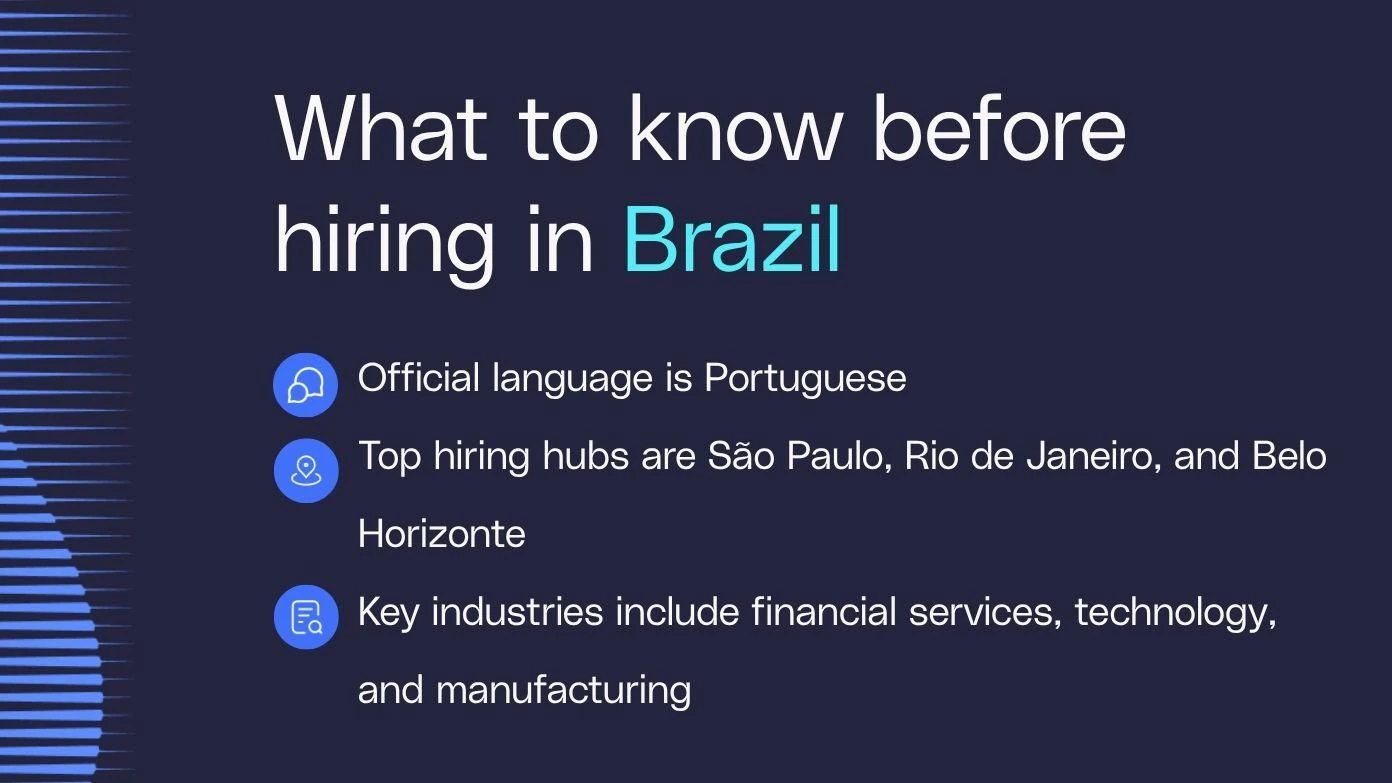
Portuguese is the official language, spoken by over 99% of the population. Brazil is the only Portuguese-speaking nation in the Americas. With the growth of Mercosur (the Southern Common Market) and increased trade, the economic necessity of Spanish has grown in schools and businesses. As with most countries, you're more likely to hear English in city centers in Brazil than in other parts of the country, but English is not widely spoken.
3. Working hours and compensation
The legal maximum workweek is 44 hours. This is spread across eight hours per day, Monday through Friday, and four hours on Saturday, or as agreed upon in collective bargaining agreements (CBAs). Employees get a minimum one-hour lunch break if they work more than six continuous hours. Alternative schedules are allowed if established by a CBA or written agreement.
Overtime is paid at a minimum of 150% for hours worked beyond the standard daily or weekly limits (Monday to Saturday). Work performed on Sundays or public holidays has to be paid at 200% unless a compensatory day off is provided. CBAs can set higher overtime rates.
The minimum wage in Brazil is RD 1,621.00 per month in 2026. Some states, like São Paulo, have higher regional minimum wages, and employers must pay the higher applicable rate. The minimum wage is adjusted annually based on inflation and GDP growth.
Hoewel het geen wettelijke vereiste is, zijn jaarlijkse salarisaanpassingen gebruikelijk vanwege vakbondsonderhandelingen en inflatie.
The 13th-month salary is a mandatory annual bonus. It's equal to one month's salary, paid in two installments, one by Nov. 30 and the second by Dec. 20. It's calculated as one-twelfth of the monthly salary for each month worked in the calendar year. Commissions and certain bonuses can be included if they're part of regular compensation.
4. Vacation and sick leave
Annual leave requirements are generous in Brazil compared to other countries. After one year of service, employees get 30 days of vacation leave. Employees can divide their vacation time into three periods: one lasting at least 14 days, and two more lasting at least 5 days. Employees have the option to cash in up to 10 vacation days. These vacation days are paid, and employers must pay a vacation bonus equal to one-third of the employee's monthly salary.
Employees in Brazil also get paid sick leave. When an employee misses work due to a medical issue, employers must pay them for their first 15 days of illness, as long as the employee provides a doctor's note. If the employee misses more than 15 days due to their medical condition, then the National Institute of Social Security (INSS) will take over.
5. Required benefits
Brazil has generous statutory benefits, including paid vacation, 13th-month salary, social security (INSS), the severance fund (FGTS), and mandatory meal and transportation vouchers.
Employers must withhold a portion of employees' pay for INSS and make an employer contribution. The employer's rate is typically 20% of payroll plus extra contributions for workplace accident insurance and third-party entities, which can add 5.8% or more, depending on the company's risk profile and sector.
Employee INSS contributions are withheld at progressive rates (7.5% to 14% in 2026) based on salary.
Meal vouchers and food vouchers aren't required by federal law. However, Collective Bargaining Agreements (CBAs) can mandate them, and they are customary in many sectors.
Employers must deposit 8% of the employee's monthly salary into the FGTS account. This isn't withheld from the employee's pay; it's an extra employer cost. FGTS is available to employees upon termination without cause, retirement, or in other circumstances like serious illness or a home purchase.
Hiring models for global companies in Brazil
When hiring in Brazil, you have several options. The right model depends on your long-term plans, workforce size, and business activities. There are four common models:
- Direct employer registration: If you already have a legal entity, you can register your company as an employer and hire in Brazil directly. This allows you to control all your HR operations. Your company will manage tax withholding, payroll, statutory benefits, eSocial reporting, and employment documentation. Direct hiring is ideal if you already have an established local entity and the resources to manage local employment requirements.
- Employer of record: If you don't have a legal entity in Brazil, you can hire professionals in Brazil through an employer of record. With G-P EOR, you can hire, onboard, and manage professionals in Brazil without worrying about employment requirements. G-P will handle the country-specific compliance requirements, leaving you to manage the company's day-to-day responsibilities. This model is ideal when you need to hire quickly or test the market before making long-term plans.
- Subsidiary or branch: Setting up a subsidiary or branch makes sense when you plan to maintain long-term operations in the country. A local entity will give your company a legal presence in Brazil. Setting up a subsidiary or branch requires more time and resources. In addition, you will be responsible for employment compliance, payroll, taxes, benefits, and other employment obligations.
- Independent contractor and misclassification risk: If you have temporary or need-based work and it isn't necessary to create a traditional employment relationship, hiring independent contractors makes sense. However, classifying your workers depends on their actual working responsibilities. If their responsibilities function like employment, Brazilian authorities can reclassify the contractor as an employee. You will then be responsible for social security contributions, FGTS payments, taxes, employment benefits, and other liabilities.
If you plan to hire contractors in Brazil, G-P Contractor™ allows you to manage contractor payments and create contracts so that you can meet all compliant contractor requirements.
Top wervingshubs in Brazilië
Brazil's major cities have different strengths. Knowing what each city has to offer allows you to focus your hiring efforts in the right place and fill roles faster.
De belangrijkste talentenhubs in Brazilië zijn:
- São Paulo is Brazil's largest city and the main business, financial, and technology center. It hosts multinational companies and startups, making it the top hiring hub for a wide range of industries.
- Rio de Janeiro is known for its energy, oil and gas, tourism, and creative industries. The city is a major employment center, especially for roles in engineering, media, and services.
- Belo Horizonte is a hub for mining, technology, and business services with a growing start-up ecosystem.
- Brasília is the nation's capital. Brasília is the center for government, public administration, and related services, attracting talent in law, policy, and administration.
- Curitiba is known for its advanced manufacturing, automotive, and technology sectors, as well as its reputation for urban planning and sustainability.
Belangrijke industrieën in Brazilië
Understanding Brazil's top industries allows you to benchmark salaries and benefits. You can use this insight to make smart choices about where to invest and grow your talent pool.
De belangrijkste industrieën in Brazilië zijn onder andere:
- Financial services: Brazil has one of the largest financial markets in Latin America. This includes major commercial banks, investment firms, and the B3 (Brazil, Bolsa, Balcão) stock exchange, located in São Paulo.
- Technology and digitalization: Brazil is a hub for technology in Latin America, with a growing startup ecosystem and many unicorn companies. This includes areas like fintech, proptech, and edtech.
- Manufacturing: Brazil is a leading industrial nation globally. Areas include automotive (manufacturing and assembly of cars, trucks, and auto parts), aerospace (home to Embraer, one of the world's largest commercial jet manufacturers), and chemicals and petrochemicals (processing crude oil and natural gas).
- Energy, oil, and gas: Brazil is a global producer of oil, thanks to large offshore pre-salt reserves. The state-owned company Petrobras is a big force in this sector. Brazil is a global leader in renewable energy, with 89% of its electricity generation coming from renewable sources, primarily hydroelectric.
- Agriculture: Brazil is important in global food security and commodity markets. Brazil is the world's largest producer of soybeans, coffee, and sugarcane. The country is also a big producer of corn, beef, and chicken.
Cost of hiring an employee in Brazil
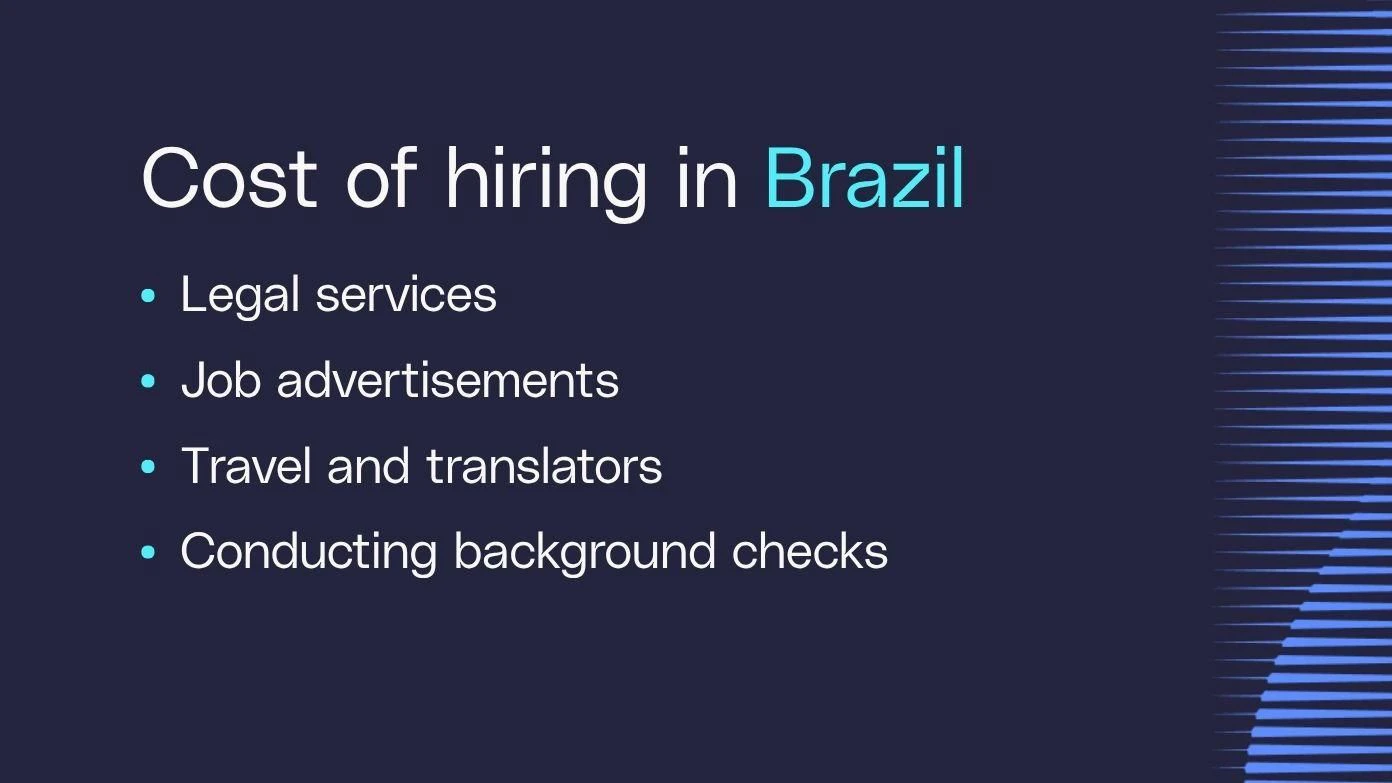
Whether you're hiring one employee or an entire team in Brazil, expenses are inevitable. Budget for the following:
- Het opzetten van een entiteit (tenzij je samenwerkt met een geregistreerde werkgever)
- vacatures adverteren;
- Doorverwijzingsbonussen betalen aan werknemers met connecties in Brazilië
- een interne wervingscommissie betalen;
- Reizen van en naar Brazilië, inclusief hotelverblijven, maaltijden en vervoer
- Een dienst voor antecedentenonderzoek gebruiken om kandidaten te screenen
- Opstellen van arbeidsovereenkomsten die aan de regels voldoen, juridische toetsing en overleg met HUMAN RESOURCES- en juridische deskundigen
- Kosten voor het leveren van computers, telefoons en softwarelicenties
- Uitgaven voor onboardingmateriaal en initiële opleiding
- Verplichte werkgeversbijdragen
- Kosten voor het bijhouden van de vereiste belasting- en loonadministratieadministratie en documentatie
According to G-P Verified Sources from Gia, the employer burden rate in Brazil, which includes costs triggered on top of salaries, ranges from 60% to 100%, excluding accident insurance that can vary.
Wat heeft een bedrijf nodig om werknemers in Brazilië aan te nemen?
Zorg ervoor dat je deze essentiële zaken behandelt voordat je je TEAM in Brazilië uitbreidt:
- Richt je bedrijf op in Brazilië.
- Registreer de naam van uw bedrijf bij de Board of Trade in de staat waar uw bedrijf zal opereren.
- Registreer je bij de federale belastingdienst om een belasting-ID te krijgen.
- Registreer je bij de relevante belastingdienst van de staat en laat je registreren.
- Registreer u bij de plaatselijke gemeente voor een exploitatievergunning.
- Open een lokale bankrekening.
- Registreer je bij de INSS voor sociale zekerheid-bijdragen.
- Registreer je bij het ontslagvergoeding indemnity fund (FGTS) systeem.
- Registreer je bij het Ministerie van Arbeid en Werkgelegenheid om nieuwe medewerkers te melden.
- Stel een conform loonadministratiesysteem in dat alle wettelijke aftrekposten berekent en inhoudt.
- Zorg dat het systeem geïntegreerd is met eSocial.
- Stel arbeidsovereenkomsten op in het Portugees.
- Processen opzetten om de vereiste voordelen te bieden.
- Registreer je bij de arbeidsveiligheidsautoriteiten.
- Houd nauwkeurige gegevens bij van arbeidsovereenkomsten, loonadministratie, tijdregistratie en alle arbeidsgerelateerde documenten.
Setting up a subsidiary in Brazil can take weeks or months. Use G-P EOR to hire full-time employees in Brazil without setting up your own entity. Build your team at a lower cost and with peace of mind that you're doing so compliantly.
Steps to hiring in Brazil
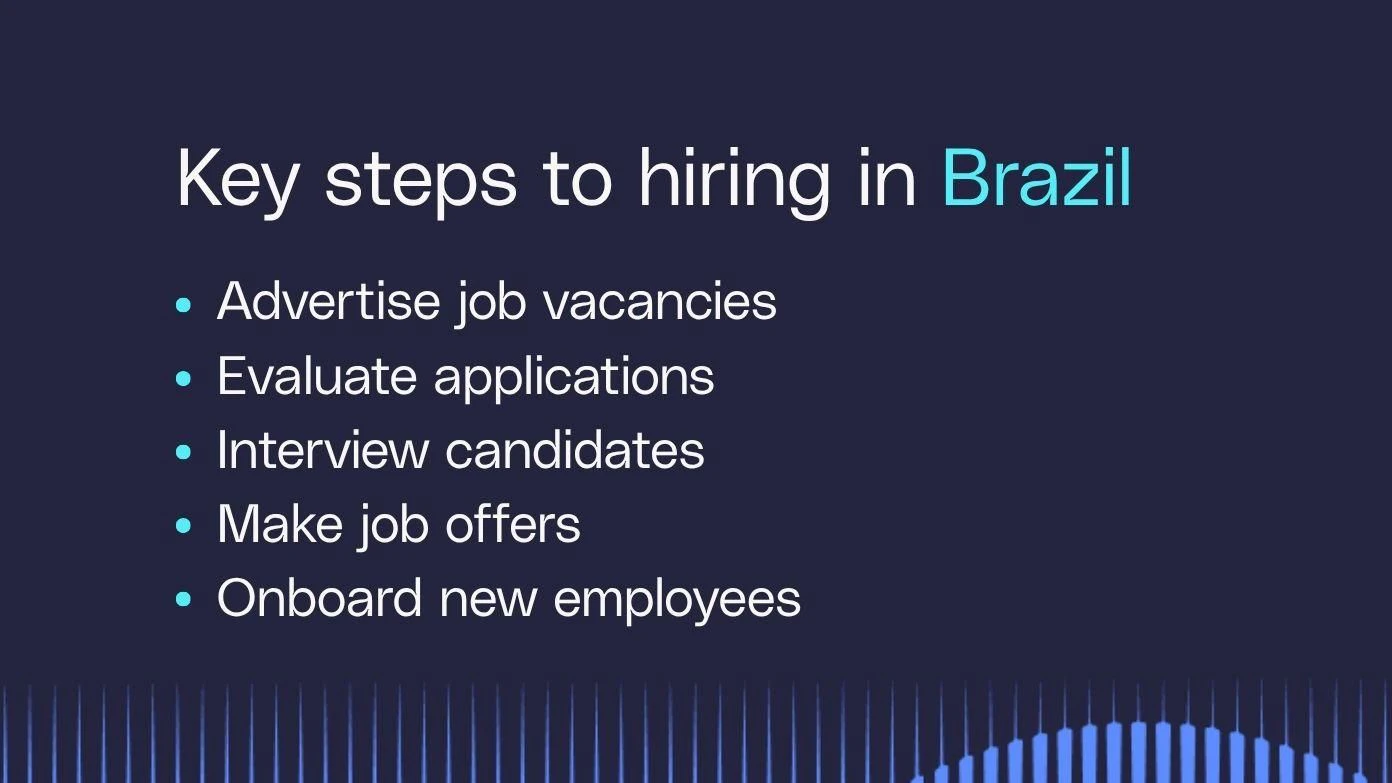
The hiring process in Brazil is similar to the one you're likely familiar with in your own country. The hiring process follows five basic steps: advertising the job, evaluating applications, interviewing candidates, sending job offers, and onboarding new employees.
1. Advertising job vacancies
Create a detailed job description, including required qualifications, responsibilities, and benefits. Internships aren't considered employment under the CLT. Job ads for internships must clearly identify the position as an internship and meet all legal requirements for such roles.
LinkedIn, Catho, InfoJobs en Vagas.com zijn populaire vacaturesites in Brazilië.
2. Evaluating applications
Verzamel sollicitaties en bekijk cv's. Screenen sollicitaties en interviews houden compliance met lokale wetten.
3. Interviewing candidates
Interview candidates who made it onto your shortlist. You can do these interviews in person or virtually. Verify references and, if relevant, conduct background checks in compliance with Brazilian data protection laws (LGPD).
Gia can help you create questions that follow anti-discrimination laws in Brazil, so you can find the best fit for the role while complying with local regulations.
4. Baanaanbiedingen doen
Contact your chosen candidate to offer them a position with your company. Offers are typically made in writing. Draft an employment contract in Portuguese, including all mandatory clauses and statutory benefits. Both parties must sign the written contract.
5. Onboarding new employees
Now you can onboard new employees. Register your new hire with eSocial, INSS, and FGTS. Update the employee's digital work card.
If you're working with G-P EOR™, you won't have to worry about the administrative burden of onboarding. We'll streamline the process, so you can focus on training your new hire and integrating them into your company culture.
Aannemers inhuren in Brazilië
Working with independent contractors in Brazil can be a cost-effective way to test the market and build a presence without the commitment of full-time employees.
Contractors based in Brazil understand local consumer behavior, rules, and business practices. They'll be ready to start working quickly with their own equipment and established work processes.
Hiring contractors allows you to easily adjust your talent pool based on your business needs without the complexities and costs of employment.
Before you enter an agreement with an independent contractor in Brazil, consider the following.
1. Werknemers versus onafhankelijke contractanten
It's important to understand the difference between employees and independent contractors. In Brazil, employers hire employees to do work and, in return, pay them a regular salary and benefits. Independent contractors provide services. Unlike employees, contractors set their schedules, use their own equipment, and work on specific projects rather than having an ongoing role.
2. Boetes voor verkeerde classificatie
Classifying someone as a contractor when they're not can lead to severe penalties. If misclassification occurs, you'll need to:
- Betaal met terugwerkende kracht alle wettelijke arbeidsrechten en -voordelen.
- Face administrative fines for failing to register employees, nonpayment of social charges, and other violations.
- Achterstallige bijdragen aan sociale zekerheid (INSS) en FGTS, plus rente en monetaire correctie.
3. Hoe contractanten te betalen
G-P Contractor neemt het rommelige, tijdrovende proces weg van het inhuren en betalen van Internationale aannemers. Je kunt contracten opstellen en uitgeven en aannemers betalen met slechts een paar klikken, terwijl je tegelijkertijd een conform proces waarborgt.
Hire employees and contractors in Brazil with G-P
Onze Global Employment Platform™ en haar kunstmatige intelligentie-gedreven producten, Employer of Record, Contractor en Gia, ondersteunen bedrijven bij het opbouwen en beheren van wereldwijde teams.
G-P is de erkende leider in wereldwijde werkgelegenheid met meer dan tien jaar ervaring; het grootste TEAM van HR-, juridische en compliance experts; en een wereldwijde eigendomskennisbasis.
Make your expansion to Brazil easier with G-P. Contact us or book a demo today.

Veelgestelde vragen
Wat zijn de belangrijkste wettelijke vereisten voor het aannemen van werknemers in Brazilië?
Companies must be legally registered, have a CNPJ (tax ID), register with social security (INSS), FGTS, and the Ministry of Labor, and use the eSocial platform for reporting. Employment contracts must be in Portuguese and include all statutory benefits.
Wat zijn de verplichte werknemervoordelen in Brazilië?
Required benefits include paid vacation (30 days per year), a vacation bonus (one-third of monthly salary), 13th-month salary, FGTS (8% employer contribution), INSS (social security), and transportation vouchers.
Hoeveel kost het om een werknemer in Brazilië in te huren?
The employer burden rate ranges from 60% to 100% of the employee's salary, depending on sector, location, and collective agreements.
Kunnen arbeidsovereenkomsten in Brazilië in het Engels zijn?
Contracts must be in Portuguese. Dual-language contracts are allowed, but the Portuguese version prevails in case of dispute.
What's the standard workweek and overtime policy in Brazil?
The standard workweek is 44 hours, usually eight hours per day, Monday to Friday, and four hours on Saturday. Overtime is paid at 150% of the regular rate, and work on Sundays and holidays is paid at 200%.