




Key takeaways
- Global HR compliance extends beyond employment laws. Tech companies also need to consider intellectual property ownership, cybersecurity, data privacy, and technology transfer regulations when hiring across borders.
- Local regulations shape global hiring strategies. Employment contracts, worker classification, payroll obligations, and statutory benefits vary by jurisdiction, making localized HR practices essential.
- Effective compliance depends on cross-functional coordination. HR, Finance, Legal, and IT teams need to work together to manage regulatory risks, protect business assets, and support distributed workforces.
- The right employment model supports more efficient global expansion. Working with an employer of record (EOR) can reduce administrative burden, simplify local employment compliance, and give tech companies greater flexibility when entering new markets.
For growing tech companies, global hiring provides access to specialized skills, helps fill critical roles, and creates opportunities to enter new markets. However, building an international workforce also introduces employment, tax, data protection, and regulatory challenges.
In the tech sector, there are unique compliance considerations that go beyond standard employment obligations. When your company hires developers, engineers, and other tech professionals across borders, you must take intellectual property, cybersecurity, and technology transfer regulations into account.
Understanding these requirements is key to successfully building a global team while keeping legal and operational risks in check. This guide explores common compliance challenges tech companies face and practical steps you can take to operate globally with ease.
What is compliance in HR for technology companies?
HR compliance means following applicable employment laws, statutory benefit requirements, payroll tax obligations, and data privacy rules wherever you hire. For tech companies, compliance also includes protecting intellectual property rights and managing access to sensitive systems and information.
Compliance for IT companies is more complex when teams operate across borders. Local employment laws can affect everything from contract terms and equity compensation to ownership of software developed by your team members. Companies must also consider how remote developers access code repositories, cloud infrastructure, and proprietary data.
Company policies and contract terms must account for mandatory local employment laws, which may take precedence when the two conflict. By adapting your HR practices to local requirements, you can reduce compliance risks, protect your technology, and build a stronger global workforce as your company grows.
Why compliance matters for tech companies
Compliance failures can lead to severe financial penalties, legal disputes, operational disruptions, and reputational damage for expanding tech companies.
Managing these risks starts with addressing several key responsibilities:
- Labor laws and regulations: Follow local requirements for employment contracts, working hours, minimum wages, statutory benefits, and termination procedures.
- Immigration laws and work permits: Verify that professionals have the appropriate work authorization, including any necessary visas or permits.
- Taxation and payroll regulations: Manage applicable income tax withholding, employer social security contributions, payroll reporting, and other statutory obligations.
- Data protection and privacy laws: Protect personal information in accordance with applicable regulations, such as the EU General Data Protection Regulation (GDPR) and California Consumer Privacy Act (CCPA).
Global expansion roadmap for tech companies
Beyond employment and payroll obligations, your tech company needs to account for industry-specific regulations when entering new markets. Building these considerations into your expansion roadmap can help you identify risks early and avoid costly disruptions.
Key compliance areas include:
- Local tech regulations and standards: Identify applicable technology laws, software licensing requirements, and industry-specific standards. For example, the EU’s Digital Services Act (DSA) establishes rules for certain online platforms and intermediary services operating in the region.
- Intellectual property rights: Protect proprietary software, source code, and other innovations through appropriate contracts and IP ownership provisions. Requirements can vary by country, particularly when you’re engaging independent contractors.
- Cybersecurity and data protection: Establish safeguards for sensitive business information, employee data, and proprietary technologies. Assess applicable security and privacy obligations when managing distributed teams and cross-border data access.
- Export controls and technology transfers: Determine whether sharing controlled software, source code, or technical information across borders triggers export restrictions. For example, certain technology transfers may fall under the U.S. Export Administration Regulations (EAR).
What do HR, Finance, and Legal leaders at tech companies need to know about global expansion?
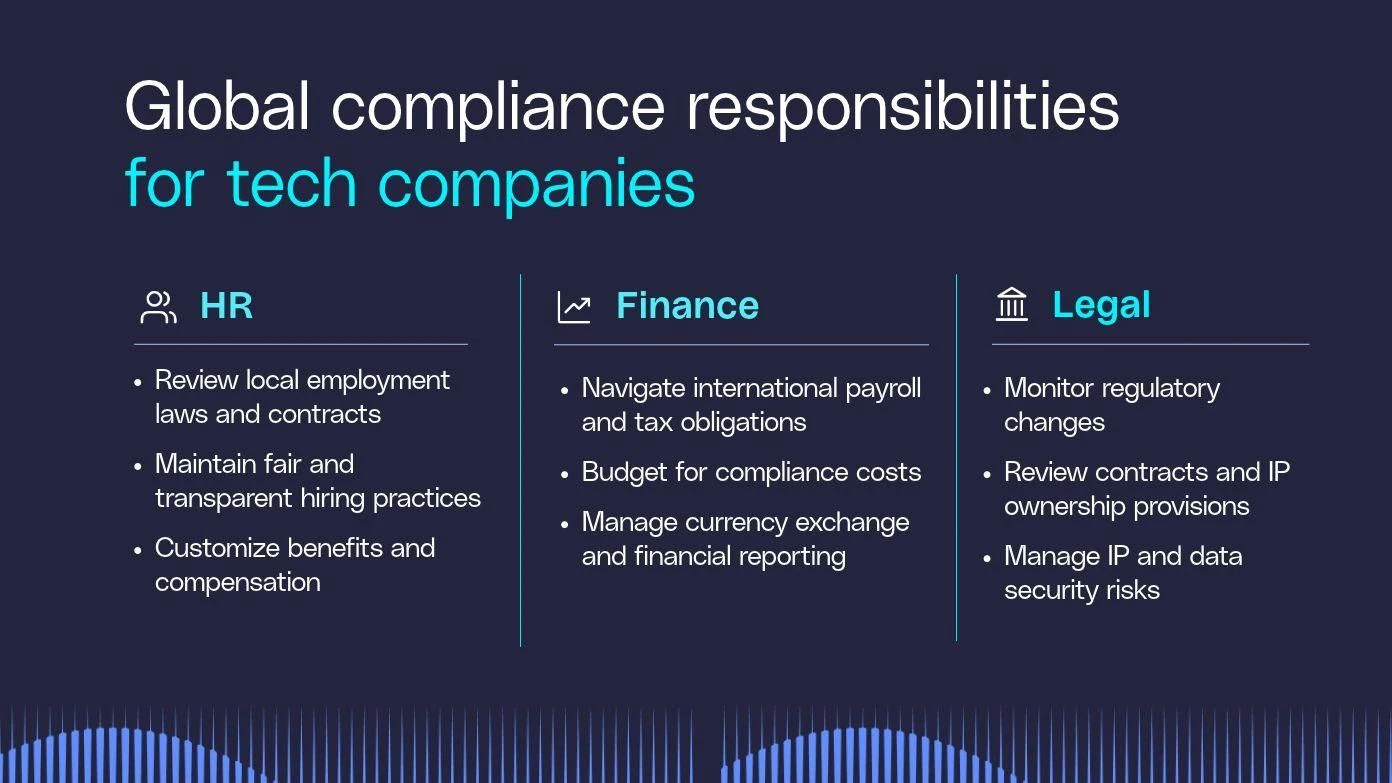
Expansion on a global scale creates different compliance responsibilities for HR, Finance, and Legal teams. Each department plays a role in managing employment obligations, protecting business assets, and supporting your company’s growth.
Compliance task snapshot: HR
Attracting and retaining top talent across multiple markets needs to be a priority for HR leaders at tech companies. Competitive compensation, locally appropriate benefits, and flexible working arrangements can help you recruit skilled professionals while meeting employment requirements.
Managing distributed teams also means accounting for differences in local labor laws, workplace expectations, and cultural practices.
For HR teams, three areas deserve particular attention:
- Review local labor laws and contracts: Align employment agreements with applicable requirements for working hours, leave, termination, and other employment conditions.
- Maintain fair and transparent hiring practices: Follow applicable anti-discrimination and pay transparency rules throughout recruitment and compensation decisions.
- Customize benefits and compensation: Meet statutory benefits requirements while considering locally competitive compensation packages, including relevant in-kind benefits.
Compliance task snapshot: Finance
Finance leaders need to manage the financial complexities of international expansion, from global payroll and taxation to compliance costs and currency exchange. Software licensing and subscription models can also create financial reporting considerations across markets.
Planning for these requirements helps your business control costs while meeting local rules and identifying potential R&D tax incentives.
Finance teams can focus on three areas:
- Navigate international payroll and tax: Account for local income tax withholding, employer social security contributions, payroll reporting, and other applicable obligations.
- Budget for compliance costs: Plan for statutory employer expenses, professional services, and other costs associated with operating in different countries.
- Manage currency exchange and financial reporting: Monitor foreign exchange exposure and follow applicable accounting and reporting requirements.
Compliance task snapshot: Legal
Legal teams need to monitor regulatory changes, review employment agreements, and address risks involving intellectual property, data privacy, and technology transfers.
For tech companies, this includes ensuring that contracts clearly define ownership of software and other innovations developed by global team members.
Legal teams need to prioritize the following:
- Monitor employment laws and regulations: Track changes to local employment requirements, including worker protections, statutory entitlements, and termination rules.
- Review contracts and agreements: Establish appropriate terms for intellectual property ownership, confidentiality, liability, and termination under applicable laws.
- Manage IP and data security risks: Coordinate with IT and security teams to protect proprietary technology, manage data access, and address relevant privacy obligations.
HR compliance best practices for scaling tech firms
Managing HR compliance across multiple countries calls for consistent processes that account for local legal requirements. The following HR compliance best practices can help your tech company reduce risks as you grow your global workforce.
- Conduct regular worker classification audits: Review contractor arrangements against applicable local classification rules. Consider factors such as worker independence and the nature of the working relationship. Evaluate roles against the worker classification tests that apply in each jurisdiction.
- Balance global policies with local requirements: Establish consistent company-wide HR standards while adapting employment contracts, statutory leave, notice periods, and severance provisions to local laws.
- Automate regulatory monitoring: Use compliance technology and AI-powered global HR agents, such as G-P Gia™, to track legal changes, identify potential gaps, and support timely updates to HR policies. Maintain human oversight of compliance decisions.
- Coordinate employee offboarding and system access: Align local notice, final pay, and termination requirements with IT procedures for revoking access to code repositories, cloud platforms, and sensitive company data.
How an employer of record (EOR) helps tech companies succeed globally
An employer of record can help tech companies hire professionals in new markets without establishing local entities. The EOR serves as the legal employer, managing employment-related responsibilities such as payroll, taxes, benefits, and compliance with applicable local employment laws. Meanwhile, you manage the day-to-day work of your team.
With G-P EOR, you can enter new markets faster while reducing administrative work. Using an EOR also gives you flexibility when scaling operations or exiting markets without the complexities of closing a local entity.
Benefits of partnering with an EOR
|
Access to global tech talent |
Build a team of skilled tech professionals worldwide without setting up new legal entities. |
|---|---|
|
Faster hiring for urgent projects |
Onboard professionals in new markets without waiting to establish a local entity, so you can meet project deadlines and launch products faster. |
|
Support for local employment compliance |
Navigate country-specific requirements with expert support, reducing administrative complexity and compliance risks. |
G-P EOR in action: How OneStream Software grew farther, faster
Based in Birmingham, Michigan, OneStream’s mission is to empower companies with smart finance solutions that streamline and improve operations. The company’s leadership team was concerned about the potential administrative burden associated with expanding globally and its possible toll on their HR and legal teams.
OneStream’s VP of Global Culture, Diversity, and People, Martha Angle, was impressed by how easy G-P’s platform is to use and the secure insights it provides.
“
We chose to work with G-P after working with a different EOR partner because G-P delivers the trusted support we needed for global expansion. Their platform is secure and makes billing simple."
Martha Angle
VP of Global Culture, Diversity, and People at OneStream
Today, G-P supports OneStream’s international growth through G-P EOR, self-service technology, and access to in-region HR and legal expertise. OneStream has expanded its global workforce through G-P to more than 35 professionals across 11 countries and four continents.
Ensure HR compliance with G-P
Build your global tech workforce with G-P’s Global Employment Platform and its AI-powered products, EOR, Contractor, and Gia. With G-P EOR, you can hire, onboard, and manage employees in 180+ countries without establishing local entities.
From employment contracts and payroll to benefits administration and ongoing HR support, G-P helps you manage the complexities of global HR compliance n, so you can focus on innovation and business growth.
Grow your tech team beyond borders. Contact G-P to explore your global hiring options.
 FAQs
What is compliance in HR?
HR compliance means following applicable employment laws, payroll tax obligations, statutory benefit requirements, and data privacy regulations. For global tech companies, these responsibilities vary by country and affect hiring, compensation, and workforce management.
What does HR compliance mean for tech companies?
For technology companies, HR compliance also involves managing employment-related risks connected to intellectual property, remote work, and access to sensitive systems. This includes establishing appropriate IP ownership terms and protecting proprietary information when hiring developers and other technical professionals.
Why is HR compliance important for tech companies?
HR compliance helps tech companies reduce legal and financial risks while supporting international growth. Effective compliance practices also help protect intellectual property, support fair employment conditions, and create a stronger foundation for managing distributed teams.
How do tech companies conduct an HR compliance audit?
Your company should start by reviewing employment contracts, worker classifications, payroll practices, statutory benefits, and data privacy procedures in each country where you hire. Identify deviations from applicable local requirements, prioritize corrective actions, and establish regular reviews to maintain compliance.
What HR compliance risks are specific to tech companies?
Tech companies face additional risks involving software IP ownership, contractor misclassification, cross-border access to proprietary code, and technology transfers. Remote development teams may also introduce data security and privacy concerns that need coordination between HR, Legal, and IT.