








Key takeaways
-
What is HR document management: It covers how employee records are handled across the full lifecycle — from creation to lawful destruction.
-
The global compliance challenge: Manual tracking creates gaps that show up in audits and disputes. HR must keep records for mandated periods while meeting privacy requirements.
-
Security beyond storage: Sensitive workforce data needs enterprise-grade security. Encrypt data at rest and in transit, restrict access with role-based permissions (RBAC), and manage audit trails.
-
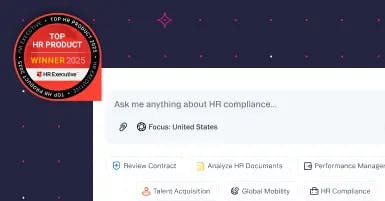
AI-powered efficiency: G-P Gia™ is a global HR agent that generates compliant contracts and policies in minutes. It can cut compliance costs by up to 95%.
Spreadsheets can’t keep up with global HR.
Record-keeping laws are different everywhere. An action that’s legal in one jurisdiction can be illegal in another: The U.S. requires keeping payroll records for at least three years, but the EU's data protection laws forbid holding personal data longer than necessary.
This creates a structural problem for global HR teams who have to juggle dozens of document types and follow different rules for creation, storage, access, and disposal.
To scale compliantly, you need centralized HR document management. That means ditching the spreadsheets and shared drives for document lifecycle automation.
What is HR document management?
HR document management streamlines employee records across the full lifecycle — from creation to secure destruction. It ensures every document, from an offer letter to a termination agreement, is created, stored, accessed, and deleted in a safe and compliant way.
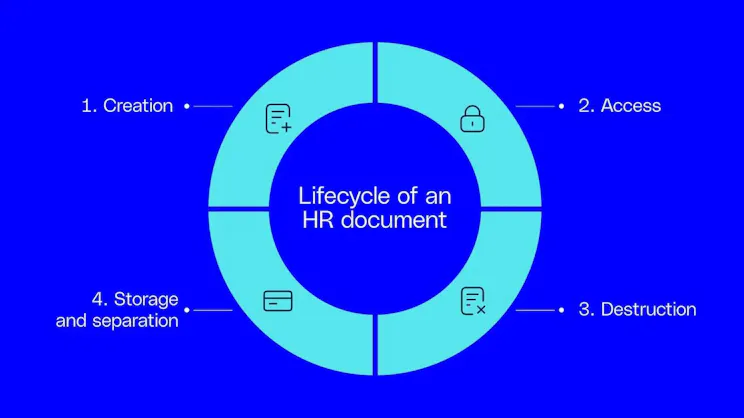
A compliant HR document management system has three main features:
Feature 1. Safe document creation, separation, and access
Creation
Compliance starts when you create a document. Contracts and workplace policies must reflect current local labor laws. Outdated templates and manual drafting create avoidable risk.
Storage
Document storage requirements differ across jurisdictions and record types. For example, in the U.S., Form I-9 must be stored separately from personnel records. Employee medical information collected under the Americans with Disabilities Act (ADA) must stay confidential and be kept separately. You may need to store one employee’s information in three locations. Noncompliance can result in audits, fines, and reputational damage.
Access
Data breaches are also expensive. The global average cost of a data breach was USD 4.4M in 2025. Breach risk increases when sensitive HR data is accessible and poorly tracked. Role-based access restricts viewing and editing to authorized users so audit logs can capture the full history: who accessed a document, when, and what changed.
Modern HR document management systems compliantly create documentation, organize, file, and limit access by role.
Feature 2. Retention rules you can actually follow
HR rarely manages one deadline. You’re tracking overlapping requirements across labor, tax, and benefits rules — each with its own timeline. For example, in the U.S.:
-
Personnel records must be retained for at least one year.
-
Payroll records must be kept for three years.
-
Employment tax records must be retained for at least four years.
-
Benefit plan documentation varies with longer retention rules.
Layer in a new country’s requirements and it gets more complex. Payroll records in the U.K. must be kept for three years from the end of the tax year they relate to, not from the time an employee leaves the company.
Modern HR document management systems apply the correct retention period by document type and jurisdiction — and track deadlines automatically.
Feature 3. Accurate disposal
You need to dispose of records in a way that prevents reconstruction when they reach end of life. In the EU and Canada, data must be deleted once its defined purpose ends.
Holding documents too long or deleting them too early can trigger audits and penalties.
Modern HR document management systems automate secure destruction by applying deletion rules consistently and logging every action — so disposal stays compliant.
Common HR documents
These are the main document types global HR teams manage, protect, and destroy in line with local laws:
|
Document category |
Examples |
Context |
|---|---|---|
|
Recruitment records |
Resumes Offer letters Interview notes |
These records are referred to during hiring disputes. |
|
Employment agreements |
Contracts aligned to local labor law |
Version control matters. Small language differences can change legal meaning across regions. |
|
Payroll and tax forms |
Tax withholding forms and social security registrations by country |
These documents contain sensitive identifiers and compensation data, so they need tighter access controls and audit trails. |
|
Performance records |
Reviews Disciplinary actions Promotion letters |
These records keep track of performance history. They support consistent decision-making and are often referenced in disputes. |
|
Termination documents |
Severance agreements Exit interview records |
These records are referred to during post-employment claims. |
Key aspects of HR document management
Document management HR is balancing retention, privacy, access, and risk — all at the same time. HR teams need a system built on these pillars:
Global compliance and retention
Compliance is keeping the right things for the right period — and deleting what you aren’t allowed to hold. But laws differ across countries, and sometimes states or regions.
That’s why retention timelines and document requirements can’t run on one universal policy. They must be set and enforced by region.
A strong document management system classifies records by jurisdiction and purpose, applies the right legal basis, and retains what’s required — then deletes what isn’t.
Accessibility and organization
Document access needs guardrails. The 2025 Future of jobs report lists “cybersecurity” and “broadening digital access” as top trends reshaping business through 2030.
For HR, this means moving from folders to advanced role-based access control (RBAC). RBAC gives hiring managers access to candidate materials, while only authorized HR or legal leaders can view sensitive tax forms, salary data, and other restricted records.
Version control
Using the wrong version of a document is a compliance risk.
Version control keeps teams on the latest approved template every time. It prevents mistakes like issuing contracts with outdated clauses or circulating old compensation terms.
This matters even more for global teams. Legal updates don’t happen on the same timeline in every country. A structured system stops expired clauses from circulating and keeps documentation aligned with current requirements.
Benefits of HR document management
HR document management solutions protect your business and keep HR moving.

Benefit 1. Reduced legal risk
Documentation supports cases in employment disputes. Courts and regulators rely on these records. Incomplete or inconsistent files weaken your case.
Audits create another pressure point. Ignoring local rules on how long documents must be kept or how they must be stored can lead to fines.
Global HR teams need good HR document management to prove what was signed, when it was signed, who accessed it, and how long it was retained.
Benefit 2. Faster workflows with fewer errors
Manual document handling is an expensive bottleneck.
Teams duplicate employee data, chase signatures, and rebuild contracts that should already exist as templates. This takes time and costs you money. An HR data entry costs USD 5,68 on average.
Automated HR processes “liberate” HR — moving teams off repetitive admin tasks and onto strategic work like shaping culture and designing the future workforce.
Benefit 3. A better employee experience
New hires notice friction — and a lot of it comes from onboarding paperwork.
HR document management gets employees the right forms at the right time. You cut version mix-ups and reduce delays. Digital onboarding removes the “print, sign, scan, email, follow up” loop so anyone can complete paperwork from anywhere. You can also track completion in real time, so your team doesn't get repeat requests or outdated documents.
Protecting sensitive HR information
Data privacy rules raise the bar for how global companies handle workforce records. Regulations like GDPR and Brazil’s Lei Geral de Proteção de Dados Pessoais (LGPD) have strict controls for access, storage, and processing. A locked filing cabinet or a shared drive won’t meet that standard.
Protecting sensitive HR information starts with security controls embedded in the system. Our global employment products are built on SOC 2 Type II principles and support core safeguards such as:
-
Role-based access control
Limit sensitive data access to authorized users. Controls like multi-factor authentication and single sign-on add another layer of protection. -
Encryption
Encrypt data so it stays protected in storage and during transfer. -
Audit trails
Log key actions so teams can see who accessed a document, when, and what changed. -
AI data confidentiality
Isolate customer queries and documents so proprietary data stays private and isn’t used to train public models.
How tech helps HR document management
G-P Gia™ is an AI-powered global HR agent that generates compliant documents across 50+ countries and reviews drafts to flag issues early — so documentation doesn’t become a blocker.
With Gia, you can:
Draft compliant HR documents in minutes
Gia drafts offer letters and employment agreements that adapt to local laws instantly. Gia cuts the time and cost of compliance by up to 95%, so your internal teams can focus on people work instead of paperwork.
Get answers you can trust
Gia uses a RAG-based (retrieval augmented generation) approach to base responses on 100,000+ legally vetted articles and 1,500+ government sources. It’s 10x more accurate than traditional LLMs. Gia delivers legal-grade precision for creating policies and reviewing documents, reducing policy management overhead by 50%.
Handle sensitive exits
Gia streamlines terminations, saving up to five hours per offboarding — an 85% reduction — keeping documentation aligned with local labor laws and supporting a respectful employee experience.
Keep sensitive HR data safe
Gia is built on SOC 2 Type II principles. Data is encrypted at rest and in transit, and your proprietary information is never used to train public LLMs. For more details on how we manage data, see our security and privacy standards overview.
Gia in the real world
Let’s look at a hiring scenario with Priya, an HR Director managing a team in Germany. Daniel, her co-worker, needs to quickly send an employment contract to their top candidate, Lukas.
|
Without Gia |
With Gia |
|---|---|
|
Daniel is in a rush. Unfortunately, Daniel doesn’t realize the file is from 2021. The non-compete clause he used isn’t enforceable under current German law. Lukas signs, and six months later, when a legal issue arises, Priya discovers the error. The contract is void, the company is liable, and Priya is left cleaning up a costly compliance mess caused by a simple version-control mistake. |
Daniel is in a rush. Lukas signs, and six months later, when a legal issue arises, Priya simply enforces the contract. |
With G-P Gia, we’ve cut compliance costs significantly. If I need to write a policy, I plug in the parameters and jurisdiction, and Gia creates it instantly. Knowing that Gia’s guidance is based on expert-reviewed, legally vetted sources gives me peace of mind.
Katy Burris
Senior Director of Human Resources at Herb Pharm
Generate compliant HR documents with Gia
HR teams that chase signatures and templates pay in errors and delays.
Gia creates compliant contracts, tracks retention and deletion rules, and protects sensitive HR information with enterprise-level security across 50 countries and all 50 U.S. states.
See Gia in action.