








Key takeaways
- Separate global expansion from administrative complexity: Scale your international business without the admin headaches. Enter new markets and hire global talent in days, all without creating local corporate entities.
- Reduce compliance and structural risks: Expanding across borders opens you to misclassification and Permanent Establishment (PE) risks. A global employment platform builds local labor law intelligence into cross-border workflows.
- Choose the right entry vehicle: Strategic flexibility requires choosing expansion entry models — like employer of record (EOR) or global contractor platforms — that balance speed, expenditure, control, and regulatory exposure.
- Standardize globally, localize precisely: A resilient global expansion strategy standardizes your operations, governance, and workflows across time zones while adapting to local employment, payroll, and benefits requirements.
Going global should speed up your growth. But traditional expansion is full of roadblocks. Setting up local entities can take weeks or even months, and every new country comes with its own tax, payroll, and labor laws. Managing these rules can clutter your operations, delay hiring, and keep your team from capturing new market opportunities.
A global employment platform breaks that cycle by separating revenue growth from administrative headaches. With a unified global setup, you can hire talent in new markets in days without ever opening a local entity. Everything is centralized in one place, keeping your setup clean, compliant, and ready to scale.
What is business scalability in a borderless economy?
Business scalability means growing your revenue and launching in new markets without bloating your operating costs and admin workload at the same rate. In a borderless economy, it’s the foundation that dictates how you run your operations, stay compliant, and structure your team.
Rethinking growth in a distributed world
As your headcount expands across international markets, country-by-country requirements can multiply. Traditional international expansion adds overhead through local registrations, payroll setups, benefits, tax rules, and legal documents for every new location. A global employment platform changes that. Instead of rebuilding a custom HR and legal stack in every country, you can hire distributed teams and meet customer demand instantly.
|
Feature |
Linear international growth |
Scalable global expansion |
|---|---|---|
|
Administrative overhead |
High. Scales with every new hire |
Low. Streamlined through single platform |
|
Time-to-market |
Months to years per country |
Days |
|
Regulatory exposure |
High. Complex local legal risks |
Lower. Managed compliance architecture |
|
Executive focus |
Shifted to local setup operations |
Centered on core business growth |
|
Workforce elasticity |
Rigid and costly to adjust |
Flexible to market changes |
Why business scalability dictates international expansion success
Business scalability can make international expansion easy. A scalable operating model lets your company expand across markets without admin headaches or messy hiring processes.
Core drivers of scalable growth
- Faster market entry: Change from drawn out entity setups to hiring talent instantly so you can test new markets and capture revenue immediately.
- Direct access to global talent: Access specialized skills in tech and knowledge hubs worldwide without location limits or compliance headaches.
- Stronger innovation: Research shows that international teams out perform domestic-only teams by blending global perspectives with local insights.
- Continuous follow-the-sun operations: Build handoffs across time zones to keep projects moving around the clock without burning out your team.
The hidden cost of premature scaling
Scaling too fast can backfire if your sales team enters new countries before your HR, payroll, and compliance systems are ready. By setting up standardized global workflows early, you balance local compliance with central control. This balance keeps global expansion fast, safe, and sustainable.
Evaluating frameworks for an international business expansion strategy
To go global, pick scaling models that handle market complexity without slowing you down.
Beyond traditional expansion models
Traditional global expansion was slow and cautious, pushing companies to move gradually into nearby countries. Today, you can evaluate new international markets quickly and effectively with the CAGE framework. This looks at hurdles in four main areas:
- Cultural distance: Differences in language, communication styles, work norms, and customer expectations.
- Administrative distance: Differences in local labor laws, legal systems, tax regulations, and government policies.
- Geographic distance: Physical distance, time zone spreads, logistics, and communication workflows.
- Economic distance: Local income levels, purchasing power, labor costs, and overall market maturity.
Comparing global entry strategies
How you enter a new country impacts almost everything, from startup costs and setup speed to tax liabilities, legal risk, and how much control you maintain over local operations.
|
Entry strategy |
Capital expenditure |
Deployment velocity |
Operational control |
Tax and regulatory friction |
Strategic scalability |
|---|---|---|---|---|---|
|
EOR |
Low |
Days |
High (over daily tasks) |
Low (mitigated risk) |
High |
|
Wholly owned subsidiary |
High |
Months to years |
Full |
High |
High (at scale) |
|
Mergers and acquisitions |
High |
Months |
Moderate to High |
High |
Moderate |
|
Joint venture |
Moderate to High |
Months |
Shared |
Moderate |
Low to Moderate |
|
Local commercial agency |
Low |
Weeks |
Low |
Moderate |
Low |
Positioning EOR for agile growth
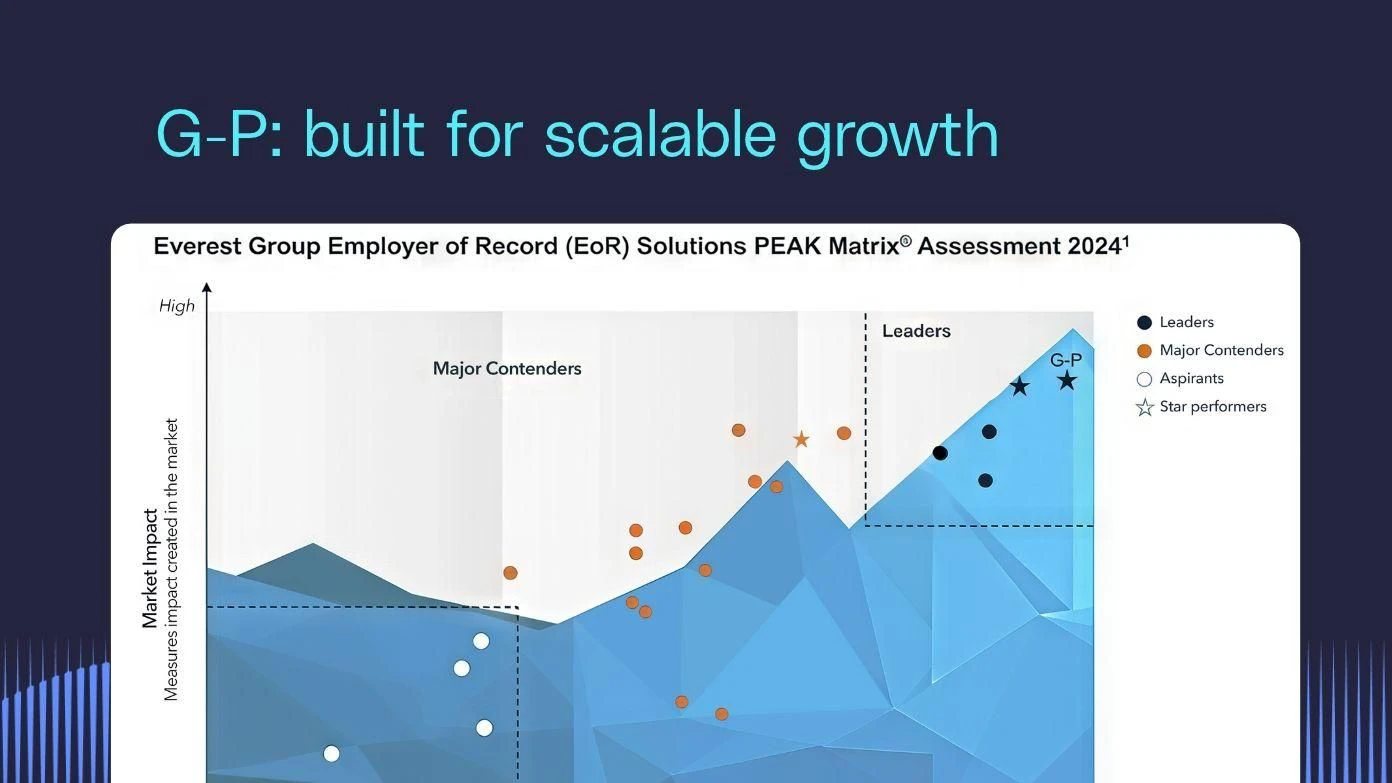
G-P is consistently recognized as an EOR industry leader by top analyst reports. An EOR lets you test new markets with lower setup burden and manageable risk, serving as one of the most flexible global market expansion strategies. With the right provider and country fit, you can engage local talent in days while evaluating long-term expansion plans.
Operational traps and risk reduction in global team scaling
Going global brings complex legal, tax, and HR challenges. G-P EOR simplifies everything by centralizing your global employment and protecting your business from costly mistakes. From local labor laws and tax rules to data privacy, handling risk early prevents financial liabilities down the road.
The compliance reality of worker misclassification
Misclassifying employees as independent contractors is a risk. Labor authorities look past whatever your contract says and focus on how you work together in practice. Key risks include:
- You direct their daily work
- You provide their equipment
- You integrate them into your core team.
Getting this wrong can result in penalties, including back pay, back taxes, unpaid benefits, interest fees, and even criminal liability.
Navigating PE risk in remote environments
Hiring remote talent in new markets creates PE risk based on local tax law, treaty rules, role authority, and physical location. A PE triggers local corporate tax obligations alongside registration and filing requirements. Two pathways create PE exposure:
- Having a physical footprint: Remote employees working in a country full-time or more than 50% of their time can count as a permanent operational base.
- Granting sales authority: Local reps habitually negotiating or closing contracts overseas can create an agency tax presence.
Unmanaged PE risks can lead to double taxation, back taxes, and heavy penalties. Global employment infrastructure monitors employee locations and contract authority to keep your expansion compliant and tax-safe.
Architectural blueprint: executing a resilient global market expansion strategy
To successfully scale across borders, your team must strike a balance between global consistency and local compliance:
- Keep your core operations standard: Use the same HR systems, corporate equity strategy, governance rules, and data security standards across every region.
- Adapt to local rules: Flex your employment contracts, benefits packages, working hours, leave policies, and termination rules to fit local laws.
Transitioning from synchronous meetings to asynchronous workflows
Managing a team across multiple time zones can easily turn scheduling into a headache. Here’s how to manage cross-border collaboration effectively:
- Centralize documentation: Keep all updates, project details, and timelines in a single shared tool so anyone can jump in, anytime.
- Measure outcomes over hours: Measure progress by milestones completed rather than hours spent at a desk.
- Empower independent work: Give remote team members clear decision-making power and simple ways to escalate issues so projects don't stall waiting on approvals.
Using an agentic global employment platform
Managing a global expansion strategy in-house strains your internal teams. G-P’s Global Employment Platform combines trusted compliance, connected workforce data, and intelligent AI action to transform how you manage your global workforce through automated, guided action rather than administration.
Using G-P, you can:
- Hire in 180+ countries: Onboard top global talent in minutes with zero local entities required.
- Access our Global Compliance Engine: A proprietary system that digitizes and applies labor laws and regulations across 180+ countries in real-time, validating every employment action with precision and compliance.
- Use G-P Gia™: An intelligent HR compliance platform that serves as the complete action layer, automating the mundane tasks of HR execution — from drafting localized documents to navigating complex cross-border compliance scenarios.
Scaling with confidence: the long-term outlook for global enterprises
Long-term business scalability is a long-term strategy. A flexible operating model creates clear financial and strategic advantages:
- Support your balance sheet: Eliminate entity setup costs, cut legal overhead, and minimize regulatory fines.
- Maintain strategic agility: Onboard talent in supported markets faster, test new concepts, and adapt your workforce strategy.
- Improve operational predictability: Turn global workforce expansion into a repeatable, efficient operating model for international scaling.
Learn how G-P’s Global Employment Platform allows you to scale your global workforce in minutes, reduce liability, and compete locally anywhere on Earth. FAQs
What is business scalability, and why does it matter for my global expansion?
Business scalability in global expansion is a company’s ability to enter new international markets and grow headcount without experiencing a linear increase in overhead costs, administrative burdens, or legal friction. It allows you to maintain operating margins and service quality while expanding into multiple jurisdictions.
What is the difference between business growth and business scalability for my company?
Business growth occurs when revenue increases but requires a proportional increase in resources, staff, and expenditure. Scalability occurs when a company increases revenue and market presence while keeping marginal operational costs flat or compressing them through automated infrastructure.
How does an EOR support my business scalability?
An EOR lets you hire, onboard, and pay talent in 180+ countries without setting up local legal entities. By using the EOR's existing legal infrastructure and compliance engines, you reduce months of incorporation delays, reduce administrative overhead, and scale their workforce dynamically.
What are the biggest compliance risks I face when scaling a global team?
The two main compliance risks are independent contractor misclassification and unintended PE. Misclassification occurs when contractors are managed like full-time employees, triggering retroactive tax and benefit penalties. PE occurs when remote activities create an unexpected corporate tax presence in a global jurisdiction.
When should I transition my company from an EOR to an owned subsidiary?
A company typically considers transitioning from an EOR to an owned subsidiary when regional headcount crosses 30–50 professionals, long-term market presence is proven, and the administrative cost of entity maintenance becomes lower than cumulative platform fees.


