





Key takeaways
- Global talent can fill skills gaps: You can widen your talent pool beyond local markets and find talent with specialized skills.
- Salary is only part of the hiring cost: Factors like payroll, statutory benefits, taxes, and employer contributions add to your total employment costs.
- A unified employment model improves control: A standard and centralized global employment process provides better visibility and transparency as you expand.
Global hiring gives you access to talent beyond your local market, but it also introduces costs and compliance requirements that are not part of a salary offer.
Uncertainty around local employment rules, payroll, taxes, and worker classification is where global hiring gets tricky. Finance leaders must weigh access to talent against the full costs and potential risks of hiring across borders.
Having a standardized global hiring strategy brings these issues into your financial plan from the start.
Macroeconomic forces and modern global hiring trends
Companies are looking beyond their local markets for specific skills and capabilities, especially in fast-growing yet specialized areas like AI. According to our AI at Work Report, 82% of global executives would hire in a country where they don't have existing employees to secure top AI talent. Skills-based hiring and flexible work arrangements expand the available talent pool and help you find professionals with the expertise you need.
As a result, the focus of global hiring has shifted from finding lower cost jurisdictions to determining where the right skills exist and what those employees will cost in total. Finance leaders must consider compensation alongside taxes, statutory contributions, benefits, and other employment costs.
Technology is changing workforce management, too. Standardized digital platforms can give teams a shared view of payroll, employment data, hiring costs, and compliance requirements. The result is a more disciplined approach to global hiring. Your company should identify the skills you need and determine the full cost of employment before hiring.
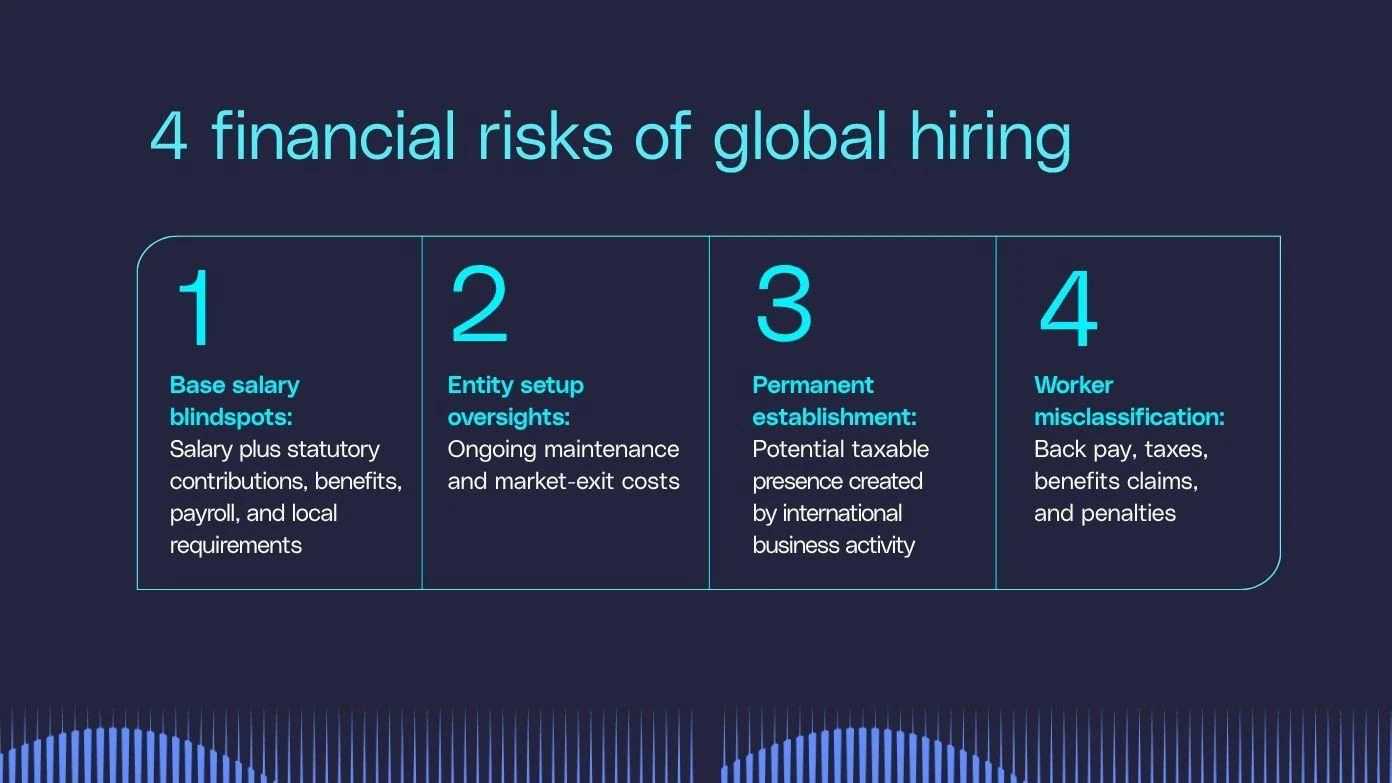
4 structural balance sheet pitfalls of global hiring
1. Total cost of workforce (TCOW) vs. base salary blindspots
Base salary doesn't give you the entire financial picture. When you hire in another country, you also need to take into account additional factors. These include benefits, insurance, paid leave, payroll costs, employer-side statutory contributions, and other local requirements.
These costs vary by country. Employer-side costs can significantly increase the total cost of hiring, depending on the country and employment arrangement. Benefits also vary by market, making it important to understand local expectations and requirements when building your global compensation package.
Some countries also require additional compensation, such as 13th-month or 14th-month payments. Others require large social contributions. A lower salary doesn't necessarily mean a lower total workforce cost. Before approving the final hiring budget, calculate the benefits package, compensation level, and employer costs by country. G-P's Employer Burden Calculator lets you compare employer costs by country and compensation level, so you can build a more accurate hiring business case.
2. Entity setup oversights
When you hire in a new country, it can create a larger commitment than you originally planned. Establishing a legal entity requires local registrations, banking, accounting, tax administration, and payroll processes. These requirements can take months to complete. You also need people or providers to manage these responsibilities. That infrastructure creates unnecessary overhead when you only have a small team or when you're testing a market.
Exiting a market creates another layer of complexity. If your business strategy changes, winding down a subsidiary can take six to 18 months, depending on the country. You may need to close accounts, settle outstanding tax and payroll obligations, complete regulatory filings, and dissolve the entity before you can exit the market.
Use our EOR ROI calculator to get the full cost picture, including compliance, payroll, and entity setup, before you commit to a costly entity.
3. Permanent establishment (PE) and international corporate tax risk
Permanent establishment, or PE, is when a company's activities in another country result in a taxable business presence. That can trigger local tax and legal obligations.
Remote work adds another layer of complexity. In November 2025, the OECD updated the commentary to its Model Tax Convention to clarify when an employee's home or another remote-work location could constitute a fixed place of business. The update reflects existing PE principles rather than creating rules that automatically apply in every country. Actual exposure depends on local law and the employee's activities.
When hiring internationally, account for these rules before an employee starts working. Consider the candidate's responsibilities and location. A remote worker who negotiates or closes contracts may create different tax considerations than someone performing those same activities locally.
Take into account international taxes before hiring candidates rather than addressing the issues after the hire. Failing to address these obligations can result in additional taxes, penalties, and compliance costs.
4. Worker misclassification and regulatory liabilities
Calling someone an independent contractor doesn't decide their legal status. Classification rules will still apply. Local authorities assess the actual working relationship, working hours, supervision, and economic dependence.
If authorities determine that you misclassified an employee as a contractor, you can face back pay, penalties, tax liabilities, and benefits claims. Before classifying a potential international hire as an independent contractor, assess the relationship against the rules in the country.
G-P Contractor gives you a centralized way to manage and pay contractors while helping you assess classification and reduce misclassification risk.
“G-P has been a strong partner in supporting our global payroll operations, including variable payments such as commissions and bonuses. Their platform helps ensure accurate and timely payouts across countries, and their support has improved visibility into our payout process.
Cammi Liu
Global Payroll Operations at Coursera
5 global hiring challenges
Global hiring involves local advisors, staffing firms, legal counsel, and banking relationships. Each of these adds another process that your company must manage. Each system also creates another data source for finance and HR teams to track and reconcile.
Here are some global hiring challenges for CFOs to watch out for:
- Talent shortages: Skills gaps are still a challenge for employers globally. The World Economic Forum's Future of Jobs Report 2025 found that 63% of employers identify skills gaps as the biggest barrier to business transformation, highlighting the difficulty companies face in finding workers with the capabilities they need.
- Payroll complications: Hiring from different countries means HR must manage and comply with different labor laws, payroll requirements, and tax rules. These requirements can increase the workload for your HR, finance, and payroll teams.
- Salary inflation: Specialized skills often force salaries higher. If you don't take market rates into account when hiring, these increases can push projects over budget.
- Erosion of trust: Job seekers are increasingly cautious about phony job descriptions or ghost jobs. Transparent hiring processes help your team build trust with potential candidates.
- Onboarding and assimilation: Hiring cross-border employees must take into account cultural differences, time zone gaps, and communication practices.
Global hiring trends to watch
Some trends to monitor as workforce expectations continue to evolve include:
- Remote and distributed teams: Professionals expect greater flexibility in where and how they work. You need compliant processes that can manage cross-border employment, taxes, and payroll.
- Skills-based hiring: Employers are focusing on skills and experience rather than location. This approach gives you more access to specialized talent and can help reduce shortages in key markets.
- Greater demand for flexibility: Candidates value flexible schedules, hybrid work, and benefits that reflect local needs. Competitive employment packages help you attract and retain talent.
- Technology-enabled workforce management: Digital tools help you track hiring costs, manage global payroll, and analyze workforce data. Centralized data also helps you make faster decisions.
- Stronger focus on compliance and employee experience: Balance hiring speed with local employment requirements. Clear onboarding also helps build trust with team members.
Track these trends to align your workforce strategy with changing employee expectations, and make better decisions about where and how to hire globally.
The operational costs hiding behind vendor fragmentation
Managing global hiring across multiple advisors, staffing firms, legal providers, payroll providers, and banks creates fragmented processes and additional layers of workforce data.
This creates costs in several ways:
- Manual administration: Your HR and finance teams must spend time collecting and validating information across a variety of cross-border providers.
- Variable fees: Contract changes, offboarding, and payroll adjustments can create unexpected charges.
- Currency costs: Paying workers in multiple currencies introduces foreign exchange and banking considerations.
- Reporting gaps: Disconnected systems make it harder to have a centralized and consistent workforce and financial reporting system.
- Payroll errors: Local calculation mistakes can affect employee trust and create compliance issues.
Reduce these operational costs by managing the entire employment lifecycle with a Global Employment Platform. A unified platform allows your finance and HR teams to keep global hiring and payroll costs predictable and aligned with budget, while reducing risk exposure and the number of vendors you rely on.
How to evaluate a Global Employment Platform
When comparing platforms, focus on business outcomes rather than checking off a list of features.
- Start with predictable pricing: Look for clear pricing that allows you to forecast your workforce costs before you hire. Compare flat-rate fee structures vs. percentage-of-salary billing models.
- Look at the employment infrastructure: Determine whether the provider has its own entity infrastructure, operates through third-party partners, or offers a combination of both. Understand who is accountable for payroll, compliance support, employment administration, and other critical processes.
- Evaluate the full employee lifecycle: Your platform should support onboarding, contracts, payroll, compensation, compliance, and offboarding with AI-driven compliance tools. G-P Gia provides AI-powered global HR and compliance guidance backed by G-P's proprietary knowledge base and in-country expertise.
A playbook for global hiring
Global hiring becomes more manageable when you follow a structured process. For a more detailed framework covering market selection, expansion readiness, and execution, see G-P's Global Expansion Playbook.
- Phase one - Model total cost before you hire: Start with the position you're hiring for and the target country. Then calculate salary, statutory contributions, benefits, payroll costs, provider fees, and other required employment expenses. Compare this total cost across different markets before extending an offer.
- Phase two - Review tax and classification exposure: Review worker classifications and permanent establishment considerations. Also, check the candidate's duties, location, and employment relationship against local regulations. Repeat the assessment when the role changes or your business takes on new responsibilities.
- Phase three - Consolidate the operating model: Once you know where you want to hire, replace ad-hoc vendors with a centralized Global Employment Platform.
Hire anywhere with total cost predictability
Global hiring gives you access to skills that can accelerate growth. But unpredictable employer costs, unclear fees, and inconsistent payroll accuracy across countries disrupt quarterly forecasts. A centralized Global Employment Platform manages that complexity for you.
G-P's agentic Global Employment Platform embeds vetted legal and HR expertise into a single tech stack that supports compliant employment in 180+ countries, so you can build and manage global teams without the risk.
Want to calculate the cost of your next global hire? Check out the Global Employment Cost Calculator or book a demo to evaluate the ROI of using a unified Global Employment Platform for all your employment needs.
FAQs
How can companies hire globally?
Start by identifying the skills your company needs and the locations that support your business strategy. Next, review the local labor requirements, tax considerations, worker classification, and total employment costs. An employer of record allows you to hire anywhere without establishing your own local entity.
Should I use an employer of record or set up a local entity?
The right choice depends on your long-term business strategy, workforce size, and hiring plans. An employer of record lets you access talent quickly without the cost of establishing a local entity. However, an entity makes sense if you plan to have a long-term presence in a market.
What legal risks come with hiring internationally?
Some legal risks include local employment law violations, payroll and tax requirements, data protection, benefits, and worker classification. Your obligations will depend on the country and the nature of your business.
How is payroll and taxes handled for global hires?
Companies can handle payroll and taxes through their own local entities and payroll providers or use an employer of record (EOR). In either model, the responsible employer must calculate pay, withhold required taxes, make employer contributions, and complete local reporting. A Global Employment Platform can centralize these processes and give HR and finance teams greater visibility into workforce data.
What are common cultural challenges in international hiring?
Common cultural challenges include differing workplace expectations and distinct collaboration and communication styles. Clear communication and cultural awareness, from hiring to onboarding, can help build trust among global teams and encourage effective workflows.