







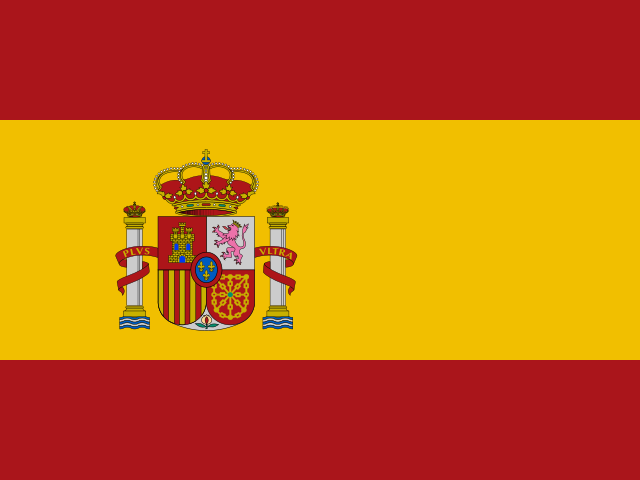
Créer une filiale en Espagne demande plus que de simples formalités administratives. . Le processus est complexe et peut prendre 6à8 semaines ou plus, selon la conformité et les obligations légales. Ce calendrier peut retarder l'entrée sur le marché et inciter les candidats potentiels à envisager d'autres opportunités.
Cependant, G-P propose une alternative. Au lieu de suivre la voie subsidiaire conventionnelle en Espagne, nous pouvons accélérer votre entrée — sans nouvelles entités requises — afin que vous puissiez commencer les opérations en quelques minutes au lieu de mois.
Comment établir une filiale en Espagne
L'établissement d'une filiale en Espagne commence par le choix de la forme d'entité appropriée. Bien qu'il existe des alternatives telles que les succursales ou les bureaux de représentants, elles n'offrent pas la même protection en matière de responsabilité qu'une filiale. Pour la plupart des entreprises international, le choix se résume à deux types de sociétés :
- Sociedad de Responsabilidad Limitada (SL) : Semblable à une société à responsabilité limitée, il s'agit de la structure la plus courante pour les sociétés international en raison de sa flexibilité et de ses exigences en capital moindres.
- Société anonyme (SA) : Équivalente à une société anonyme, cette structure est plus rigide, a des exigences de capital plus élevées et est généralement utilisée pour les grandes entreprises qui ont l'intention de s'inscrire en bourse.
Étapes pour constituer une filiale en Espagne
Le processus de création d'une S.L. en Espagne suit généralement les étapes suivantes :
- Obtention du NIE pour les administrateurs international : Tous les administrateurs et actionnaires non nationaux doivent obtenir un numéro d’identification d’étranger (Número de Identificación de Extranjero, ou NIE) auprès des autorités espagnoles.
- Certifiez le nom de l'entreprise : Demandez un certificat de validité de nom (Certificación Negativa de Denominación Social) auprès du Registre central du commerce pour vous assurer que le nom proposé est unique.
- Ouvrir un compte bancaire : Après l'ouverture du compte bancaire d'entreprise, vous devez déposer le capital social.
- Projet de règlement intérieur : Préparez les statuts de l’entreprise (Estatutos sociales), définissant les règles de gouvernance, les activités commerciales et la structure de l’actionnaire.
- Exécution de l'acte constitutif : Les fondateurs ou leurs représentants légaux doivent signer l'acte constitutif public devant un notaire espagnol.
- Obtenir un numéro d'identification fiscale provisoire (NIF) : Demandez un numéro d'identification fiscale provisoire (Número de Identificación Fiscal, ou NIF) auprès de l'Agence fiscale espagnole (Agencia tributaria).
- Inscription au registre du commerce : Déposer l'acte constitutif auprès du registre du commerce provincial (Registro Mercantil) pour enregistrer officiellement l'entreprise.
- Finaliser les inscriptions : Une fois inscrit, obtenir le NIF définitif et s’inscrire à la sécurité sociale et aux autres activités commerciales et fiscales nécessaires.
Lois et exigences subsidiaires de l’Espagne
Lors de la création d’un S.L. en Espagne, vous devrez respecter plusieurs lois et exigences, telles que :
- Capital social : Conformément à la loi « Crea y crece » (Loi 18/2022), le capital social minimum requis pour une SL est de EUR 1. Toutefois, si le capital est inférieur à EUR 3,000, l'entreprise doit affecter 20% de ses bénéfices à une réserve légale chaque année jusqu'à ce que le total combiné de la réserve et du capital social atteigne EUR 3,000.
- Structure de gestion : Une SL n'est pas tenue d'avoir un conseil d'administration. La gestion peut être structurée avec un administrateur unique, des administrateurs conjoints ou un conseil d'administration de 3–12 administrateurs. Tous les administrateurs doivent posséder un NIE espagnol.
- Transferts d'actions : Les actions d'une SL ne sont pas cessibles et sont soumises aux restrictions prévues par les statuts de l'entreprise et la loi espagnole. Une SL ne peut pas émettre d'obligations.
- Comptabilité et audit : Toutes les entreprises doivent établir des états financiers annuels et les déposer auprès du registre du commerce. Les audits sont obligatoires pour les entreprises qui atteignent certains seuils de taille.
Avantages des filiales espagnoles :
- Accès au marché local: L’établissement d’une filiale en Espagne permet un accès direct aux marchés espagnol et européen, facilitant le développement commercial et la proximité avec la clientèle.
- Responsabilité limitée: La responsabilité de la société mère est généralement limitée à son investissement dans la filiale, ce qui réduit le risque financier.
- Statut juridique: Une filiale est une entité juridique distincte, qui peut conclure des contrats, posséder des actifs et embaucher des employés de manière indépendante.
- Avantages fiscaux potentiels: Les filiales peuvent bénéficier d’incitations fiscales locales, de conventions de double fiscalité et de directives de l’UE.
- Crédibilité accrue: Opérer en tant qu'entreprise locale peut améliorer la réputation et la confiance auprès des clients, partenaires et autorités espagnols.
Inconvénients des filiales espagnoles :
- Mise en place et conformité complexes: La création et le maintien d'une filiale impliquent un travail administratif important, notamment l'enregistrement, la gouvernance locale et la conformité continue avec les impôts sur les sociétés et le droit du travail espagnols.
- Coûts plus élevés: Des coûts sont associés à la constitution en société, aux conseils juridiques, à la comptabilité et aux opérations courantes.
- Exigences réglementaires: Les filiales espagnoles doivent respecter les réglementations locales en matière de rapports, d’audit et d’emploi, qui peuvent être complexes et chronophages.
- Fiscalité: Les bénéfices sont soumis aux impôts espagnols sur les sociétés, et il peut y avoir des implications fiscales supplémentaires pour le rapatriement des bénéfices vers la société mère.
- Défis de gestion: L'exploitation d'une filiale nécessite une gestion et une supervision locales, ce qui peut complexifier les opérations mondiales.
Alternative à la création d'une filiale espagnole
Bien qu’une filiale offre les avantages d’un établissement permanent et d’une responsabilité limitée, le processus est long, coûteux et contraignant. Si votre objectif est de recruter rapidement talent en Espagne, il existe une alternative plus simple. G-P vous permet de recruter talent en quelques minutes sans les tracas liés à une filiale.
Les avantages de l'utilisation d'un employeur of record (portage salarial (EOR)) en Espagne inclure :
- Rapidité de pénétration du marché: Un portage salarial (EOR) vous permet d'intégrer immédiatement talent en Espagne, car vous n'avez pas besoin de passer par le long processus de création d'une entité juridique. La création d’une filiale peut prendre des mois en raison des exigences réglementaires, bancaires et administratives.
- Garantie de conformité: La législation du travail en Espagne est complexe et offre une protection élevée aux salariés. Un portage salarial (EOR) garantit la conformité avec l' Estatuto de los Trabajadores (Statut des travailleurs), les CBA applicables, les réglementations en matière de paie, les retenues d'impôt et les avantages sociaux, réduisant ainsi votre risque de non-conformité et les pénalités potentielles.
- Rentabilité: La création et le maintien d'une filiale (par exemple, SL) engendrent des coûts initiaux et continus importants, notamment les frais juridiques, la comptabilité, la gestion locale et les frais administratifs. Un portage salarial (EOR) est plus rentable, surtout si vous embauchez une petite équipe ou si vous testez le marché espagnol.
- Simplicité administrative: Avec un portage salarial (EOR), vous évitez la charge administrative de la gestion de la paie, des cotisations sociales obligatoires, des déclarations fiscales et de la conformité aux RESSOURCES HUMAINES. Le portage salarial (EOR) gère ces responsabilités, vous permettant de vous concentrer sur votre activité principale.
- Flexibilité: Si les besoins de votre entreprise évoluent, un accord de portage salarial (EOR) est plus facile à adapter à la hausse ou à la baisse que la liquidation d'une filiale.
- Atténuation des risques: Un portage salarial (EOR) gère les risques juridiques liés à l'emploi, tels que la classification des travailleurs, vous offrant ainsi une couche de protection supplémentaire.
Pénétrez de nouveaux marchés avec G-P — aucune nouvelle entité n'est nécessaire.
Créer une filiale ou une entité juridique en Espagne est coûteux et prend du temps. G-P portage salarial (EOR) vous permet d'embaucher talent en quelques minutes sans les tracas et les complications d'une filiale.
Demandez une proposition dès aujourd'hui pour en savoir plus sur nos produits d'emploi mondiaux et nos solutions de portage salarial (EOR).
Quelles sont les exigences de visa de travail 2026 employé en Espagne ?
Les professionnels hors UE, hors EEE et non suisses doivent obtenir un visa standard trabajo por cuenta ajena pour travailler en Espagne. Les employeurs espagnols parrainants doivent obtenir une autorisation initiale de travail et de résidence auprès des autorités locales du travail avant de soumettre une candidature de visa.
Quand les administrateurs ou représentants ont-ils besoin d’un NIE en Espagne ?
Les actionnaires, administrateurs et représentants autorisés non résidents doivent obtenir un NIE (numéro d’identification fiscale pour non-citoyens) avant de finaliser une constitution ou des déclarations fiscales espagnoles. Les entreprises établissant un S.L. espagnol doivent obtenir les NIE tôt afin d’éviter les retards d’enregistrement notariel, d’état civil et fiscal.
Quels documents américains nécessitent une apostille et une traduction sous serment en espagnol ?
Incorporer un S.L. espagnol nécessite des dossiers corporatifs américains spécifiques :
Preuve de fondation ou constitution
Documents de gouvernance actuels
Certificats de bonne conduite ou d’existence
Résolutions d’entreprise
Procurations
Les documents publics ou notariés doivent porter une apostille officielle. Les documents non espagnols doivent inclure une traduction sous serment en espagnol.
Quand le S.L. acquiert-il sa personnalité juridique au Registre des Commerces ?
Une S.L. espagnole acquiert une personnalité juridique distincte une fois que le Registre commercial provincial enregistre officiellement son acte de constitution. Signer l’acte devant un notaire espagnol constitue une étape essentielle, mais cette signature seule ne crée pas l’entité juridique.
En quoi une succursale espagnole diffère-t-elle d’une filiale espagnole ?
Branche espagnole : Fonctionne comme une extension directe de la international société mère. Elle manque de personnalité juridique distincte et expose directement la société mère à des responsabilités locales.
Filiale espagnole : Fonctionne comme une entité juridique espagnole indépendante, le plus souvent une S.L. Elle maintient des obligations distinctes de gouvernance, d’impôts et de déclaration tout en protégeant les actionnaires par la responsabilité limitée.