



Viktiga takeaways
- Hire from Sweden's skilled workforce: Sweden offers a well-educated talent pool with expertise across different fields, such as engineering, technology, pharmaceuticals, financial services, and green energy.
- Understand Sweden's collective bargaining agreements: CBAs determine benefits, pay, working hours, pensions, leave, and other employment requirements in Sweden.
- Budget for employer contributions: When hiring in Sweden, you'll pay social security contributions of 31.42% of gross salary and taxable benefits.
- Choose the right hiring model: You can hire professionals through direct employer registration, a subsidiary or branch, an employer of record, or independent contractor arrangements.
Sverige har en välutbildad, flerspråkig arbetskraft med stark kompetens inom IT, läkemedel, grön energi och finansiella tjänster. Landet rankas konsekvent högt i globala innovationsindex och är känt för sin produktiva arbetskultur.
Before expanding into Sweden, you'll need a solid understanding of contracts, taxes, wages, benefits, and other employment considerations. Our guide will tell you everything you need to know about hiring in Sweden.
Vad du ska veta innan du anställer i Sverige
If you're expanding your business into Sweden for the first time, there are important legal requirements to be aware of. These norms and laws influence hiring practices in Sweden and many aspects of the employer-employee relationship, including compensation and benefits.
G-P Gia™, our AI-powered global HR agent, can answer your toughest compliance questions across 50 countries — including Sweden — and all 50 U.S. states. Reduce your reliance on outside counsel and cut the time and cost of compliance by up to 95% with Gia.
Här är fem saker att veta om att anställa i Sverige.
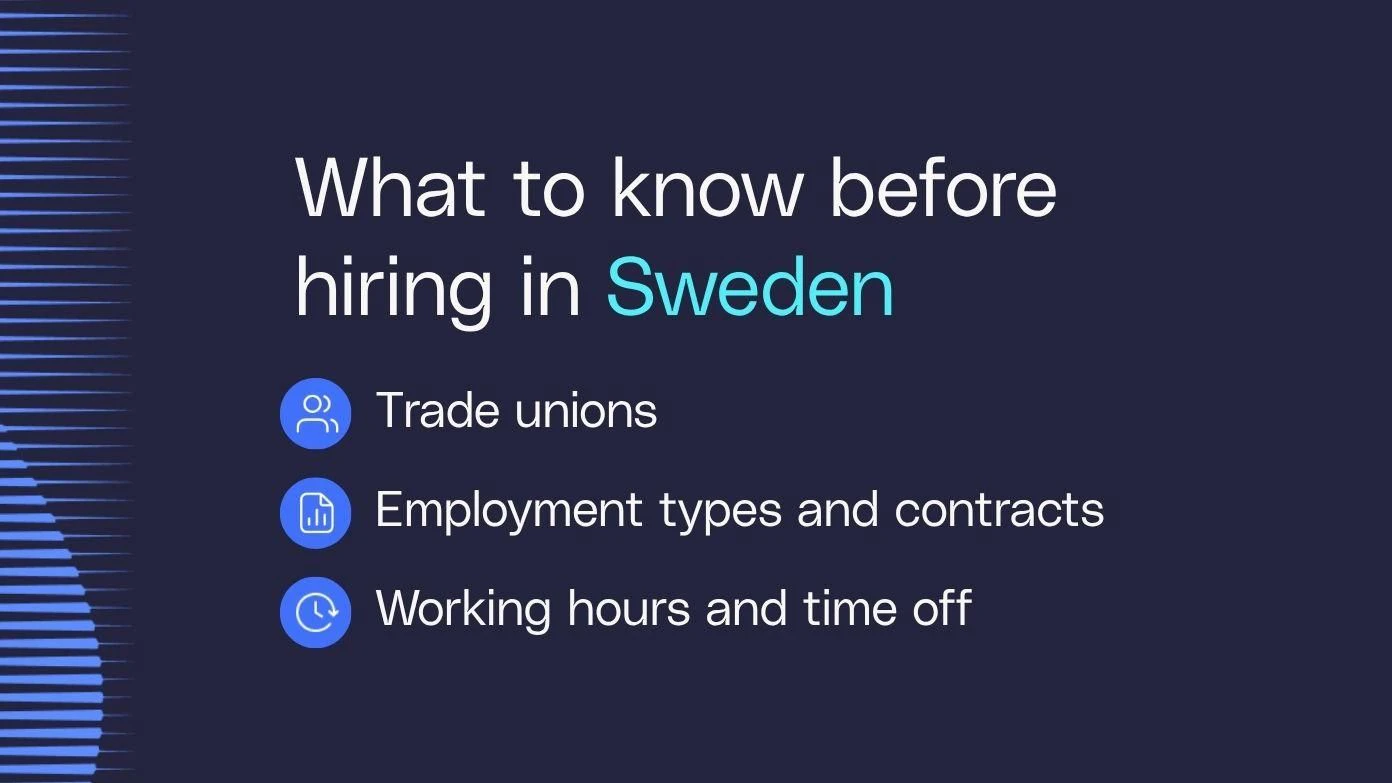
1. Fackföreningar
Sweden has one of the highest union rates in the world: 70% of workers are affiliated with a trade union. Unions negotiate Collective Bargaining Agreements (CBAs) with employers at national, sectoral, or company level. These agreements set wages, working conditions, benefits, and other employment terms for nearly 90% of the workforce because trade unions even cover non-members at workplaces where a CBA is in force.
2. Skatt
Sweden has a comprehensive and progressive tax system that includes national, municipal, and social security taxes. Higher-earning employees pay an income tax rate of over 50%. All residents pay municipal tax (between 29–35%, depending on the municipality) on their taxable income. For incomes above SEK 643,000, a national state tax of 20% is added to the portion above that threshold. There's no local or regional income tax beyond the municipal tax.
Employers pay social security contributions (arbetsgivaravgifter). The rate is currently 31.42% of gross salary and taxable benefits. Employees don't pay separate social security contributions. Instead, these are included in the employer's payroll costs.
Employers are responsible for withholding income tax and remitting it to the Swedish Tax Agency (Skatteverket) every month. Employees file annual tax returns. However, most employees receive pre-filled returns from the Swedish Tax Agency and only need to confirm or adjust them if necessary.
3. Anställningstyper och anställningsavtal
The Employment Protection Act (LAS) and CBAs govern employment contracts in Sweden. Employers provide a written statement of employment terms to the employee within seven days of starting work. This document should include details such as:
- yrkestitel,
- arbetsuppgifter
- lön
- Arbetstid
- Uppsägningsperioder
- Startdatum
- Reference to applicable collective agreement
Permanent (indefinite) contracts are the default employment contract in Sweden. They don't have a fixed end date and continue until terminated by either party with proper notice and just cause. Fixed-term contracts are allowed for temporary projects or seasonal work. If an employee has multiple fixed-term contracts with the same employer for more than two years within a five-year period, the employment can automatically convert to permanency.
Sectoral or company-level CBAs set most employment terms like pay, working hours, and benefits. These agreements are legally binding for all employees at workplaces covered by them, regardless of union membership. Notice periods and grounds for termination are regulated by law and CBAs. Dismissals have to be objectively justified, and employees have strong protections against unfair termination.
G-P EOR has an Employment Contract Generator to help you draft compliant employment contracts that meet all legal needs and best practices in Sweden.
4. Arbetstid
Sweden's working hours highlight the country's commitment to work-life balance. On average, an employee in Sweden works 1,441 hours per year. This is about 18% less than the average for OECD member countries.
Working hours are set by the Working Hours Act (Arbetstidslagen) and are further specified by CBAs. The average workweek is 40 hours spread over five days. Daily working hours and scheduling can vary by sector and agreement.
The statutory maximum working hours per week is 48. This includes overtime. Overtime is paid at premium rates set by the relevant CBA. Employees get at least 11 consecutive hours of rest each day and 36 hours of rest at the end of the week.
Employees shouldn't work longer than five consecutive hours without a break.
Flexibla arbetsformer och deltidsarbete är vanliga och skyddade enligt lag. Anställda har rätt att begära ändringar i sin arbetstid, och arbetsgivare måste överväga sådana förfrågningar.
5. Ledighet
Statutory law and CBA agreements govern time off. All employees, whether full-time or part-time, get at least 25 days of paid vacation every year. Many collective agreements include provisions for extra days. The Swedish Vacation Act gives employees the legal right to take four consecutive weeks of vacation during the summer.
Employees with a fixed monthly salary get a statutory holiday supplement of 0.43% of their monthly salary for each vacation day they take. The holiday supplement is paid in the month following the vacation. Sweden has several public holidays every year. These include New Year's Day, Easter, Midsummer, and Christmas. Employees don't usually have to work on these days. If they do, premium pay can apply.
In Sweden, sick pay is employer-funded at 80% of the employee's regular salary for the first 14 days. After this, the Swedish Social Insurance Agency (Försäkringskassan) provides sickness benefits. Vård av Barn (VAB) allows employees to take time off work to care for a sick child, but you don't pay for this time off. Instead, employees claim compensation from the Försäkringskassan.
Maternity and paternity leave are covered under parental leave. Parents share 480 days of paid leave for each child. Of those, 390 days are paid at approximately 80% of salary (up to a specified cap). The rest are paid at a lower flat rate. 90 days are reserved for each parent and can't be transferred to the other. Parental leave is flexible and can be taken until the child turns 12.
Hiring models for global companies in Sweden
When you hire employees in Sweden, you have several options. The right hiring model depends on the size of your workforce, how quickly you plan to hire, and whether your goal is to establish a long-term business in the country.
- Direct employer registration: Direct employer registration gives you complete control over the employment process. Although you won't have to form a subsidiary immediately, your company will remain responsible for taxes, payroll, benefits, and all employment requirements. You will also need to determine whether your business activities require a registered branch in Sweden.
- Employer of record: An employer of record lets you hire professionals in Sweden without having to set up a local entity in the country. The employer of record serves as the legal employer and handles payroll, tax withholding, benefits, employment contracts, and other employment requirements. With G-P EOR, you can hire, onboard, and manage professionals in Sweden. An employer of record makes sense when you need a small team, or you'd like to test a market before establishing a long-term entity.
- Subsidiary or branch: A subsidiary or branch gives you a business presence in Sweden. This model makes sense when you plan to have long-term operations in the country. A subsidiary is a separate legal entity, while a branch is a part of your company. If you're establishing a branch, you must register it with the Swedish Companies Registration Office (Bolagsverket). The subsidiary or branch will then take responsibility for payroll, taxes, employment compliance, and other employment requirements.
- Independent contractor: Another way to hire in Sweden is by hiring independent contractors. When you hire contractors in Sweden, they apply for F-tax approval. This means they're responsible for paying their own social security contributions and taxes. Review Sweden's classification arrangements before hiring. G-P Contractor™ lets you create contracts, manage payments, and engage contractors in 190+ countries compliantly.
De bästa anställningscentrumen i Sverige
Vissa städer i Sverige är kända för särskilda branscher. Genom att veta vad varje stad har att erbjuda kan du fokusera dina anställningsinsatser på rätt plats och fylla roller snabbare.
De främsta kompetenshubbarna i Sverige är:
- Stockholm is the capital and largest city. It's Sweden's main business and hiring hub, especially for technology, finance, and professional services. Big companies like Spotify, Klarna, and Ericsson are headquartered here.
- Gothenburg is home to Sweden's automotive industry. Companies like Volvo Cars, AB Volvo, CEVT, and Polestar have a presence here.
- Malmö is located in southern Sweden. It's a hub for logistics, technology, and international business. The city has close commercial ties to Copenhagen, Denmark via the Öresund Bridge.
- Uppsala is known for its university and research institutions. It's a center for life sciences, pharmaceuticals, and education.
- Lund is famous for Lund University, one of Scandinavia's oldest universities. The city is known for its technology, research, and innovation sectors, particularly in life sciences and IT.
Nyckelbranscher i Sverige
Understanding Sweden's main industries helps you benchmark salaries and benefits. You can use this insight to make smart choices about where to invest and grow your workforce.
De viktigaste näringsgrenarna i Sverige är:
- Technology and IT: Sweden is a leader in technology, particularly in Stockholm. The country is known for innovation in software, telecommunications, and digital services. It's home to successful companies like Spotify and Klarna. Specialist talent includes software development, cybersecurity, AI, data science, and gaming.
- Manufacturing and engineering: Sweden has a long tradition of advanced engineering and high-quality manufacturing. This sector includes automotive companies such as Volvo and Scania, as well as machinery and industrial equipment. Specialist talent includes engineers, R&D specialists, and roles in manufacturing and supply chain.
- Life sciences and pharmaceuticals: Sweden is a hub for biotechnology, pharmaceuticals, and medical technology. Specialist talent includes researchers, medical professionals, biotechnologists, and pharmaceutical specialists.
- Green energy and environmental technology: The country invests heavily in renewable energy. Hydropower is a big source of electricity for Sweden. Specialist talent includes various engineering roles.
- Financial services: Sweden has a strong banking, insurance, and fintech sector. Specialist talent includes various software engineers and developers, finance analysts, and accountants and auditors.
Kostnad för att anlita en anställd i Sverige
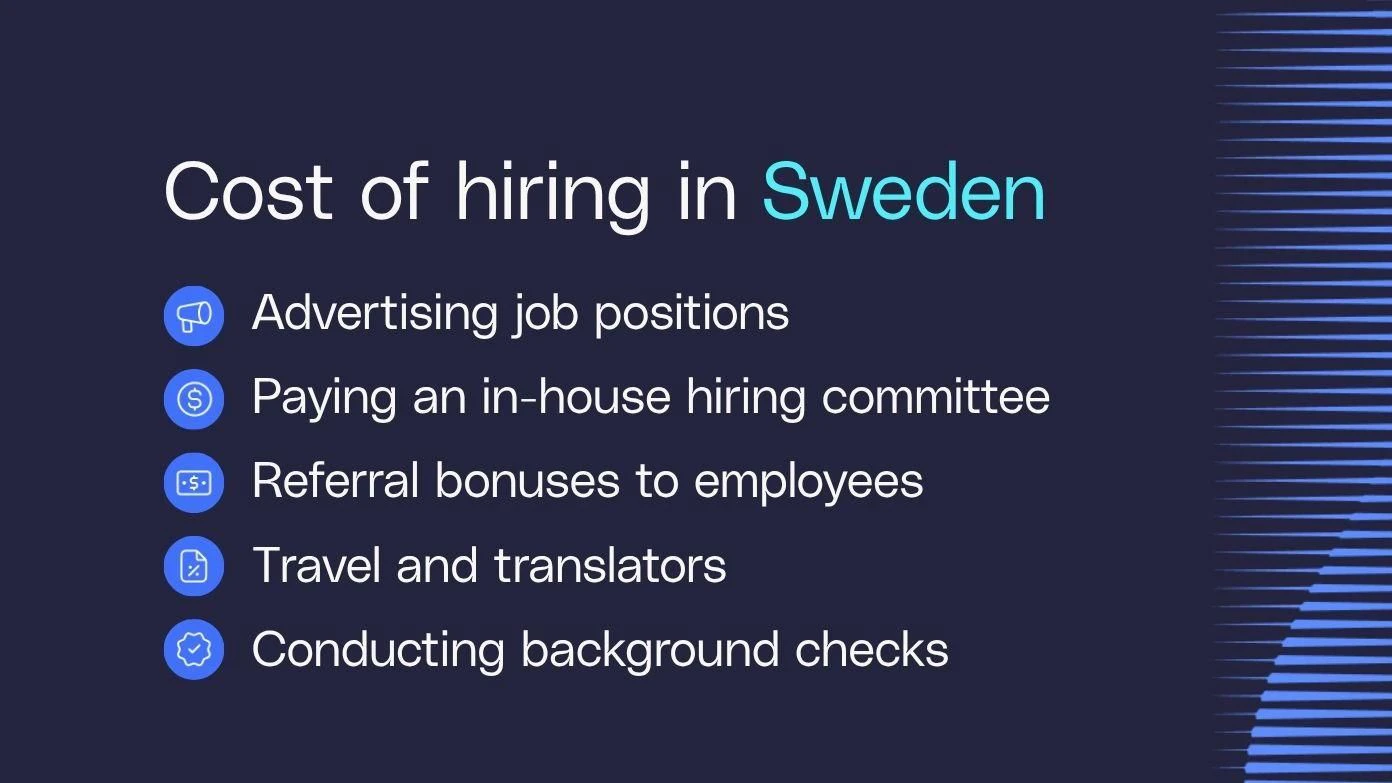
Whether you're hiring one employee or an entire team in Sweden, expenses are inevitable. Budget for the following:
- Att etablera en enhet (såvida du inte samarbetar med en registrerad arbetsgivare)
- att annonsera öppna befattningar,
- Betala remissbonus till anställda med anknytning i Sverige
- att betala en intern anställningskommitté
- Resa till och från Sverige, inklusive hotellvistelser, måltider och transport
- Samarbeta med en översättare för att utarbeta dokument eller underlätta samtal (om tillämpligt)
- Använda en bakgrundskontrolltjänst för att granska kandidater
According to G-P Verified Sources from Gia, the employer burden rate in Sweden, which includes costs triggered on top of salaries, is around 31.42%.
Vad behöver ett företag göra för att anställa personal i Sverige?
Se till att du har täckt igenom dessa viktiga saker innan du utökar ditt team i Sverige:
- Betala skatt för att registrera ditt företag hos Skatteverket
- Registrera en lokal filial hos Svenska Företagsregistreringskontor
- Opening a bank account once you're officially incorporated
- Insättning av det minsta nödvändiga kapitalet
- Konsultation med en svensk advokatbyrå för att hålla sig laglig genom anställningsprocessen
Setting up a subsidiary in Sweden can take several weeks. Instead, you can use G-P EOR to hire full-time workers in Sweden without setting up your own entity. Build your team in Sweden at a lower cost and with peace of mind that you're doing so compliantly.
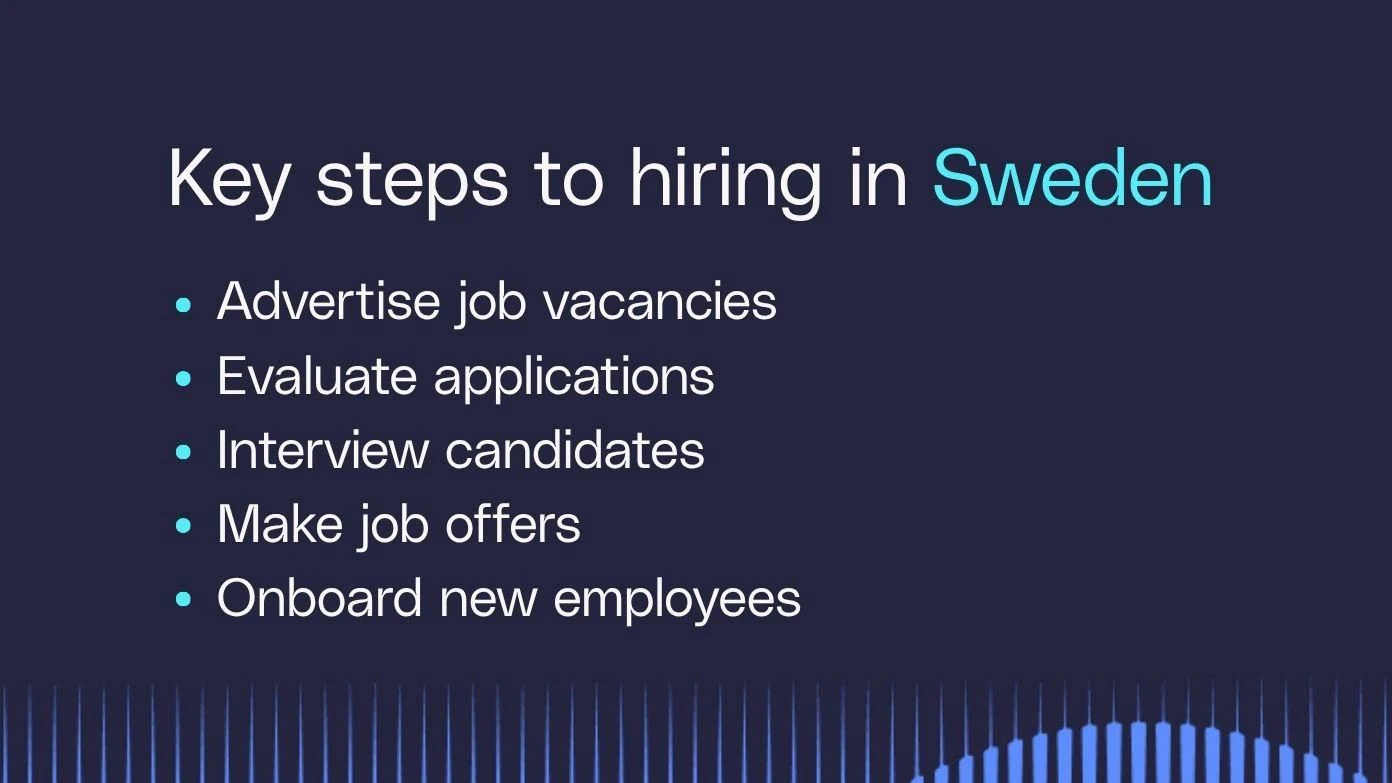
Steg för att anställa i Sverige
The hiring process in Sweden is similar to the one you're likely familiar with in your own country. It follows five basic steps: advertising the job, evaluating applications, interviewing candidates, sending job offers, and onboarding new employees.
1. Annonsera lediga jobb
Companies can advertise job vacancies on Platsbanken, the Swedish public employment service's official job board. This service promotes transparency and equal opportunity for all job seekers.
Use inclusive and nondiscriminatory language in your job posting. Any language requirements, such as Swedish proficiency, must be justified and documented.
2. Utvärdera ansökningar
Evaluate candidates based on their relevant qualifications and competencies. Sweden's antidiscrimination framework is one of the strongest in Europe. The Discrimination Act prohibits discrimination based on gender identity, ethnicity, religion, disability, sexual orientation, and age.
3. Intervjua kandidater
Intervjua kandidater som kom in på din kortlista. Du kan göra dessa intervjuer personligen eller virtuellt. Kom ihåg att använda strukturerade, icke-diskriminerande intervjufrågor. Förvara dokumentation av rekryteringsprocessen, inklusive jobbannonser, intervjuanteckningar och anställningsbeslut.
Gia can help you create questions that follow antidiscrimination laws in Sweden, so you can find the best fit for the role while complying with local regulations.
4. Lägg jobberbjudande
Kontakta din valda kandidat för att erbjuda dem en Befattning med ditt företag. De flesta anställda omfattas av CBA. Dessa avtal fastställer löner, arbetstider, övertid, föräldraledighet, pensioner och andra villkor. Även om muntliga avtal är juridiskt giltiga i Sverige rekommenderar vi att du tillhandahåller ett skriftligt avtal som beskriver alla anställningsvillkor.
5. Onboarda nyanställda
Now, you can onboard new employees. You will have to register with the Swedish Tax Agency before paying wages or benefits. New employees need a personal identity number (personnummer) or a coordination number (samordningsnummer) for tax and social security purposes. Onboarding best practices include pre-employment communication, orientation, role-specific training, and compliance with work environment regulations.
If you're working with an EOR like G-P, you won't have to worry about the administrative burden of onboarding. We'll streamline the process, so you can focus on training your new team members and integrating them into your company culture.
Hyra entreprenörer i Sverige
Working with independent contractors in Sweden can be a cost-effective way to test the market and build a presence, without the commitment of full-time employees.
Contractors based in Sweden understand local consumer behavior, rules, and business practices. They will be ready to start working quickly with their own equipment and established work processes.
Att anlita entreprenörer gör att du enkelt kan anpassa din arbetskraft baserat på dina affärsbehov, utan de komplexiteter och kostnader som en anställning medför.
Innan du ingår ett avtal med en oberoende entreprenör i Sverige, tänk på följande:
1. Anställda kontra oberoende entreprenörer
It's important to understand the difference between employees and independent contractors. In Sweden, employers hire employees to do work and, in return, pay them a regular salary and benefits. Independent contractors provide services. Unlike employees, contractors set their schedules, use their own equipment, and work on specific projects rather than having an ongoing role.
2. Avgifter för felklassificering
The Swedish Tax Agency (Skatteverket) and the Swedish Work Environment Authority (Arbetsmiljöverket) oversee worker classification. Treating someone as a contractor when they are not can lead to severe penalties. If you hire contractors in Sweden and misclassification occurs, you'll have to:
- Betala retroaktiv skatt och socialförsäkringsavgifter.
- Ge retroaktiva anställningsförmåner till anställd, såsom betald ledighet och pensionsavgifter.
- Betala administrativa sanktionsavgifter.
3. Hur man betalar entreprenörer i Sverige
G-P Contractor tar bort den röriga och tidskrävande processen att anlita och betala internationella entreprenörer. Du kan skapa och utfärda avtal och betala entreprenörer med bara några få klick, samtidigt som du säkerställer en smidig process.
Anlita anställda och entreprenörer i Sverige med G-P
Our Global Employment Platform and AI-powered products – EOR, Contractor, and Gia – help companies as they build and manage global teams.
G-P is the recognized leader in global employment, with more than a decade of experience, the largest team of HR, legal, and compliance experts, and a global proprietary knowledge base.
Make your expansion to Sweden easier with G-P. Contact us or book a demo today.
Vanliga frågor
What is the statutory notice period for termination in Sweden?
Notice periods depend on the employee's length of service. They can be one month if the employee has been employed for less than two years, or up to six months if the employee has completed 10+ years of service.
Finns det en lagstadgad minimilön?
No. Wages are set by Collective Bargaining Agreements (CBAs), which cover the majority of employees in Sweden.
Vilka socialförsäkringsavgifter betalar arbetsgivare?
Social security contributions are approximately 31.42% of the employee's gross salary and covered benefits, including pensions, health insurance, parental insurance, and occupational injury insurance.
Vilka regler gäller för sjukfrånvaro och föräldraledighet?
Employers pay 80% of the employee's salary for the first 14 days. Parental leave is up to 480 days per child, with income support provided by the Swedish Social Insurance Agency.
Hur påverkar kollektivavtal (CBA) sysselsättningen?
CBAs are legally binding and set terms that replace statutory minimums, including wages, working hours, notice periods, and termination procedures. Employers planning on hiring in Sweden must identify and comply with any applicable CBAs for their sector.