



Viktiga takeaways
-
Federal struktur, lokala regler: Medan federala lagar (som arbetslagen och skyldighetslagen) fastställer standardiserade anställningsstandarder, varierar specifika skattesatser, helgdagar och administrativa processer mellan 26 kantoner.
-
Strikta arbetstillståndsregler för icke-EU/EFTA-kompetens: För att anställa anställda i Schweiz från icke-EU/EFTA-arbetare måste du visa lokal arbetsmarknadsprioritet, träffa strikta nationella kvoter och få tillståndsgodkännande i flera nivåer.
-
Arbetsgivaravgiften är 10%–20%: Utöver grundlönerna måste arbetsgivare budget för obligatoriska och sedvanliga avgifter när du anställer dig i Schweiz. Detta inkluderar socialförsäkring (AHV/IV/EO), arbetslöshetsförsäkring, tjänstepension (BVG), olycksfallsförsäkring och löner 13per tredje månad.
-
Felklassificering medför fem års retroaktiv avgifter: Att felklassificera anställda som uppdragstagare vid anställning i Schweiz kan utlösa ekonomiska avgifter, inklusive fem års retroaktiva arbetsgivare- och anställd socialförsäkringsbetalningar, plus ränta.
Schweiz befolkning på 8.9 million är en kombination av schweiziska, tyska, franska, italienska, portugisiska och Kosovo. Varje kanton använder samma nationella valuta - den schweiziska francen. Toppsektorer inkluderar finans och bank, medicinsk utrustning och teknik.
Gynnsamma bolagsskattelagar och kulturell tillgänglighet är två anledningar till att många multinationella företag expanderar till Schweiz. Vår guide berättar allt du behöver veta om att anställa i Schweiz.
Vad du ska veta innan du anställer i Schweiz
Om du expanderar ditt företag till Schweiz för första gången finns det viktiga juridiska krav att vara medvetna om. Dessa normer och lagar påverkar anställningspraxis i Schweiz.
Om du är osäker på var du ska börja kan G-P Gia™, vår globala HR agent baserad på artificiell intelligens, svara på dina tuffaste efterlevnadsfrågor i 50 länder – inklusive Schweiz – och alla 50 amerikanska delstater. Minska ditt beroende av extern rådgivning och minska tiden och kostnaden för efterlevnad med upp till 95% med Gia.
Låt oss ta en titt på åtta saker att veta om att anställa i Schweiz.
1. Stadgar för arbetsgivarens anställning
Alla arbetsgivare-anställda relationer måste följa följande stadgar:
-
SR 151.1 - Den federala lagen om jämställdhet
-
SR 220 - Skyldighetskoden
-
SR 822.11 — Arbetslagen
-
SR 822.14 — Lagen om arbetstagarmedverkan
-
SR 823.11 — Den federala lagen om arbetsförmedling och uthyrning av tjänster
-
SR 823.20 — Lagen om utstationerade arbetstagare
Schweiz erkänner fackföreningar så länge de uppfyller alla lagkrav.
2. Kantoner i Schweiz
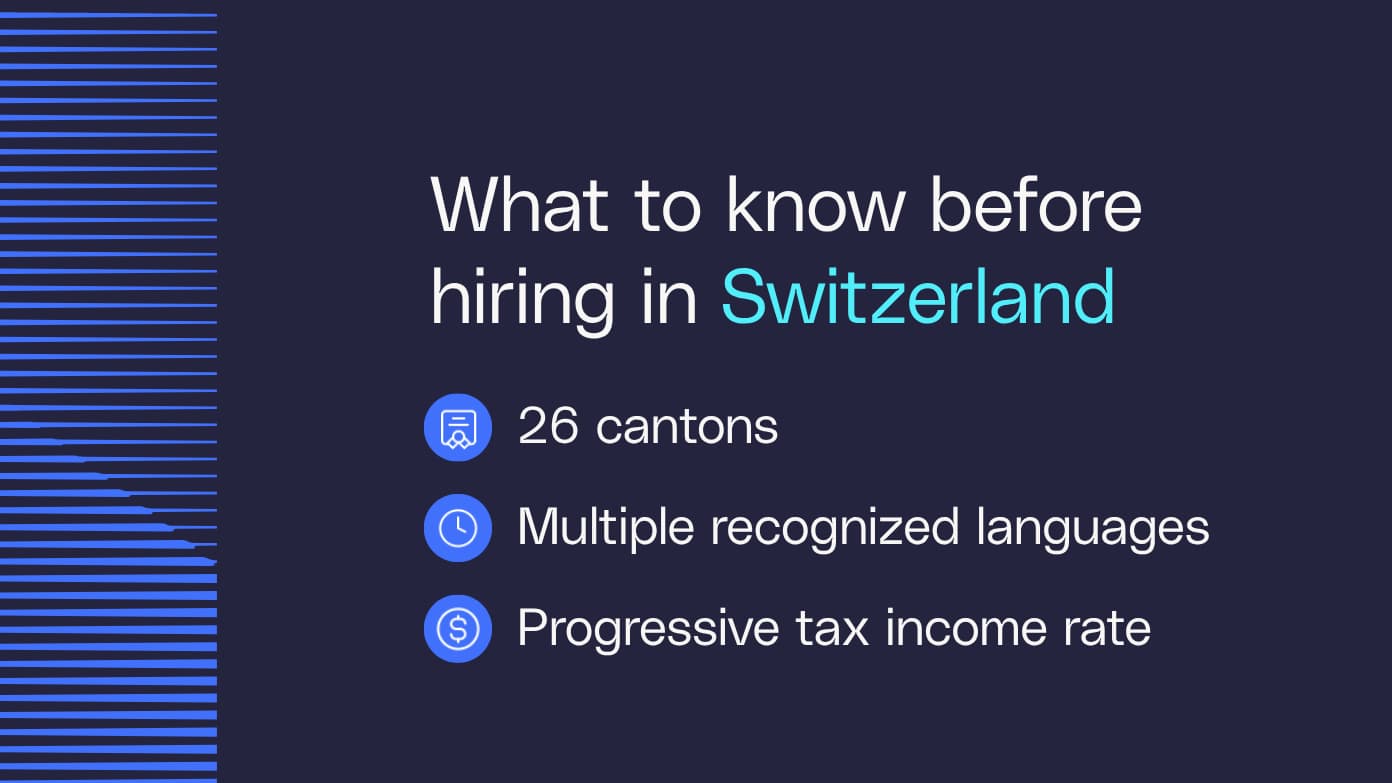
Schweiz är indelat i 26 kantoner. Även om de alla faller under det schweiziska nationella paraplyet, är de mäktiga enheter i sig själva. Varje kanton har unika traditioner och kultur. De har också sina egna sätt att styra sig själva, inklusive lagar, konstitutioner och regeringsstruktur.
När du anställer personal i Schweiz, var medveten om i vilken kanton du annonserar din Befattning. Kandidaternas kanton där de är bosatta ger dig insikt i förväntningar på översättning, skattesatser att inkludera i dina anställningsavtal och överväganden kring vilka semesterdagar de har rätt till.
Kommuner – mindre statliga organ inom varje kanton – bestämmer hur man ska anställas i Schweiz.
3. Arbetsmarknaden i Schweiz
Mer än 5 miljoner människor är aktiva på den schweiziska arbetsmarknaden. Sysselsättningsgraden är 80,6%. Som jämförelse är EU-procenten 75,8%. Arbetarna är högkvalificerade och har examen från högre utbildningsinstitutioner. När det gäller förskoleutbildning och gymnasieskolor varierar det schweiziska utbildningssystemet mellan kantonerna. IMD World Talent Ranking 2024 utsåg Schweiz till det1 :e landet i världen för att främja inhemsk kompetens.
4. Språk i Schweiz
Flerspråkighet är en kärnkomponent i schweizisk kultur, till stor del tack vare språklagen. Denna lag erkänner tyska, franska, italienska och rätoromanska som nationalspråk. Tyska, franska och italienska är också de officiella språken i Konfederationen. Rätoromanska används officiellt i kommunikation med rätoromanska talare. Ungefär två tredjedelar av landets invånare talar mer än ett språk. Schweiziska barn lär sig minst två av de nationella språken under sina tidiga skolår.
Schweizisk-tyska är den mest talade i kantoner. Franska är vanligt i västra kantoner och italienska i söder. Romansh är ett mindre använt språk som härstammar från det rhaetiska folket, tidiga invånare i Alperna. Vissa kantoner och demografi har också sina egna dialekter och kollokvialismer.
Alla anställningsavtal, intervjuer och uppdrag bör ta hänsyn till den som intervjuas eller anställs modersmål. Det är god praxis att få alla dokument översatta och att anlita en tolk vid behov.
5. Arbetstimmar och ledighet
Den schweiziska arbetslagen reglerar lagar om arbetstid och ledighet. Den maximala arbetsveckan är 45 timmar för anställda i industriföretag, kontorspersonal, teknisk personal och säljpersonal i stora detaljhandelsföretag. För alla andra anställda är det 50 timmar. Den dagliga arbetstiden, inklusive raster och övertid, bör inte överstiga 14 timmar. I praktiken är den typiska arbetstiden i Schweiz 12.5 timmar.
Övertid är endast tillåtet under extraordinära omständigheter. Det måste kompenseras med en lönepremie på 25% eller motsvarande avgift. Anställda måste ha minst 11 på varandra följande vilotimmar varje dag. Detta kan minskas till 8 timmar en gång i veckan, så länge den genomsnittliga vilan över två veckor är minst 11 timmar. Arbetare får en kontinuerlig paus på minst 35 timmar varje vecka, inklusive söndag.
Anställda har rätt till tre veckors sjukfrånvaro inom det första anställningsåret hos ett företag. Varje kanton har sina egna begränsningar för betald ledighet och sjukfrånvaro.
Gravida anställda får 14 veckor betald föräldraledighet, och pappor har rätt till två veckors pappaledighet.
Oavsett kanton får varje anställd fyra veckors semester varje år, eller fem om anställden är 20 eller yngre. Anställda och arbetsgivare kan förhandla om ytterligare ledighet i sina avtal om så önskas.
Kantonerna har sina egna lokala och allmänna helgdagar. Nationaldagen den 1augusti är den enda federala helgdagen. Om nationaldagen infaller på en tisdag eller torsdag är det vanligt att ge anställda en långhelg. Schweiz firar även nyårsdagen, påskdagen och juldagen, men specifika regler för dessa tider varierar mellan arbetsgivare. Anställda kan välja extra lön istället för att ta ut betald semester.
6. Anställningsavtal
Anställda kan vara visstidsanställda, inhyrda av bemanningsföretag, deltidsanställda eller heltidsanställda. Den första anställningsmånaden betraktas som prövotid. Du kan förlänga detta till maximalt tre månader i ditt anställningsavtal. Om du vid någon tidpunkt väljer att avsluta arbetsförhållandet måste du ge minst sju dagars uppsägningstid.
Anställningsavtal krävs inte men är vanliga och rekommenderas starkt eftersom vissa villkor endast är juridiskt erkända om de är skriftliga. Kontrakt är bindande. Arbetsgivare kan inte gå emot villkoren i det överenskomna kontraktet. Schweiz har flera lagar för att skydda fackföreningar och vissa anställda, som kvinnor eller minderåriga. Arbetsgivare är skyldiga att ha ett skriftligt brev som beskriver startdatum, arbetsfunktion, lön och antal timmar som de anställda kommer att arbeta varje vecka.
Tillsvidareanställningar är vanliga i Schweiz. ”Kedjekontrakt” ses ogynnsamt av schweiziska domstolar. Kedjekontrakt är en serie tidsbestämda kontrakt som initieras back-to-back med samma anställd. Praxisen kan betraktas som ett missbruk av rättigheter om den används för att kringgå skyddet för tillsvidareanställning, såsom anställningstrygghet och uppsägningstider. När kontraktets sista dag har löpt ut är anställd-arbetsgivare-förhållandet avslutat utan uppsägningstid.
Du och din teammedlem kan komma överens om lika lång tid för att meddela om avgång eller uppsägning. Denna uppsägningstid bör inte vara kortare än en månad under det första anställningsåret och två månader för varje anställningsperiod upp till nio år. Tre månader utöver det är brukligt. Du kan inte säga upp anställda om de är gravida, sjuka eller har föräldraledighet. Du behöver bara betala avgångsvederlag om anställda är 50 år eller äldre och har arbetat för dig i 20+ år.
G-P Employer of Record har en generator för anställningskontakter som hjälper dig att utarbeta lagliga anställningsavtal när du anställer anställda i Schweiz, vilka uppfyller alla lagkrav och bästa praxis.
7. Kompensation och förmåner
Den schweiziska federala lagen om jämställdhet (GEA) kräver att alla företag med 100 eller fler anställda genomför en internrevision för att säkerställa att lönejämlikhet upprätthålls.
Schweiz har ingen enda federal minimilön. Minimilöneskyldigheter kan komma från kantoner eller kommuner, kollektivavtal eller anställningsavtal för specifika sektorer. Annars sätts lönen genom avtal och marknadspraxis. Anställda får betalt en gång i slutet av månaden.
Lagstadgad övertid inkluderar tid som arbetats utöver det maximala antalet lagstadgade arbetstimmar. Lagstadgad övertid skiljer sig från avtalsenlig övertid och är endast tillåten under dag- eller kvällsskift på arbetsdagar. Det ska kompenseras med ett lönetillägg på minst 25%.
Anställda kan också välja ledighet istället för löneökning. Lagstadgad övertid bör aldrig överstiga två timmar per dag och får aldrig överstiga 170 timmar för 45-timmars veckor eller 140 timmar för 50-timmars arbetsveckor. Vissa undantag kan beviljas i nödsituationer.
Arbetsgivare betalar vanligtvis 80% – med en årlig gräns – av en anställds lön om de har drabbats av en arbetsrelaterad skada. Beloppet kan variera beroende på bransch eller specifik försäkringsplan. Arbetsgivare ansvarar för att upprätta en socialförsäkringsrelation mellan sina anställda och sin kantons försäkringskassa. Social omfattar bidrag till föräldraledighet (MSE), invaliditetsförsäkring (DI), barnbidragsförsäkring (FZ) och pension, eller ålders- och efterlevandeförsäkring (OASI). Social är 6,4% för arbetsgivaren och 6.4% för anställd.
Bonusar och 13månaders lön krävs inte men är vanliga. Arbetsgivare kan bevilja bonusar enligt avtal eller efter eget gottfinnande. Observera att Schweiz har strikta bonusriktlinjer för finansbranschen. Detta är för att förhindra överdrivet risktagande och säkerställa att ersättningspraxis inte undergräver den finansiella stabiliteten.
Om en anställd har varit anställd i ditt företag i mer än tre månader, arbetar minst åtta timmar varje vecka och uppfyller inkomstkraven, kan de delta i en arbetsgivares pensionsfond. Det nuvarande lägsta beloppet för AHV-pension är CHF 1,260. Arbetsgivare är också ansvariga för olycksfallsförsäkringen.
Du kan enkelt administrera förmånsplaner med G-P Employer of Record. Våra interna experter övervakar kontinuerligt arbetslagstiftningen för att uppfylla landsspecifika regler och normer. Skapa och hantera förmånsplaner via vår plattform för att ge en smidig anställningsupplevelse.
8. Skatt
Schweiz federala inkomstskattesats är progressiv, med en maximal sats på 11,5% för den högsta inkomstklassen. Det är viktigt att notera att kantonala och kommunala skatter också tillkommer. Detta kan påverka din totala skattebelopp kraftigt, beroende på var du är baserad. Den federala momssatsen är 8,1%.
9. Jämställdhet, dataskydd och rekryteringsrutiner
Rekryterings- och anställningsrutiner måste följa den federala jämställdhetslagen. Detta förhindrar direkt och indirekt könsbaserad diskriminering under hela anställningscykeln, inklusive:
-
Anställa
-
Betalning
-
Fördelning av arbetsuppgifter
-
Främjande
-
Utbildning
-
Trakasserier
-
Entledigande.
Arbetsgivare måste säkerställa lika lön för arbete av likvärdigt värde. Objektiva, arbetsrelaterade kriterier för rekrytering, ersättning, befordran och uppsägningsbeslut måste gälla.
Arbetsgivare med 100 eller fler anställda i Schweiz måste göra en intern analys av lika lön med hjälp av en vetenskapligt giltig metod. Analysen måste verifieras oberoende och resultaten måste kommuniceras till anställda inom den angivna tidsramen. Detta är separat från den allmänna skyldigheten att tillämpa lika lön för alla arbetsgivare.
Kandidaters personuppgifter måste samlas in och behandlas i enlighet med schweiziska dataskyddskrav. Detta inkluderar den federala dataskyddslagen och de anställningsspecifika begränsningarna i den schweiziska förpliktelselagen. Rekryteringsdata måste vara:
-
Begränsat till vad som är nödvändigt för att bedöma lämpligheten för rollen
-
Hanteras transparent och säkert
-
Förvaras endast så länge som behövs.
Bakgrundskontroller kan endast göras när de är proportionerliga, arbetsrelevanta och korrekt redovisade.
Rekrytering av modeller för globala företag i Schweiz
Den bästa modellen när du bestämmer dig för att anställa personal i Schweiz beror på dina övergripande affärsmål.
| Modell | Bäst för | Viktiga punkter | Huvudsakliga risker |
|---|---|---|---|
| Direkt arbetsgivareregistrering | Anställning i Schweiz utan lokal enhet. | Registrera dig hos schweiziska socialförsäkrings- och skattemyndigheter. Kör schweizisk lönehantering. Hantera tillstånd, förmåner och lagenlig anställning. | Hög administrativ börda. Skillnader i kantonala processer. Risk för fel i lönehantering, skatt eller tillstånd. |
| Employer of Record, som G-P Registrerad arbetsgivare | Snabb process för att anställa i Schweiz utan att etablera en juridisk enhet. | Den registrerade arbetsgivaren är den juridiska arbetsgivaren. Leverantören hanterar löner, förmåner och avtal. Måste ha behörighet för uthyrning av personal. | Risk med olicensierad leverantör. Mindre direkt kontroll. Klienter kan fortfarande ha arbetsplats- och övervakningsuppgifter. |
| Dotterbolag eller filial | Långsiktig verksamhet i Schweiz. | Skapar en formell lokal närvaro. Stöder direkt anställning och lokal ledning. Bäst för större eller permanenta team. | Högre installations- och underhållskostnad. Mer bolagsskatt, löne- och HR efterlevnadsuppgifter. |
| Oberoende entreprenör | Kortvarigt, specialiserat, projektbaserat arbete. | Entreprenörer måste arbeta självständigt. Använd leverbarhetsbaserade termer. Verifiera egenföretagarstatus där det är möjligt. | Risk för felklassificering. Stöd socialförsäkring och skatterisk. Anställningsrättigheter kan gälla retroaktivt. |
De bästa uthyrningscentrumen i Schweiz
Vissa schweiziska städer är kända för särskilda industrier. Att veta vad varje stad har att erbjuda kan hjälpa dig att kanalisera dina rekryteringsinsatser till rätt plats och tillsätta tjänster snabbare när du anställer dig i Schweiz.
De främsta kompetenshubbarna i Schweiz är:
-
Zürich är den största staden i Schweiz. Dess viktigaste finans- och affärscentrum är känt för bank, teknologi och professionella tjänster. Storbanker som UBS, Julius Baer och ZKB finns här.
-
Genève är ett internationellt nav med många globala ideella organisationer och företag inom finans och handel. Det är hem för viktiga internationella organisationer som FN:s europeiska högkvarter, WHO, WTO och Röda Korset.
-
Basel är känt för sina läkemedels-, kemi- och biovetenskapliga industrier. Det har en stark finansiell närvaro och är huvudkontor för stora företag som Roche och Novartis och många mindre bioteknikföretag och forskningsinstitutioner.
-
Bern är ett nav för myndigheter, administration och servicenäringar. Många jobb och roller inom den federala regeringen inom hälso- och sjukvård, utbildning och tillverkning är baserade här.
-
Lausanne är känt för utbildning och teknologi. Denna fransktalande stad utmärker sig inom undervisning och forskning relaterad till biovetenskap, IT och sportmanagement.
Nyckelbranscher i Schweiz
Att förstå Schweiz huvudindustrier hjälper dig att jämföra löner och förmåner när du anställer i Schweiz. Du kan använda denna insikt för att göra smarta val om var du ska investera och expandera din arbetskraft.
De viktigaste industrierna i Schweiz inkluderar:
-
Finansiella tjänster: Schweiz är välkänt för sin bank-, försäkrings- och kapitalförvaltning. Landets politiska stabilitet, sekretesslagar och expertis lockar kunder över hela världen. Stora globala banker som UBS har sina huvudkontor här. Specialistkompetensen inkluderar finansiella rådgivare, förmögenhetsplanerare och investeringsanalytiker.
-
Läkemedel och biovetenskap: Schweiz är värd för många ledande läkemedels-, bioteknik- och medicintekniska företag. Globala ledare som Roche och Novartis är baserade där. Sektorn fokuserar på högvärdiga produkter, såsom vacciner, specialiserade läkemedel och serum. Specialistkompetenser inkluderar FoU-personal, forskare och ingenjörer.
-
Maskiner, precisionsinstrument och teknik: Schweiz är världsledande inom högprecisionsmaskiner, klockor och instrument. Specialistkompetens omfattar olika ingenjörspositioner, såsom maskin-, el- och produktionsingenjörer.
-
Informationsteknik och kommunikation: Schweiz är ledande inom blockkedjeteknik och kryptovaluta och lockar till sig startups och etablerade decentraliserade finansbolag. Specialistkompetenser inkluderar mjukvaruutvecklare, data scientists och molnarkitekter.
-
Kemikalier: Den kemiska industrin omfattar stora företag inom arom- och doftsektorn, såsom Givaudan och DSM-Firmenich. Specialistkompetenser inkluderar FoU-personal, ingenjörer och forskare.
Kostnaden för att anställa en anställd i Schweiz
Oavsett om du anställer en anställd eller ett helt team, kommer anställningsprocessen i Schweiz med oundvikliga kostnader.
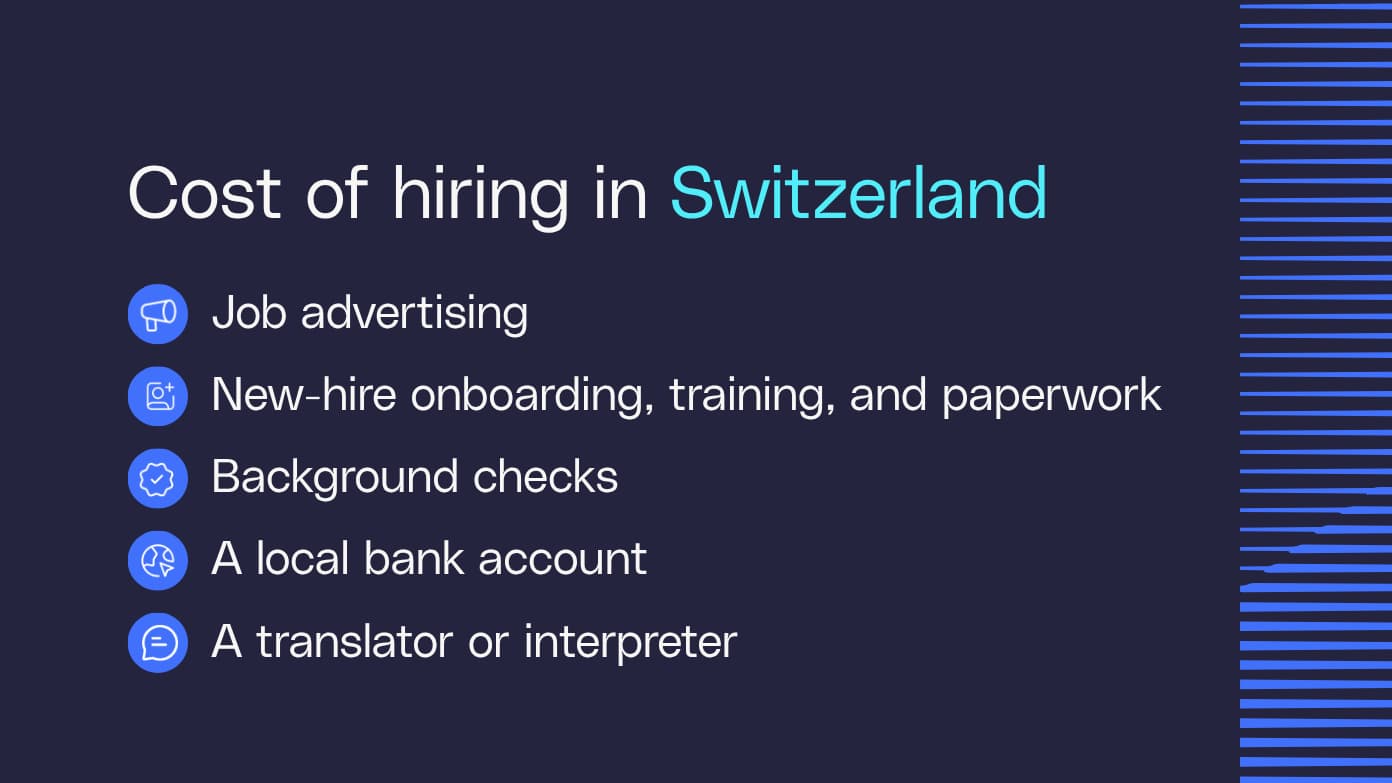
Budget för följande:
-
Jobbannonsering
-
Onboarding, utbildning och pappersarbete
-
Programvara för spårning av sökande
-
bakgrundskontroll
-
All specialutrustning för anställda
-
Översättare eller tolk (om tillämpligt)
-
Resekostnader för resor till och från Schweiz, om det behövs
-
AHV/IV/EO
-
Arbetslöshetsförsäkring
-
Arbetsolycksfallsförsäkring
-
Familjens traktamente bidrag
-
Sjukdagliga traktamente försäkring
-
Anställdas semesterrätt
-
Anställds betald ledighet och rätt till sjukfrånvaro
Enligt Gia ligger den totala årliga arbetsgivarens belastning i Schweiz, inklusive kostnader utöver lönerna, mellan 10% och 20% av bruttolönen. Priserna kommer att bero på anställds lön, bransch och kanton. Gia utnyttjar G-P :s mer än 13års globala arbetslivserfarenhet, tillsammans med insikter från nästan en miljon verkliga scenarier, för att tillhandahålla korrekt och aktuell information om arbetslagstiftelser.
Vad behöver ett företag anställa i Schweiz?
EU/EFTA kontra icke-EU/EFTA-arbetare
Tack vare avtalet om fri rörlighet för personer (AFMP) är det få administrativa hinder att anställa medborgare från EU/EFTA-länder. Arbetsgivare behöver inte prioritera lokala schweiziska arbetstagare eller motivera varför en EU/EFTA-kandidat valdes ut. För korttidskontrakt (upp till 90 dagar per kalenderår) behöver företag bara lämna in en online-anmälan innan anställningen påbörjar arbetet. För längre arrangemang registrerar anställden sig hos sin lokala schweiziska hemkommun för att få ett uppehållstillstånd/arbetsstillstånd (t.ex. ett L- eller B-tillstånd). Detta ger dem omedelbar tillgång till den schweiziska arbetsmarknaden.
Medborgare utanför EU/EFTA
Att anställa kandidater från länder utanför EU/EFTA (inklusive Storbritannien och USA) är mer reglerat. Enligt den federala lagen om utländska medborgare och integration (FNIA) måste arbetsgivare bevisa att lokala rekryteringsinsatser misslyckades. Tillstånd från länder utanför EU/EFTA är nästan uteslutande begränsade till personal som chefer, seniora specialister eller universitetsexaminerade med specialiserad erfarenhet.
Tillståndskvoter och administrativ tidslinje
Den schweiziska regeringen har en strikt årlig nationell kvot för arbetstillstånd för medborgare utanför EU/EFTA. Arbetsstillståndet behöver en flerstegsgodkännandeprocess som involverar kantonala arbetsmyndigheter och statssekretariatet för migration (SEM). Arbetsgivare måste påbörja tillståndsansökan i förväg. Anställda kan inte påbörja arbetet förrän formellt godkännande erhållits.
Det ligger i ditt bästa intresse att upprätta en relation med en kantons lokala ekonomiska kontor eller ambassad. Du behöver ingen juridisk rättighet för att anställa i Schweiz, men om du väljer att starta ett schweiziskt företag kan du välja mellan:
-
En ensägares enmansföretag
-
Ett allmänt partnerskap
-
Ett kommanditbolag
-
Ett aktiebolag eller aktiebolag
-
En bolagsform av typen ”limited liability company”
-
Ett dotterbolag
-
En lokal filial
Filialer är en vanlig väg för internationella företag och kräver att du betalar lokala skatter och har minst en schweizisk bosatt med laglig behörighet. Du måste ha all juridisk dokumentation, kontrakt och fastställda finansiella rapporter förberedda.
Anställ anställda i Schweiz utan att skapa en egen enhet med G-P Employer of Record. Bygg ditt team i Schweiz till en lägre kostnad och med tryggheten i att du uppfyller varje kantons unika krav.
Steg för att hyra i Schweiz
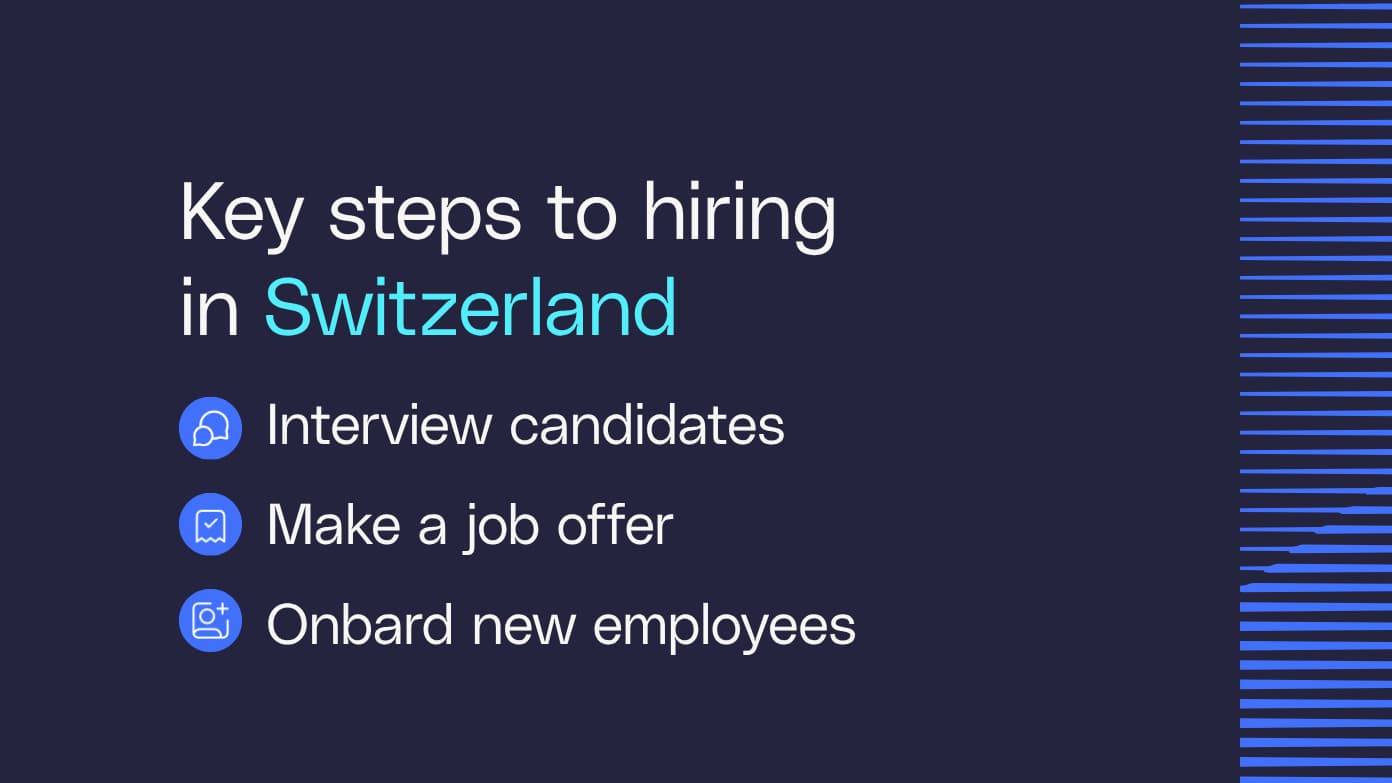
Anställningsprocessen i Schweiz följer fem grundläggande steg: annonsera jobbet, utvärdera ansökningar, intervjua kandidater, skicka jobberbjudanden och onboarding av nya medarbetare.
1. Annonsera lediga jobb
Skapa först en detaljerad arbetsbeskrivning. Definiera rollen, ansvarsområden och kvalifikationer du behöver. För vissa yrken med högre arbetslöshet är arbetsgivare enligt lag skyldiga att meddela de kantonala arbetsförmedlingarna om lediga platser innan de annonseras offentligt. Detta säkerställer prioriterad åtkomst för registrerade arbetssökande och efterlevnad av den federala lagen om arbetsförmedlingar.
2. Utvärdera ansökningar
När arbetssökande söker dina nya tjänster kan du utvärdera deras ansökningar och avgöra vilka kandidater som passar bäst för Befattningen. Schweizisk lag förbjuder diskriminering på grund av kön, ålder, ursprung, ras, religion, funktionshinder, sexuell läggning, eller andra skyddade egenskaper i alla rekryteringsstadier. Detta beskrivs i den schweiziska federala konstitutionen och jämställdhetslagen.
Dubbelkontrollera att jobbannonser, urvalskriterier och intervjufrågor är fria från partiskhet.
3. Intervjua kandidater
Intervjua sedan kandidater som kom med på din lista. Använd arbetsrelevanta urvalskriterier och strukturerade intervjuer för att säkerställa rättvisa och konsekvens. Gia kan hjälpa dig att skapa intervjufrågor som följer antidiskrimineringslagar vid anställning i Schweiz, så att du kan hitta den bästa personen för rollen samtidigt som du följer lokala bestämmelser.
Det är bästa praxis att behålla dokumentation av rekryteringsprocessen, inklusive intervjuanteckningar och urvalsbeslut, i minst fem år.
4. Lägg jobberbjudande
Nu är det dags att meddela din valda kandidat. Utarbeta ett skriftligt anställningsavtal som följer schweizisk arbetsrätt. Avtalet bör innehålla viktiga villkor såsom tjänstetitel, arbetsuppgifter, lön, arbetstider, uppsägningstider och eventuella tillämpliga kollektivavtal.
5. Onboarda nyanställda
Registrera den nya anställd hos det schweiziska socialförsäkringssystemet (AHV/AVS), olycksfallsförsäkring, pensionsfond (BVG/LPP) och i förekommande fall hos relevanta skattemyndigheter. Ställ in lönehantering för att säkerställa korrekta löneutbetalningar, avdrag för socialförsäkring, pensionsavgifter och skatter.
Anställa entreprenörer i Schweiz
Att arbeta med oberoende entreprenörer i Schweiz kan vara ett kostnadseffektivt sätt att testa marknaden och bygga upp en närvaro utan att behöva engagera sig i heltidsanställda. Entreprenörer baserade i Schweiz förstår lokalt konsumentbeteende, regler, och affärsmetoder. De kommer att vara redo att börja arbeta snabbt med sin egen utrustning och etablerade arbetsprocesser.
Att anlita entreprenörer gör att du enkelt kan anpassa din arbetskraft baserat på dina affärsbehov, utan komplexiteten och kostnaderna för anställning.
Innan du ingår ett avtal med en oberoende entreprenör i Schweiz, tänk på följande:
1. Anställda kontra oberoende entreprenörer
Det är viktigt att förstå skillnaden mellan anställda och oberoende entreprenörer. I Schweiz innehåller anställningsavtal för anställda ofta exklusivitetsklausuler och specificerar arbetstider, plats och arbetsuppgifter. Tjänsteavtal för entreprenörer fokuserar på leveranser och resultat, med betoning på arbetarens autonomi och oberoende.
Företagen ställer anställda att arbeta och betalar dem i gengäld en vanlig lön eller lön. Entreprenörerna ska ordna sina egna socialförsäkringar och pensionsplaner. Till skillnad från anställda sätter entreprenörer sina scheman, använder sin egen utrustning och arbetar med specifika projekt snarare än att ha en pågående roll.
2. Avgifter för felklassificering
Att klassificera någon som entreprenör när de inte är det kan leda till allvarliga avgifter. Om felklassificering uppstår under dina anställningsförsök i Schweiz kan du behöva:
-
Betala både arbetsgivarens och anställds andel av socialförsäkringsavgifterna retroaktivt i upp till fem år. Detta inkluderar bidrag till ålders- och efterlevandeförsäkring (OASI), invaliditetsförsäkring och arbetslöshetsförsäkring.
-
Betala räntekostnader och avgifter beräknade baserat på det skyldiga beloppet och förseningens varaktighet.
-
Ansiktet genomför revisioner och efterlevnadsgranskningar från schweiziska myndigheter, såsom statssekretariatet för ekonomi (SECO), vilket kan leda till ytterligare verkställighetsåtgärder om felklassificering upptäcks.
3. Hur man betalar entreprenörer i Schweiz
G-P Contractor™ tar bort den röriga och tidskrävande processen att anlita och betala internationella entreprenörer. Du kan skapa och utfärda avtal och betala entreprenörer med bara några få klick, samtidigt som du säkerställer en smidig process.
Anlita anställda och entreprenörer i Schweiz med G-P
Våra Mjukvara som en service och AI-drivna produkter – Employer of Record, Contractor och Gia – hjälper företag av alla storlekar att bygga och hantera globala team.
Med mer än ett decennium av erfarenhet, det största team av HR, juridik- och efterlevnadsexperter, samt en global, egenutvecklad kunskapsbas, är G-P den erkända ledaren inom global anställning när du behöver anställa anställda i Schweiz.
Gör din expansion till Schweiz enklare med G-P. Kontakta oss eller boka en demo idag.