
주요 요점
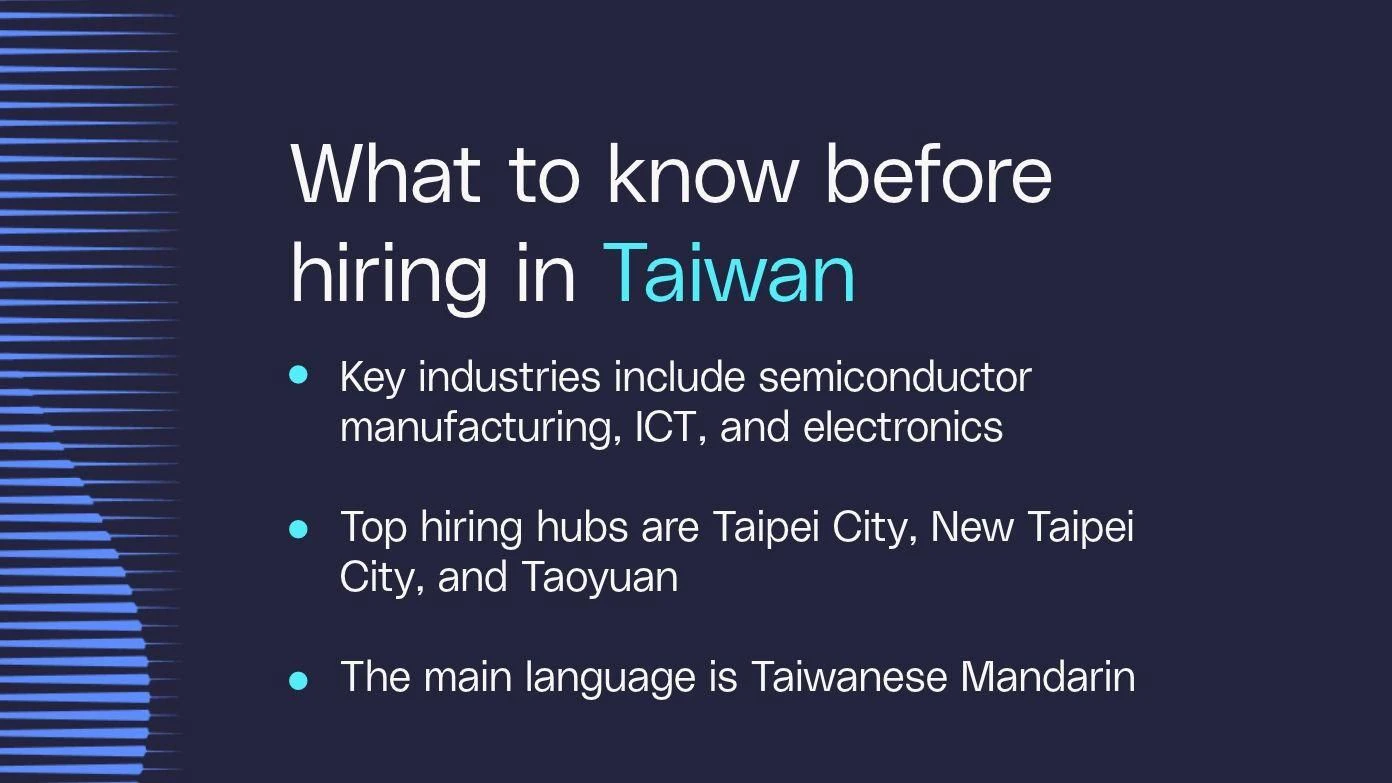
- Taiwan’s top hiring hubs are Taipei City, New Taipei City, and Taoyuan.
- Key industries include semiconductor manufacturing, information and communication technology (ICT), and electronic component manufacturing.
- Companies hiring in Taiwan have various options for setup, including partnering with an employer of record (EOR), hiring contractors, establishing a subsidiary, or direct employer registration.
Taiwan has a workforce of 12 million people, so it's an excellent place to find talented employees. Workers are known for high loyalty, leading to long tenures. Unemployment rates are low, at about 3.35%. Around 38.9% of people aged 25 to 64 have a bachelor's degree or higher. Over a quarter of these degrees are in engineering due to Taiwan's leadership in semiconductors and high-tech manufacturing.
대만으로 확장하기 전에 계약, 세금, 임금, 복지 및 기타 고용법을 이해해야 합니다. 저희 가이드가 대만에서 채용에 필요한 모든 정보를 알려드립니다.
대만에서 채용을 진행하기 전에 알아야 할 사항
If you’re expanding your business into Taiwan for the first time, you will have important legal requirements to consider. These norms and laws influence hiring practices in Taiwan and many aspects of the employer-employee relationship, including compensation and benefits.
G-P Gia™, our AI-powered global HR agent, can answer your toughest compliance questions about Taiwan and over 50 other countries. Reduce your reliance on outside counsel and cut the time and cost of compliance by up to 95% with Gia.
Ready to get started and learn all the details about hiring in Taiwan? Here are the six essential things you need to know.
1. 언어
Taiwanese Mandarin is the main language used in government, business, and education. Mandarin, Taiwanese Hokkien, Hakka, and the indigenous languages are all considered national languages under the Development of National Languages Act.
Taiwan’s bilingual 2030 policy aims to increase the nation's global presence, so lately, there has also been a major push to boost English proficiency. Taiwanese Hokkien is the most widely spoken language after Mandarin and is often used in daily life. There is also a significant portion of the country that speaks Hakka.
2. 근로시간 및 휴가
Standard working hours are 40 hours per week with a maximum of eight hours per day. Employees get two rest days per week: one mandatory regular day off and one flexible rest day. The flexible rest day can become a workday with employee consent and overtime pay. Employees can’t work more than six days without a rest day. Total working hours, including overtime, can’t exceed 12 hours in a single day. Overtime is capped at 46 hours per month. A labor-management agreement can increase overtime to 54 hours per month.
Employees get a 30-minute break after every four hours of work. For shift workers, there must be at least 11 hours of rest between shifts. This can be reduced to eight hours with union or labor-management approval.
유급 연차 휴가는 휴가를 기준으로 합니다:
- Six months to one year: three days
- One to two years: seven days
- Two to three years: 10 days
- Three to five years: 14 days
- Five to 10 years: 15 days
- More than 10 years: one extra day per year, capped at 30 days after 25 years of service
Mothers get eight weeks (56 days) of paid maternity leave. If employed for more than six months, they get full pay; if less, they get half pay. Fathers get seven days of paid paternity leave. Employers can apply for a government subsidy for the sixth and seventh days.
Sick leave for issues that don't require hospitalization is up to 30 days per year. This is paid at 50% of the wage. Hospitalized sick leave can be up to one year within a two-year period. The first 30 days are paid at 50%. The remainder is unpaid unless covered by labor insurance. The combined total of ordinary and hospitalized sick leave can’t exceed one year in any two-year period.
Taiwan has 12 national holidays for which all employees get leave. If a national holiday falls on a rest day, the employer must provide compensation or a substitute day off.
Employers must keep detailed attendance records, which include both arrival and departure times to the minute, for at least five years.
3. 근로계약서
The Labor Standards Act (LSA) regulates employment relationships in Taiwan. The LSA may apply to Taiwan-based employers even if their employees are assigned abroad. Whether the Act applies to a particular employment relationship depends on the agreement that governs it and any applicable legal rules.
Taiwan businesses work with two main types of employment contracts:
- Indefinite-term: This is the default and is required for any continuous work, including all part-time and full-time permanent roles.
- Fixed-term: This is only for non-continuous work such as temporary, short-term, seasonal, or project work. You may not use fixed-term contracts for ongoing roles.
The LSA doesn’t require all employment contracts to be in writing, but it's strongly recommended and is best practice. All contracts must comply with the minimum standards of the LSA.
A comprehensive written contract in Taiwan includes:
- 직원의 역할 및 직무 설명
- 예상 임무
- 예상 급여 및 계산 방법
- 시작일(및 기간제 계약의 경우 종료일)
- 휴가 및 휴가 자격
- 행동 규칙 및 징계 조치
- 해지 조건과 해고(severance)
- 고용 관계와 관련된 기타 중요한 정보는 없습니다
4. 보상 및 복리후생
Under the Labor Standards Act, wages must be paid at least twice a month unless both parties agree in writing to a monthly or other schedule. As of 2026, the minimum wage in Taiwan is NTD 29,500 per month and NTD 196 per hour.
The cost of national health insurance (NHI) is split. The employer pays 60%, the employee pays 30%, and the government pays 10%. The premium rate is 5.17%. Employers must enroll employees in the NHI on their first day of work.
Labor insurance is mandatory for employees of covered business entities, generally those with five or more employees. Separate rules govern employment insurance and occupational accident insurance. Employers pay 70% of the premium, the employee pays 20%, and the government pays 10%. Labor insurance covers occupational accidents, disability, death, and maternity benefits.
Employment insurance is mandatory for most employees aged 15 to 65 with some exceptions. The employer pays 70%, the employee pays 20%, and the government pays 10%. The premium is 1%, and it provides unemployment, parental leave, and job training benefits.
Employers must contribute at least 6% of each employee’s monthly wage to an individual pension account under the Labor Pension Act. Employees can make voluntary contributions of up to 6% of their wages.
5. 세금
Taiwan tax residency generally depends on domicile and habitual residence or, for individuals without a Taiwan domicile, a stay of 183 days or more in a tax year.
Taiwan-source income is subject to individual income tax. Residents are taxed on their worldwide income. Nonresidents are taxed only on Taiwan-sourced income. Confirm individual circumstances with a qualified tax adviser.
Taiwan uses a progressive income tax system with rates from 5% to 40%. For 2026, the brackets are:
- 5%: up to NTD 610,000
- 12%: NTD 610,001 to 1,380,000
- 20%: NTD 1,380,001 to 2,770,000
- 30%: NTD 2,770,001 to 5,190,000
- 40%: over NTD 5,190,001
The income basic tax (IBT) is an alternative minimum tax and applies only if certain thresholds are met. For example, it would apply if a taxpayer has large income from sources such as stock gains, insurance payouts, or tax-exempt international income. Most ordinary salary earners don’t pay IBT. If the IBT calculation exceeds the regular income tax, the taxpayer pays the higher amount. The IBT rate is 20%.
As an employer, it will be your responsibility to withhold income tax from employee salaries and remit it to the tax authorities monthly. You'll also need to provide annual withholding statements to both employees and the tax office.
Hiring models for global companies in Taiwan
- Direct employer registration: You can hire employees directly by opening a business in Taiwan. This requires you to register with the Ministry of Economic Affairs, pay taxes, and follow local labor compliance rules. It takes more time and effort to launch a new business in Taiwan, but it's useful if you're planning to have a long-term presence in the country.
- Employer of record: An employer of record (EOR) is an independent third party that handles hiring and staffing. You tell them what sort of employees you need, and they follow Taiwan's legal and financial rules for you. You’ll guide the work and day-to-day priorities of global talent, while the EOR manages employment administration and files the appropriate tax documentation. It's a flexible and convenient option if you want Taiwanese workers while maintaining a global presence.
- Subsidiary or branch: If you like the idea of having a business in Taiwan but already have a business elsewhere, consider a subsidiary or branch. A subsidiary tends to have more authority than a branch. Both subsidiaries and branches take some work to set up, but then you can hire employees directly.
- Independent contractors: Independent contractors are freelance workers that you contract to perform a specific task for a set amount of time. You can hire contractors in Taiwan instantly and do not need to be located in Taiwan or work with an EOR. Just keep in mind that Taiwan doesn't allow businesses to treat contractors like traditional employees. If the government finds out that you've misclassified actual employees as contractors, you might owe fees and fines for things like insurance and failure to provide appropriate leave.
대만의 주요 채용 허브
대만의 일부 도시는 특정 산업으로 유명합니다. 각 도시가 제공하는 서비스를 파악하면 적재적소에 채용 노력을 집중하고 더 빠르게 직책을 채울 수 있습니다.
대만의 주요 인재 허브는 다음과 같습니다:
- Taipei City is the capital and largest city of Taiwan. Taipei is also the main business, finance, and technology center. It hosts the headquarters of multinational corporations, tech companies, and financial institutions.
- New Taipei City surrounds Taipei. New Taipei City is a large industrial and residential area with a large number of manufacturing, logistics, and service sector employers.
- Taoyuan is known for its large industrial parks. Taoyuan is a hub for manufacturing, logistics, and high-tech industries.
- Hsinchu is often called the Silicon Valley of Taiwan. Hsinchu is home to the Hsinchu Science Park. This houses many of the world’s leading semiconductor, electronics, and IT companies.
- Taichung is a major city in central Taiwan. Taichung is a strong manufacturing base known for precision machinery. It's growing in the tech and service sectors.
대만의 주요 산업
대만의 주요 산업을 이해하면 급여와 복리후생을 벤치마킹할 수 있습니다. 이 인사이트를 활용하여 어디에 투자하고 인력을 성장시킬지 현명한 선택을 할 수 있습니다.
대만의 주요 산업은 다음과 같습니다:
- Semiconductor manufacturing: Taiwan is a world leader in chip manufacturing. Companies like Taiwan Semiconductor Manufacturing Company (TSMC) are important for everything from smartphones to AI data centers.
- Information and communication technology (ICT): Another main industry of Taiwan is the production and export of computers, laptops (Acer, Asus, MSI), components, motherboards, servers, and electronic parts.
- Electronic components: This industry includes the manufacturing of parts like integrated circuits, passive components, and flat-panel displays.
- Machine tools and CNC machinery: Taiwan is a global exporter of high-precision machine tools, which are important for automotive, aerospace, and general manufacturing industries worldwide.
- Automation equipment: Taiwan produces a variety of smart machinery and robotics equipment. This sector has a lot of support from government policies designed to enhance Taiwanese manufacturing.
대만에서 직원 채용에 드는 비용
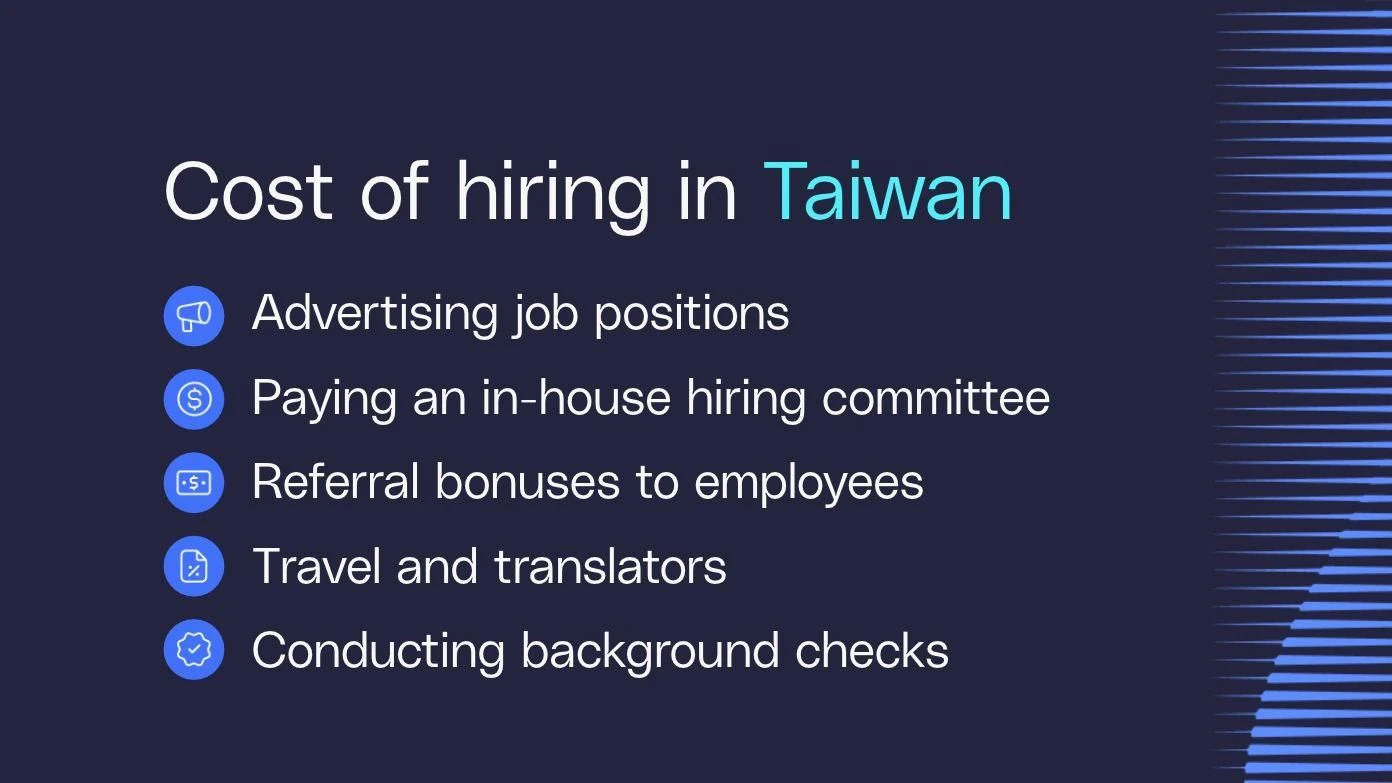
대만에서 직원 한 명을 고용하든 팀 전체를 고용하든 비용은 피할 수 없습니다. 다음 항목에 대한 예산을 책정합니다:
- 법인 설립 (단, 공식 고용주 와 제휴하는 경우는 제외)
- 구인 광고
- 지원자 검토를 위한 인건비
- 급여
- 세금
- 월급
- 혜택
- 보너스
- 수당
- 보험
- 여행
- 번역가(해당되는 경우)
According to G-P Verified Sources from Gia, the employer burden rate in Taiwan, which includes costs triggered on top of salaries, is approximately 18% to 19%.
대만에서 기업이 채용 직원을 채용하려면 무엇이 필요한가요?
대만에서 팀을 확장하기 전에 다음 필수사항을 반드시 챙기세요:
- 상무부와 경제부(MOEA)에 공식 기업명을 선택하고 등록하세요.
- 정관을 공증하고, 필요 시 재무 담당자의 진술서 또는 기타 설립 문서도 공증합니다.
- 대만에 귀하의 기업의 물리적 주소를 등록하세요.
- Apply for a government uniform invoice (GUI) number to track your taxable transactions with the National Taxation Bureau.
- Register for value-added tax (VAT).
- 현지 은행 계좌를 개설합니다.
- 기업과 모든 직원을 다음 항목에 등록하세요:
- 노동보험(대부분 직원에게 필수)
- 국민 건강보험(NHI)
- 노동 연금 제도
- 고용 보험 (자격이 있는 근로자 대상 보험)
- Draft compliant employment contracts for all employees.
- 직원이 30 명 이상인 경우, 현지 노동 당국에 회사의 취업규칙을 제출하여 승인을 받으세요.
- 세무서에 원천징수 대리인으로 등록하고 매월 원천징수 세금을 송금하세요.
- 해당 분야에 필요한 사업자 등록증이나 허가를 취득하세요.
Setting up a Taiwan subsidiary can take weeks or months. Use G-P EOR to hire full-time employees in Taiwan without setting up your own entity. Build your team in Taiwan at a lower cost, with peace of mind that you’re doing so compliantly.
대만에서의 채용 단계
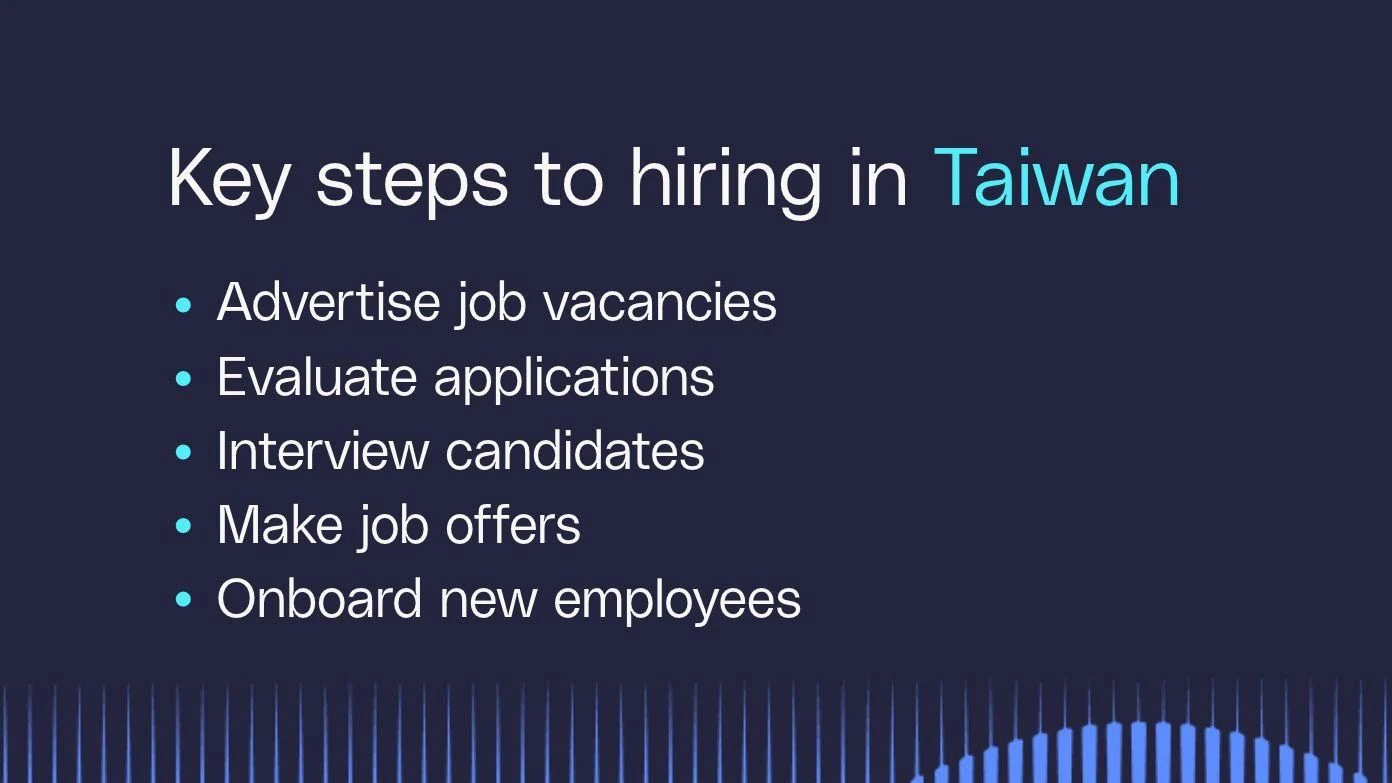
The hiring process in Taiwan is similar to the one you’re likely familiar with in your own country. Even though there are some extra legal details, the main goal is still to find a talented employee who is a good fit for your business. The hiring process follows five basic steps: advertising the job, evaluating applications, interviewing candidates, sending job offers, and onboarding new employees.
1. Advertising job vacancies
Clearly define the role, responsibilities, qualifications, and compensation package. Make sure the job description complies with Taiwan’s anti-discrimination laws. Don’t mention gender, age, marital status, or other protected personal characteristics unless legally justified. You must specify the salary range for any job with a regular monthly salary below NT 40,000. Vague terms like “negotiable” are prohibited for these positions.
104 Job Bank and 1111 Job Bank are popular job sites in Taiwan. For certain positions, you’ll need to notify the local public employment service office.
2. Evaluating applications
지원서를 수집하고 이력서를 검토합니다. 지원자의 자격, 경력, 역할 적합성을 기준으로 지원자를 선별합니다.
3. Interviewing candidates
Interview candidates who made it onto your shortlist. You can conduct these interviews in person or virtually. Use structured, nondiscriminatory interview questions. Gia can help you create questions that follow anti-discrimination laws in Taiwan, so you can find the best match for the role while complying with local regulations.
For some roles, background checks or reference checks can be performed with the candidate's consent.
4. 채용 제안하기
Contact your chosen candidate to offer them a position with your company. Prepare a compliant employment contract in Mandarin (and English if needed for international hires). Both parties must sign the contract before the employment start date.
5. Onboarding new employees
Now, you can onboard new employees. Enroll the new employee in any required labor insurance, national health insurance (NHI), labor pension, and employment insurance on or before their first day of work.
급여, IT 접근, 필요한 장비를 설정하세요. 근로계약서, 개인정보, 필요한 모든 등록 서류 사본을 보관하세요.
If you’re working with G-P EOR, you won’t need to worry about the administrative burden of onboarding. We’ll streamline the process, so you can focus on training your new team member and integrating them into your company culture.
대만에서 계약자 채용
Working with independent contractors in Taiwan can be a cost-effective way to test the market and build a presence without the commitment of full-time employees. Contractors will be ready to start working quickly with their own equipment and established work processes. And like all other employees based in Taiwan, they'll understand local consumer behavior, rules, and business practices.
계약직 직원을 고용하면 복잡한 정규직 채용 절차와 그에 따른 비용 부담 없이 사업 필요에 따라 인력을 손쉽게 조정할 수 있습니다.
Before you enter into an agreement with an independent contractor in Taiwan, consider the following:
1. 직원 대 독립계약자
It’s important to understand the difference between employees and independent contractors. In Taiwan, employers hire employees to do work and, in return, pay them a regular salary and benefits. Independent contractors provide services. Unlike employees, contractors set their schedules, use their own equipment, and work on specific projects rather than having an ongoing role.
2. 잘못된 분류에 대한 처벌
Classifying someone as a contractor when they’re not can lead to severe penalties. If misclassification occurs, you’ll:
- Face fines for violations of the Labor Standards Act (LSA).
- Need to back pay all statutory entitlements, including unpaid wages, overtime, and holiday pay.
- Need to back pay social insurance contributions (labor insurance, national health insurance, labor pension) with interest and possible late fees.
3. 계약자에게 지불하는 방법
G-P Contractor는 해외 계약직 직원을 고용하고 급여를 지급하는 복잡하고 시간 소모적인 과정을 없애줍니다. 몇 번의 클릭만으로 계약을 생성 및 발행하고 계약자에게 비용을 지불할 수 있으며, 이 모든 과정에서 규정준수 절차를 준수할 수 있습니다.
G-P를 통해 대만에서 직원 및 계약자를 고용하세요.
We chose G-P because of their flexibility and expertise in handling our global hiring needs. We needed a partner who could help onboard and manage our diverse team across multiple regions with challenging employment regulations. G-P's global presence made them the ideal solution for our dynamic workforce."
Our Global Employment Platform and its AI-powered products, EOR, Contractor, and Gia, support companies as they build and manage global teams.
G-P 10년 이상의 경험을 보유한 글로벌 고용 분야의 선도 기업으로 인정받고 있으며, 인사, 법률 및 규정 준수 전문가로 구성된 최대 규모의 팀과 글로벌 독자 지식 기반을 갖추고 있습니다.
Make your expansion to Taiwan easier with G-P. Contact us or book a demo today.
 FAQ
대만에서 최저 임금은 뭐야?
최저 임금은 NTD 29, 월500 또는 시간당 NTD 196 입니다.
대만의 법정 근무 시간과 초과 근무 규정은 어떻게 되나요?
Standard working hours are eight hours per day and 40 hours per week. Overtime is capped at 46 hours per month and must be paid at premium rates. This cap can be increased to 54 hours per month with a labor-management agreement.
대만에는 어떤 사회 보험 프로그램이 있나요?
Taiwan has several statutory employee protection programs, including labor insurance, National Health Insurance (NHI), labor pension, and employment insurance. Employers must determine and meet the enrollment and contribution requirements applicable to their business and employees.
대만에서는 근로계약서 작성이 필수인가요?
Not always, but it is strongly recommended as best practice. For global employees, a written contract is mandatory.
대만에는 어떤 유형의 휴가가 있나요?
Paid annual leave is based on tenure and can range from three to 30 days. There are 12 national holidays. Additional statutory leave types include sick, maternity, paternity, marriage, and bereavement leave.