




Principais conclusões
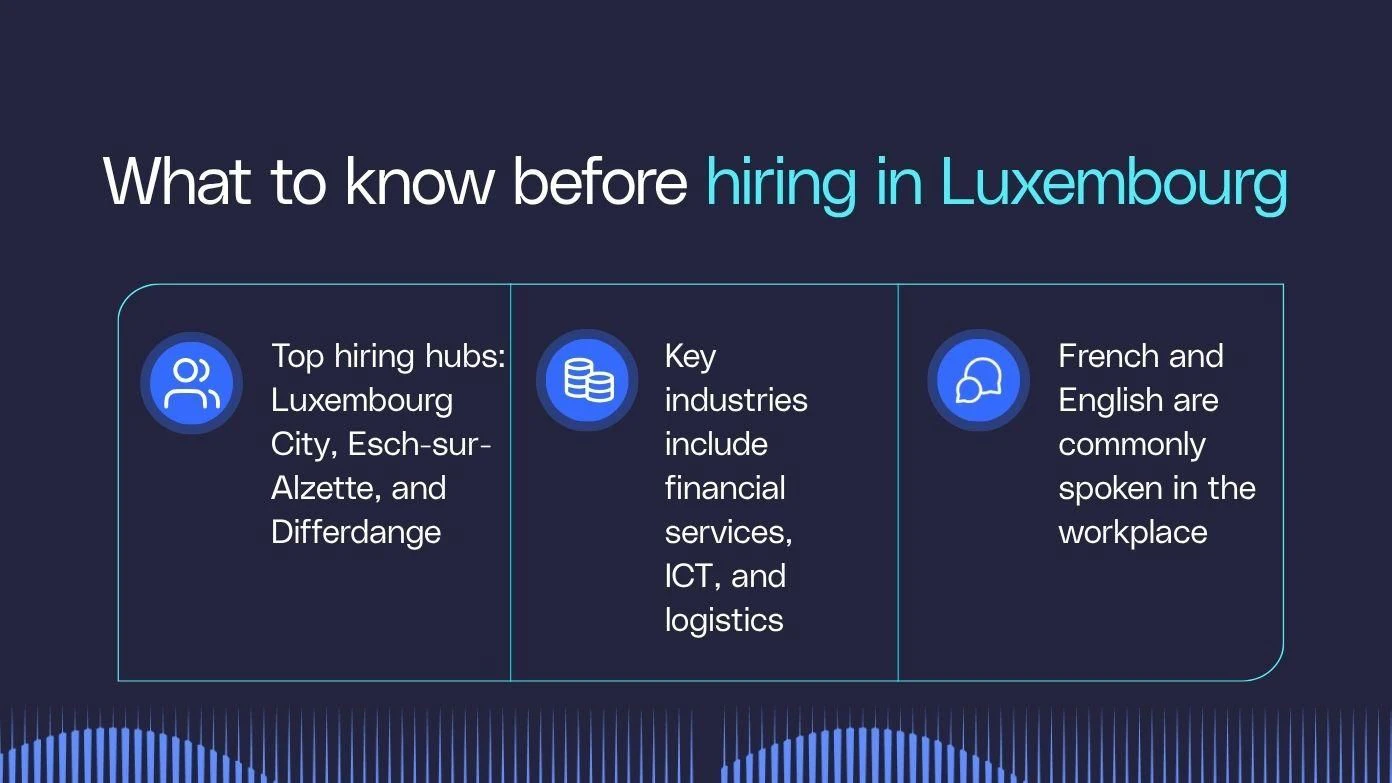
- Os principais centros de contratação de Luxemburgo são Cidade de Luxemburgo, Esch-sur-Alzette e Differdange.
- Os principais setores industriais do Luxemburgo incluem serviços financeiros, TIC (Tecnologias da Informação e Comunicação) e logística.
- As empresas que contratam no Luxemburgo têm várias opções de estruturação, incluindo a parceria com um empregador registado (EOR, na sigla em inglês), a contratação de prestadores de serviços, a criação de uma subsidiária ou o registo direto como empregador.
Localizado na Europa Central, Luxemburgo faz fronteira com importantes economias como a Alemanha, a França e a Bélgica. O país oferece excelente acesso comercial e às transações com o mercado da UE. A extensa rede de tratados para evitar a dupla tributação em Luxemburgo reduz a carga tributária para empresas globais. Luxemburgo pode passar despercebido, mas pode fornecer a vantagem estratégica que você precisa.
Nosso guia lhe dirá tudo o que você precisa saber sobre contratação em Luxemburgo.
O que você precisa saber antes de contratar alguém em Luxemburgo
Se você está expandindo seus negócios para Luxemburgo pela primeira vez, há importantes requisitos legais que você precisa conhecer. Essas normas e leis influenciam as práticas de contratação em Luxemburgo e muitos aspectos da relação empregador-empregado.
Se você não sabe por onde começar, GP Gia ™, nossa agente global de RH com inteligência artificial, pode responder às suas perguntas mais difíceis sobre conformidade em 50 países e em todos os 50 estados dos EUA. Reduza sua dependência de consultores externos e diminua o tempo e o custo de conformidade em até 95% com a Gia.
Vamos analisar cinco coisas que você precisa saber sobre contratação em Luxemburgo.
1. A força de trabalho luxemburguesa
Apesar de seu pequeno tamanho, Luxemburgo é um país diverso — os trabalhadores transfronteiriços representam 47% da força de trabalho de Luxemburgo e apenas um em cada quatro funcionários é cidadão luxemburguês. Trabalhadores transfronteiriços deslocam-se diariamente para o trabalho a partir de países vizinhos como França, Bélgica e Alemanha.
A força de trabalho em Luxemburgo também é impressionantemente qualificada, especialmente em multilinguismo e em setores como logística da cadeia de suprimentos, engenharia e finanças. Em 2025, 60.3% das pessoas empregadas no Luxemburgo tinham educação terciária, colocando o país entre os mais altos da UE.
Alguns dos setores empresariais mais importantes do país incluem:
- Fabricação avançada
- Tecnologias limpas
- Economia de dados
- Fintech e finanças
- Tecnologias de saúde
- Logística e gestão da cadeia de suprimentos
- Marítimo
- Mobilidade inteligente
- Espaço
- Aço
- Agricultura
- turismo
2. Diversidade linguística
Os quase 691,000 habitantes do Luxemburgo são linguisticamente diversos. O censo mais recente do país constatou que cerca de 61 % usam regularmente o 2, 50 % usam o francês 825 % usam 7francês. use inglês, 22.5% use alemão, 19.8% use Portuguese, 5.8% usam italiano e 18% usam outros idiomas. Segundo o governo de Luxemburgo, o francês é a língua mais utilizada no ambiente de trabalho, seguido pelo inglês.
O inglês é especialmente prevalente nos setores bancário, financeiro, de seguros, de comércio internacional e nas instituições europeias. O luxemburguês é particularmente comum na administração pública e na educação, enquanto o alemão é frequentemente usado na área da saúde, administração pública, indústria e comércio.
Se a sua empresa utiliza um idioma diferente, você pode precisar de um especialista para traduzir a escritura de constituição — incluindo os estatutos sociais — para um dos idiomas administrativos de Luxemburgo.
3. Impostos e previdência social
Luxemburgo é conhecido por seu ambiente fiscal favorável e reputação amigável aos negócios. No entanto, calcular os impostos dos funcionários nem sempre é simples.
Os empregadores são responsáveis por reter os impostos e as contribuições para a segurança social dos seus funcionários. Mas uma alta porcentagem de trabalhadores são cidadãos de outros países, o que aumenta a complexidade.
Os residentes do Luxemburgo pagam imposto de renda e contribuições para a previdência social. As taxas de imposto são progressivas e levam em consideração a faixa de renda do funcionário, seu estado civil e seus dependentes. No que diz respeito às contribuições sociais obrigatórias, ambas as partes contribuem para os seguros de saúde e de pensões. Os funcionários são os únicos responsáveis pelo pagamento do seguro de cuidados de longa duração. Os empregadores arcam com as contribuições para o seguro contra acidentes, serviços de saúde ocupacional e seguro mútuo do empregador, que prevê reembolsos parciais da remuneração paga aos funcionários ausentes.
Os trabalhadores transfronteiriços pagam imposto de renda sobre qualquer rendimento que obtenham no Luxemburgo. Isso não inclui rendimentos obtidos em outras fontes. Uma pessoa que mantém uma residência efetivamente utilizada no Luxemburgo ou que permanece no país por mais de seis meses consecutivos é geralmente considerada residente fiscal no Luxemburgo e sujeita a impostos sobre a sua renda mundial.
Os trabalhadores destacados para o Luxemburgo geralmente permanecem cobertos pelo sistema de segurança social do país onde trabalham normalmente, sujeitos aos acordos internacionais aplicáveis. Para trabalhadores destacados de um Estado-Membro da UE, o período inicial de destacamento é geralmente limitado a 24 meses.
4. Compensação
A moeda nacional do Luxemburgo é o euro. O salário mínimo social em Luxemburgo varia de acordo com a idade e as qualificações do trabalhador.
A partir de 1 de junho de 2026, as taxas horárias são:
- 18+ (qualificado): EUR 19.22
- 18+ (não qualificado): EUR 16.02
- 17–18 anos de idade: EUR 12.82
- 15–17 anos de idade: EUR 12.01
Alguns funcionários em Luxemburgo recebem um 13salário ou outro bônus além de seus salários regulares. Esses pagamentos não são universalmente exigidos por lei, mas podem se tornar obrigatórios quando especificados em um contrato de trabalho ou acordo coletivo, ou estabelecidos por meio de prática consistente da empresa.
Os Acordos Coletivos de Trabalho (ACTs) podem estabelecer condições de emprego específicas para os trabalhadores abrangidos no Luxemburgo. Os empregadores devem cumprir os requisitos aplicáveis do Acordo Coletivo de Trabalho (ACT), que podem incluir tabelas salariais, horário de trabalho, horas extras, feriados e férias anuais.
5. Semana de trabalho e períodos de descanso
A semana de trabalho padrão em Luxemburgo é 40 horas, normalmente dividida em cinco dias de oito horas. Os funcionários podem fazer horas extras em determinadas circunstâncias. Funcionárias grávidas ou em período de amamentação não podem ser obrigadas a fazer horas extras, embora possam optar por fazê-lo.
Os funcionários têm direito a 26 dias de férias anuais remuneradas por ano e geralmente podem começar a tirar férias após três meses de emprego contínuo. Além do direito a férias anuais, Luxemburgo tem 11 feriados públicos ao longo do ano.
Com o GP EOR, você pode administrar planos de benefícios com facilidade. Nossos especialistas internos monitoram continuamente as leis trabalhistas para garantir o cumprimento das normas e regulamentações específicas de cada país. Crie e gerencie planos de benefícios por meio de nossa plataforma para proporcionar uma experiência tranquila aos funcionários.
Modelos de contratação para empresas globais em Luxemburgo
Ao expandir suas operações para Luxemburgo, você tem vários modelos de contratação à sua disposição. A melhor opção para sua empresa depende de vários fatores, incluindo se você já possui presença legal no país e a rapidez com que deseja contratar.
Não existe um modelo de contratação universal, pois cada organização tem necessidades e objetivos de expansão diferentes. Você pode descobrir que uma empresa semelhante à sua utiliza um Employer of Record (EOR), enquanto um modelo diferente funciona melhor para você devido aos seus planos de longo prazo.
- Registro direto de empregador: Ao registrar sua empresa estrangeira no Centro Comum de Segurança Social de Luxemburgo (CCSS), você pode se tornar um empregador local sem precisar constituir uma subsidiária local separada. No entanto, dependendo das atividades que sua empresa realiza em Luxemburgo, você também poderá precisar obter registros ou autorizações comerciais adicionais. Nesse modelo de contratação, você tem um vínculo empregatício direto com seus funcionários, mas também será responsável pela folha de pagamento, retenção de impostos e contribuições para a previdência social.
- Empregador formal: Um Empregador formal, como a GP, atuará como empregador legal de seus funcionários e será responsável por todas as questões relacionadas à folha de pagamento, retenção de impostos e contribuições para a previdência social. A vantagem desse modelo é que você pode contratar trabalhadores locais e manter o controle sobre o trabalho diário deles, mas deixar muitas das responsabilidades administrativas de emprego para o Empreendedor Residente (EOR). Isso permite que você entre rapidamente em um mercado e construa uma força de trabalho local. Empresas que desejam testar um novo mercado e preferem evitar o tempo e o custo de estabelecer uma entidade local geralmente optam por esse modelo devido à sua flexibilidade.
- Subsidiária ou filial: Você pode estabelecer uma subsidiária ou filial em Luxemburgo, mas precisa entender como essas duas estruturas diferem entre si. Com uma subsidiária, você está criando uma entidade jurídica separada da sua empresa matriz estrangeira. Com uma filial, o negócio permanece parte da empresa matriz estrangeira, que geralmente é responsável pelas dívidas e obrigações legais da filial. Você precisará avaliar seus planos de expansão a longo prazo e considerar fatores como responsabilidade civil, custos e requisitos administrativos para decidir qual dessas estruturas funciona melhor para sua empresa.
- Contratação de profissionais autônomos e risco de classificação incorreta: Se você precisa de profissionais especializados para seus projetos, mas não quer contratar funcionários permanentes, pode sempre contratar profissionais autônomos. Mas você precisa pensar em quanto controle exerce sobre o trabalho deles e na natureza da relação de trabalho para garantir que não classifique erroneamente um funcionário como contratado. Um erro desse tipo pode acarretar problemas de conformidade e resultar em penalidades que prejudiquem sua expansão. Você também deve considerar como gerenciará os pagamentos aos contratados e planejar para cargas de trabalho flutuantes, pois os contratos com contratados, a emissão de faturas e os processos de pagamento diferem daqueles usados para funcionários tradicionais.
Principais polos de contratação em Luxemburgo
Algumas cidades luxemburguesas são conhecidas por indústrias específicas. Conhecer as ofertas de cada cidade pode ajudar você a direcionar seus esforços de recrutamento para o local certo e preencher as vagas mais rapidamente.
Os principais polos de talento em Luxemburgo são:
- A cidade de Luxemburgo é a capital e a maior cidade de Luxemburgo. É o principal centro financeiro e de negócios, com muitas empresas multinacionais, bancos e instituições da UE. Existem muitas oportunidades de emprego nas áreas de finanças, TI, consultoria e administração.
- Esch-sur-Alzette, conhecida pelo seu setor industrial, concentra-se cada vez mais em tecnologia e pesquisa.
- Differdange, que é um importante centro industrial e educacional. É onde se encontra o campus Belval da Universidade de Luxemburgo.
- Dudelange, que possui uma forte base industrial e está próxima da fronteira francesa.
- Ettelbruck, que desempenha um papel importante na área da saúde, logística e serviços.
Principais setores industriais em Luxemburgo
Compreender os principais setores da economia do Luxemburgo ajuda a comparar salários e benefícios. Você pode usar essa informação para tomar decisões inteligentes sobre onde investir e expandir sua força de trabalho.
Os principais setores industriais do Luxemburgo incluem:
- Serviços financeiros: Luxemburgo é um importante centro global para serviços bancários, fundos de investimento e seguros. O setor financeiro continua sendo um importante contribuinte para a economia do país, com talentos que incluem especialistas em fundos de investimento, planejadores patrimoniais, consultores tributários e controladores financeiros.
- Tecnologias de informação e comunicação (TIC): O atual governo prometeu investir em inovação para posicionar Luxemburgo como líder em novas tecnologias digitais. Inteligência artificial, 5e computadores de alto desempenho são fundamentais para este plano. O talento em TIC inclui profissionais nas áreas de fintech, cibersegurança e tecnologias de nuvem.
- Logística e transporte: A localização central de Luxemburgo na Europa faz dele um importante polo para serviços de logística, carga aérea e transporte. O país conta com especialistas em cadeia de suprimentos e logística, operações de armazém e conformidade aduaneira e comercial.
- Aço e indústria: Luxemburgo possui uma rica história de produção de aço e desempenha um papel significativo nesse setor. É a sede da ArcelorMittal, uma das maiores produtoras de aço do mundo. O talento especializado abrange funções nas áreas de engenharia, produção e operações.
- Tecnologia de satélite: Luxemburgo possui um setor espacial comercial bem estabelecido, com forte foco em comunicações via satélite. Luxemburgo entrou na indústria espacial em 1985 com a fundação da SES, que desde então se tornou líder global em comunicações via satélite.
O custo de contratar um funcionário em Luxemburgo
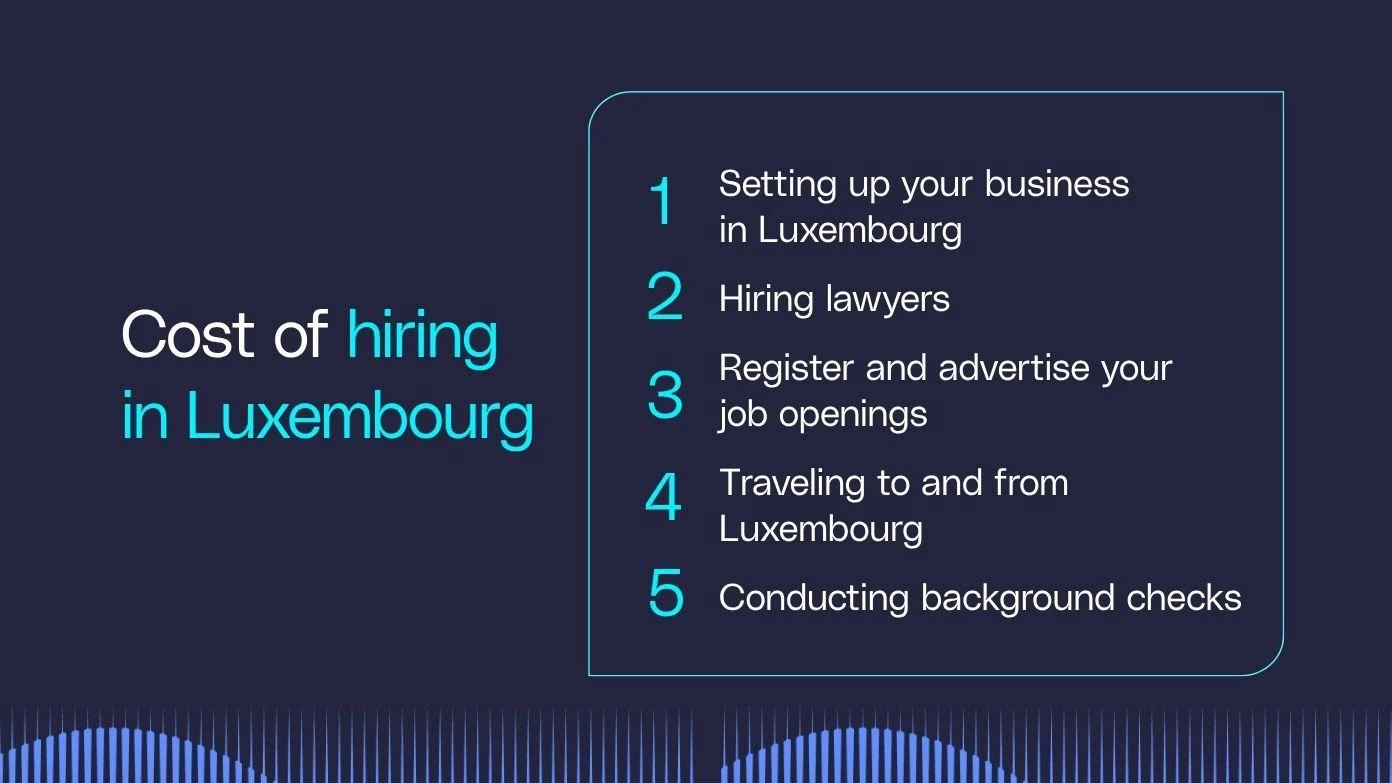
Quer esteja a contratar um funcionário ou uma equipa inteira no Luxemburgo, as despesas são inevitáveis. Orçamento para o seguinte:
- Contratar advogados e contadores para se manter atualizado sobre as leis trabalhistas, comerciais e tributárias.
- Constituir a sua entidade comercial no Luxemburgo, se necessário para o modelo de contratação escolhido.
- publicar anúncios de emprego em classificados e sites de networking;
- contratar um tradutor para preparar documentos em luxemburguês, alemão ou francês;
- contratar um serviço de verificação de antecedentes para as triagens pré-emprego; e
- viajar a Luxemburgo para montar seu escritório ou fazer entrevistas.
Do que uma empresa precisa para contratar em Luxemburgo?
A menos que você trabalhe com uma EOR (Empresa de Registro de Exportadores), você pode precisar de uma entidade para contratar funcionários em Luxemburgo. Uma opção é formar uma Société à Responsabilité Limitée (SARL), que é semelhante a uma sociedade de responsabilidade limitada.
Os passos para estabelecer uma subsidiária no Luxemburgo incluem:
- Verificar a disponibilidade do nome da sua empresa através do Registo Comercial e de Empresas (RCS)
- Redigir os estatutos da associação perante um notário e registrá-los no RCS (Registo Comercial de Singapura).
- abrir uma conta bancária no país e depositar o capital necessário;
- adquirir um escritório registrado em Luxemburgo;
- solicitar um alvará de funcionamento;
- inscrever sua empresa no Registro de Comércio e Empresas; e
- cadastrar-se nos órgãos fiscais.
- Obtenção de licenças comerciais específicas do setor
Utilize uma EOR (Empresa de Registro de Exportador) de Luxemburgo para contratar funcionários em tempo integral sem precisar abrir sua própria empresa. Monte sua equipe em Luxemburgo a um custo menor e com a tranquilidade de estar em total conformidade com a legislação.
Etapas para contratar em Luxemburgo
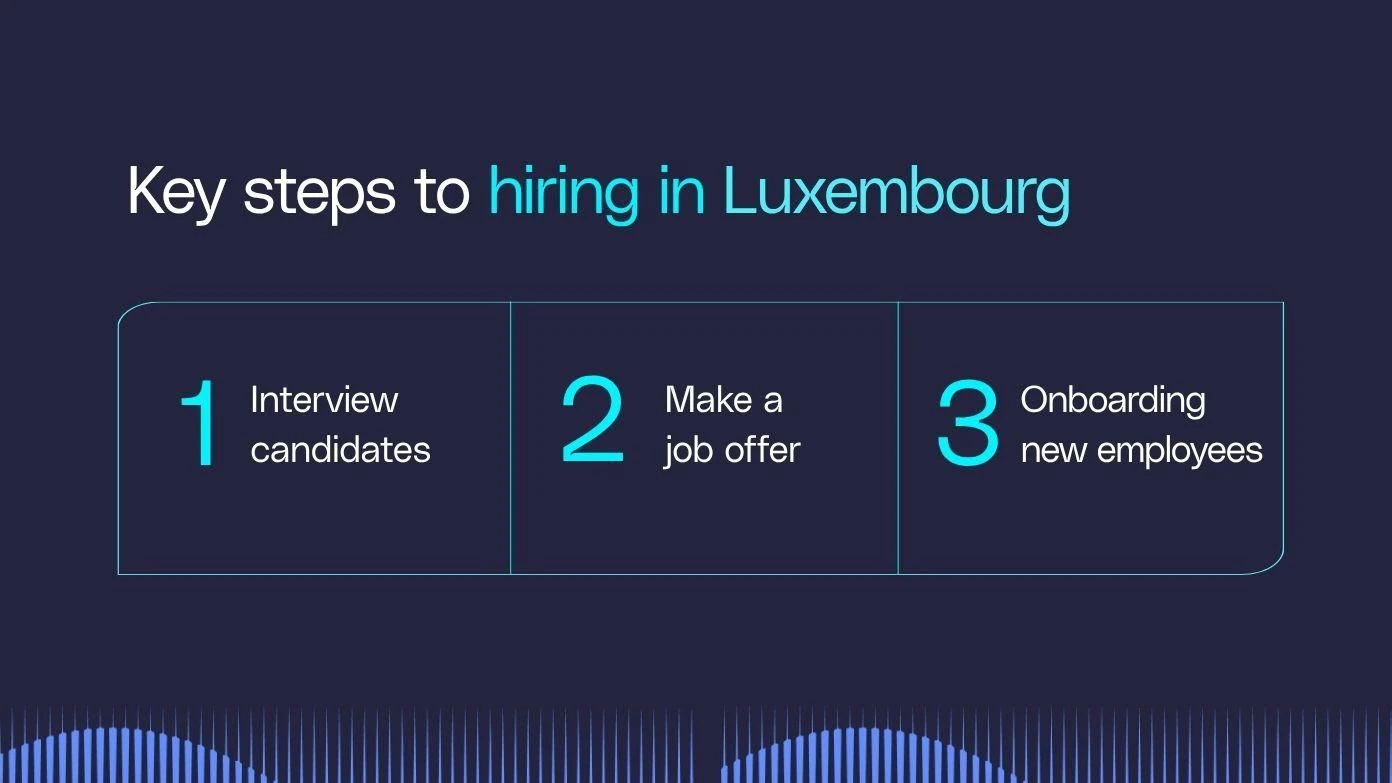
O processo de recrutamento no Luxemburgo tem cinco etapas básicas: anunciar a vaga, avaliar as candidaturas, entrevistar os candidatos, enviar as propostas de emprego e integrar os novos funcionários.
1. Cadastre e anuncie a vaga de emprego.
Os empregadores devem declarar a vaga junto à Agência Nacional de Emprego (ADEM) antes de anunciar a posição. Assim que a vaga for registrada, os empregadores poderão começar a recrutar candidatos.
Fazer networking é uma excelente maneira de encontrar funcionários em Luxemburgo. No entanto, se você é novo no mercado, pode não ter contatos em Luxemburgo. Uma forma de criar conexões e conhecer candidatos é por meio de uma feira de empregos.
Anunciar vagas de emprego online é outra opção popular. Sites como jobs.lu e jobfinder.lu são bons lugares para publicar anúncios de emprego. Você também pode querer publicar anúncios de emprego no LinkedIn.
2. Selecionar os principais candidatos
Os trabalhadores luxemburgueses estão habituados a candidatar-se a empregos com o seu CV e uma carta de apresentação. A diversidade na força de trabalho significa que você pode encontrar currículos em vários formatos.
Geralmente, os candidatos tendem a enviar suas candidaturas no mesmo idioma da vaga anunciada. Se você deseja que os candidatos enviem suas candidaturas em um idioma específico, indique isso no anúncio da vaga.
3. Fazer entrevistas
Em seguida, entreviste os candidatos que chegaram à sua lista final. Você pode realizar entrevistas virtualmente ou presencialmente, caso possua uma filial ou subsidiária. Entrevistas por telefone ou vídeo são úteis se você estiver contratando funcionários remotos em Luxemburgo e quiser evitar viagens. Com uma taxa de penetração da internet 99% no Luxemburgo, os candidatos a emprego geralmente têm um forte acesso a ferramentas e serviços online.
Durante as entrevistas, evite perguntas que possam ser consideradas discriminatórias. Isso inclui perguntas pessoais sobre as crenças políticas ou religiosas de uma pessoa, sua idade, orientação sexual ou etnia. Gia pode ajudar você a criar perguntas que estejam de acordo com as leis antidiscriminação, para que você encontre o candidato ideal para a vaga, em conformidade com as regulamentações locais.
Em Luxemburgo, os empregadores costumam submeter os candidatos a várias entrevistas antes de fazerem uma oferta de emprego. Portanto, não hesite em convidar os candidatos para entrevistas adicionais, se necessário, antes de fazer ofertas de emprego.
4. Preparar contratos de trabalho e enviar ofertas de emprego
Quando estiver pronto para fazer propostas de emprego, elabore contratos de trabalho para compartilhar com os candidatos. A legislação luxemburguesa exige que os empregadores criem um contrato de trabalho por escrito o mais tardar no primeiro dia de trabalho do funcionário. Este acordo deve especificar os detalhes do emprego, incluindo:
- Data de início do funcionário
- Local de trabalho
- Deveres inerentes à função
- Horário de trabalho habitual
- Remuneração
- Férias anuais
- Período de aviso prévio, se houver
- Duração do período de experiência, se houver
- Acordo coletivo de trabalho relevante, se aplicável.
- Plano de pensão, se houver.
Se o contrato for por prazo determinado, você deverá incluir itens adicionais no acordo.
A GP EOR possui um Gerador de Contratos de Trabalho para ajudá-lo a redigir contratos de trabalho que estejam em conformidade com os requisitos legais e as melhores práticas em Luxemburgo.
Em Luxemburgo, os empregadores podem realizar determinadas verificações pré-emprego quando estas estiverem diretamente relacionadas e forem necessárias para o cargo. Por exemplo, um empregador pode solicitar uma certidão de antecedentes criminais recente se isso for necessário para uma função específica, e o consentimento do candidato for necessário para determinadas verificações.
5. Admissão dos novos funcionários
Assim que os candidatos concordarem com os termos do contrato e o assinarem, você poderá iniciar o processo de integração. Isso envolve tarefas básicas como obter os cartões de contribuinte dos funcionários para configurar a folha de pagamento e registrar os funcionários no Centro Comum da Previdência Social (CCSS) dentro de oito dias após a contratação.
Contratação de prestadores de serviços no Luxemburgo
Trabalhar com prestadores de serviços independentes no Luxemburgo pode ser uma forma economicamente viável de testar o mercado e construir uma presença sem o compromisso de funcionários em tempo integral. Os prestadores de serviços sediados no Luxemburgo compreendem o comportamento do consumidor local, as regras e as práticas comerciais. Eles estarão prontos para começar a trabalhar rapidamente com seus próprios equipamentos e processos de trabalho já estabelecidos.
Contratar prestadores de serviços permite ajustar facilmente sua força de trabalho de acordo com as necessidades do seu negócio, sem as complexidades e os custos da contratação de funcionários.
Antes de celebrar um contrato com um trabalhador independente no Luxemburgo, considere o seguinte.
1. Empregados versus trabalhadores independentes
É importante entender a diferença entre funcionários e trabalhadores autônomos. Uma característica fundamental da relação de trabalho no Luxemburgo é a subordinação, ou seja, o empregado realiza o trabalho sob a autoridade do empregador em troca de remuneração. Os trabalhadores independentes geralmente atuam por conta própria, em vez de trabalharem sob a autoridade de um empregador.
2. Penalidades por classificação incorreta
Classificar erroneamente um funcionário como prestador de serviços independente pode gerar riscos de não conformidade para empresas que operam em Luxemburgo. Como os empregados e os trabalhadores autônomos têm obrigações trabalhistas e de seguridade social diferentes, as empresas devem avaliar cuidadosamente a natureza da relação de trabalho antes de classificar um trabalhador.
3. Como pagar empreiteiros no Luxemburgo
A GP Contractor ™ simplifica o processo complicado e demorado de contratar e pagar prestadores de serviços internacionais. Você pode criar e emitir contratos e pagar contratados com apenas alguns cliques, tudo isso mantendo um processo em conformidade com a lei.
Contrate funcionários e prestadores de serviços no Luxemburgo com a GP
Nossa Plataforma Global de Emprego e seus produtos com inteligência artificial, EOR, Contractor e Gia, auxiliam empresas na formação e gestão de equipes globais.
A GP é líder reconhecida em relações trabalhistas globais, com mais de uma década de experiência; a maior equipe de especialistas em RH, direito e compliance; e uma base de conhecimento proprietária global.
Facilite a sua expansão para o Luxemburgo com a G-P. Entre em contato conosco ou agende uma demonstração hoje mesmo.

Perguntas frequentes
O que os contratos de trabalho devem incluir?
Os empregadores devem fornecer um contrato de trabalho por escrito no momento em que os funcionários iniciarem suas funções. O contrato deve incluir as responsabilidades do cargo, o salário, o horário de trabalho e outros detalhes relevantes.
É permitida a verificação de antecedentes durante o processo de contratação?
Sim, os empregadores podem realizar certas verificações de antecedentes quando estas estiverem diretamente relacionadas e forem necessárias para o cargo. Por exemplo, os empregadores podem solicitar um extrato de antecedentes criminais quando isso for relevante para a função.
Quais são as obrigações dos empregadores em matéria de segurança social?
Os empregadores devem registrar os novos funcionários no Centro Comum da Previdência Social (CCSS) dentro de oito dias após a contratação e pagar as contribuições previdenciárias aplicáveis, tanto do empregador quanto do empregado.
Cidadãos de países não pertencentes à UE precisam de autorização de trabalho e/ou visto?
Em geral, cidadãos de países terceiros precisam de autorização para permanecer em Luxemburgo para fins de emprego, enquanto os requisitos de visto dependem da nacionalidade e das circunstâncias de cada um.
Quais são as regras do período probatório?
A legislação trabalhista de Luxemburgo não exige períodos de experiência. Os empregadores que optarem por especificá-las devem fazê-lo por escrito, e os funcionários devem concordar com elas, o mais tardar, no primeiro dia de trabalho do funcionário. Geralmente variam de duas semanas a seis meses, embora certos funcionários altamente remunerados possam ter um período probatório de até 12 meses.