



Key takeaways
- Big market reach: Southeast Asia offers over 670 million people and a quickly growing consumer base. Expanding here opens new revenue streams in the Asian global market and diversifies your business beyond a single country.
- Diverse economic strengths: Tailor your strategy to your Asia business goals. You can use high-growth hubs like Vietnam and the Philippines for manufacturing and tech scaling, or tap into mature markets like Singapore for regional headquarters and IP security.
- Strategic trade connectivity: ASEAN sits on shipping lanes near China. Using trade agreements like RCEP helps you streamline cross-border supply chains and lower operational costs across the Southeast Asia economy.
- Fast, compliant hiring: Working through distinct local tax, payroll, and labor laws in each country can slow you down. Partnering with an employer of record (EOR) lets you hire and manage top regional talent quickly without the cost or delay of setting up local legal entities.
Southeast Asia offers the Asian global market resilient supply chains, a connected consumer base, and diverse talent pools. With a smart global employment strategy, you can take advantage of these opportunities and move fast while protecting your business from financial and compliance risks.
Let's explore six countries with attractive business in Southeast Asia opportunities, plus hiring tips to build a dynamic workforce that grows with you.
Why expand into Southeast Asia?
The member countries of the Association of Southeast Asian Nations (ASEAN) are home to over 670 million people. Estimates anticipate 140 million new consumers in Southeast Asia by 2030. These large talent and consumer markets support business stability. Proximity to major supply bases and dense shipping lanes also shortens lead times and lowers logistics risk for any Asia business.
Different industries in Southeast Asia are attracting global investors, particularly sectors like technology and data infrastructure, manufacturing and electronics, e‑commerce and payments, healthcare, and renewables.
Southeast Asia's economy is undeniable. Companies that expand into the region can expect:
- Market growth and diversification: Multiple demand centers reduce reliance on a single country. You can balance revenue across mature hubs like Singapore and fast‑growing markets like Vietnam and the Philippines.
- Talent availability: Large, tech‑savvy talent pools support engineering, operations, finance, and customer roles. Strong English proficiency and a culture of upskilling allow for fast and cost-efficient hiring for your Asian business.
- Strategic location and global connectivity: ASEAN’s strategic location near China and key Indo-Pacific trade routes positions the region as a compelling platform for companies seeking access to fast-growing consumer markets and integrated supply chains. Frameworks such as the Regional Comprehensive Economic Partnership (RCEP) can facilitate regional trade and investment by supporting tariff commitments, common rules of origin, and more streamlined cross-border commerce, subject to product, sector, and country-specific requirements. As businesses pursue China Plus One strategies, ASEAN can offer diversified options for production, sourcing, and distribution across a range of markets. A plausible hub-and-spoke model can include setting up a headquarters or commercial hub in Singapore, while locating manufacturing operations in Vietnam or Thailand and serving customers across ASEAN and wider global markets. With appropriate planning, this structure can improve lead times, reduce concentration risk, and inform regional site selection, supply-chain strategy, and investment allocation.
- Regulatory alignment: While rules differ by country, legal teams can standardize core policies based on ASEAN norms and then adapt contracts, payroll, and benefits to local law.
Comparative overview: the SEA-6 macro landscape
Choosing where to establish your business in Southeast Asia depends on your goals. Some markets offer fast-scaling opportunities, while others deliver long-term stability.
|
Country |
Projected annual GDP growth (2026–2035) |
Main advantage for your business |
|---|---|---|
|
Vietnam |
6.2% |
High-speed manufacturing and tech expansion |
|
The Philippines |
5.8% |
Scalable customer operations and IT services |
|
Indonesia |
5.4% |
Large consumer market access |
|
Malaysia |
4.3% |
Advanced data infrastructure and engineering talent |
|
Singapore |
2.7% |
Strategic regional headquarters and strong IP protection |
|
Thailand |
2.2% |
Established industrial supply chains and logistics |
Source: https://www.dbs.com/newsroom/Southeast_Asias_fortunes_remain_intertwined_as_region_enters_decade_of_divergence_Bain_n_Company_DBS_Bank_and_Vriens_n_Partners
Southeast Asia’s economy isn't a single entity. You will find fast-growing markets alongside mature financial hubs. If you want high revenue upside in the Asian global market, look to emerging powerhouses like Vietnam and the Philippines. They offer quickly growing consumer bases and tech talent.
If you need market stability, Singapore and Malaysia offer mature legal systems and world-class infrastructure. They help you secure IP and manage regional operations with confidence. By balancing fast-growing markets with stable regional hubs, you protect your revenue while scaling at your own pace.
The top 6 countries in Southeast Asia for global expansion
If you’re ready to tap into Southeast Asia's talent pool, here are six countries worth looking into.
1. Singapore
Singapore offers strong IP protection and fast licensing, which helps companies start operations quickly. Hiring senior talent is straightforward under the COMPASS framework for Employment Passes. The country's logistics network, including the Port of Singapore and Changi Airport, supports time‑sensitive operations for any Asia business.
Operating costs are higher than in other ASEAN countries, but deep financial markets and an extensive free trade agreement network, including the RCEP, can help offset them. Many companies operate in Singapore and place cost‑sensitive teams in nearby markets.
2. Malaysia
Malaysia combines skilled, English‑proficient talent with competitive costs and extensive data infrastructure to support growing Asian business needs.
Businesses operating in Malaysia must manage personal data under the Personal Data Protection Act. Investment approvals run through the Malaysian Investment Development Authority, with targeted incentives for priority sectors. Companies must plan for statutory contributions to:
- The Employee Provident Fund
- The Social Security Organization
- The Employment Insurance System
Kuala Lumpur and Penang offer experienced engineering and finance teams, while Johor provides proximity to Singapore with lower real estate and labor expenses.
3. Indonesia
As a dominant player in the Southeast Asia economy, Indonesia's large, growing population makes it an attractive market. The Positive Investment List has opened more sectors to international ownership.
HR teams should account for:
- Provincial minimum wages
- Badan Penyelenggara Jaminan Sosial health and employment program contributions
- Detailed employment rules, including the overtime cap of four hours per day or 18 hours per week
Companies building a business in Southeast Asia via Indonesia should have risk management plans, strong payroll controls, and in‑country legal guidance.
4. Vietnam
Vietnam is a manufacturing and tech vendor hub for electronics, apparel, and device assembly in the Asian global market. Competitive wages and improving infrastructure attract foreign direct investment. Hanoi and Ho Chi Minh City provide growing engineering and operations talent. Before you make the move to Vietnam, make sure to research compulsory social, health, and unemployment insurance, overtime limits, and union engagement.
G-P Gia™, an intelligent Global HR Compliance Platform and AI Agent, delivers instant expert compliance guidance. Gia answers complex compliance questions across 50 countries — including Vietnam — and all 50 U.S. states.
5. Thailand
Thailand has strong automotive, electronics, and food processing sectors and is well-connected to the wider region. The Board of Investment provides tax holidays and visa facilitation for approved projects, and the Eastern Economic Corridor focuses on incentives for advanced industry.
Employers contribute to the Social Security Fund and follow a structured severance schedule based on tenure.
6. Philippines
The Philippines is a leader in information technology and business process management (IT-BPM) and customer operations. The country has high English proficiency rates and a large workforce for any Asia business. Payroll requirements include:
- Mandatory 13th-month salary
- Social security contributions
- Philippine Health Insurance Corporation contributions
- Home Development Mutual Fund contributions
- Night shift and holiday premiums
With the right technology, country-specific guidance, and consistent processes, companies can hire quickly and compliantly across these ASEAN countries.
How to simplify hiring in Southeast Asia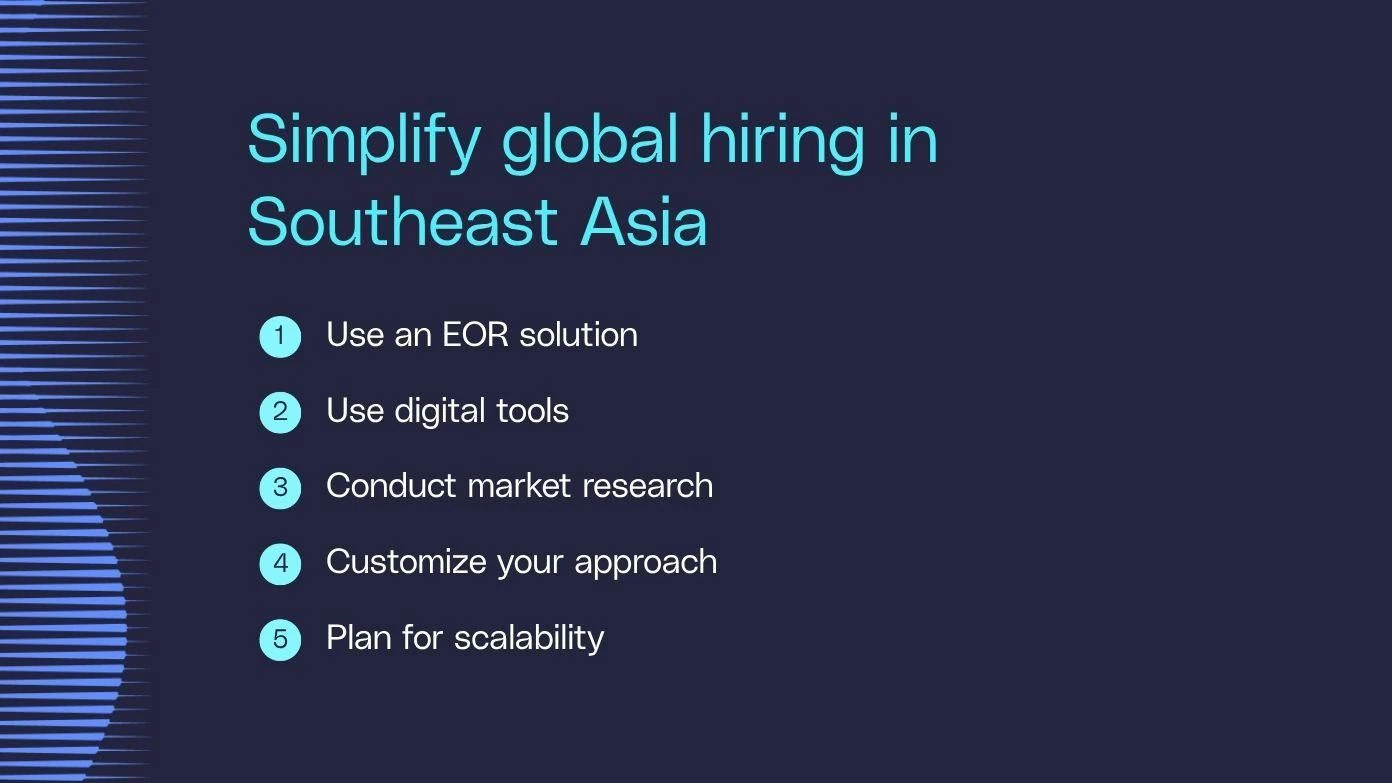
These tips will help you hire and grow your business in Southeast Asia:
- Use an EOR solution: Hire talent in target countries without setting up an entity by partnering with an employer of record (EOR). An EOR ensures full compliance with local labor laws and tax regulations.
- Use digital tools: Choose a user-friendly global employment platform to streamline hiring, payroll, benefits, and workforce management.
- Conduct market research: Assess business environments, talent pools, and regulatory landscapes with an AI-powered global HR agent like Gia.
- Customize your approach: Tailor contracts, benefits, HR policies, and engagement practices to local requirements and team expectations. Communication and decision-making styles can differ by company and context, so listen first and avoid assumptions. Build trust through respectful introductions, relationship-building, and reliable follow-up. Train managers, involve local HR early before rollout, provide compliant public-holiday entitlements in each location, and schedule thoughtfully around key religious and cultural observances.
- Plan for scalability: Start with one or two countries, and then expand over time.
Factors to consider before expanding into Southeast Asia
Consider these factors before expanding into the Asian global market:
- Workforce availability and skills: Choose a market with the skills you need to meet your goals. For example, the Philippines' IT-BPM sector is on track to employ 2.5 million people, indicating a strong supply of skills in these areas. An EOR with local presence enables accurate cost-benefit analyses to compare opportunities for your Asian business across ASEAN countries.
- Ease of doing business: Corporate tax rates, baseline employment benefits, and costs of doing business in Southeast Asia vary between countries.
- Market entry strategy: Setting up a local entity can be time-consuming, expensive, and risky. An EOR hires talent, streamlines payroll and benefits, and maintains compliance with local labor laws — no entity needed.
Build your global team with G-P™
G-P is the #1 EOR according to all industry analyst reports. G-P enables companies of all sizes to hire, onboard, and manage global teams in 180+ countries, regardless of entity status. G-P global employment products and EOR solutions combine AI-powered technology with the largest team of in-country HR, legal, and compliance experts to streamline the global employment lifecycle.
Contact us today to expand your business to Southeast Asia.
FAQs
How does Asia influence global business trends?
Asia drives the global economy through its manufacturing supply chains, tech innovation, and large consumer base. By expanding into the region, you position your business at the center of world trade and future market growth.
What are the main risks of doing business in Asia?
Working through quickly changing local labor laws and managing complex regulatory compliance present the biggest hurdles. You need to plan around supply chain disruptions and political or currency fluctuations across different jurisdictions.
How do business cultures differ across Asian countries?
Communication and decision-making range from consensus-driven and indirect in markets like Japan or Vietnam to direct and fast-paced in hubs like Singapore. Building trust requires you to adapt your leadership style, respect local workplace norms, and prioritize long-term relationship-building.
What defines the Southeast Asia economy today?
Southeast Asia is a dynamic two-speed growth engine powered by digital adoption, manufacturing exports, and expanding middle-class demand. It offers a balance between high-growth emerging markets and stable, world-class financial hubs.
What are the best markets to enter in Southeast Asia?
Singapore, Vietnam, Malaysia, Indonesia, the Philippines, and Thailand lead the region. Choose high-growth economies like Vietnam for scaling production or mature hubs like Singapore for regional operations and IP protection.