



Wichtigste Erkenntnisse
- Einstellungsoptionen mit Compliance-Abwägungen: Globale Arbeitgeber können mit einem Employer of Record (EOR)), einer direkten Registrierung ohne Unternehmen, der Gründung einer lokalen Tochtergesellschaft oder der Zusammenarbeit mit unabhängigen Auftragnehmern nach Polen einreisen. Die Wahl des richtigen Modells ist wichtig. Unsachgemäße Einrichtungen können von der polnischen Staatlichen Arbeitsinspektion (PIP) angefochten werden, was zu Rückzahlungen und gesetzlichen Geldstrafen führt.
- Starkes Wirtschafts- und Talentzentrum: Polen hat eine wachsende Wirtschaft (3.4%. durchschnittliches jährliches Bruttoinlandprodukt Wachstum) unterstützt von einer hochqualifizierten, mehrsprachigen und auf MINT ausgerichteten Belegschaft. Es ist ein Top-Ziel für IT, Business Services (BPO/SSC) und fortgeschrittene Fertigung.
- Strenge Einhaltung und Beschäftigungsstandards: Das polnische Arbeitsrecht verlangt schriftliche Verträge (auf Polnisch oder zweisprachig) vor dem ersten Tag, die Registrierung der ZUS-Sozialversicherung innerhalb von sieben Tagen sowie eine verpflichtende medizinische und sicherheitsbedingte (BHP) Vorabgenehmigung. Die regulären Arbeitswochen sind auf 40 Stunden begrenzt, mit verpflichtenden Ruhezeiten, einem monatlichen Mindestlohn von PLN 4,806und 20–26 Tagen bezahlter Urlaub.
Polen ist eine der am schnellsten wachsenden Volkswirtschaften in der EU. Die Wirtschaft des Landes hat sich stetig weiterentwickelt, mit einer durchschnittlichen jährlichen Wachstumsrate des Bruttoinlandsprodukts von 3.4% im letzten Jahrzehnt.
Polen ist ein attraktives Ziel für ausländische Direktinvestitionen (FDI) aufgrund großer geplanter Investitionen aus EU-Wiederaufbaufonds und dem Privatsektor, der sich auf fortschrittliche Fertigung, IT und Energietransformation konzentriert. Polens Talentpool ist hochqualifiziert, gut ausgebildet (insbesondere in MINT-Fächern) und mehrsprachig, was ein großer Anziehungspunkt für globale Unternehmen ist, die in Polen Einstellung anstreben.
Bevor Sie nach Polen expandieren, müssen Sie Verträge, Steuern, Löhne, Leistungen und andere Arbeitsgesetze verstehen. Unser Leitfaden erklärt Ihnen alles, was Sie über die Einstellung von Mitarbeitern in Polen wissen müssen.
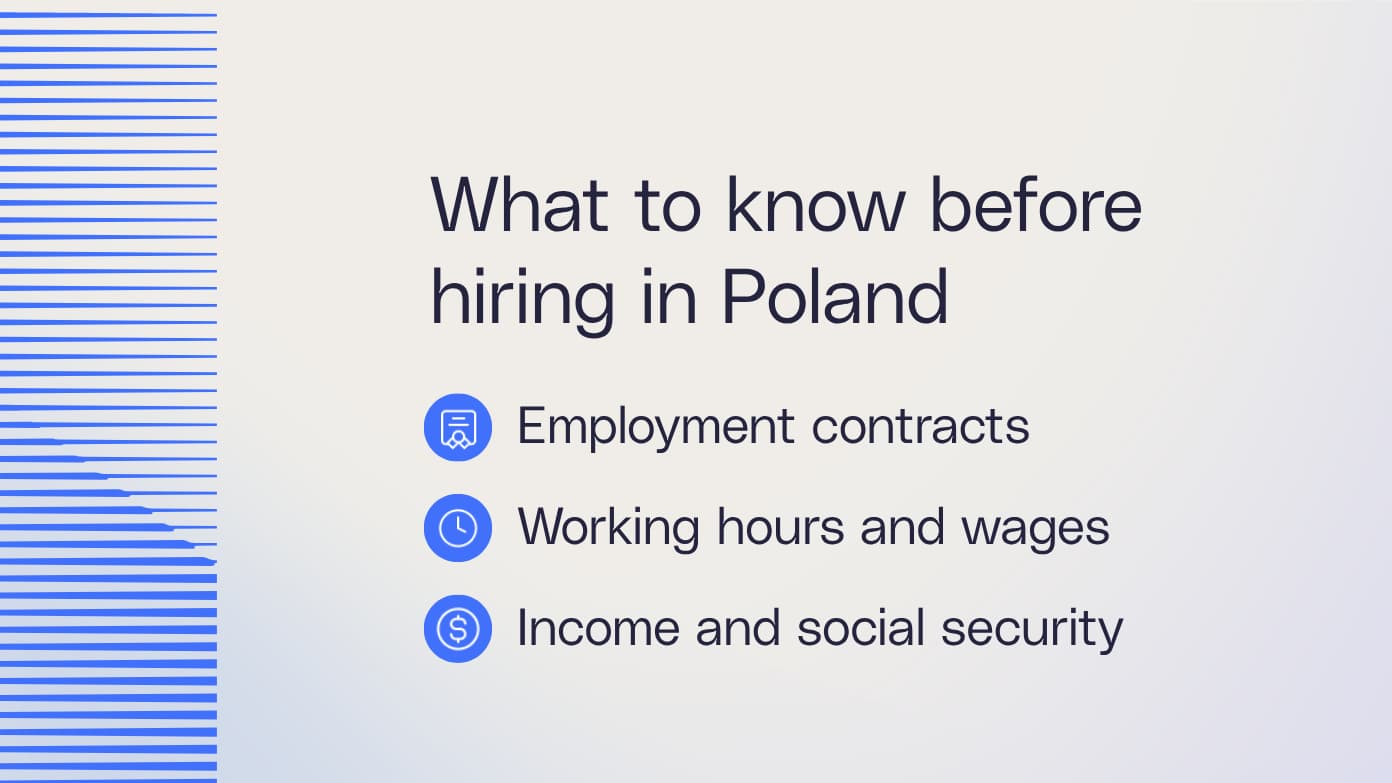
Was man vorher wissen sollte Einstellung in Polen
Wenn Sie Ihr Unternehmen zum ersten Mal nach Polen ausweiten, gibt es wichtige rechtliche Anforderungen, die Sie beachten sollten. Diese Normen und Gesetze beeinflussen die Einstellungspraktiken in Polen und viele Aspekte der Arbeitgeber-Mitarbeiter-Beziehung, einschließlich Abfindung und Sozialleistungen.
G-P Gia™, unser von Künstliche Intelligenz unterstützter globaler Personaldienstleister, kann Ihre schwierigsten Compliance-Fragen in 50 Ländern – einschließlich Polen – und allen 50 US-Bundesstaaten beantworten. Reduzieren Sie Ihre Abhängigkeit von externen Anwälten und reduzieren Sie die Zeit und Kosten für die Einhaltung von Gia um bis zu 95%.
Hier sind fünf Dinge, die Sie über die Personalbeschaffung in Polen wissen sollten.
1. Sprachen in Polen
Polnisch ist die Amtssprache. Englisch ist die am häufigsten verwendete nicht-polnische Sprache. Das Land rangiert weltweit unter den besten 1520 Englischkenntnissen.
Die großen Sektoren Business Process Outsourcing (BPO) und Shared Services Center (SSC) in Polen werden von einem großen Pool qualifizierter, mehrsprachiger Talente angetrieben.
2. Arbeitsverträge in Polen
Arbeitgeber müssen vor Arbeitsbeginn einen schriftlichen Arbeitsvertrag oder eine schriftliche Bestätigung der Hauptbedingungen vorlegen.
Der Vertrag muss auf Polnisch sein oder von einer polnischen Übersetzung begleitet werden. Bei mehrsprachigen Verträgen ist die polnische Version rechtlich bindend.
Der Vertrag muss mindestens Folgendes enthalten:
- Art des Arbeitsvertrags (Probearbeitsvertrag, befristet, unbefristet)
- Namen und Adressen von Arbeitgeber und Mitarbeitern
- Vertragsdauer (befristet oder Probezeit)
- Datum der Unterzeichnung und Beginn der Arbeiten
- Stellenbezeichnung und Beschreibung
- Arbeitsort(e)
- Aufschlüsselung der Vergütung und Zusatzleistungen
- Arbeitszeit (Vollzeit/Teilzeit)
Sofern dies nicht im Vertrag enthalten ist, müssen Arbeitgeber innerhalb von sieben Tagen nach Arbeitsbeginn des Mitarbeiters schriftlich Folgendes mitteilen:
- Täglicher und wöchentlicher Arbeitsplan
- Zahlungszeiträume und Zahlungsmethode
- Anspruch auf Urlaub
- Kündigungsfrist für die Kündigung
- Regeln für Überstunden, Ruhezeiten und Pausen
- Alle anwendbaren Tarifverträge
Diese Details müssen mit dem Mitarbeiter spätestens an seinem ersten Arbeitstag besprochen werden.
3. Arbeitszeiten und Löhne in Polen
Die Arbeitswoche in Polen beträgt 40 Stunden, verteilt auf fünf Tage. Überstunden sind auf 150 Stunden pro Jahr begrenzt, es sei denn, es wird eine höhere Grenze in einem Tarifvertrag, Arbeitsvorschriften oder einem Einzelvertrag festgelegt. Unabhängig von einer Vereinbarung dürfen die durchschnittlichen wöchentlichen Arbeitsstunden (einschließlich Überstunden) nicht mehr als 48 Stunden betragen. Mitarbeiter bekommen mindestens 11 aufeinanderfolgende Ruhestunden pro 24-Stunden-Periode und mindestens 35 aufeinanderfolgende Ruhestunden pro Woche.
Stand 2025beträgt der Mindestlohn in Polen PLN 4806 pro Monat.
4. Bezahlte arbeitsfreie Zeiten in Polen
Polen hat 14 nationale Feiertage. Die Mitarbeiter bekommen diese bezahlten Tage frei.
Die Berechnung der Dienstjahre umfasst alle vorherigen Beschäftigungen (unabhängig von Pausen oder Arbeitgeber) und die anerkannten Ausbildungsperioden (z. B. bis zu acht Jahre für die höhere Ausbildung). Mitarbeiter mit weniger als 10 Jahren anerkannter Dienstzeit (einschließlich Beschäftigung und bestimmter Ausbildungszeiten) erhalten 20 bezahlten Jahresurlaub. Mitarbeiter mit 10 oder mehr Jahren anerkannter Dienstzeit erhalten 26 Tage.
Arbeitgeber müssen mindestens 80% der Mitarbeitervergütung für den Genesungsurlaub zahlen. Die Höhe der vom Arbeitgeber finanzierten Krankheitstage hängt vom Alter des Mitarbeiters ab:
- Für Mitarbeiter unter 50 zahlt der Arbeitgeber bis zu 33 Tage Genesungsurlaub pro Kalenderjahr.
- Für Arbeitnehmer ab einem Alter von 50 Jahren zahlt der Arbeitgeber bis zu 14 Tage.
- Nach diesen Zeiträumen (33 oder 14 Tage, je nach Alter) übernimmt die Sozialversicherung (ZUS) das Krankheitsgeld.
5. Einkommensteuer und Sozialversicherung in Polen
Arbeitgeber müssen ihre Mitarbeiter innerhalb von sieben Kalendertagen nach Arbeitsbeginn bei ZUS registrieren. Social Sicherungsbeiträge umfassen Renten-, Invaliditäts-, Unfall- und Krankenversicherung, mit spezifischen Beiträgen für jede Art. Der Beitragssatz der Krankenversicherung beträgt 9% der Vergütung. Arbeitgeber müssen die Sozialversicherungsbeiträge bis zum 15 oder 20 des folgenden Monats an ZUS weiterleiten, abhängig von ihrem rechtlichen Status.
Polen verwendet ein fortschrittliches Einkommensteuersystem. In 2025liegen die Sätze bei 12% des Jahreseinkommens bis PLN 120,000und 32% auf Einkommen über dieser Schwelle. Arbeitgeber sind verantwortlich für die Berechnung, Einbehaltung und Abführung der Einkommensteuer (PIT).
Arbeitgeber müssen monatlich sowohl die Mitarbeiter- als auch die Arbeitgeber -Sozialversicherungsbeiträge abziehen und an die ZUS weiterleiten. Social umfasst Renten-, Invaliditäts-, Unfall- und Krankenversicherung sowie die Krankenversicherung.
- Rentenversicherung: gleichmäßig aufgeteilt (9.76%)
- Invaliditätsversicherung: 6.5% wird vom Arbeitgeber bezahlt, 1.5% vom Mitarbeiter
- Unfallversicherung: Vom Arbeitgeber bezahlt, typischerweise 1.67% bei kleinen Arbeitgebern, aber die Quote variiert je nach Risiko
- Krankenversicherung: bezahlt vom Mitarbeiter (245%)
- Krankenversicherung: bezahlt vom Mitarbeiter (9%)
Insgesamt liegen die Arbeitgeberbeiträge (einschließlich aller Mittel) bei etwa 18–20% und die Mitarbeiterbeiträge bei 13–14%.
Arbeitgeber müssen 2beitragen.45% des Bruttolohns der Arbeitnehmer in den Arbeitsfonds (100% in den Arbeitsfonds und 145% in den Solidaritätsfonds). Arbeitgeber tragen auch 0bei.1% in den garantierten Leistungsfonds der Mitarbeiter.
Die Finanzierung der Gesundheitsversorgung erfolgt durch Pflichtbeiträge der Krankenversicherung. Sie müssen keine private Krankenversicherung abschließen, eine Zusatzkrankenversicherung ist jedoch eine beliebte Leistung.
Einstellungsmodelle für globale Unternehmen, die suchen möchten Einstellung in Polen
Das beste Modell für die Einstellung von Mitarbeitern in Polen hängt von Ihren allgemeinen Geschäftszielen ab.
| Modell | Am besten geeignet für | Wichtigste Punkte | Hauptrisiken |
|---|---|---|---|
| Direkte Arbeitgeberregistrierung | Einstellung von Mitarbeitern in Polen ohne lokale Einrichtung, wo möglich. | Führe die polnische Gehaltsabrechnung durch, halte PIT zurück, zahle ZUS, registriere Mitarbeiter innerhalb 7 Tage, führe Aufzeichnungen. | Lohnfehler, verspätete ZUS-Registrierung, Steuergefährdung, Nichteinhaltung von Arbeitsgesetzbuchs, Durchsetzung von PIP/ZUS. |
| Employer of Record | Schneller Markteintritt. | Der Employer of Record kümmert sich um Verträge, Gehaltsabrechnung, ZUS, Steuereinbehaltung und die Einhaltung des Arbeitsgesetzbuchs. | Es besteht die Gefahr illegaler Arbeitnehmerüberlassung, wenn der Auftraggeber die Arbeitnehmer wie den eigentlichen Arbeitgeber behandelt oder die Vereinbarung keine rechtmäßige Struktur aufweist. |
| Tochtergesellschaft oder Zweigstelle | Langfristige Operationen. | Zuständig für Einstellungen, Lohnabrechnung, ZUS-Registrierung sowie Arbeitsgesetzbuch, Steuern, Buchhaltung und Unternehmenscompliance. | Höhere Aufbaubelastung, unternehmensrechtliche Compliance, Steuerrisiko, Mutterhaftung und Versäumnisse der lokalen Governance. |
| Selbstständige Auftragnehmer | Projektbasierte Arbeit mit Autonomie. | Erhalte die Unabhängigkeit der Auftragnehmer. Vermeiden Sie Arbeitsstil-Kontrolle, feste Zeitpläne und Integration. | Die Umklassifizierung nach Artikel 22 Arbeitsgesetzbuch birgt das Risiko einer Durchsetzung von PIP/ZUS, rückwirkender ZUS/Steuern, Ansprüchen und Geldstrafen. |
Die wichtigsten Rekrutierungszentren in Polen
Einige Städte in Polen sind für bestimmte Industrien bekannt. Wenn Sie wissen, was jede Stadt zu bieten hat, können Sie Ihre Anstrengungen bei der Einstellung von Mitarbeitern in Polen fokussieren und Positionen schneller besetzen.
Die wichtigsten Talentzentren in Polen sind:
- Warschau ist die Hauptstadt und größte Stadt Polens. Warschau ist das führende Wirtschafts-, Finanz- und Technologiezentrum des Landes. Hier sind multinationale Konzerne, Finanzinstitute und Technologieunternehmen ansässig.
- Krakau ist bekannt für seine IT-Branche, seine Geschäftsdienstleistungen (BPO/SSC) und seine Startup-Szene. Krakau ist ein wichtiges Ziel, wenn sich globale Unternehmen für eine Niederlassung in Polen entscheiden, insbesondere in den Bereichen Technologie, Finanzen und Shared Services.
- Breslau ist ein Zentrum für IT, Forschung und Entwicklung, Fertigung und Unternehmensdienstleistungen mit einer starken Präsenz globaler Technologieunternehmen und Ingenieurfirmen.
- Poznań ist bekannt für seine Fertigungs-, Logistik- und Geschäftsdienstleistungssektoren und ist ein beliebter Standort für globale Arbeitgeber.
- Danzig verfügt über einen Pool an qualifizierten Fachkräften in den Bereichen IT, Schifffahrt, Logistik und Finanzen. Die Stadt verzeichnet eine wachsende Zahl von Technologie-Startups und globalen Geschäftszentren.
Schlüsselindustrien in Polen
Das Verständnis der wichtigsten polnischen Branchen ermöglicht es dir, Gehälter und Vorteile bei der Einstellung in Polen zu vergleichen. Sie können diese Erkenntnisse nutzen, um kluge Entscheidungen darüber zu treffen, wo Sie investieren und Ihre Belegschaft vergrößern.
Zu den wichtigsten Wirtschaftszweigen in Polen gehören:
- Business Process Outsourcing (BPO) und Shared Services (SSC): Dies ist einer der am schnellsten wachsenden und modernsten Sektoren Polens. Globale Unternehmen stützen ihre Shared Service Center für Finanzen, Buchhaltung, Personalwesen und Forschung & Entwicklung in Städten wie Krakau, Warschau und Breslau aufgrund der hochqualifizierten, mehrsprachigen und gebildeten Belegschaft.
- IT und digitale Dienstleistungen: Polen ist ein bedeutendes Zentrum für IT-Talente mit einem großen Pool an Softwareentwicklern, Ingenieuren und IT-Spezialisten. Globale Unternehmen errichten hier zunehmend Forschungs- und Entwicklungszentren sowie Zentren für digitale Technologien. Die Regierung investiert auch stark in digitale Technologien und Künstliche Intelligenz.
- Automobil: Dies ist einer der größten Industriesektoren Polens. Der Schwerpunkt liegt auf der Herstellung von Teilen und Komponenten (für globale Hersteller) sowie leichte Nutzfahrzeuge. Polen verfügt außerdem über die größte Batteriefabrik für Elektrofahrzeuge Europas.
- Elektronik und Haushaltsgeräte: Polen ist ein führender europäischer Hersteller von Elektronik und Haushaltsgeräten. Große globale Unternehmen unterhalten dort Produktions- und Forschungszentren.
- Fortschrittliche Fertigung: Dazu gehören Bereiche wie die Luft- und Raumfahrt sowie die Verteidigungsindustrie, insbesondere in Clustern wie Aviation Valley im Südosten.
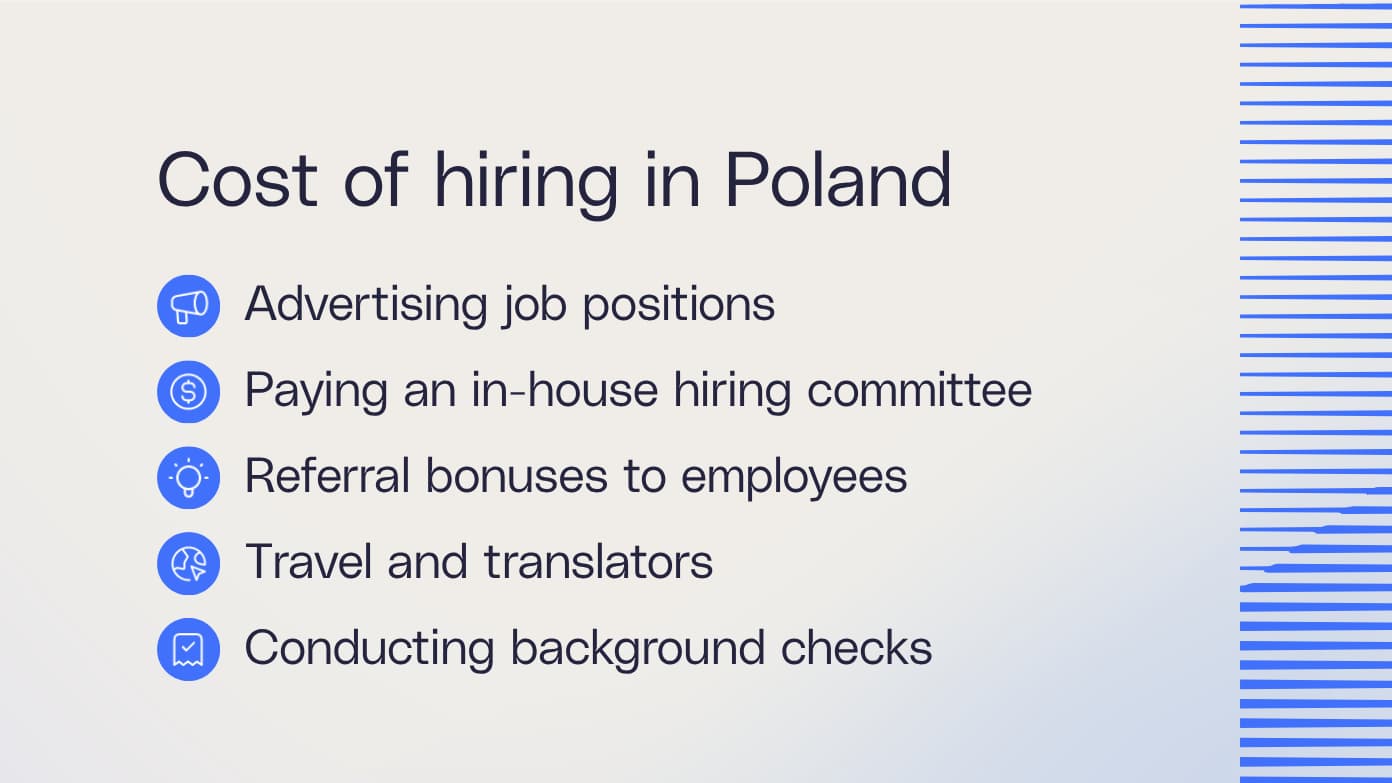
Kosten von Einstellung von Mitarbeitern in Polen
Egal, ob Sie ein Teammitglied einstellen oder eine ganze Abteilung erweitern, die Kosten sind unvermeidlich, wenn Sie Mitarbeiter in Polen beauftragen. Budget für Folgendes:
- Einrichtung der Gesellschaft (es sei denn, Sie arbeiten mit einem offiziellen Arbeitgeber zusammen)
- Stellenausschreibungen
- Arbeitskosten für die Überprüfung von Bewerbern
- Lohnabrechnung
- Steuern
- Vergütungen
- Vorteile
- Boni
- Zulagen
- Versicherung
- Reisen
- Übersetzer (falls zutreffend)
Laut G-P verifizierten Quellen aus Gialiegt die Arbeitgeberbelastung in Polen, die zusätzlich zu den Gehältern verursachte Kosten einschließt, bei etwa 2021%.
Was braucht ein Unternehmen zur Einstellung von Mitarbeitern in Polen?
Bevor Sie Ihr Team in Polen erweitern, sollten Sie diese wichtigen Punkte unbedingt beachten:
- Registrieren Sie das Unternehmen, meist KRS für Unternehmen oder CEIDG für Einzelunternehmer.
- Bestätigen Sie die REGON- und NIP-Nummern.
- Registrieren Sie sich als ZUS-Beitragszahler.
- Eröffnen Sie ein polnisches Bankkonto zur Zahlung von Lohnabrechnung, Steuern und ZUS.
- Registrieren Sie jeden Mitarbeiter innerhalb von sieben Tagen nach Beginn bei ZUS.
- Legen Sie vor Arbeitsbeginn einen schriftlichen Arbeitsvertrag vor.
- Erfüllen Sie die erforderlichen BHP-Verpflichtungen, einschließlich der ersten Sicherheitsschulungen, bevor die Arbeit beginnt.
- Richten Sie Compliance-Gehaltsabrechnung, PIT-Einbehaltung, ZUS-Beiträge und Mitarbeiteraufzeichnungen ein.
- Lassen Sie sich für die Mehrwertsteuer registrieren.
Die Gründung einer polnischen Tochtergesellschaft kann Wochen oder Monate dauern. Nutzen SieG-P Employer of Record, um Mitarbeiter in Polen zu Einstellung, ohne eine eigene Gesellschaft zu gründen. Baue dein TEAM in Polen zu geringeren Kosten und mit der Gewissheit auf, dass du das konform machst.
Schritte zur Personalbeschaffung in Polen
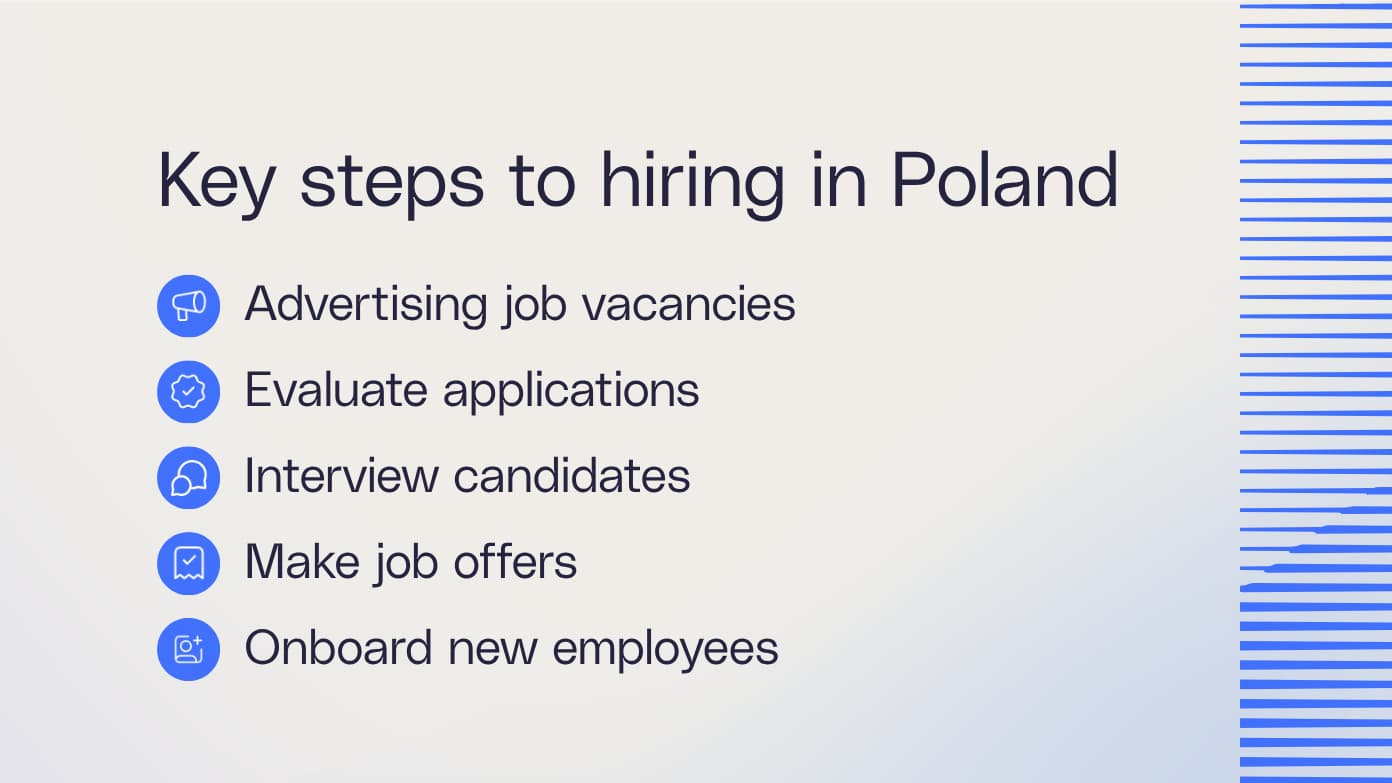
Der Einstellungsprozess in Polen ähnelt dem, den du wahrscheinlich in deinem eigenen Land kennst. Der Einstellungsprozess folgt fünf grundlegenden Schritten: Ausschreibung der Stelle, Bewertung von Bewerbungen, Vorstellungsgespräche mit Kandidaten, Versenden von Jobangeboten und Einarbeitung neuer Mitarbeiter.
1. Stellenanzeigen in Polen schalten
Erstellen Sie eine detaillierte Stellenbeschreibung und definieren Sie die Rolle anhand von Verantwortlichkeiten und Qualifikationen. Stellen Sie sicher, dass die Stellenbeschreibung den polnischen Antidiskriminierungs- und Arbeitsgesetzen entspricht.
Pracuj, Praca, OLX Praca, LinkedIn und GoldenLine sind beliebte Jobbörsen in Polen.
2. Bewerten Sie die Bewerbungen Ihrer polnischen Kandidaten
Bewerbungen sammeln und Lebensläufe prüfen. Die Kandidaten werden anhand ihrer Qualifikationen, ihrer Erfahrung und ihrer Eignung für die Stelle ausgewählt. Für die Durchführung von Hintergrundüberprüfungen, die Kontaktaufnahme mit früheren Arbeitgebern oder die Überprüfung der Social-Media-Profile einer Fachkraft ist deren ausdrückliche Einwilligung erforderlich.
3. Bewerber in Polen interviewen
Interviewe Kandidaten, die es auf deine Shortlist geschafft haben. Sie können diese Vorstellungsgespräche entweder persönlich oder virtuell führen. Verwenden Sie strukturierte, nicht diskriminierende Interviewfragen. Gia kann Ihnen helfen, Fragen zu erstellen, die den Antidiskriminierungsgesetzen in Polen entsprechen, damit Sie die beste Passung für die Rolle finden und dabei die lokalen Vorschriften einhalten.
4. Stellenangebote in Polen erstellen
Nehmen Sie Kontakt mit dem von Ihnen ausgewählten Bewerber auf, um ihm eine Stelle in Ihrem Unternehmen anzubieten. Bereiten Sie einen Compliance-Arbeitsvertrag auf Polnisch vor. Geben Sie alle gesetzlich vorgeschriebenen Angaben an, wie z. B. Berufsbezeichnung, Vergütung, Arbeitszeiten, Eintrittsdatum usw. Beide Parteien müssen den Vertrag unterzeichnen, bevor der Mitarbeiter seine Arbeit aufnimmt.
5. Neue Mitarbeiter in Polen einarbeiten
Jetzt können Sie neue Mitarbeiter einstellen. Registrieren Sie Ihren möglicher neuer Mitarbeiter innerhalb von sieben Tagen nach Arbeitsbeginn bei ZUS. Organisieren Sie eine verpflichtende Schulung zum Arbeitsschutz (BHP) und vereinbaren Sie eine medizinische Untersuchung vor der Beschäftigung. Sammeln und überprüfen Sie notwendige Dokumente wie Ausweis, Diplome und Arbeitserlaubnisse.
Wenn Sie mit einem Employer of Record wie G-P™ zusammenarbeiten, müssen Sie sich keine Sorgen um die administrative Belastung der Einarbeitung machen. Wir optimieren den Prozess, sodass Sie sich darauf konzentrieren können, Ihre möglicher neuer Mitarbeiter zu schulen und sie in die Unternehmenskultur zu integrieren.
Auftragnehmer in Polen einstellen
Die Zusammenarbeit mit unabhängigen Auftragnehmern in Polen kann eine kostengünstige Möglichkeit sein, den Markt zu testen und eine Präsenz aufzubauen, ohne die Verpflichtung von Vollzeitbeschäftigten. In Polen ansässige Auftragnehmer kennen das lokale Konsumverhalten, die Regeln und die Geschäftspraktiken. Sie werden mit ihrer eigenen Ausrüstung und ihren etablierten Arbeitsprozessen schnell einsatzbereit sein.
Durch die Einstellung von Auftragnehmern können Sie Ihre Belegschaft ganz einfach an Ihre Geschäftsanforderungen anpassen, ohne die Komplexität und die Kosten einer Anstellung.
Bevor Sie einen Vertrag mit einem unabhängigen Auftragnehmer in Polen abschließen, sollten Sie Folgendes beachten:
1. Angestellte vs. freie Mitarbeiter in Polen
Es ist wichtig, den Unterschied zwischen Mitarbeitern und unabhängigen Auftragnehmern zu verstehen. In Polen wird ein Auftragnehmer rechtlich als Mitarbeiter umklassifiziert, wenn er folgende Arbeit verrichtet:
- Unter direkter Aufsicht oder Leitung des Unternehmens
- Zu einem bestimmten Zeitpunkt und Ort, der vom Unternehmen festgelegt wird
- Im Austausch für regelmäßige Vergütung
Selbstständige Auftragnehmer bieten Dienstleistungen an. Im Gegensatz zu Mitarbeitern legen Auftragnehmer ihre Zeitpläne fest, verwenden ihre eigene Ausrüstung und arbeiten an bestimmten Projekten, anstatt eine durchgehende Rolle zu haben.
2. Strafen für falsche Klassifizierung in Polen
Jemanden als Auftragnehmer einzustufen, obwohl er es nicht ist, kann zu schweren Strafen führen. Wenn eine falsche Klassifizierung vorkommt, müssen Sie:
- Zahlen Sie alle ausstehenden Sozialversicherungsbeiträge zuzüglich gesetzlicher Zinsen.
- Für nicht gezahlte rückständige Einkommenssteuern haftbar sein.
- Stellen Sie dem Arbeitnehmer rückwirkend angesammelte Mitarbeiterleistungen (z. B. bezahlter Urlaub, Überstundenvergütung) bereit.
- Zahlen Sie Verwaltungsstrafen von PLN 1000bis30000 pro Vergehen.
3. Wie man Auftragnehmer in Polen bezahlt
G-P Contractor nimmt den komplizierten, zeitaufwändigen Prozess der Einstellung und Bezahlung international Auftragnehmer weg. Sie können Verträge erstellen und ausstellen sowie Auftragnehmer mit nur wenigen Klicks bezahlen – und dabei einen Compliance-Prozess sicherstellen.
Stellen Sie mit G-PMitarbeiter und Auftragnehmer in Polen ein.
Unsere Software-as-a-Service- und KI-gestützten Produkte – Employer of Record, Contractor und Gia – unterstützen Unternehmen beim Aufbau und der Verwaltung globaler Teams.
G-P ist der anerkannte führende Anbieter im globalen Bereich der Beschäftigung mit mehr als einem Jahrzehnt Erfahrung, dem größten TEAM aus HR-, Rechts- und Compliance-Experten sowie einer globalen, proprietären Wissensbasis.
Mach die Einstellung in Polen mit G-P einfacher. Kontaktieren Sie uns oder buchen Sie noch heute eine Demo .
FAQ – Häufig gestellte Fragen
Welche rechtlichen Voraussetzungen gelten für die Einstellung von Mitarbeitern in Polen?
Sie müssen Ihr Unternehmen anmelden, eine Steueridentifikationsnummer (NIP) beantragen, sich bei der ZUS registrieren und Compliance-Arbeitsverträge in polnischer Sprache erstellen. Jeder neue Mitarbeiter muss innerhalb von sieben Tagen nach Arbeitsbeginn bei ZUS registriert werden.
Was sollte ein Arbeitsvertrag in Polen beinhalten?
Der Vertrag muss die Vertragsart, die Angaben zu den Vertragsparteien, die Berufsbezeichnung, den Arbeitsort, die Vergütung, die Arbeitszeiten, den Vertragsbeginn und weitere Vertragsbedingungen enthalten. Zusätzliche Beschäftigungsbedingungen müssen, sofern sie nicht bereits im Vertrag enthalten sind, innerhalb von sieben Tagen schriftlich mitgeteilt werden.
Wie lange ist die übliche Probezeit in Polen?
Die Probezeit kann bis zu drei Monate betragen. Je nach Art und Dauer des Folgevertrags können spezifische Regeln gelten.
Welche Regelungen gelten für die regulären Arbeitszeiten und Überstunden in Polen?
Die reguläre Arbeitswoche beträgt 40 Stunden (acht Stunden pro Tag, fünf Tage pro Woche). Überstunden sind auf 150 Stunden pro Jahr begrenzt, es sei denn, in einem Tarifvertrag ist eine höhere Grenze festgelegt. Die durchschnittliche wöchentliche Arbeitszeit (einschließlich Überstunden) darf 48 Stunden nicht überschreiten.
Was sind die Hauptbeiträge der Arbeitgeber-Sozialversicherung in Polen?
Sie müssen Beiträge zur Renten-, Invaliditäts-, Unfallversicherung, zum Arbeitsfonds, zum Solidaritätsfonds und zum Fonds für garantierte Leistungen für Arbeitnehmer leisten. Die Gesamtbelastung des Arbeitgebers beträgt etwa 20–21% der Vergütung.