







Key takeaways:
-
The compliance reality: The EU AI act and pay transparency laws add a new layer of complexity to global expansion in 2026. Outsourcing minimizes the risk of costly internal mistakes so you can grow with confidence.
-
Strategic reallocation of resources: When you offload the heavy lifting of global payroll, you can move away from time-consuming admin work and start focusing on workforce management.
-
Cost efficiency vs. infrastructure: Instead of a big upfront investment to set up your own local entity, choosing a scalable model means you only pay for expertise when you need it.
-
EOR vs. traditional outsourcing: While traditional outsourcing handles specific tasks, an employer of record (EOR) manages the entire employment lifecycle.
The administrative burden of HR is a weight every team carries. As highlighted in the 2026 Global Workforce Trends, 35% of HR leaders believe they’re spending too much time on admin work. Too much paperwork stops you from focusing on high-impact strategies like talent development and employee experience.
This blog explores how international HR outsourcing can relieve this pressure and free up your HR team’s daily workflows.
Think of international HR outsourcing as handing over the technical parts of global expansion — like payroll, taxes, compliance, and benefits — to a third-party partner.
When you choose to outsource, you can:
-
Lighten your workload: You reduce administrative burden and operational risk.
-
Keep your compliance on track: Lean on experts to stay up to date with shifting global rules so you don’t have to worry about missing a deadline or a new law.
-
Grow as fast as you want: You can enter new markets and scale your workforce without waiting months for local setups.
-
Focus on your real goals: You get the space to work on strategic projects that drive your business forward.
Let's say an expanding tech company outsources payroll and compliance for new hires across multiple countries. Instead of being tied up with administrative tasks, your VP of HR can dedicate more time to launching a global leadership development program and building strategies for employee growth. So if someone unexpectedly quits, rather than scrambling to fill that vacancy, your team already has a game plan for who will step into the position.
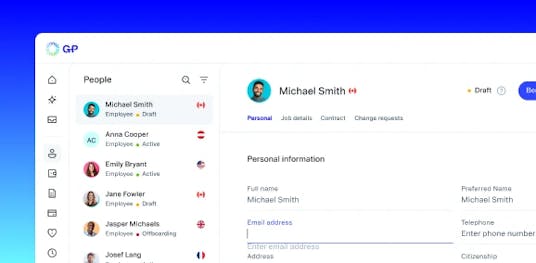
G-P pro tip: Use the G-P EOR to manage onboarding, payroll, and compliance for your entire global workforce. Gain real-time visibility and control, no matter where your teams are located.
Key aspects of international HR outsourcing
When it comes to outsourcing HR, payroll is usually the first thing you'll want to offload. Navigating local laws, social security, and tax withholdings across different countries is complicated.
It's important to distinguish the legal boundaries when outsourcing. When you outsource, you remain the legal employer. You’re responsible for your people and have the final say in your business decisions. Your partner manages the specific HR tasks you’ve assigned to them.
Choosing the right path for you
To decide which human resources outsourcing services or HR outsourcing solutions fit your business, look at your footprint, bandwidth, and risk tolerance:
-
Your global footprint: How many countries are you currently operating in?
-
Your team's bandwidth: Is your HR focus better spent on high-level strategy rather than day-to-day administration?
-
Your comfort with risk: How much local compliance do you feel confident managing on your own?
G-P combines advanced technology with in-country HR and payroll experts to make sure you stay compliant with local laws and payroll requirements. You can confidently expand and operate in new markets without added complexity.
3 benefits of HR outsourcing
Partnering with global HR specialists gives you a level of agility that’s hard to build in-house across multiple time zones and legal systems.
Benefit 1: Scale your budget, not your overhead
Building your own global HR infrastructure is a big capital investment. You need a local legal counsel and tax experts in every single jurisdiction. Outsourcing these functions is more cost-effective because you aren't funding a big internal department that has to play catch-up with every new country you enter. Instead, you pay for the expertise you need, when you need it.
Benefit 2: Protect your business with global expertise
When you tap into specialized knowledge for your global payroll, compliance, and benefits, you shield your business from costly mistakes. You no longer have to worry about your internal teams trying to guess their way through challenging international employment laws.
Benefit 3: Get back to your core mission
The biggest benefit is the gift of focus. By delegating HR administration, you can channel your energy toward strategic goals rather than day-to-day management. This gives you the space to:
-
Enter new markets: You can map out your next hub.
-
Keep your best people: You have more time to build company culture and retention strategies.
-
Grow your business: You can focus on product development and market share instead of back-office maintenance.
G-P pro tip: Use G-P EOR to scale your workforce globally with speed and confidence. Our EOR offering gives you real-time insights and compliance support so your HR team can focus on driving innovation and business growth.
3 challenges of global HR outsourcing
While international HR outsourcing has plenty of benefits, you’ll want to keep an eye on the following challenges:
Challenge 1: Navigating cultural nuances
Managing the human side of HR, like communication styles and regional expectations, is tricky. The challenge is maintaining company culture while respecting local practices.
For example, say a U.S.-based tech company opens an engineering hub in Germany. The U.S. office might expect teams to be all hands on deck in late December. But there’s a cultural expectation in many European countries to disconnect around the Christmas period. If the U.S. company ignores that nuance, it can lead to high turnover in the German office and difficulty hiring top local talent.
Challenge 2: New data processing and AI regulations
Employee information is a high-stakes priority. With the EU AI act and GDPR in full swing, your HR tools are under more scrutiny than ever. If your partner isn’t aligned with these digital regulations, you could be at risk of big fines.
Say you outsource your data processing to a provider that hasn't updated its systems for the new EU AI act. During a routine audit, regulators could find that sensitive employee data was processed without the proper consent mechanisms. These types of compliance issues can lead to fines as high as EUR 35M or 7% of your total global turnover.
Challenge 3: The misclassification trap
One of the most expensive mistakes you can make is misclassifying workers. The line between a contractor and an employee is a target for regulators in 2026. With frameworks like the EU platform work directive, the burden of proof is now on you to show that workers are classified correctly.
-
The risk: In Spain, misclassification can result in back payments of social security contributions for up to four years, surcharges, and fines ranging up to EUR 225K per worker. Other EU countries have similar penalties.
-
The reality: Executives in jurisdictions may face personal criminal liability for intentional misclassification.
Even with outsourcing, your company is responsible for compliance and risk management. While choosing the right outsourcing partner can help reduce these challenges, ongoing oversight and strategic alignment are important.
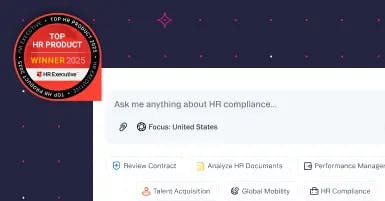
G-P pro tip: Use G-P Gia™ to get instant, expert guidance on local employment laws, data privacy regulations, and worker classification. This helps you avoid compliance mistakes and navigate cultural and legal complexities in every country you operate in.
Traditional outsourcing vs. employer of record (EOR)
Traditional outsourcing meant juggling multiple vendors, manual processes, and services across countries. Now, you can use an EOR with a global employment platform that simplifies everything for you.
With an EOR, you stay in charge of your team’s daily work, goals, and performance. Legally, the EOR acts as the official employer, taking care of the HR, payroll, and compliance details so you can be confident you're meeting local regulations.
In traditional outsourcing, you hand off a whole project to another company. They manage their own staff and decide how the work gets done, which gives you less control over who is doing the work or how they carry it out.
The main difference is the scope: an EOR covers the entire employment journey, from onboarding to offboarding. Traditional outsourcing only handles specific tasks. This makes the EOR model a great fit if you want to manage your global team directly without the compliance headaches.

Choosing between these two options depends on your end goal:
-
Do you need an in-house task completed by an outside party? Choose outsourcing.
-
Do you need a dedicated global team that feels like your own, without the administrative burden of entity setup? Choose EOR.
G-P pro tip: With G-P EOR, you can hire and manage employees in over 180 countries while offloading employment contract generation, payroll, benefits, and compliance. This lets you build a fully integrated global team without the need to set up local entities or worry about regulatory risks.
The new era of global agility
In 2026, growing your business internationally is about agility and trust. The right global partner can simplify the process. At G-P, we’re your partner in global employment. We make your expansion straightforward and stress-free.
Book a demo to learn how to build your global team today.