




Principaux enseignements
-
Structure fédérale, règles locales : Alors que les lois fédérales (comme la loi sur le travail et le Code des obligations) fixent des normes d'emploi de référence, les taux d'imposition spécifiques, les jours fériés et les processus administratifs varient selon les cantons 26 .
-
Règles strictes de permis de travail pour talent non-UE/AELE : Pour embaucher des employés en Suisse parmi les travailleurs non-UE/AELE, vous devez démontrer une priorité du marché du travail local, atteindre des quotas nationaux stricts et obtenir une approbation de permis à plusieurs niveaux.
-
Le taux de charge de l'employeur se situe entre 10% et20% : Au-delà des salaires de base, les employeurs doivent budget les cotisations obligatoires et habituelles lorsqu'ils embauchent en Suisse. Cela comprend la sécurité sociale (AHV/IV/EO), l'assurance chômage, les pensions professionnelles (BVG), l'assurance accident et le 133e mois de salaire.
-
Une mauvaise classification entraîne des pénalités rétroactives de cinq ans : laclassification erronée d'employés comme entrepreneurs lors de leur embauche en Suisse peut entraîner des sanctions financières, notamment cinq ans de paiements antidatés de la sécurité sociale de l'employeur et de l'employé, plus les intérêts.
La population de la Suisse, qui s'élève à 8.9 millions d'habitants, est composée de Suisses, d'Allemands, de Français, d'Italiens, de Portugais et de Kosovars. Chaque canton utilise la même monnaie nationale, le franc suisse. Les secteurs les plus importants sont la finance et la banque, les équipements médicaux et l'ingénierie.
Les lois favorables en matière d'impôts sur les sociétés et l'accessibilité culturelle sont deux des raisons pour lesquelles de nombreuses multinationales s'implantent en Suisse. Notre guide vous dira tout ce qu'il faut savoir sur la location en Suisse.
Que savoir avant d’embaucher en Suisse
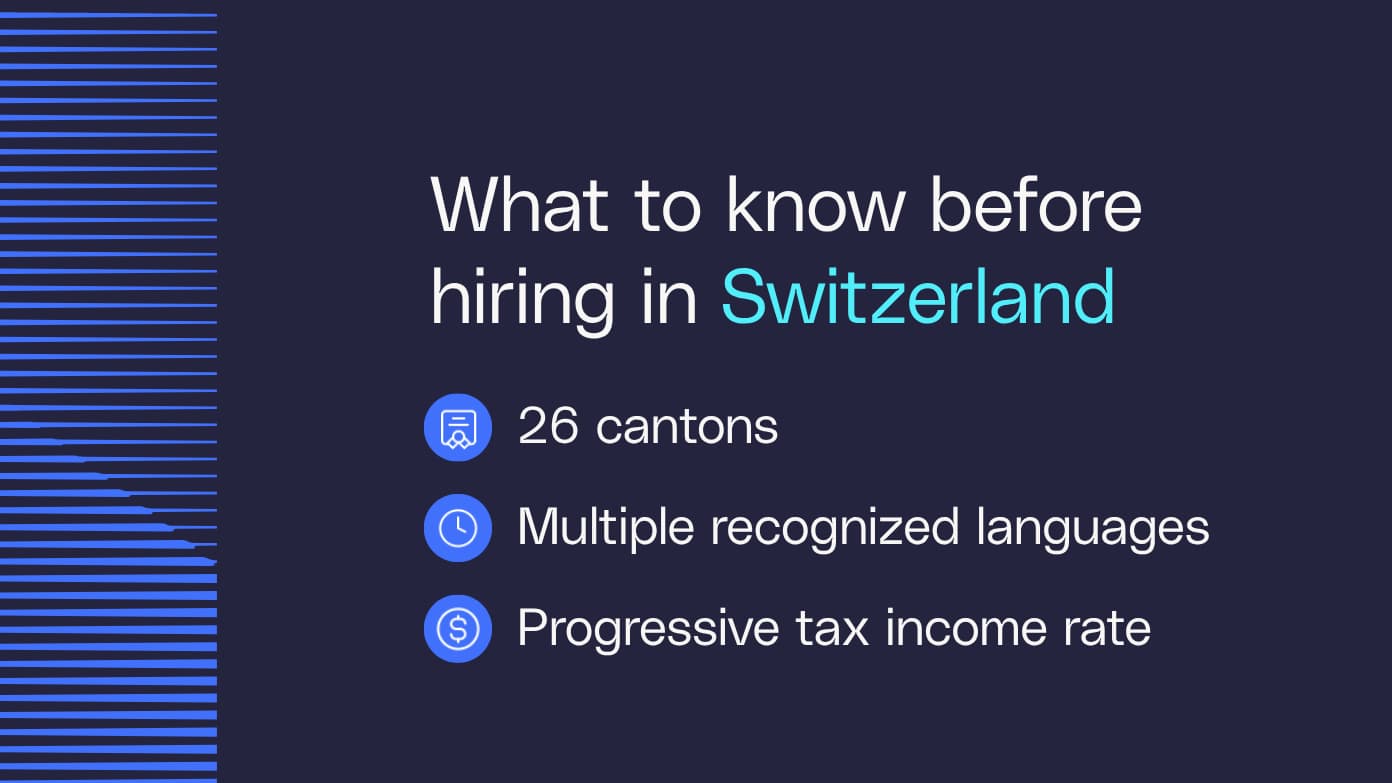
Si vous développez votre activité en Suisse pour la première fois, vous devez tenir compte de certaines dispositions légales importantes. Ces normes et ces lois influencent les pratiques d'embauche en Suisse.
Si vous ne savez pas par où commencer, G-P Gia™, notre agent mondial RESSOURCES HUMAINES alimenté par une intelligence artificielle, peut répondre à vos questions de conformité les plus difficiles dans 50 pays — y compris la Suisse — et dans tous les 50 États américains. Réduisez votre dépendance à un avocat externe et réduisez le temps et le coût de conformité jusqu’à 95% avec Gia.
Voici huit choses à savoir sur l'embauche en Suisse.
1. Statuts employeur-employé
Toutes les relations employeur-employé doivent respecter les statuts suivants :
-
SR 151.1 - La loi fédérale sur l'égalité entre femmes et hommes
-
SR 220 - Le code des obligations
-
SR 822.11 — La loi sur le travail
-
SR 822.14 — Loi sur la participation des travailleurs
-
SR 823.11 — Loi fédérale sur les services d'emploi et l'embauche de services
-
SR 823.20 — Loi sur les travailleurs détachés
La Suisse reconnaît les syndicats tant qu’ils respectent toutes les exigences légales.
2. Les cantons en Suisse
La Suisse est divisée en 26 cantons. Bien qu’elles relèvent toutes de l’autorité nationale suisse, ce sont des entités puissantes à part entière. Chaque canton possède des traditions et une culture uniques. Ils possèdent également leurs propres modes d'autonomie, notamment des lois, des constitutions et une structure gouvernementale.
Lors du recrutement d'employés en Suisse, tenez compte du canton dans lequel vous publiez votre offre d'emploi. Le canton de résidence des candidats vous donnera des indications sur les attentes en matière de traduction, les taux d'imposition à inclure dans vos contrats de travail et les congés auxquels ils ont droit.
Les communes - des organes gouvernementaux plus petits résidant dans chaque canton - déterminent comment embaucher en Suisse.
3. Le marché du travail en Suisse
Plus de 5 millions de personnes sont actives sur le marché du travail suisse. Le taux d'emploi est 80.6%. À titre de comparaison, le taux de l'UE est 75.8%. Les travailleurs sont hautement qualifiés et titulaires de diplômes d'établissements d'enseignement supérieur. En matière d'éducation préscolaire et d'enseignement secondaire, le système éducatif suisse varie selon les cantons. Le classement mondial des talents de l'IMD 2024 a désigné la Suisse comme le pays n°1 pour la promotion talent locaux dans le monde.
4. Les langues en Suisse
Le multilinguisme est une composante essentielle de la culture suisse, notamment grâce à la loi sur les langues. Cette loi reconnaît l'allemand, le français, l'italien et le romanche comme langues nationales. L'allemand, le français et l'italien sont également les langues officielles de la Confédération. Le romanche est utilisé officiellement dans les communications avec les locuteurs romanches. Environ deux tiers des habitants du pays parlent plus d'une langue. En Suisse, les enfants apprennent au moins deux des langues nationales durant leurs premières années d'éducation.
Le suisse-allemand est le plus parlé dans les cantons. Le français est courant dans les cantons de l’ouest et l’italien dans le sud. Le romanche est une langue moins utilisée qui provient du peuple rhétique, premiers habitants de la région des Alpes. Certains cantons et démographies possèdent également leurs propres dialectes et expressions familières.
Tous les contrats de travail, entretiens et affectations doivent tenir compte de la première langue du candidat ou de l'employé. Il est conseillé de faire traduire tous les documents et de faire appel à un interprète si nécessaire.
5. Heures de travail et congés
La loi suisse sur le travail réglemente la durée du travail et les congés. La durée maximale de la semaine de travail est de 45 heures pour les employés des entreprises industrielles, le personnel de bureau, le personnel technique et le personnel de vente des grandes entreprises de vente au détail. Pour tous les autres employés, c’est 50 heures. Les heures de travail quotidiennes, pauses et heures supplémentaires comprises, ne doivent pas dépasser 14 heures. En pratique, la durée de travail typique en Suisse est de 12.5 heures.
Les heures supplémentaires ne sont autorisées que dans des circonstances exceptionnelles. Elle doit être compensée par une prime de salaire 25% ou un congé équivalent. Les employés doivent bénéficier d'au moins 11 heures consécutives de repos chaque jour. Cette durée peut être réduite à 8 heures une fois par semaine, à condition que le repos moyen sur deux semaines soit d'au moins 11 heures. Les travailleurs bénéficient d'une pause continue d'au moins 35 heures par semaine, y compris le dimanche.
Les employés ont droit à trois semaines de congé maladie au cours de leur première année d'emploi au sein de l'entreprise. Chaque canton a ses propres restrictions en matière de congés payés et de congés maladie.
Les employées enceintes bénéficient de14 semaines de congé maternité payé, et les pères ont droit à deux semaines de congé paternité.
Quel que soit leur canton, chaque employé bénéficie de quatre semaines de vacances par an, ou de cinq si l'employé a 20 ou moins. Les employés et les employeurs peuvent négocier des congés supplémentaires dans leurs contrats, s'ils le souhaitent.
Chaque canton a ses propres jours fériés locaux et publics. La fête nationale du 1août est le seul jour férié fédéral. Si la fête nationale tombe un mardi ou un jeudi, il est courant d'accorder aux employés un long week-end. La Suisse célèbre également le Jour de l'An, Pâques et Noël, mais les réglementations spécifiques à ces périodes varient d'un employeur à l'autre. Les employés peuvent choisir un supplément de salaire au lieu de prendre des congés payés.
6. Contrats de travail
Les employés peuvent être temporaires, fournis par une agence d'intérim, à temps partiel ou à temps plein. Le premier mois d'emploi est considéré comme la période probatoire. Vous pouvez prolonger cette période jusqu'à un maximum de trois mois dans votre contrat de travail. Si vous décidez à tout moment de mettre fin à votre relation de travail, vous devez respecter un préavis d'au moins sept jours.
Les contrats de travail ne sont pas obligatoires mais sont courants et fortement recommandés puisque certains termes ne sont légalement reconnus que s’ils sont écrits. Les contrats sont contraignants. Les employeurs ne peuvent pas aller à l’encontre des termes du contrat convenu. La Suisse dispose de plusieurs lois protégeant les syndicats et certains employés, comme les femmes ou les mineurs. Les employeurs sont tenus de fournir une lettre écrite détaillant la date de début, la fonction du poste, le salaire et le nombre d'heures que les employés travailleront chaque semaine.
Les contrats à durée indéterminée sont courants en Suisse. Les contrats « en chaîne » sont perçus d’un mauvais côté par les tribunaux suisses. Les contrats en chaîne sont une série de contrats à durée déterminée initiés consécutivement avec le même employé. Cette pratique peut être considérée comme un abus de droits si elle est utilisée pour contourner les protections de l’emploi permanent, telles que la sécurité de l’emploi et les délais de préavis. Une fois le dernier jour du contrat terminé, la relation employé-employeur prend fin, sans préavis requis.
Vous et votre membre de l’équipe pouvez convenir d’une durée égale pour donner un préavis de départ ou de licenciement. Ce préavis ne doit pas être inférieur à un mois la première année d'emploi, et à deux mois pour chaque période d'emploi allant jusqu'à neuf ans. Au-delà de cela, il faut compter généralement trois mois. Vous ne pouvez pas licencier une employée si elle est enceinte, malade ou en congé maternité. Vous n'avez à payer d'indemnités de licenciement que si les employés ont 50 ans ou plus et ont travaillé pour vous pendant 20ans ou plus.
G-P portage salarial (EOR) dispose d'un générateur de contrats de travail pour vous aider à rédiger des contrats de travail conformes lorsque vous embauchez des employés en Suisse, qui répondent à toutes les exigences légales et aux meilleures pratiques.
7. Masse salariale et avantages sociaux
La loi fédérale suisse sur l’égalité des sexes (LES) exige que toutes les entreprises comptant 100 ou plus d’employés effectuent un audit interne pour garantir l’application de l’égalité salariale.
La Suisse n'a pas de salaire minimum fédéral unique. Les obligations de salaire minimum peuvent provenir des cantons ou des municipalités, des conventions collectives ou des contrats de travail de secteurs spécifiques. Sinon, la rémunération est fixée par contrat et selon les pratiques du marché. Les employés sont payés une fois par mois, à la fin de chaque mois.
Les heures supplémentaires légales comprennent le temps travaillé au-delà du nombre maximal d'heures de travail légales. Les heures supplémentaires légales sont différentes des heures supplémentaires contractuelles et ne sont autorisées que pendant les quarts de jour ou de soir les jours ouvrables. Elle doit être compensée par un supplément de salaire d'au moins 25%.
Les employés peuvent également opter pour un congé plutôt que pour une augmentation de salaire. Les heures supplémentaires légales ne doivent jamais dépasser deux heures par jour et ne peuvent jamais dépasser 170 heures pour les semaines de 45heures ou 140 heures pour les semaines de travail de 50heures. Certaines exceptions peuvent être accordées en cas d’urgence.
Les employeurs paient généralement 80% — avec une limite annuelle — du salaire d'un employé s'il a subi une blessure liée au travail. Le montant peut varier en fonction du secteur d'activité ou du régime d'assurance spécifique. Il incombe aux employeurs d’établir une relation de sécurité sociale entre leurs employés et le bureau de sécurité sociale de leur canton. La sécurité Social comprend des cotisations à l'assurance congé de maternité (MSE), à l'assurance invalidité (DI), à l'assurance allocations familiales (FZ) et à la pension, ou assurance vieillesse et survivants (OASI). Les taux de sécuritéSocial sont 6.4% pour l'employeur et 6.4% pour l'employé.
Les bonus et le13mois de salaire ne sont pas obligatoires mais sont courants. Les employeurs peuvent octroyer des primes contractuellement ou à leur discrétion. À noter que la Suisse applique des règles strictes en matière de bonus pour le secteur financier. Il s'agit de prévenir les prises de risques excessives et de veiller à ce que les pratiques salariales de Masse ne compromettent pas la stabilité financière.
Si un employé travaille dans votre entreprise depuis plus de trois mois, travaille au moins huit heures par semaine et répond aux exigences de revenu, il peut participer à un régime de retraite parrainé par l'employeur. Le minimum actuel pour la pension AHV est de CHF 1,260. Les employeurs sont également responsables de l'assurance accident.
Vous pouvez facilement gérer des régimes d’avantages sociaux avec G-P salaire de portage (EOR). Nos experts internes surveillent en permanence les lois du travail afin de respecter les réglementations et normes spécifiques à chaque pays. Créez et gérez des plans d’avantages sociaux via notre plateforme pour offrir une expérience employé fluide.
8. Impôts
Le taux de l'impôt fédéral sur le revenu en Suisse est progressif, avec un taux maximal de 11.5% pour la tranche de revenus la plus élevée. Il est important de noter que les taxes cantonales et municipales s'appliquent également. Cela peut avoir un impact considérable sur le montant total de vos impôts, selon votre lieu de résidence. Le taux de TVA fédéral est 8.1%.
9. Égalité, confidentialité des données et pratiques de recrutement
Les pratiques de recrutement et d'emploi doivent être conformes à la loi fédérale sur l'égalité des sexes. Cela permet de prévenir la discrimination directe et indirecte fondée sur le sexe tout au long du cycle de vie professionnel, notamment :
-
Embauche
-
Paie
-
Répartition des tâches
-
Promotion
-
Formation
-
Harcèlement
-
Congédiement.
Les employeurs doivent garantir l'égalité de rémunération pour un travail de valeur égale. Des critères objectifs et liés à l'emploi doivent s'appliquer aux décisions de recrutement, de masse salariale, de promotion et de licenciement.
Les employeurs comptant 100 ou plus d’employés en Suisse doivent effectuer une analyse interne de l’égalité salariale en utilisant une méthode scientifiquement valide. L'analyse doit être vérifiée de manière indépendante et les résultats communiqués aux employés dans les délais impartis. Cela n'a rien à voir avec l'obligation générale d'égalité salariale qui s'applique à tous les employeurs.
Les données personnelles des candidats doivent être collectées et traitées conformément à la réglementation suisse en matière de protection des données. Cela inclut la loi fédérale sur la protection des données et les limites spécifiques à l'emploi prévues par le Code suisse des obligations. Les données de recrutement doivent être :
-
Limité à ce qui est nécessaire pour évaluer l'adéquation au poste
-
Géré de manière transparente et sécurisée
-
Conservé uniquement le temps nécessaire.
Les vérifications des antécédents ne peuvent être effectuées que si elles sont proportionnées, pertinentes pour l'emploi et dûment divulguées.
Modèles de recrutement pour les entreprises internationales en Suisse
Le meilleur modèle lorsque vous décidez d’embaucher des employés en Suisse dépend de vos objectifs commerciaux globaux.
| Modèle | Meilleur pour | Points clés | Principaux risques |
|---|---|---|---|
| Enregistrement direct de l’employeur | Recrutement en Suisse sans entité locale. | Inscrivez-vous auprès des autorités suisses de sécurité sociale et fiscales. Gérer la paie suisse. Gérer les permis, les avantages sociaux et la conformité en matière de droit du travail. | Charge administrative importante. Différences de processus cantonaux. Risque d'erreurs liées à la paie, aux impôts ou aux permis. |
| portage salarial (EOR), comme G-P portage salarial (EOR) | Processus rapide pour embaucher en Suisse sans créer d'entité. | portage salarial (EOR) est l'employeur légal. Le prestataire gère la paie, les avantages sociaux et les contrats. Doivent être dûment agréées pour la location de personnel. | Risque lié aux prestataires non agréés. Contrôle moins direct. Les clients peuvent toujours avoir des responsabilités liées au lieu de travail et à la supervision. |
| Filiale ou succursale | Opérations à long terme en Suisse. | Crée une présence locale formelle. Soutient le recrutement direct et la gestion locale. Idéal pour les équipes plus grandes ou permanentes. | Coûts d'installation et de maintenance plus élevés. Plus d'obligations de conformité aux impôts sur les sociétés, à la paie et aux RESSOURCES HUMAINES. |
| Prestataire indépendant | Travail ponctuel, spécialisé et axé sur des projets. | Les entrepreneurs doivent travailler de manière indépendante. Utilisez des conditions basées sur les livrables. Vérifiez le statut de travailleur indépendant lorsque cela est possible. | Risque de mauvaise classification. Retour à la sécurité sociale et à l'exposition fiscale. Les droits des travailleurs peuvent s'appliquer rétroactivement. |
Principaux centres d'embauche en Suisse
Certaines villes suisses sont connues pour des industries particulières. Connaître ce que chaque ville a à offrir peut vous aider à orienter vos efforts de recrutement vers le bon endroit et à pourvoir les postes plus rapidement lorsque vous recrutez en Suisse.
Les principaux centres talent en Suisse sont les suivants :
-
Zurich est la plus grande ville de Suisse. Son principal centre financier et commercial est reconnu pour ses services bancaires, technologiques et professionnels. De grandes banques comme UBS, Julius Baer et ZKB sont situées ici.
-
Genève est un pôle international avec de nombreuses associations et entreprises mondiales dans la finance et le commerce. Elle abrite d’importantes organisations international telles que le siège européen des Nations Unies, l’OMS, l’OMC et la Croix-Rouge.
-
Bâle est réputée pour ses industries pharmaceutiques, chimiques et des sciences de la vie. Elle dispose d’une forte présence financière et abrite le siège de grandes entreprises comme Roche et Novartis ainsi que de nombreuses petites entreprises biotechnologiques et instituts de recherche.
-
Berne est un centre névralgique pour le gouvernement, l'administration et les industries de services. De nombreux emplois et postes au sein du gouvernement fédéral, dans les secteurs de la santé, de l'éducation et de l'industrie manufacturière, sont basés ici.
-
Lausanne est réputée pour son enseignement et sa technologie. Cette ville francophone excelle dans l'enseignement et la recherche liés aux sciences de la vie, à l'informatique et au management du sport.
Principaux secteurs d'activité en Suisse
Comprendre les principaux secteurs d'activité de la Suisse vous aide à vous référer aux salaires et aux avantages sociaux lors de l'embauche de personnel en Suisse. Vous pouvez utiliser ces informations pour faire des choix judicieux concernant vos investissements et le développement de votre personnel.
Les principales industries en Suisse sont les suivantes :
-
Services financiers : La Suisse est bien connue pour ses domaines bancaire, d’assurance et de gestion d’actifs. La stabilité politique du pays, les lois sur la confidentialité et son expertise attirent des clients du monde entier. Les grandes banques mondiales comme UBS y ont leur siège. Les talent spécialisés incluent les conseillers financiers, les planificateurs de patrimoine et les analystes en investissement.
-
Industrie pharmaceutique et sciences de la vie : la Suisse abrite de nombreuses entreprises de premier plan dans les secteurs pharmaceutique, biotechnologique et des dispositifs médicaux. Des leaders mondiaux tels que Roche et Novartis y ont leur siège. Ce secteur se concentre sur les produits à forte valeur ajoutée, tels que les vaccins, les médicaments spécialisés et les sérums. talent spécialisés comprennent des professionnels de la recherche et du développement, des scientifiques et des ingénieurs.
-
Machines, instruments de précision et ingénierie : la Suisse est leader mondial dans le domaine des machines, montres et instruments de haute précision. talent spécialisés comprennent divers postes d'ingénierie tels que les ingénieurs mécaniciens, électriciens et de production.
-
Technologies de l’information et communications : La Suisse est un leader dans la technologie blockchain et la cryptomonnaie, attirant des startups et des sociétés financières décentralisées établies. Les talent spécialisés incluent les développeurs logiciels, les data scientists et les architectes cloud.
-
Produits chimiques : L'industrie chimique comprend des entreprises majeures dans le secteur des arômes et des parfums, telles que Givaudan et DSM-Firmenich. talent spécialisés comprennent des professionnels de la recherche et du développement, des ingénieurs et des scientifiques.
Coût de l'embauche d'un employé en Suisse
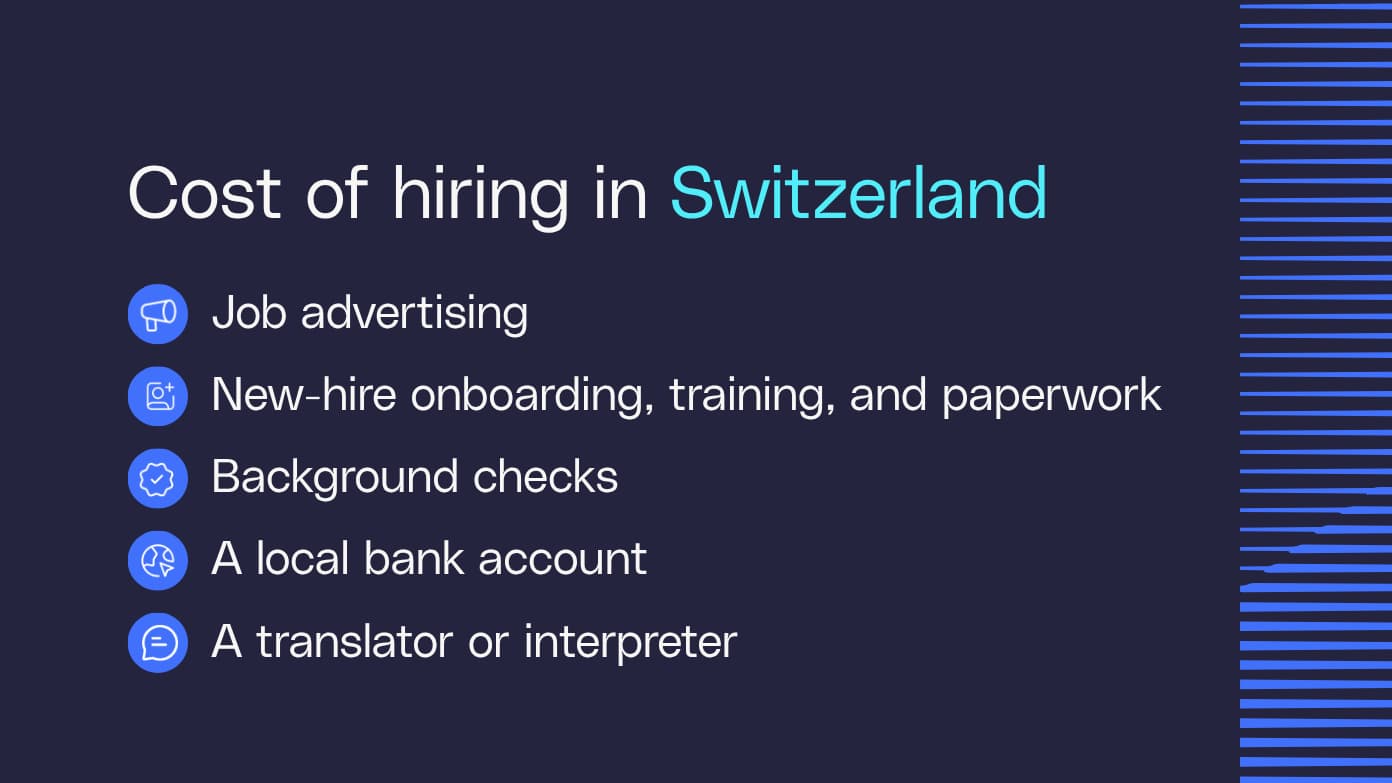
Que vous embauchiez un seul employé ou une équipe entière, le processus d'embauche en Suisse engendre des dépenses inévitables.
Budget pour les éléments suivants :
-
Annonces d’emploi
-
Intégration, formation et paperasse
-
Logiciel de suivi des candidats
-
vérification des antécédents
-
Tout équipement spécial pour les employés
-
Un traducteur ou un interprète (le cas échéant)
-
Frais de voyage pour se rendre en Suisse et en revenir, si nécessaire
-
AHV/IV/EO
-
Assurance chômage
-
assurance accidents du travail
-
Cotisations indemnités familiales
-
Assurance indemnités journalières maladie
-
Droit aux vacances des employés
-
Congés payés et congés maladie des salariés
Selon Gia, le taux annuel total de charges patronales en Suisse, qui comprend les coûts déclenchés en plus des salaires, se situe entre 10% et 20% du salaire brut. Les tarifs dépendront du salaire de l'employé, du secteur d'activité et du canton. Gia s’appuie sur les 13plus de 6 ans d’expérience mondiale de G-P en matière d’emploi, ainsi que sur les enseignements tirés de près d’un million de scénarios réels, pour fournir des informations précises et à jour sur le droit du travail.
De quoi une entreprise a-t-elle besoin pour embaucher en Suisse ?
Travailleurs de l’UE/AELE vs travailleurs non-UE/AELE
Grâce à l’ Accord sur la libre circulation des personnes (ALCP), l’embauche de citoyens des États membres de l’UE/AELE ne comporte que peu d’obstacles administratifs. Les employeurs n’ont pas à privilégier les travailleurs suisses locaux ni à justifier le choix d’un candidat de l’UE/AELE. Pour les contrats à court terme (jusqu'à 90 jours par année civile), les entreprises doivent seulement soumettre une notification en ligne avant que l'employé ne commence à travailler. Pour les contrats de longue durée, l’employé s’inscrit auprès de sa commune suisse de résidence pour obtenir un permis de séjour/permis de travail (tel qu’un permis L ou B). Cela leur donne un accès immédiat au marché du travail suisse.
Ressortissants non-UE/AELE
Le recrutement de candidats originaires de pays non membres de l'UE/AELE (y compris le Royaume-Uni et les États-Unis) est soumis à une réglementation plus stricte. En vertu de la Loi fédérale sur les étrangers et l'intégration (LFEI), les employeurs doivent prouver que leurs efforts de recrutement locaux ont échoué. Les permis non-UE/AELE sont réservés presque exclusivement à des personnels tels que des cadres, des spécialistes de haut niveau ou des diplômés universitaires possédant une expérience spécialisée.
Quotas de permis et calendrier administratif
Le gouvernement suisse applique un quota national annuel strict en matière de permis de travail pour les ressortissants de pays hors UE/AELE. Le permis de travail nécessite une procédure d’approbation à plusieurs niveaux impliquant les autorités cantonales du travail et le Secrétariat d’État aux migrations (SEM). Les employeurs doivent entamer la procédure de demande de permis à l'avance. L'employé ne peut pas commencer à travailler avant d'avoir reçu l'autorisation officielle.
Il est dans votre intérêt d'établir une relation avec les services économiques locaux du canton ou son ambassade. Vous n’avez pas besoin d’une entité juridique pour embaucher en Suisse, mais si vous choisissez de créer une entreprise suisse, vous pouvez choisir entre :
-
Une entreprise individuelle à propriétaire unique
-
Une société en nom collectif
-
Une société en commandite
-
Une société ou une entreprise par actions
-
Une société à responsabilité limitée
-
Une filiale
-
Une antenne locale
Les succursales sont une solution courante pour les entreprises international et impliquent le paiement des impôts locaux et la présence d'au moins un résident suisse disposant d'une autorité légale. Vous devez avoir préparé tous les documents juridiques, les contrats et les comptes financiers établis.
Embauchez des employés en Suisse sans créer votre propre entité avec G-P portage salarial (EOR). Constituez votre équipe en Suisse à moindre coût et en toute sérénité, sachant que vous respectez les exigences spécifiques de chaque canton.
Les étapes de l'embauche en Suisse
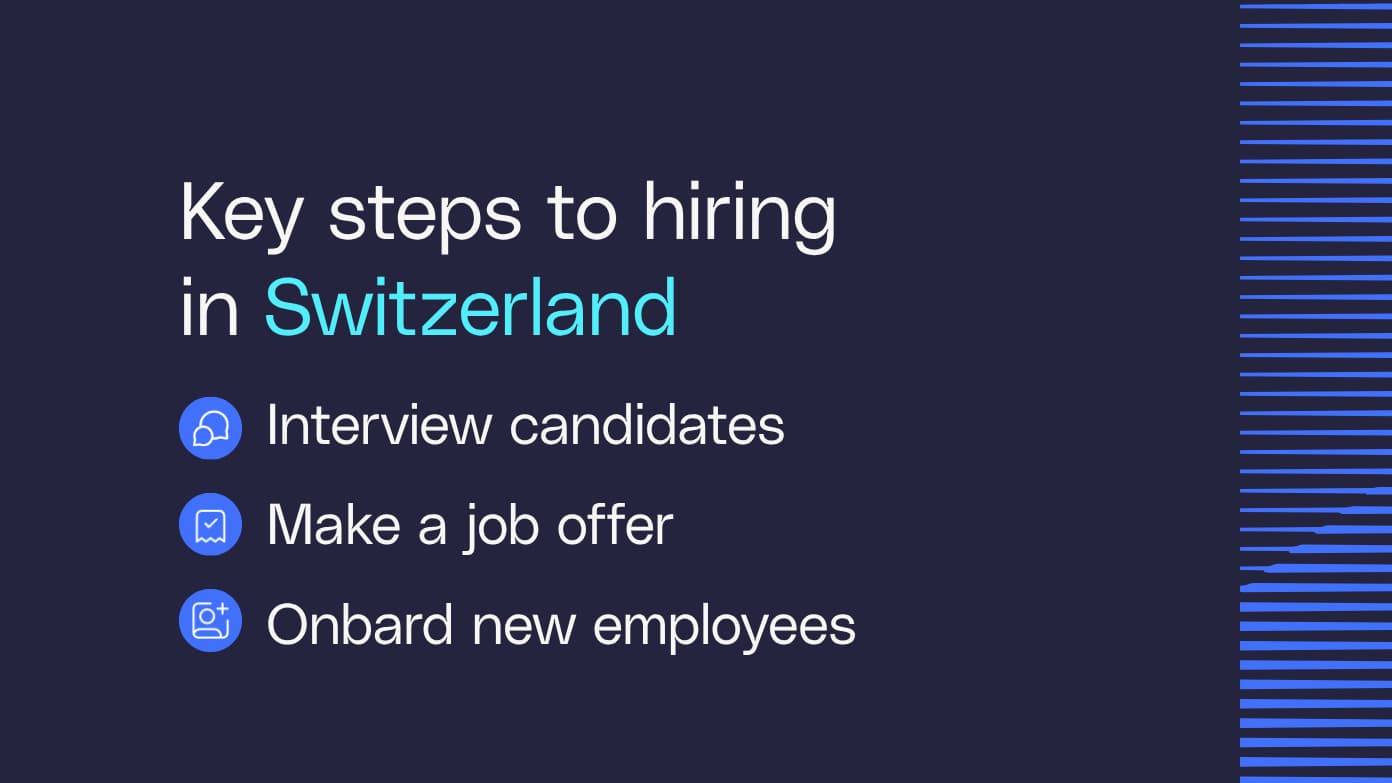
Le processus d'embauche en Suisse comprend cinq étapes fondamentales : la publication de l'offre d'emploi, l'évaluation des candidatures, les entretiens avec les candidats, l'envoi des offres d'emploi et l'intégration des nouveaux employés.
1. Publier les postes vacants
Tout d'abord, rédigez une description détaillée du poste. Définissez le rôle, les responsabilités et les qualifications dont vous avez besoin. Pour certaines professions dont le taux de chômage est élevé, les employeurs sont légalement tenus d'informer les offices cantonaux de l'emploi des postes vacants avant de les annoncer publiquement. Cela garantit un accès prioritaire aux demandeurs d'emploi inscrits et le respect de la loi fédérale sur les services de l'emploi.
2. Évaluer les candidatures
Une fois que les demandeurs d'emploi ont postulé à vos nouveaux postes, vous pouvez évaluer leurs candidatures et déterminer quels sont les candidats les plus aptes à occuper le poste. La loi suisse interdit toute discrimination fondée sur le sexe, l'âge, l'origine, la race, la religion, le handicap, l'orientation sexuelle ou d'autres caractéristiques protégées à tous les stades du recrutement. La Constitution fédérale suisse et la loi sur l'égalité entre les femmes et les hommes en font état.
Vérifiez bien que les offres d’emploi, les critères de sélection et les questions d’entretien sont exempts de biais.
3. Entretiens avec les candidats
Ensuite, interviewez les candidats qui figurent sur votre liste restreinte. Utilisez des critères de sélection pertinents pour le poste et des entretiens structurés pour garantir l’équité et la cohérence. Gia peut vous aider à créer des questions d’entretien conformes aux lois anti-discrimination lors de l’embauche des employés en Suisse, afin que vous puissiez trouver la meilleure option pour le poste tout en respectant la réglementation locale.
Il est recommandé de conserver la documentation du processus de recrutement, y compris les notes d’entretien et les décisions de sélection, pendant au moins cinq ans.
4. Faites des offres d'emploi
Il est maintenant temps de notifier le candidat que vous avez choisi. Rédiger un contrat de travail écrit conforme au droit du travail suisse. Le contrat doit comprendre des termes essentiels tels que l'intitulé du poste, les fonctions, le salaire, les heures de travail, les délais de préavis et toute convention collective applicable.
5. Intégrer les nouveaux employés
Inscrivez le nouvel employé auprès de la sécurité sociale suisse (AVS), de l'assurance accident, du régime de retraite (LPP) et, le cas échéant, auprès des autorités fiscales compétentes. Établir la paie pour garantir le paiement correct des salaires, les déductions pour la sécurité sociale, les cotisations de retraite et les impôts.
Engager des entrepreneurs en Suisse
Travailler avec des entrepreneurs indépendants en Suisse peut être un moyen rentable de tester le marché et d'établir une présence sans l'engagement d'employés à plein temps. Les entrepreneurs basés en Suisse comprennent le comportement des consommateurs, les règles et les pratiques commerciales locales. Ils seront prêts à commencer à travailler rapidement avec leur propre équipement et des processus de travail établis.
Le recours à des contractuels vous permet d'adapter facilement votre personnel en fonction des besoins de votre entreprise, sans les complexités et les coûts liés à l'embauche.
Avant de conclure un accord avec un prestataire indépendant en Suisse, tenez compte des éléments suivants :
1. Employés vs. prestataires indépendants
Il est important de comprendre la différence entre les employés et les travailleurs indépendants. En Suisse, les contrats de travail des employés comprennent souvent des clauses d'exclusivité et précisent les horaires de travail, le lieu de travail et les fonctions. Les contrats de services pour les entrepreneurs mettent l'accent sur les livrables et les résultats, en privilégiant l'autonomie et l'indépendance du travailleur.
Les entreprises embauchent des employés pour effectuer un travail et, en retour, leur versent un salaire régulier. Les entrepreneurs doivent organiser eux-mêmes leurs régimes de sécurité sociale et de retraite. Contrairement aux salariés, les entrepreneurs fixent leurs horaires, utilisent leur propre matériel et travaillent sur des projets spécifiques, plutôt que d'avoir un rôle permanent.
2. Pénalités en cas d'erreur de classification
Classer quelqu’un comme prestataire alors qu’il ne l’est pas peut entraîner de lourdes sanctions. En cas d'erreur de classification lors de vos démarches de recrutement en Suisse, vous pourriez avoir besoin de :
-
Payer la part de l'employeur et celle de l'employé dans les cotisations de sécurité sociale avec effet rétroactif sur une période maximale de cinq ans. Il s'agit des cotisations à l'assurance vieillesse et survivants (AVS), à l'assurance invalidité et à l'assurance chômage.
-
Payer des intérêts et des pénalités calculés en fonction du montant dû et de la durée du retard.
-
Les autorités suisses, telles que le Secrétariat d'État à l'économie (SECO), effectuent des audits et des contrôles de conformité qui peuvent déboucher sur des mesures d'exécution supplémentaires si une erreur de classification est détectée.
3. Comment payer les entrepreneurs en Suisse
G-P Contractor™ élimine le processus complexe et chronophage d'embauche et de paiement des contractuels international . Vous pouvez créer et délivrer des contrats et payer des entrepreneurs en seulement quelques clics, tout en assurant un processus de conformité.
Embauchez des employés et des entrepreneurs en Suisse avec G-P
Nos produits SaaS et basés sur l'intelligence artificielle – portage salarial (EOR), Contractor et Gia – aident les entreprises de toutes tailles à constituer et à gérer des équipes mondiales.
Avec plus d'une décennie d'expérience, la plus grande équipe d'experts en ressources humaines, juridiques et de conformité, et une base de connaissances exclusive mondiale, G-P est le leader reconnu de l'emploi mondial lorsque vous avez besoin d'embaucher des employés en Suisse.
Facilitez votre expansion en Suisse avec G-P. Contactez-nous ou réservez une démonstration dès aujourd’hui.