




主要收获
- Understand Brazil's employment requirements: The Consolidation of Labor Laws (CLT) governs employment requirements, including worker protections, leave, termination, and working hours.
- Budget beyond base salary: You need to account for a variety of statutory costs, such as the 13th-month salary, the FGTS severance fund, and vacation pay.
- Choose the right hiring model: You can set up a local entity or use an employer of record, depending on your company's needs and long-term goals.
- Hire without establishing an entity: G-P EOR lets you hire, onboard, and manage professionals in Brazil without setting up a local entity.
Brazil is the largest country in South America by both land area and population (213.8 million in 2026), and it's the 10th largest economy in the world. The Consolidation of Labor Laws (CLT) governs Brazil's employment laws. The CLT outlines mandatory benefits like the 13th-month salary, paid vacations, and strict rules on termination and overtime.
Before expanding into Brazil, you'll need to understand contracts, taxes, wages, benefits, and other employment laws. Our guide will tell you everything you need to know about hiring in Brazil.
在巴西招聘前需知
If you're expanding your business into Brazil for the first time, there are important legal requirements to be aware of. These norms and laws influence hiring practices in Brazil and many aspects of the employer-employee relationship, including compensation and benefits.
G-P Gia™, our AI-powered global HR agent, can answer your toughest compliance questions across 50 countries — including Brazil — and all 50 U.S. states. Reduce your reliance on outside counsel and cut the time and cost of compliance by up to 95% with Gia.
以下是在巴西招聘的五点须知。
1. Employee-centric regulations
Brazil's employment laws strongly favor employees. Workers have a wide range of statutory rights and benefits, including paid leave, anti-discrimination protections, and severance entitlements. These are greater than those in many other countries.
Employee termination in Brazil is highly regulated. Dismissals, especially those without cause, must adhere strictly to notice periods, severance payments, and documentation. The risk of post-termination lawsuits is high.
Written employment contracts aren't legally required for all employment relationships, but they are strongly recommended. Oral contracts are valid under the CLT.
2. Official languages
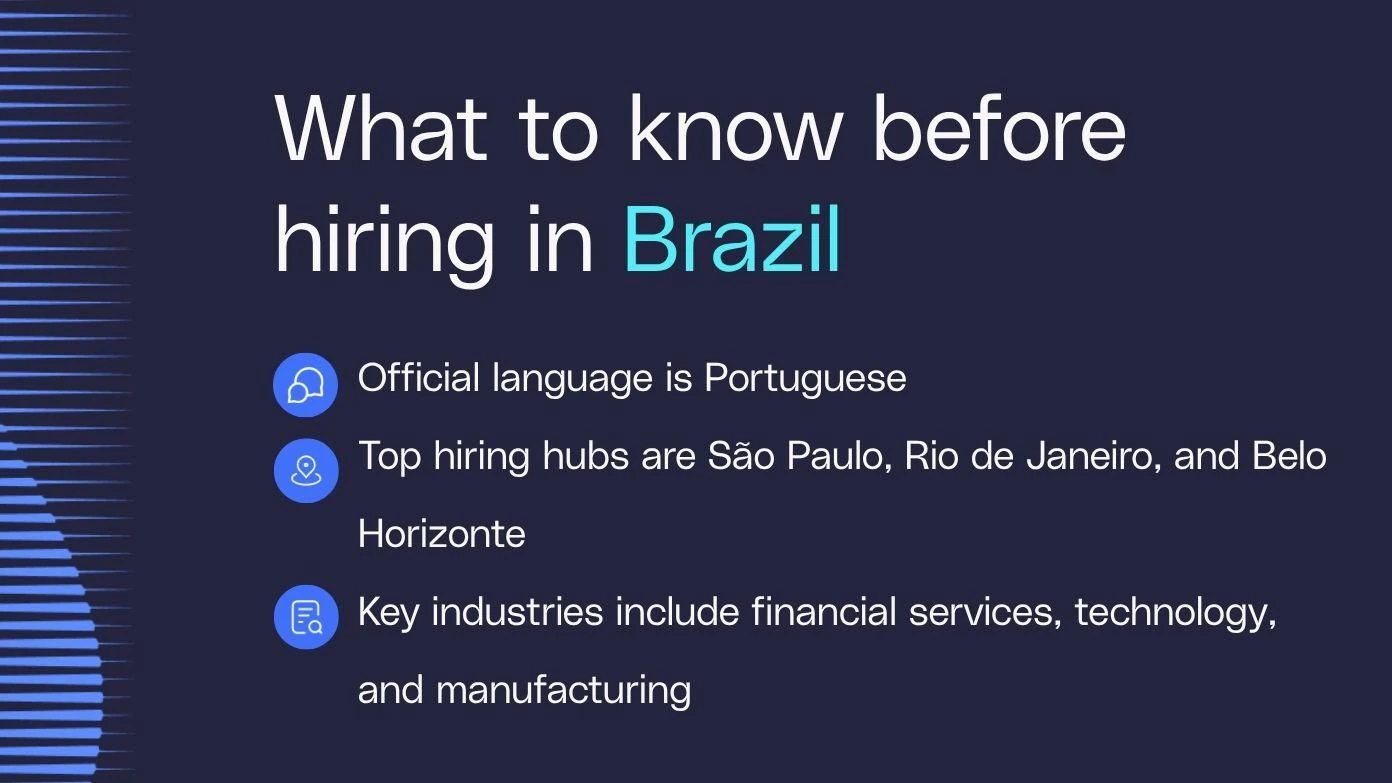
Portuguese is the official language, spoken by over 99% of the population. Brazil is the only Portuguese-speaking nation in the Americas. With the growth of Mercosur (the Southern Common Market) and increased trade, the economic necessity of Spanish has grown in schools and businesses. As with most countries, you're more likely to hear English in city centers in Brazil than in other parts of the country, but English is not widely spoken.
3. Working hours and compensation
The legal maximum workweek is 44 hours. This is spread across eight hours per day, Monday through Friday, and four hours on Saturday, or as agreed upon in collective bargaining agreements (CBAs). Employees get a minimum one-hour lunch break if they work more than six continuous hours. Alternative schedules are allowed if established by a CBA or written agreement.
Overtime is paid at a minimum of 150% for hours worked beyond the standard daily or weekly limits (Monday to Saturday). Work performed on Sundays or public holidays has to be paid at 200% unless a compensatory day off is provided. CBAs can set higher overtime rates.
The minimum wage in Brazil is RD 1,621.00 per month in 2026. Some states, like São Paulo, have higher regional minimum wages, and employers must pay the higher applicable rate. The minimum wage is adjusted annually based on inflation and GDP growth.
虽然法律没有明确规定,但由于工会谈判和通货膨胀,年度薪资调整很常见。
The 13th-month salary is a mandatory annual bonus. It's equal to one month's salary, paid in two installments, one by Nov. 30 and the second by Dec. 20. It's calculated as one-twelfth of the monthly salary for each month worked in the calendar year. Commissions and certain bonuses can be included if they're part of regular compensation.
4. Vacation and sick leave
Annual leave requirements are generous in Brazil compared to other countries. After one year of service, employees get 30 days of vacation leave. Employees can divide their vacation time into three periods: one lasting at least 14 days, and two more lasting at least 5 days. Employees have the option to cash in up to 10 vacation days. These vacation days are paid, and employers must pay a vacation bonus equal to one-third of the employee's monthly salary.
Employees in Brazil also get paid sick leave. When an employee misses work due to a medical issue, employers must pay them for their first 15 days of illness, as long as the employee provides a doctor's note. If the employee misses more than 15 days due to their medical condition, then the National Institute of Social Security (INSS) will take over.
5. Required benefits
Brazil has generous statutory benefits, including paid vacation, 13th-month salary, social security (INSS), the severance fund (FGTS), and mandatory meal and transportation vouchers.
Employers must withhold a portion of employees' pay for INSS and make an employer contribution. The employer's rate is typically 20% of payroll plus extra contributions for workplace accident insurance and third-party entities, which can add 5.8% or more, depending on the company's risk profile and sector.
Employee INSS contributions are withheld at progressive rates (7.5% to 14% in 2026) based on salary.
Meal vouchers and food vouchers aren't required by federal law. However, Collective Bargaining Agreements (CBAs) can mandate them, and they are customary in many sectors.
Employers must deposit 8% of the employee's monthly salary into the FGTS account. This isn't withheld from the employee's pay; it's an extra employer cost. FGTS is available to employees upon termination without cause, retirement, or in other circumstances like serious illness or a home purchase.
Hiring models for global companies in Brazil
When hiring in Brazil, you have several options. The right model depends on your long-term plans, workforce size, and business activities. There are four common models:
- Direct employer registration: If you already have a legal entity, you can register your company as an employer and hire in Brazil directly. This allows you to control all your HR operations. Your company will manage tax withholding, payroll, statutory benefits, eSocial reporting, and employment documentation. Direct hiring is ideal if you already have an established local entity and the resources to manage local employment requirements.
- Employer of record: If you don't have a legal entity in Brazil, you can hire professionals in Brazil through an employer of record. With G-P EOR, you can hire, onboard, and manage professionals in Brazil without worrying about employment requirements. G-P will handle the country-specific compliance requirements, leaving you to manage the company's day-to-day responsibilities. This model is ideal when you need to hire quickly or test the market before making long-term plans.
- Subsidiary or branch: Setting up a subsidiary or branch makes sense when you plan to maintain long-term operations in the country. A local entity will give your company a legal presence in Brazil. Setting up a subsidiary or branch requires more time and resources. In addition, you will be responsible for employment compliance, payroll, taxes, benefits, and other employment obligations.
- Independent contractor and misclassification risk: If you have temporary or need-based work and it isn't necessary to create a traditional employment relationship, hiring independent contractors makes sense. However, classifying your workers depends on their actual working responsibilities. If their responsibilities function like employment, Brazilian authorities can reclassify the contractor as an employee. You will then be responsible for social security contributions, FGTS payments, taxes, employment benefits, and other liabilities.
If you plan to hire contractors in Brazil, G-P Contractor™ allows you to manage contractor payments and create contracts so that you can meet all compliant contractor requirements.
巴西的顶级招聘中心
Brazil's major cities have different strengths. Knowing what each city has to offer allows you to focus your hiring efforts in the right place and fill roles faster.
巴西顶尖的人才中心有:
- São Paulo is Brazil's largest city and the main business, financial, and technology center. It hosts multinational companies and startups, making it the top hiring hub for a wide range of industries.
- Rio de Janeiro is known for its energy, oil and gas, tourism, and creative industries. The city is a major employment center, especially for roles in engineering, media, and services.
- Belo Horizonte is a hub for mining, technology, and business services with a growing start-up ecosystem.
- Brasília is the nation's capital. Brasília is the center for government, public administration, and related services, attracting talent in law, policy, and administration.
- Curitiba is known for its advanced manufacturing, automotive, and technology sectors, as well as its reputation for urban planning and sustainability.
巴西的关键产业
Understanding Brazil's top industries allows you to benchmark salaries and benefits. You can use this insight to make smart choices about where to invest and grow your talent pool.
巴西的主要产业包括:
- Financial services: Brazil has one of the largest financial markets in Latin America. This includes major commercial banks, investment firms, and the B3 (Brazil, Bolsa, Balcão) stock exchange, located in São Paulo.
- Technology and digitalization: Brazil is a hub for technology in Latin America, with a growing startup ecosystem and many unicorn companies. This includes areas like fintech, proptech, and edtech.
- Manufacturing: Brazil is a leading industrial nation globally. Areas include automotive (manufacturing and assembly of cars, trucks, and auto parts), aerospace (home to Embraer, one of the world's largest commercial jet manufacturers), and chemicals and petrochemicals (processing crude oil and natural gas).
- Energy, oil, and gas: Brazil is a global producer of oil, thanks to large offshore pre-salt reserves. The state-owned company Petrobras is a big force in this sector. Brazil is a global leader in renewable energy, with 89% of its electricity generation coming from renewable sources, primarily hydroelectric.
- Agriculture: Brazil is important in global food security and commodity markets. Brazil is the world's largest producer of soybeans, coffee, and sugarcane. The country is also a big producer of corn, beef, and chicken.
Cost of hiring an employee in Brazil
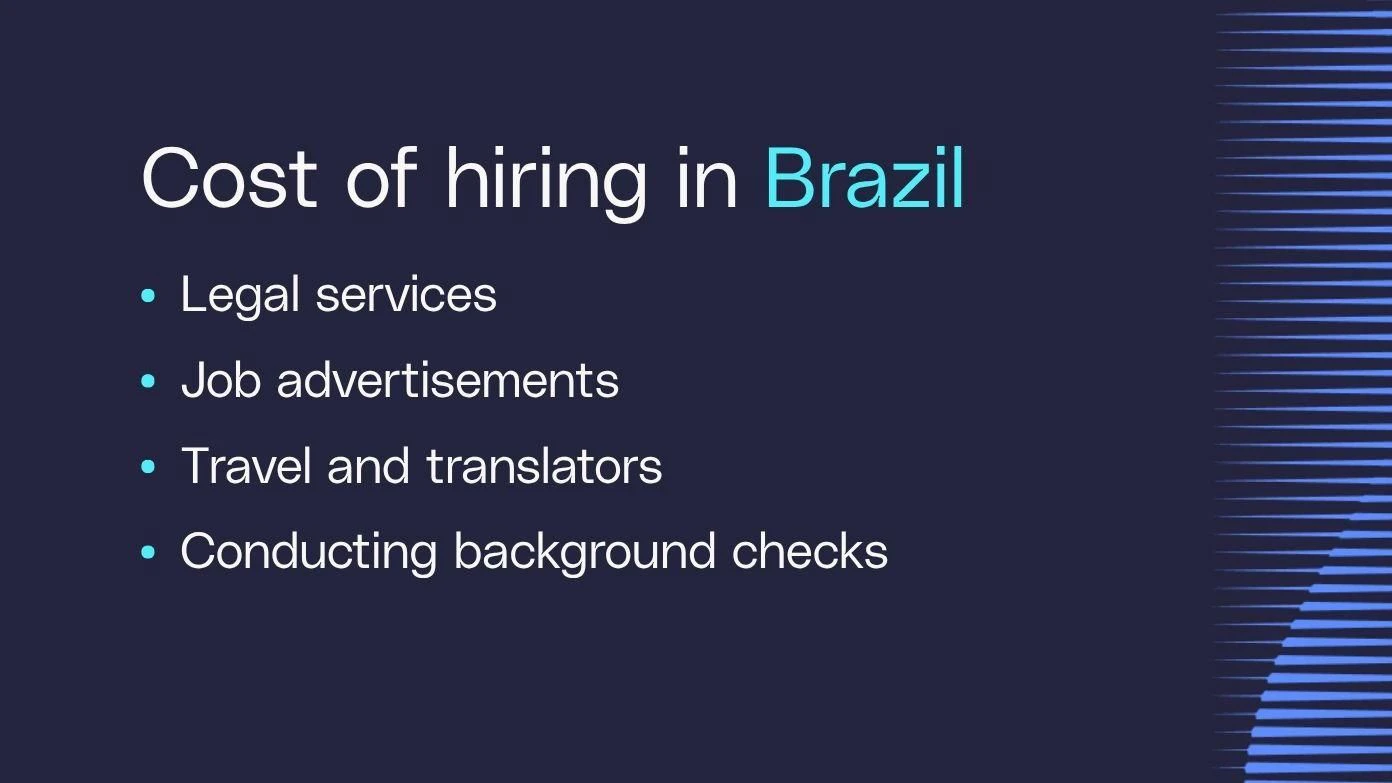
Whether you're hiring one employee or an entire team in Brazil, expenses are inevitable. Budget for the following:
- 设立实体(除非您与名义雇主合作)
- 发布招聘广告
- 向在巴西有人脉的员工支付推荐奖金
- 付给内部招聘委员会报酬
- 往返巴西的行程,包括酒店住宿、餐饮和交通。
- 使用背景调查服务筛选候选人
- 起草合规的雇佣合约,进行法律审查,并咨询人力资源和法律专家
- 提供电脑、电话和软件许可证的费用
- 入职材料和初始培训的费用
- 雇主强制性缴款
- 维护必要的税务和工资记录及文件的费用
According to G-P Verified Sources from Gia, the employer burden rate in Brazil, which includes costs triggered on top of salaries, ranges from 60% to 100%, excluding accident insurance that can vary.
公司在巴西招聘员工需要具备哪些条件?
在巴西扩充团队之前,请务必确保涵盖以下要点:
- 在巴西注册成立公司。
- 在公司经营所在州的贸易委员会注册公司名称。
- 向联邦税务局注册以获取税务识别号。
- 向相关州税务机关登记并取得州税务登记证。
- 在当地市政府注册,领取经营许可证。
- 开设当地银行账户。
- 向国家社会保障局 (INSS) 登记缴纳社会保障金。
- 在遣散赔偿基金(FGTS)系统注册。
- 向劳工部和就业部登记以报告新员工的情况。
- 建立符合规定的工资系统,计算并扣缴所有法定扣款。
- 确保系统与 eSocial 集成。
- 用葡萄牙语起草雇佣合同。
- 建立提供所需福利的流程。
- 在职业健康与安全机构注册。
- 准确记录雇用合同、工资单、时间跟踪和所有与劳动相关的文件。
Setting up a subsidiary in Brazil can take weeks or months. Use G-P EOR to hire full-time employees in Brazil without setting up your own entity. Build your team at a lower cost and with peace of mind that you're doing so compliantly.
Steps to hiring in Brazil
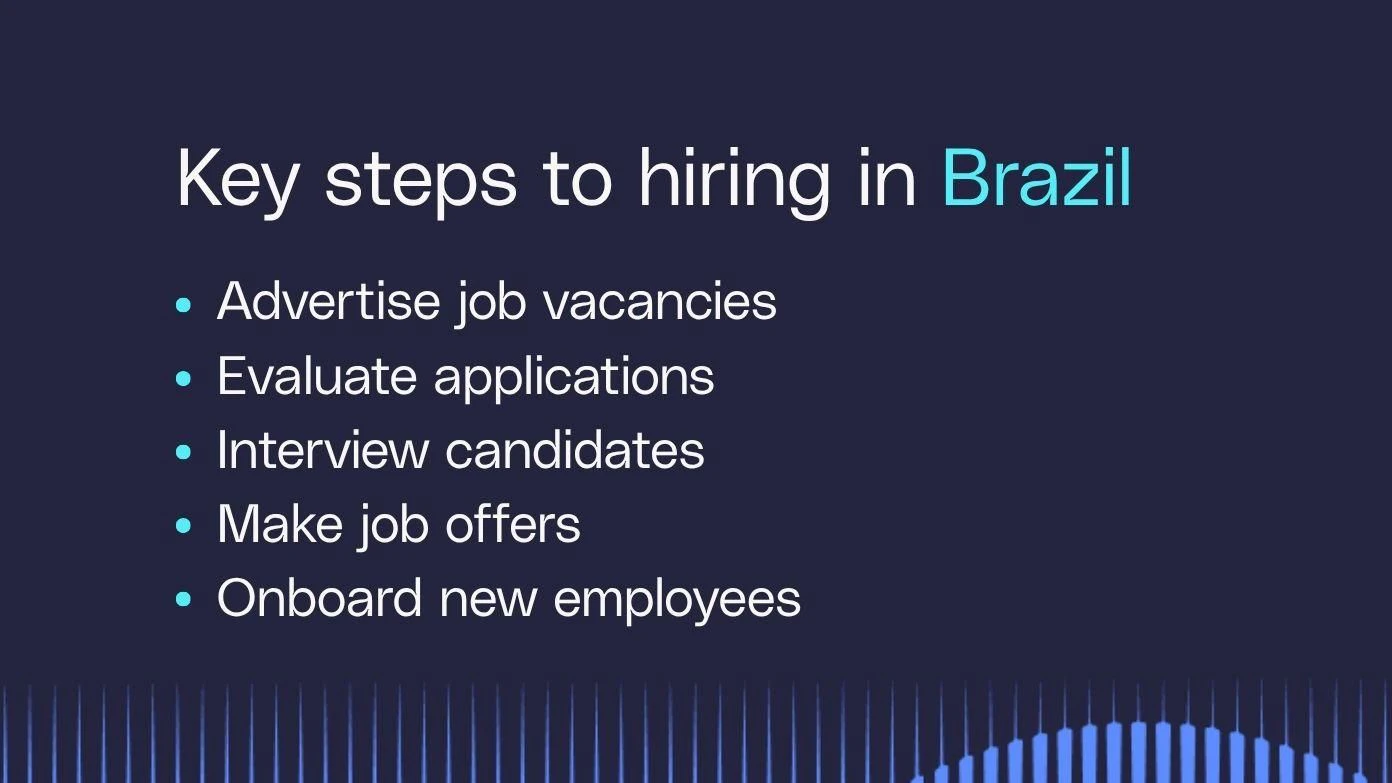
The hiring process in Brazil is similar to the one you're likely familiar with in your own country. The hiring process follows five basic steps: advertising the job, evaluating applications, interviewing candidates, sending job offers, and onboarding new employees.
1. Advertising job vacancies
Create a detailed job description, including required qualifications, responsibilities, and benefits. Internships aren't considered employment under the CLT. Job ads for internships must clearly identify the position as an internship and meet all legal requirements for such roles.
LinkedIn、Catho、InfoJobs 和 Vagas.com 是巴西最受欢迎的招聘网站。
2. Evaluating applications
收集申请材料并审核简历。根据当地法律筛选申请并进行面试。
3. Interviewing candidates
Interview candidates who made it onto your shortlist. You can do these interviews in person or virtually. Verify references and, if relevant, conduct background checks in compliance with Brazilian data protection laws (LGPD).
Gia can help you create questions that follow anti-discrimination laws in Brazil, so you can find the best fit for the role while complying with local regulations.
4。发出工作邀请
Contact your chosen candidate to offer them a position with your company. Offers are typically made in writing. Draft an employment contract in Portuguese, including all mandatory clauses and statutory benefits. Both parties must sign the written contract.
5. Onboarding new employees
Now you can onboard new employees. Register your new hire with eSocial, INSS, and FGTS. Update the employee's digital work card.
If you're working with G-P EOR™, you won't have to worry about the administrative burden of onboarding. We'll streamline the process, so you can focus on training your new hire and integrating them into your company culture.
在巴西雇用承包商
Working with independent contractors in Brazil can be a cost-effective way to test the market and build a presence without the commitment of full-time employees.
Contractors based in Brazil understand local consumer behavior, rules, and business practices. They'll be ready to start working quickly with their own equipment and established work processes.
Hiring contractors allows you to easily adjust your talent pool based on your business needs without the complexities and costs of employment.
Before you enter an agreement with an independent contractor in Brazil, consider the following.
1.员工与独立合同工
It's important to understand the difference between employees and independent contractors. In Brazil, employers hire employees to do work and, in return, pay them a regular salary and benefits. Independent contractors provide services. Unlike employees, contractors set their schedules, use their own equipment, and work on specific projects rather than having an ongoing role.
2.对误分类的罚款
Classifying someone as a contractor when they're not can lead to severe penalties. If misclassification occurs, you'll need to:
- 追溯支付所有法定就业权利和福利。
- Face administrative fines for failing to register employees, nonpayment of social charges, and other violations.
- 补缴社会保障金(INSS)和联邦政府税(FGTS)缴款,加上利息和货币调整。
3。如何向合同工付款
G-P Contractor简化了招聘和支付国际化承包商的繁琐、耗时的过程。 只需点击几下鼠标,即可创建和发布合同并向承包商付款,同时确保流程合规。
Hire employees and contractors in Brazil with G-P
我们的全球雇佣平台™ (全球雇佣平台)及其人工智能驱动的产品专业雇主、承包商和Gia为企业建立和管理全球团队提供支持。
G-P是全球就业领域公认的领导者,拥有十多年的经验;最大的人力资源、法律和合规专家团队;以及全球专有知识库。
Make your expansion to Brazil easier with G-P. Contact us or book a demo today.

常见问题解答
在巴西雇佣员工的主要法律要求是什么?
Companies must be legally registered, have a CNPJ (tax ID), register with social security (INSS), FGTS, and the Ministry of Labor, and use the eSocial platform for reporting. Employment contracts must be in Portuguese and include all statutory benefits.
巴西的强制性员工福利有哪些?
Required benefits include paid vacation (30 days per year), a vacation bonus (one-third of monthly salary), 13th-month salary, FGTS (8% employer contribution), INSS (social security), and transportation vouchers.
在巴西招聘员工需要多少钱?
The employer burden rate ranges from 60% to 100% of the employee's salary, depending on sector, location, and collective agreements.
巴西的雇佣合同可以使用英文吗?
Contracts must be in Portuguese. Dual-language contracts are allowed, but the Portuguese version prevails in case of dispute.
What's the standard workweek and overtime policy in Brazil?
The standard workweek is 44 hours, usually eight hours per day, Monday to Friday, and four hours on Saturday. Overtime is paid at 150% of the regular rate, and work on Sundays and holidays is paid at 200%.