




Principais conclusões
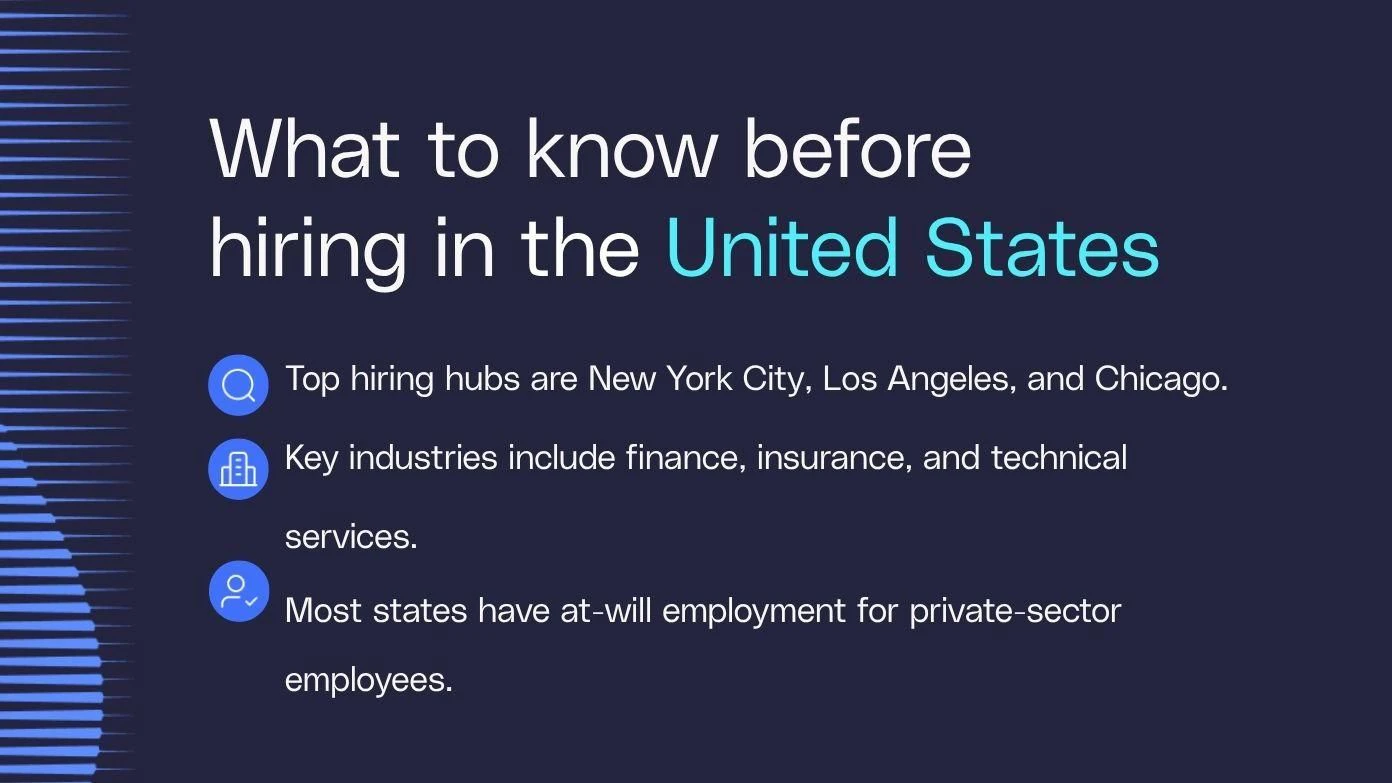
- The United States' top hiring hubs are New York City, Los Angeles, and Chicago.
- Top industries in the U.S. include finance, insurance, technical services, and healthcare.
- Companies hiring in the United States have various options for setup, including partnering with an employer of record (EOR), hiring contractors, establishing a subsidiary, or direct employer registration.
The U.S. is the world's largest economy by nominal GDP (approximately USD 32.6T) in 2026. The United States also represents the largest consumer market in the world. It continues to be a global leader in technology, finance, and innovation, from Silicon Valley and Wall Street, offering access to venture capital and a high-income customer base.
Before expanding into the U.S., you'll need to understand contracts, taxes, wages, benefits, and other employment laws. Our guide will tell you everything you need to know about hiring in the U.S.
O que você precisa saber antes de contratar nos EUA
If you're expanding your business into the U.S. for the first time, there are important legal requirements to be aware of. These norms and laws influence hiring practices in the U.S. and many aspects of the employer-employee relationship, including compensation and benefits.
G-P Gia™, our AI-powered global HR agent, can answer your toughest compliance questions across 50 countries — including the U.S. — and all 50 U.S. states. Reduce your reliance on outside counsel and cut the time and cost of compliance by up to 95% with Gia.
Here are five things to know about hiring in the U.S.:
1. At-will employment and termination
Most U.S. states have at-will employment for private sector, non-union employees. Employers can terminate employees at any time, for any legal reason, or no reason at all. Employees cannot be terminated as retaliation or for protected reasons. Contracts, collective bargaining agreements, workplace policies, and state regulations may have additional policies for compliant termination.
Notice and severance pay aren't legally required in most cases, though many employers provide them as a courtesy or for higher-level roles. Sometimes, federal WARN and mini-WARN laws require that employees be notified about upcoming major layoffs or job site closings. Other exceptions include employment contract terms, company policies, or collective bargaining agreements. There are also state-specific requirements in New Jersey and Maine.
At-will employees can leave their jobs at any time, for any reason, without legal penalty. However, in some cases, there may be a required notice period, repayments, confidentiality agreements, or other obligations.
Employment contracts aren't standard for most U.S. employees, except for executives or specialized positions. Most workers are hired without a formal contract. Public sector and unionized employees may have additional due process or just cause protections.
Montana is the only state that doesn't follow the at-will doctrine. After a 12-18 month probationary period, employees can only be terminated with good cause. Exceptions to at-will employment still apply, such as terminations that violate anti-discrimination laws, public policy, or an existing employment contract.
2. Folha de pagamento e impostos
Employers have to add employees to payroll, withhold federal and usually state income taxes, and deposit these to the IRS and state or local tax agencies. Federal income tax withholding works on a bracketed system. For employees earning up to $184,500, both employers and employees contribute 6.2% of wages to social security for 2026. The maximum social security tax is $11,439 for each party.
Employees are subject to federal income tax withholding, which uses a bracketed system. Withholding is based on taxable wages, pay frequency, and W-4 forms. State income tax rates and brackets vary by state and are based on work location, residence, reciprocity agreements, and local rules. Some states have no income tax, while others have flat or progressive rates.
Employers and employees each contribute 1.45% to Medicare. For employees earning over USD 200,000, regardless of filing status, there is an additional 0.9% employee-only Medicare tax. There are additional thresholds based on income and filing status. There is no annual wage cap on Medicare contributions.
3. Standard working hours
The culturally standard workweek in the U.S. is 40 hours, spread across eight hours per day, five days per week. The Fair Labor Standards Act (FLSA) doesn't cap working hours or require an eight-hour workday. An FLSA workweek is defined by a 168-hour period, not seven consecutive 24-hour periods.
Alternative schedules in healthcare and other industries are common. Some companies offer shorter workweeks or part-time roles.
For overtime, the U.S. law distinguishes between exempt and nonexempt employees under the FLSA:
- Exempt employees, who meet certain duties tests, don't get overtime pay.
- Covered, nonexempt employees are entitled to overtime pay at 1.5 times their regular rate of pay after working 40 hours in a workweek. For example, an employee making USD 10 per hour would make USD 15 per hour in overtime.
State and local regulations can include additional overtime requirements, rules for meal and rest breaks, split-shift premiums, and more.
4. Employee benefits
There are no federal mandates for private-sector employers to provide paid vacation, paid sick leave, or paid parental leave. However, state and local laws may require employers to provide paid leave. There are also exceptions for federal contractors and under certain employment contracts and CBAs.
The Affordable Care Act (ACA) requires employers with 50 or more full-time employees or full-time equivalents in the prior calendar year to offer affordable, minimum essential health coverage. This coverage must be offered to at least 95% of eligible workers and their dependents. The ACA affordability threshold is 9.96%.
Smaller employers may be eligible for the Small Business Health Options Program (SHOP) and related tax credits. Employer-sponsored health insurance is a big part of compensation. Out-of-pocket annual healthcare costs for U.S. employees are currently among the highest in the world, averaging up to USD 14,885 per person.
The Family and Medical Leave Act (FMLA) provides up to 12 weeks of unpaid, job-protected leave for certain family and medical reasons, but only for employees at companies with 50 or more employees within 75 miles. Employees must also meet eligibility requirements, including 12 months of service and working 1,250 hours.
The U.S. has 11 federal holidays. Private employers aren't required by law to provide these days off or pay extra for work on holidays.
5. State and federal regulations
U.S. employment regulations are a blend of state and federal laws. For instance, federal law imposes a minimum wage, currently USD 7.25 per hour for covered, non-exempt employees. However, individual states can impose higher minimum wage laws if they choose, and rates may be different for tipped industries.
Federal law requires employees to prove they're eligible to work in the U.S. No matter what state they plan to work in, employees have to be prepared to show proof of identity and work verification documents.
2026 expectativas dos funcionários nos Estados Unidos
Stress levels are creeping up for employees in the U.S. Our research found that 70% of U.S. workers are concerned about job loss due to macroeconomic factors, and 64% are worried their skills won't cut it in an AI-powered workplace.
Aproximadamente 55% dos funcionários estão procurando ativamente ou provavelmente procurarão um novo emprego nos próximos seis meses. Para empresas que contratam nos EUA, segurança no emprego e desenvolvimento profissional são fatores críticos de retenção e recrutamento. Dê ênfase à estabilidade da sua empresa e crie programas robustos de capacitação em IA para lidar com os receios de obsolescência de competências.
Hiring models for global companies in the U.S.
There are a few options for expanding your business into the U.S., each with their own pros and cons. These options include:
- Direct employer registration: forming a U.S. entity or registering a non-national entity. You will independently manage payroll, tax withholding, statutory insurance, and federal, state, and local employer obligations.
- Empregador registrado (EOR): G-P EOR acts as the legal employer, handling administrative and payroll processes on behalf of your company, including contracts, withholding, contributions, and mandatory benefits. In the U.S., EOR rules and licensing vary by state. Clients can retain joint-employment, co-employment, or other obligations and liabilities.
- Subsidiary or branch: a subsidiary will function as a separate legal entity, while a branch will function as an extension of your parent company. Regulations for branch registration and subsidiary qualifications vary from state to state.
- Independent contractor: hiring independent contractors in the U.S. generally doesn't require establishing a local entity or branch. However, there are significant penalties for misclassified workers, so federal and state tests must be followed when hiring them. Hiring contractors may still trigger registration, nexus, reporting, or other liabilities.
Principais polos de contratação nos EUA
Algumas cidades nos EUA são conhecidas por indústrias específicas. Conhecer as ofertas de cada cidade permite que você concentre seus esforços de recrutamento no local certo e preencha as vagas mais rapidamente.
Os principais polos de talento nos EUA são:
- New York City: the largest U.S. city and a global center for finance, technology, healthcare, media, and professional services.
- Los Angeles: a hub for entertainment, technology, healthcare, and global trade.
- Chicago: known for its finance, manufacturing, logistics, and healthcare sectors.
- Houston: a leader in energy, healthcare, aerospace, and manufacturing.
- Dallas-Fort Worth: a fast-growing region in technology, finance, and logistics.
- San Francisco Bay Area: the center of the tech industry, including San Francisco, San Jose, and Oakland.
- Atlanta: a big center for logistics, media, technology, and corporate headquarters.
- Boston: known for healthcare, education, biotechnology, and finance.
- Seattle: home to major employers like Amazon, Microsoft, and Boeing.
- Washington DC Metro Area: includes DC, Northern Virginia, and Maryland, and has strong government, tech, and consulting sectors.
- Miami: a gateway for global business, tourism, and finance.
- Austin: a fast-growing tech and innovation center.
Principais setores industriais nos EUA
Compreender os principais setores da economia nos EUA permite comparar salários e benefícios. Você pode usar essa informação para tomar decisões inteligentes sobre onde investir e expandir sua força de trabalho.
Os principais setores industriais nos EUA incluem:
- Finance, insurance, and real estate: This industry is the largest GDP contributor in the U.S. This includes commercial banking (USD 1.42T), health insurance (USD 1.54T), property/casualty insurance, and commercial real estate market (USD 1.48T).
- Professional, scientific, and technical services: This industry includes legal, accounting, consulting, engineering, and architectural services.
- Healthcare and social assistance: The U.S. healthcare industry is one of the largest single industries by revenue globally. Hospitals and medical insurance generate trillions of dollars.
- Information Technology (IT): While only a portion of the overall service sector, the information sector (which includes software, data processing, and IT services) is important to every other industry.
- Energy and mining: The U.S. is the world's largest producer of petroleum and natural gas.
Custo de contratação de um funcionário nos Estados Unidos
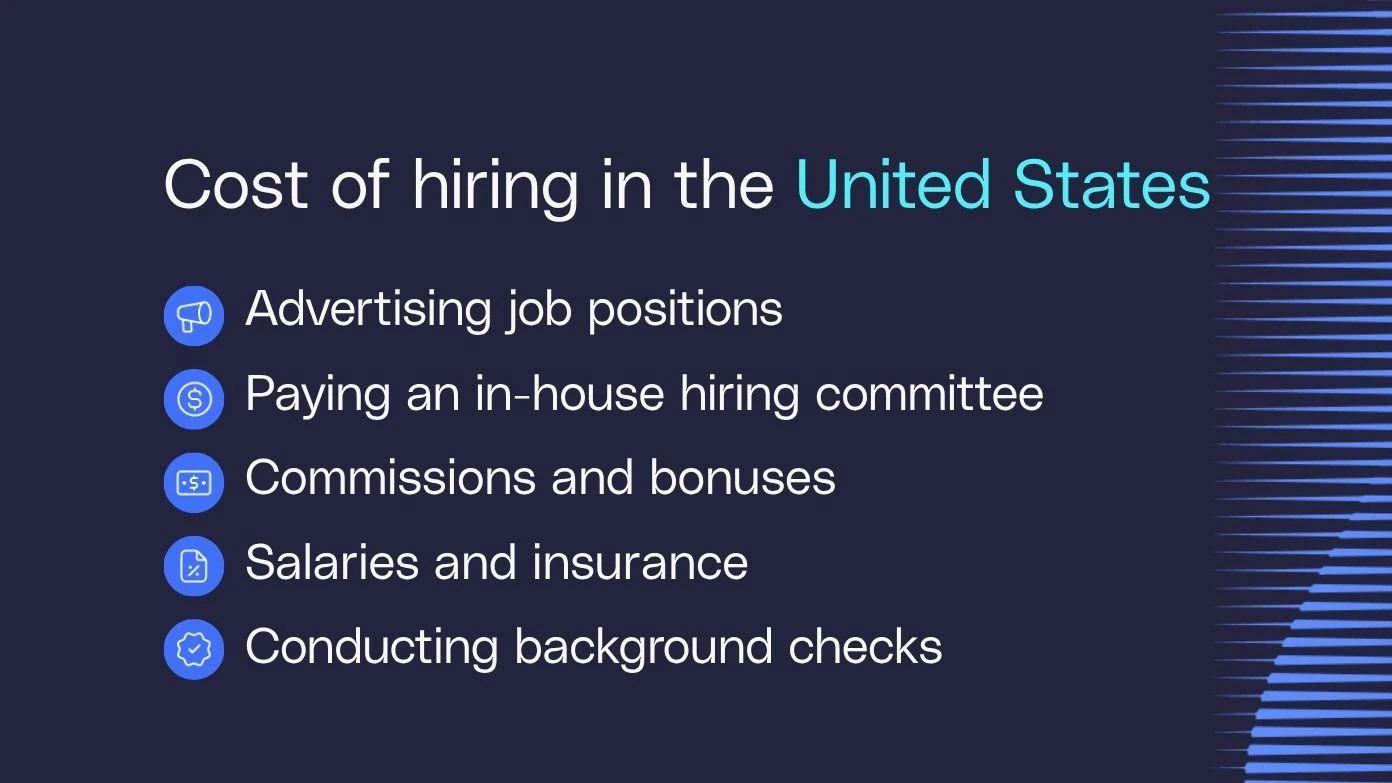
Whether you're hiring one employee or an entire team in the U.S., expenses are inevitable. Budget for the following:
- Configuração da entidade (a menos que você faça parceria com um empregador registrado)
- Anúncios de emprego
- Serviços/funcionários para analisar candidaturas
- Folha de pagamento
- Impostos
- Salários
- Benefícios
- Bônus
- subsídios;
- Seguros
- Viagem
According to G-P Verified Sources from Gia, the employer burden rate in the U.S., which includes costs triggered on top of salaries, is approximately 7.65–10%.
O que uma empresa precisa para contratar funcionários nos EUA?
Certifique-se de abordar esses pontos essenciais antes de expandir sua equipe nos EUA:
- Choose a hiring model.
- Documentos de formação de arquivos.
- Obtenha um número de identificação do empregador (EIN).
- Registre-se junto às autoridades fiscais estaduais.
- Cadastre-se para o pagamento de impostos locais (algumas cidades/condados exigem cadastros adicionais).
- Implementar um sistema para calcular, reter e recolher os impostos de renda federais e estaduais, a previdência social e o Medicare.
- Cadastre-se para o seguro-desemprego.
- Register for workers' compensation insurance.
- Elabore cartas de oferta e contratos de trabalho em conformidade com as normas.
- Desenvolver manuais e políticas para funcionários.
- Preencha o Formulário I-9 para cada novo funcionário e guarde a documentação.
- Comunicar as novas contratações ao estado. A maioria dos estados exige que o relatório seja feito em até 20 dias após a contratação.
Setting up a U.S. subsidiary can take weeks or months. Use G-P EOR to hire full-time employees in the U.S. without setting up your own entity. Build your team in the U.S. at a lower cost and with peace of mind that you're doing so compliantly.
Etapas para contratar nos EUA
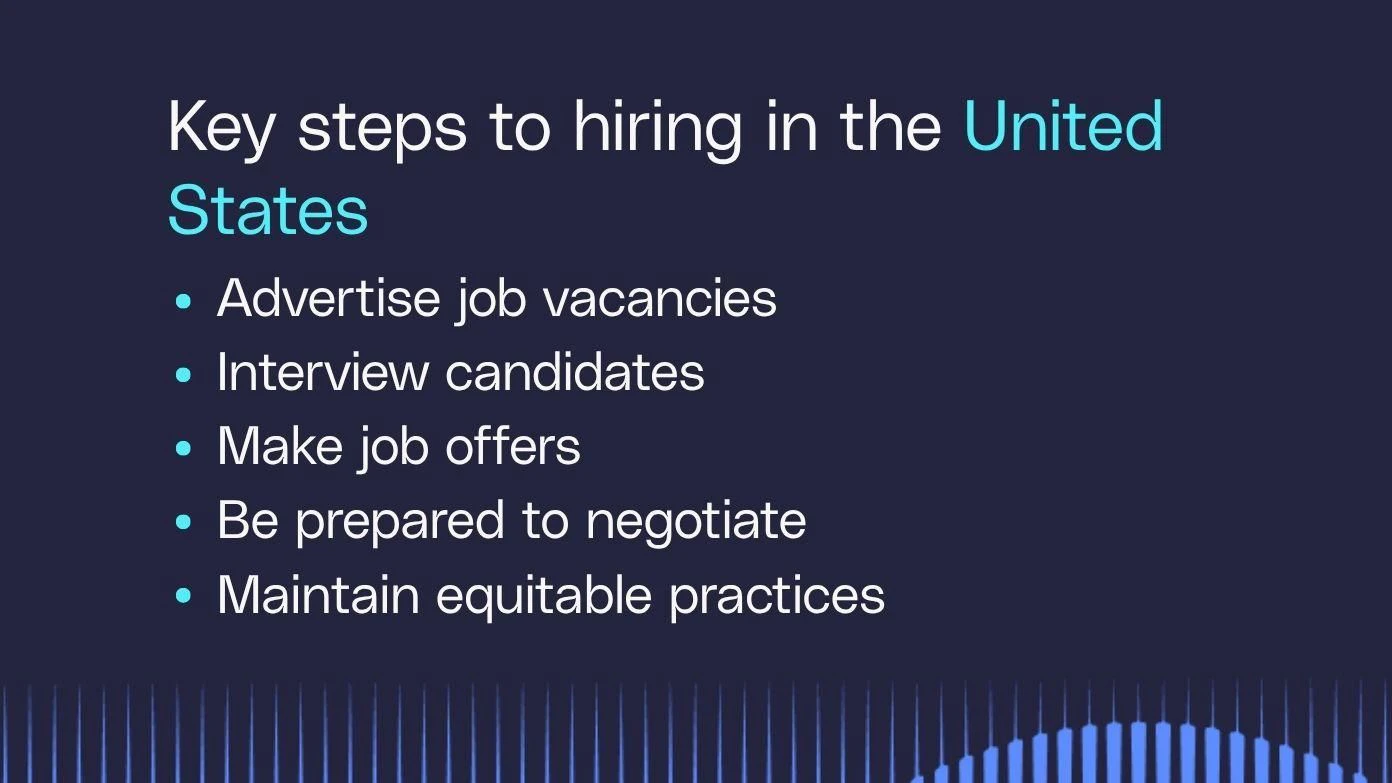
The hiring process in the U.S. is similar to the one you're likely familiar with in your own country. The hiring process follows five basic steps: advertising the job, evaluating applications, interviewing candidates, sending job offers, and onboarding new employees.
1. Anuncie vagas de emprego
Create a detailed job description and define the role based on responsibilities and qualifications. Write a clear job description outlining duties, qualifications, and skills needed. Determine compensation and benefits. It's best practice to include an Equal Opportunity Employer (EOE) statement to signal your commitment to fair hiring.
Leis estaduais e locais podem exigir a divulgação da faixa salarial em anúncios de emprego (por exemplo, Califórnia, Colorado, Nova York, Nova Jersey a partir de junho 2025). Indeed e LinkedIn são sites de emprego populares nos EUA.
2. Avaliar candidaturas
Collect applications and review resumes. Screen candidates based on their qualifications, experience, and fit for the role. Employers with 15+ employees must provide reasonable accommodations to applicants with disabilities, such as accessible application formats or interpreters for interviews.
3. Entrevistar candidatos
Interview candidates who made it onto your shortlist. You can do these interviews in-person or virtually. Use structured, nondiscriminatory interview questions. Gia can help you create questions that follow anti-discrimination laws in the U.S., so you can find the best fit for the role while complying with local regulations.
4. Fazer ofertas de emprego
Contact your chosen candidate to offer them a position with your company. Have the employee complete Form I-9 (work eligibility verification) and Form W-4 (tax withholding). Provide any state-required forms and notices. Report the new hire to the state's new hire registry (needed in all states, usually within 20 days).
5. Admissão dos novos funcionários
Now you can onboard new employees. Set up payroll and benefits. Provide orientation, your employee handbook, and required labor law posters.
If you're working with an EOR like G-P™, you won't have to worry about the administrative burden of onboarding. We'll streamline the process, so you can focus on training your new hire and integrating them into your company culture.
Contratação de empreiteiros nos EUA
Working with independent contractors in the U.S. can be a cost-effective way to test the market and build a presence, without the commitment of full-time employees. Contractors based in the U.S. understand local consumer behavior, rules, and business practices. They'll be ready to start working quickly with their own equipment and established work processes.
Contratar prestadores de serviços permite ajustar facilmente a sua força de trabalho de acordo com as necessidades do seu negócio, sem as complexidades e os custos da contratação de funcionários.
Antes de firmar um contrato com um profissional autônomo nos EUA, considere o seguinte:
1. Empregados versus trabalhadores independentes
It's important to classify workers correctly when hiring employees and independent contracts. A worker is classified as an employee when your company controls how, when, and where they work, assigns them ongoing duties, or supplies the tools they need. An independent contractor operates an independent business, controls their own work, uses their own equipment, and completes a defined project or service.
State and federal tests can differ when determining if a worker is a contractor or an employee. For legal classification, contract terms are not as important as the worker's level of control over their work and whether their services form a core part of your business.
Use G-P Contractor™ to hire and pay contractors in 190+ countries compliantly. Get peace of mind that your contractors are correctly classified with AI contract checks that deliver guidance on what to change.
2. Penalidades por classificação incorreta
Classificar alguém como contratado quando não o é pode acarretar penalidades severas. Caso ocorra uma classificação incorreta , você terá que:
- Pagamento retroativo de salários, horas extras e benefícios devidos ao trabalhador classificado incorretamente.
- Pay unpaid payroll taxes, such as social security, Medicare, and unemployment insurance, plus interest and penalties.
- Sujeitos a penalidades adicionais em nível estadual.
3. Como pagar os prestadores de serviços
A GP Contractor ™ simplifica o processo complicado e demorado de contratar e pagar prestadores de serviços internacionais. Você pode criar e emitir contratos e pagar contratados com apenas alguns cliques, garantindo ao mesmo tempo um processo em conformidade com a lei.
Contrate funcionários e prestadores de serviços nos EUA com a GP
Nossa Plataforma Global de Emprego e seus produtos com inteligência artificial, EOR, Contractor e Gia, auxiliam empresas na formação e gestão de equipes globais.
A GP é líder reconhecida em relações trabalhistas globais, com mais de uma década de experiência; a maior equipe de especialistas em RH, direito e compliance; e uma base de conhecimento proprietária global.
Make your expansion to the US easier with G-P. Contact us or book a demo today.
Perguntas frequentes
Quais documentos são necessários para contratar um novo funcionário nos EUA?
New hires have to complete Form I-9 for employment eligibility verification and Form W-4 for federal tax withholding. State-specific forms may also be required.
Preciso apresentar um contrato de trabalho nos EUA?
Most U.S. employees are hired "at-will" and do not need a formal contract, except for executives or specialized roles. Offer letters are standard practice.
Qual é o salário mínimo nos EUA?
The federal minimum wage is USD 7.25 per hour, though many states and cities enforce higher local minimums.
Quais são os impostos e contribuições sobre a folha de pagamento que os empregadores fazem nos Estados Unidos?
Employers must withhold and pay social security, Medicare, federal and state income taxes, and unemployment insurance. Specific rates vary by state.
Nos Estados Unidos, os empregadores são obrigados a fornecer benefícios?
Federal law does not mandate paid vacation, sick leave, or health insurance for small employers. However, the Affordable Care Act requires companies with 50 or more full-time employees to offer health insurance coverage.